The rain had been falling in icy, horizontal sheets since Jack crossed the state line. It was late November in Ohio, the kind of weather that turned the sky the color of wet iron and made the damp seep into a man’s bones, no matter how high he cranked the cab heater. Jack wiped a hand across his burning eyes and reached for his thermos. The coffee was lukewarm and tasted like scorched metal, but he drank it anyway.
He was fifty miles from home. Fifty miles from turning off the diesel engine of the Peterbilt, standing under a scalding shower, and collapsing into a bed that felt too large for one person. For the past five years, ever since Sarah passed, the road had been less of a living and more of a hiding place. Out here, with eighteen wheels humming against the asphalt and the CB radio crackling with occasional static, the silence of his empty house couldn’t reach him.
The two-lane highway was completely desolate. Jack’s wipers worked frantically, smearing the dirty water across the windshield. Up ahead, the headlights caught a shape on the gravel shoulder.
Usually, Jack kept his foot on the gas. Twenty-five years behind the wheel had taught him a harsh math: there was too much road and too much misery out there, and one man couldn’t fix it all. But as the rig closed the distance, the shape shifted.
It was a dog.
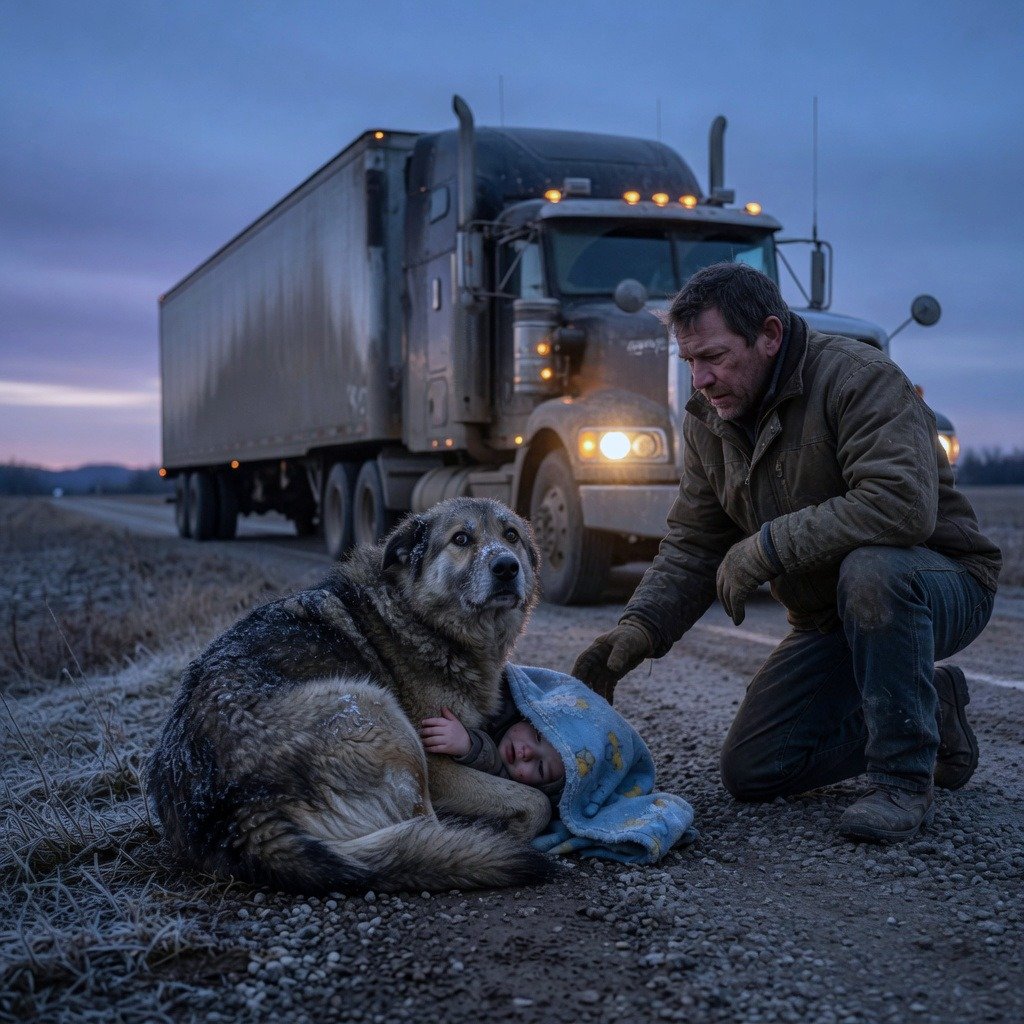
It was a large, shaggy mutt, its fur matted dark with mud and freezing rain. It lay pressed against the wet grass, right at the edge of the ditch. The animal didn’t jump up as the massive truck approached. It didn’t bark or flinch at the blinding headlights. It just lay there, its head resting on its front paws.
As Jack passed, he caught the dog’s eyes. The animal was staring straight at the truck, shivering violently, and letting out a thin, reedy whine that somehow cut through the rumble of the diesel engine. Jack looked away, checking his side mirror, fully intending to keep going. It was a stray. County animal control would handle it, or nature would take its course.
But Jack’s foot eased off the accelerator. He looked in the mirror again. The dog hadn’t moved, but it was still watching the road. It wasn’t the look of an animal waiting to die. It looked like it was waiting for something specific.
“Damn it,” Jack muttered.
He hit the air brakes. The rig hissed and shuddered to a halt, the trailer tires throwing up a wave of muddy water. He switched on the hazards, grabbed his heavy canvas jacket from the passenger seat, and pushed the door open.
The cold hit him instantly. The wind whipped the rain against his face like scattered birdshot. He zipped his coat up to his chin and walked back down the shoulder, his heavy boots crunching on the wet gravel.
The dog watched him approach. It was a shepherd mix, terribly underweight, its ribs pressing sharply against its wet coat. As Jack got within five feet, the dog let out a louder whine. It tried to lift its head, but its front legs trembled and gave out. It didn’t growl. It didn’t bare its teeth. It just shifted slightly, exposing its underbelly to the biting wind.
“What’s the matter, buddy?” Jack said, his voice loud over the storm. “You get hit?”
He knelt in the freezing mud, ignoring the water seeping into his denim jeans. He reached out to check the dog for broken bones. The animal licked his wrist, a quick, desperate swipe of a warm tongue, and leaned away from Jack’s hand.
That was when Jack saw it.
Tucked beneath the dog’s flank, pressed tight against the animal’s ribs, was a bundle of faded blue fleece.
Jack froze. The breath caught in his throat. He reached past the dog and pulled back the edge of the soaking wet fabric.
It was a baby.
A boy, maybe six or seven months old. He was wearing a thin cotton onesie beneath the inadequate fleece blanket. The child wasn’t crying. His eyes were closed, his lips carried a faint blue tint, and his tiny chest was barely moving. Jack pressed two rough fingers to the boy’s neck. The skin was shockingly cold, but there was a pulse. Faint, slow, but there.
Jack looked at the dog. The animal had curled its entire body around the infant, creating a living windbreak. It had been bleeding its own body heat into the child, keeping the boy alive on a night that should have frozen them both.
Jack didn’t hesitate. He scooped the baby into his arms, tucking the boy securely against his chest inside his canvas jacket. The dog let out a sharp cry of distress as the child was taken away.
“Come on,” Jack said, looking down at the shivering animal. “You too. Let’s go.”
The dog tried to stand, its back legs slipping in the mud. Jack swore under his breath, shifted the baby to one arm, and shoved his other arm under the dog’s chest. He practically carried the heavy, wet animal back to the idling rig. He hoisted the dog up into the passenger seat, then climbed in behind the wheel, keeping the baby zipped inside his coat.
He slammed the door, shutting out the storm. Jack cranked the cab’s heater as high as it would go, adjusted the vents to blow directly onto the passenger side, and threw the truck into gear.
The drive to the county hospital took twenty excruciating minutes. Jack drove with one hand on the wheel, his right hand resting gently over his coat, feeling the shallow, stuttering rise and fall of the baby’s chest. Beside him, the dog lay curled on the seat, its nose resting against Jack’s thigh, watching the bulge in the canvas jacket with anxious brown eyes.
Jack pulled the seventy-foot rig directly into the ambulance bay of Memorial General, ignoring the blaring horn of an outgoing paramedic unit. He threw the parking brake, unzipped his coat, and bolted out the door with the baby.
The emergency room doors slid open. The fluorescent lights inside were blinding.
“I need help!” Jack yelled, his boots leaving muddy tracks across the linoleum.
A triage nurse at the front desk looked up, her expression shifting instantly from exhausted indifference to sharp focus. She hit a button on the wall and came out from behind the glass.
“What happened?” she demanded, reaching for the child.
“Found him on the highway,” Jack said, his voice ragged. “Just outside county limits. He’s barely breathing.”
The nurse felt the baby’s skin, shouted a code down the hallway, and practically ran toward the trauma doors. A team in blue scrubs materialized out of nowhere, surrounding the child. They disappeared behind a set of double swinging doors, leaving Jack standing alone in the waiting room, dripping rainwater and mud onto the floor.
He stood there for a long time. His hands were shaking. He finally looked down and realized his jacket was covered in dog hair and wet mud.
“Sir?”
Jack turned. A hospital security guard was approaching him, holding a walkie-talkie. The man didn’t look angry, just firm.
“You can’t park a semi in the ambulance bay,” the guard said. “And you definitely can’t have a dog in here.”
Jack looked toward the automatic doors. The shaggy shepherd was sitting on the rubber mat just inside the vestibule. It had sneaked in behind him. The dog was staring down the hallway where the medical team had taken the baby, its ears pinned back.
“He saved the kid,” Jack said softly.
“I understand that, sir, but health code—”
“I’ll move the truck,” Jack interrupted. He walked over to the vestibule, knelt, and snapped his fingers. The dog looked at him, then back down the hall. “Come on, buddy. We have to wait outside.”
He led the dog back out into the rain. Jack parked the rig in the far corner of the hospital’s visitor lot. He kept the engine idling and the heater running. He sat in the driver’s seat, watching the ER entrance through the rain-streaked windshield. The dog curled up on the passenger seat, exhausted, but its eyes stayed open.
They waited.
Morning broke gray and sluggish. The rain had stopped, leaving the asphalt slick and reflecting the harsh overhead lights of the parking lot. At seven a.m., a police cruiser pulled up near Jack’s rig. A county sheriff’s deputy and a woman in a beige trench coat got out and walked toward the truck.
Jack rolled down his window.
“Mr. Evans?” the woman asked. She held a clipboard against her chest to shield it from the morning mist. “I’m Brenda Higgins, Child Protective Services. The hospital gave us your name.”
Jack opened the door and climbed down. The dog sat up, watching them through the glass.
“How is he?” Jack asked.
“He’s going to make it,” the deputy answered. “Severe hypothermia, but they got his core temp up. Doctor said if he’d been out there another hour, we’d be having a different conversation.”
Jack let out a long, slow breath. The tightness in his chest, a knot that had been coiled there since last night, finally loosened.
“We’re running checks now,” Deputy Higgins said, her tone professional but weary. “Looking for missing child reports, abandoned vehicles in the area, anything. Right now, he’s a John Doe. Once he’s medically cleared, he’ll be discharged into emergency foster care while we investigate.”
“Foster care,” Jack repeated.
“Yes. A temporary placement. A group home, most likely, given the current shortage of available families in the county.”
Jack looked past her, toward the brick facade of the hospital. He thought about the boy. He thought about the cold, the mud, and the sheer, blind luck that had made him look in his side mirror at exactly the right second. He thought about his empty house, the quiet rooms, and the endless miles of black asphalt that waited for him every week.
“I’ll take him,” Jack said.
Brenda Higgins stopped writing. She looked up at him, her expression softening into something resembling pity.
“Mr. Evans, I appreciate what you did tonight. You saved that boy’s life. But you can’t just take him home.”
“I have a house. It’s paid off. Four bedrooms.”
“You’re also a single man who drives a commercial truck for a living,” she said gently, gesturing toward the massive rig behind him. “You’re on the road for weeks at a time. The state requires stability. A fixed schedule. Background checks, home studies, licensing classes. Fostering a ward of the state takes months of preparation, and they rarely place infants with single applicants who travel.”
She wasn’t trying to be cruel. She was just outlining the brick wall of reality.
Jack looked at his calloused hands. He looked at the truck that had been his entire life, his sole source of income, and his only refuge for the last five years. Then he looked at the dog sitting in the cab, waiting.Dogs
“If I get a local job,” Jack said, his voice flat and perfectly steady. “If I sell the rig. If I’m home every night at five o’clock.”
Higgins hesitated. “It would improve your chances. But I can’t guarantee anything.”
Two weeks later, Jack stood in the gravel lot of a commercial hauling company in Toledo. The sky was the color of bruised slate, threatening snow.
Mike, a guy Jack had driven alongside for fifteen years, stood next to him. Mike was smoking a cigarette, shaking his head as he watched a mechanic inspect the engine block of Jack’s Peterbilt.
“You’re out of your mind, Jack,” Mike said, pulling his jacket tighter against the wind. “You don’t know the first thing about raising a kid. You’re sixty years old, for God’s sake. You should be putting money away for retirement, not buying diapers and paying for college.”
Jack didn’t answer right away. He reached out and ran his hand along the chrome side mirror of the truck. The metal was ice cold. He knew every inch of this machine. He knew the way the transmission shifted on steep grades, the smell of the diesel, the exact rhythm of the tires on a long stretch of empty interstate. This truck had kept him sane after Sarah died. It was his freedom.
“I’m taking the dispatcher job at the warehouse,” Jack said. “Starts Monday.”
“A desk job,” Mike scoffed, dropping his cigarette and grinding it into the gravel with the heel of his boot. “You sitting in a cubicle all day. You’ll lose your mind in a month.”
“Maybe,” Jack said. He pulled his hand away from the truck and put it in his pocket. “But I left that hospital, Mike, and I went back to an empty house. I sat in the kitchen, and it was so quiet my ears rang. I’m tired of the quiet.”
Mike looked at him, seeing the stubborn set of Jack’s jaw. He sighed. “The guy offered you thirty grand under market value for the rig. You’re getting robbed.”
“I need the cash now to show the state I have a liquid emergency fund,” Jack said. He turned his back on the truck and started walking toward his used Ford sedan. “Take care of yourself on the road, Mike. Keep the shiny side up.”
It took six months. Six months of state-mandated parenting classes held in windowless community center rooms. Six months of background checks, finger-printing, and invasive home inspections where strangers opened his cabinets and checked the temperature of his hot water heater.
Every Saturday, Jack drove to the county foster facility. He sat in a brightly lit playroom with a baby who was slowly learning to sit up on his own. Bear, the shaggy shepherd mix Jack had adopted the morning of the storm, would sit patiently in the back seat of the Ford the entire time, staring at the facility’s front doors.
When the judge finally signed the permanent adoption papers, Jack didn’t celebrate with a party. He just buckled the boy into the car seat, drove home, and carried him up the porch steps.
He set the baby carrier on the living room rug. Bear walked over slowly, his claws clicking on the hardwood. The dog lowered his massive head, sniffing the boy’s forehead. He let out a soft huff of breath, circled twice, and laid down directly between the baby and the front door, resting his chin on his paws. Jack stood in the doorway, watching them. The house wasn’t quiet anymore…
Website Disclaimer
The information provided on this website is for general informational and educational purposes only. While we strive to ensure that all content is accurate and up to date, we make no guarantees regarding the completeness, reliability, or accuracy of any information published.
The views and opinions expressed in articles belong to their respective authors and do not necessarily reflect the views of this website. Any action you take based on the information found on this website is strictly at your own risk. We will not be liable for any losses, damages, or inconveniences arising from the use of our content.
Some articles may contain opinions, third-party information, or external links. We do not endorse or guarantee the accuracy of content on external websites and are not responsible for their practices or policies.
All content on this website is provided in good faith and is intended for informational purposes only. Readers are encouraged to verify information independently and seek professional advice where appropriate.