The teacher reached toward the clipboard before the volunteer could return to the bus, making it clear that the trip roster was no longer going to remain solely in the volunteer’s hands.
She wanted the entire list.
And until she had looked at it herself, the buses were not simply going to roll away as though nothing had happened.
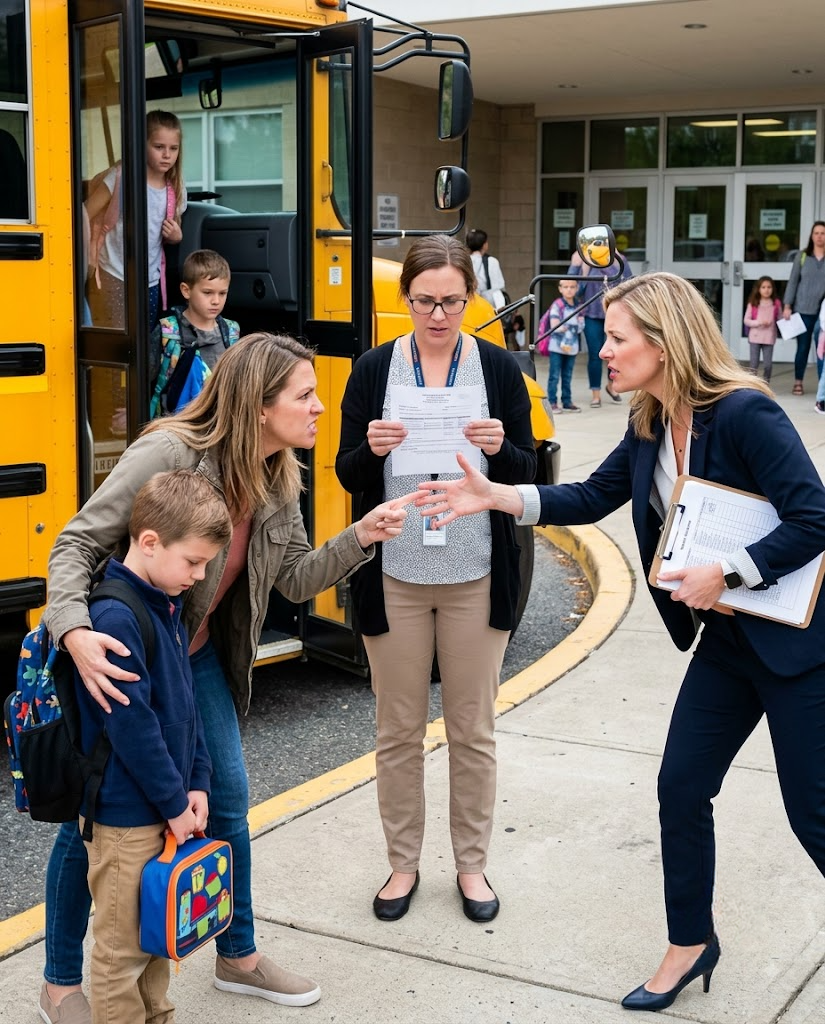
My son stayed close to me, still holding the same lunchbox he had been gripping when I arrived.
That lunchbox had become the detail I could not stop noticing.
Not the buses idling at the curb.
Not the backpacks disappearing through the doors.
Not the parents and school staff moving around us.
His lunchbox.
He had packed for the trip because he believed he was going on it.
Then an adult volunteer had pulled him out of that plan and told him his place was gone because I supposedly had not paid.
By the time I reached the school, most of the other kids were already boarding.
My son was standing near the entrance by himself.
Both hands were wrapped around the lunchbox handle.
He did not run toward me when he saw me.
That was the first thing that made my stomach drop.
Normally, if something had gone wrong at school, he would have come straight to me.
This time he just stood there as if he had already decided that making himself smaller might keep things from getting worse.
Then he said, “She told me I couldn’t go.”
A few yards away, the parent volunteer was still checking students onto the bus.
Her daughter was already inside.
I had spent the drive to the school looking at my payment receipt over and over, partly because I wanted to make sure anger had not made me misread something.
It had not.
My payment had cleared.
More importantly, the record did not simply show that I had paid.
It showed what happened afterward.
The ticket connected to my payment had been reassigned to the volunteer’s daughter.
I walked over and held up the receipt.
“You told my son I didn’t pay.”
She barely gave the paper a glance.
“That’s what the list showed.”
Her answer was so casual that for a second I wondered whether she expected me to accept it and leave.
I turned the receipt so she could see the exact line.
There was my payment.
There was the ticket tied to it.
And there was the later reassignment.
Her expression tightened.
“There was a mix-up,” she said. “We had to make a decision.”
That answer told me something important.
She was no longer saying the payment did not exist.
Now she was calling it a mix-up.
“You made the decision using the seat I paid for.”
My son stood beside me, quiet.
The lunchbox brushed his knee as he shifted his weight.
He was trying hard to act as though this confrontation was not happening where other students and adults could see it.
I hated that he felt responsible for making the situation less embarrassing.
He was the child who had been removed from a trip he was supposed to attend.
He should not have been the one worrying about everyone else’s comfort.
The volunteer lowered her voice.
“Don’t turn this into a scene.”
But I had not come to make a scene.
I had come because my child had been left standing outside while somebody else used the place I had paid for.
I wanted one answer.
So I asked her directly.
“Did you know that ticket belonged to my son when you gave it to your daughter?”
She did not look at the receipt.
She did not look at him.
She looked toward the bus.
Then she said, “Your son wasn’t on my final paid list. My daughter was. That’s all that matters.”
Except it was not all that mattered.
The paper in my hand showed that my payment existed before her daughter’s reassignment.
So I held it out again.
“Then why does this show my payment first and her reassignment afterward?”
At that point, a teacher who had been helping students board stepped toward us.
She did not make an accusation.
She did not immediately take my side.
She simply asked to see the receipt.
That was enough to change the situation.
I handed it to her.
The volunteer instantly reached for it.
“You don’t need to get involved. I handled the roster.”
The teacher did not give the receipt back.
Instead, she pulled it closer and read it herself.
Once.
Then again.
The volunteer started explaining.
There had been cancellations.
There had been last-minute changes.
Some families had not confirmed.
There were limited seats.
Maybe every one of those things had happened.
But none of them explained the sequence printed on the receipt.
My son’s place had been paid for.
Then that paid place had been moved to her daughter.
Those were not feelings.
They were not assumptions.
They were the two entries sitting in front of the teacher.
That was when my son finally said something else.
“I gave her my lunch slip because she said I wasn’t going.”
The volunteer snapped toward him.
“That’s enough.”
The teacher looked at her.
The change was subtle, but it mattered.
Until then, the volunteer had been explaining a roster problem.
Now she was telling my son to stop talking about what she had told him.
Behind us, the bus door opened.
The volunteer’s daughter appeared at the top of the steps.
She had obviously heard enough of the conversation to understand what was happening.
Her mother turned toward her.
“Get back in your seat.”
The girl did not move back inside.
She looked at my son.
Then she looked at her mother.
And she started down the steps.
Nobody had asked her to come over.
Nobody had called her into the argument.
She came down because she had information of her own.
When she reached us, she stopped near the teacher.
Then she said something that changed the meaning of the entire explanation her mother had been giving.
“Mom told me his family canceled. She said the seat was going to be empty anyway.”
The volunteer immediately denied it.
“That’s not what I said.”
Her daughter did not fight with her.
She did not raise her voice.
She looked at my son instead.
“I didn’t know you were still going until this morning,” she told him. “I thought you backed out.”
That was the first detail that took the situation beyond a possible morning mistake.
Until then, the volunteer could still try to frame the problem as confusion caused by a bad final list.
Her daughter’s explanation introduced something different.
The night before the trip, she had already been told why the seat was supposedly available.
According to her, my family had canceled.
But we had not canceled.
I had paid.
My son had packed his lunch.
He had arrived expecting to board with everybody else.
I looked at the girl and asked, “When did your mom tell you that?”
“Last night.”
The volunteer stepped toward us.
“We’re not interrogating children in a parking lot.”
For once, I agreed with part of what she was saying.
A child should not have been responsible for resolving what the adults had done.
The teacher apparently thought the same thing.
“Agreed,” she said.
She did not ask the girl another question.
She did not ask my son to prove anything either.
Instead, she turned toward him and told him to stay beside me while she sorted out the roster.
That mattered more than I can explain.
Because up to that point, my son had been treated as though the burden was on him.
He had been the one separated from the trip.
He had been the one told his payment was missing.
He had handed over his lunch slip after being told he was not going.
He had stood alone while the other kids boarded.
Now, finally, an adult at the school was treating the paperwork as the problem instead of treating him as the problem.
The volunteer turned back toward the bus.
Maybe she wanted to continue loading students.
Maybe she wanted to move the process forward before the questions became more specific.
Whatever her intention was, the teacher stopped the movement of the moment by reaching for the clipboard.
She said she needed the complete trip list before anyone left.
That clipboard mattered because the volunteer had been relying on one sentence from the beginning.
The list said my son was not paid.
The list said her daughter was.
That had been her defense when I first approached her.
It was the reason she gave for excluding him.
It was the reason she gave for using the seat.
It was the reason she apparently expected everybody else to accept.
But the receipt told a different story.
And now her own daughter had described being told, before the morning of the trip, that my family had canceled.
Those two things did not comfortably fit the explanation of a last-minute roster mix-up.
The teacher understood that enough to stop relying on the volunteer’s summary of the records.
She wanted to see them herself.
My son was still beside me.
He had not suddenly become talkative.
He was not demanding an apology.
He was not celebrating because another adult had stepped in.
He was just waiting.
That was probably the hardest part for me.
Children notice how adults handle power long before they have language for it.
My son had arrived with everything he believed he needed for the trip.
He had a paid place.
He had his lunch.
He had shown up.
And because one adult told him he did not belong on that bus, he had accepted the humiliation quietly enough to hand over his lunch slip.
The volunteer kept trying to make the issue sound administrative.
A list.
A cancellation.
A confirmation problem.
Limited space.
Those words made the situation sound impersonal.
But standing there beside my son, it was impossible to see it that way.
There was a child attached to that payment.
There was another child attached to the reassigned seat.
And there was an adult who had apparently told her daughter the night before that my family had canceled.
Her daughter seemed uncomfortable, but not defensive.
That distinction mattered too.
She had gotten on the bus believing the seat was available.
When she realized my son had actually shown up expecting to use it, she came down and said what she had been told.
I did not blame her for believing her mother.
Kids are supposed to be able to believe their parents about something as ordinary as whether a trip seat is available.
My anger was never about two children fighting over a place on a bus.
The children had not created the conflict.
The adults had.
The volunteer had tried to stop the teacher from examining the receipt.
She had told my son, “That’s enough,” after he explained what happened to his lunch slip.
She had told her daughter to return to her seat when the girl came down from the bus.
And now, after the girl said she had been given the cancellation story the night before, the volunteer wanted the conversation framed as adults interrogating children.
But no one needed the children to solve it.
The records were already there.
That was why the clipboard became so important.
If the volunteer’s explanation was accurate, the full roster should support it.
If there had truly been an innocent sequence of cancellations, confirmations and changes, the teacher could look at the entries and understand what happened.
And if the records did not support that explanation, then the problem was bigger than a misunderstanding at the curb.
I watched the teacher keep the receipt in her possession while reaching toward the roster.
For the first time since I arrived, I did not feel like I had to convince someone that my son deserved to be taken seriously.
The teacher was doing the simplest possible thing.
She was checking.
No speech.
No public accusation.
No rush to protect anyone’s reputation.
Just the receipt in one hand and a request for the full list.
The buses were still there.
My son was still beside me.
The volunteer’s daughter was no longer sitting in the seat her mother had said would otherwise be empty.
And the explanation that began with “that’s what the list showed” was finally about to be compared with the list itself.
The volunteer still had the clipboard in her hands.
The teacher extended her hand toward it.
This time, she did not ask to hear another explanation first.
Website Disclaimer
The information provided on this website is for general informational and educational purposes only. While we strive to ensure that all content is accurate and up to date, we make no guarantees regarding the completeness, reliability, or accuracy of any information published.
The views and opinions expressed in articles belong to their respective authors and do not necessarily reflect the views of this website. Any action you take based on the information found on this website is strictly at your own risk. We will not be liable for any losses, damages, or inconveniences arising from the use of our content.
Some articles may contain opinions, third-party information, or external links. We do not endorse or guarantee the accuracy of content on external websites and are not responsible for their practices or policies.
All content on this website is provided in good faith and is intended for informational purposes only. Readers are encouraged to verify information independently and seek professional advice where appropriate.