I was the one who called the bikers.
My name is Caroline Mercer, and I live three houses down from Walt, though on that road three houses can mean nearly half a mile of fields, pine trees, drainage ditches, and mailboxes leaning like tired men.
For years, I told myself I was a good neighbor.
I waved when I passed.
I brought him banana bread twice, once after a storm and once at Christmas.
I called the sheriff’s office when I saw a strange truck parked near his barn.
But the truth is, I had made a habit of caring from a distance, which is a very comfortable way to feel decent without being inconvenienced.
Walt did not ask for help.
That made it easier.
He was proud in the old way, not loud about it, but stubborn enough that he would rather patch a porch step with one hand and a bad hip than let a younger person see him need anything. He wore pressed shirts even to check the mail. He saluted the flag every morning, slow but exact. On Memorial Day, he put a folding chair beside the flagpole and sat there for one hour, whether anyone noticed or not.
Most people knew he had served in Korea.
They knew his wife, Eleanor, had died thirty years earlier.
They knew he had no children.
Or, at least, we thought he had no children.
That was one of the things we were wrong about.
The house had started going bad after Eleanor passed. First the porch rail. Then the paint. Then the shutters. Then the garden beds she had kept tidy for forty years until weeds swallowed the little stone border. Every spring, Walt bought seeds at the feed store. Every summer, he planted fewer of them. Every fall, he apologized to the dead flowers as if they had expected better from him.
I noticed.
We all noticed.
We said things like, “Somebody should organize a church group.”
Or, “Maybe the county has a senior program.”
Or, “He won’t accept help, you know how Walt is.”
Then one afternoon in May, I saw him on the porch with a paintbrush in his hand, trying to scrape the old siding while holding the rail with his other hand. He was ninety. The ladder beside him was older than some cars. His right foot slipped on the step, and though he caught himself before falling, the sight of him standing there breathing hard, pretending he was fine, put shame in me so sharp I could not ignore it.
My nephew, Ryan, rode with the Iron Table Riders.
That is how I knew Preacher.
I called Ryan first.
“Do bikers paint houses?” I asked.
He laughed.
“Some do. Some paint over mistakes. Why?”
I told him about Walt.
There was silence on the line after that, then Ryan said, “Let me ask Preacher.”
Preacher came the next day.
Not with the club.
Just him.
He rode up on a dark green Harley Road King, killed the engine near the mailbox, and took off his helmet slowly. Walt watched from the porch, stiff as a fence post.
Preacher walked up the drive wearing his leather vest, jeans, boots, and a white T-shirt stretched over a wide chest. His arms were tattooed from wrist to shoulder, names and dates and places inked into skin that looked like it had seen too much sun and too many hospital rooms.
Walt looked him over and said, “I didn’t order nothing.”
Preacher smiled.
“No, sir.”
“You selling something?”
“No, sir.”
“You lost?”
“Probably, but not today.”
That made Walt almost smile, though he caught it fast.
Preacher looked at the house.
“Ma’am down the road said you might need paint.”
Walt’s face closed.
“House is mine.”
“Yes, sir.”
“I can take care of my own house.”
Preacher nodded.
“I believe you.”
“Then why are you here?”
Preacher looked at him for a long moment, not pitying him, not challenging him, just seeing him in a way most of us had stopped doing.
“Because some jobs go faster with a crew,” he said.
Walt gripped the rail.
“I don’t take charity.”
Preacher nodded again.
“Good. We don’t give charity.”
“What do you call it?”
Preacher touched the faded veteran patch on the front of his vest.
“Maintenance.”
That was the first seed.
The second was the mailbox.
Walt’s mailbox had four faded letters on the side: W. GRAYSON. But under the cracked paint, if you looked closely, there had once been another name written below his.
Preacher noticed it.
So did I.
Walt saw us looking and turned away.
The third seed was inside the front window, just visible behind the curtain: a small pair of dusty black motorcycle boots sitting near the hallway wall.
Too small for Walt.
Too young to belong to a ninety-year-old man.
No one asked.
Not yet.
The Iron Table Riders came on Saturday.
They did not arrive like a parade.
That mattered to Preacher.
“No revving,” he told them at the gas station before they headed out. “No pictures unless he asks. No acting like saviors. We are painting a man’s house, not adopting a highway.”
By 7:00, the gravel drive was full of bikes and pickup trucks. Walt stood on the porch in pressed trousers, a clean shirt, and suspenders, holding his cane like it was a rifle.
“I told you I don’t take charity,” he said when Preacher walked up.
Preacher held out a paper bag.
“Breakfast biscuit.”
Walt stared at it.
“That charity?”
“No, sir. That’s sausage.”
Walt took the bag.
That was how the work began.
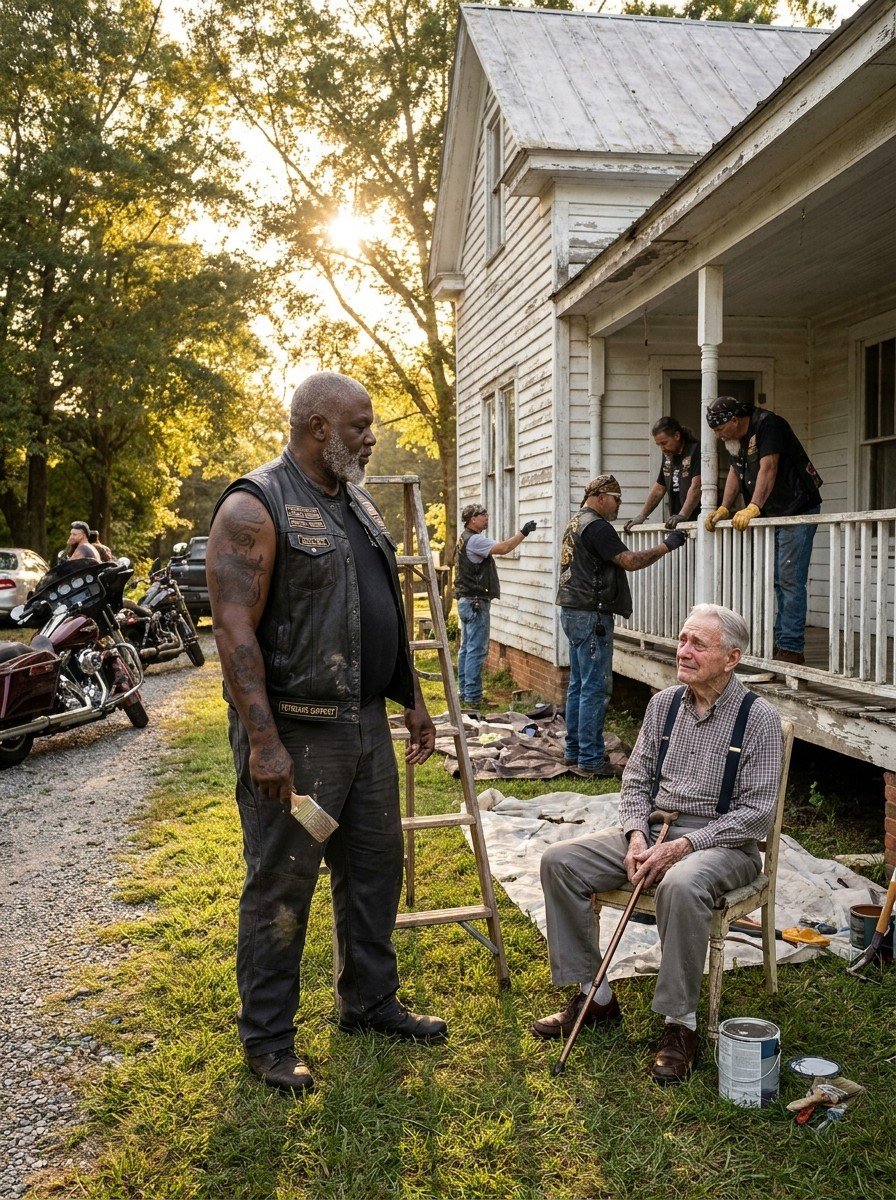
The club moved with a kind of rough grace. They laid tarps over the shrubs. Scraped the loose paint. Sanded what needed smoothing. Replaced two rotted porch boards before Walt could protest. A white American biker named Dutch, fifty-nine, huge arms, braided gray beard, and a laugh that could startle birds from trees, fixed the loose shutter on the north side. A Black American woman named Jo, fifty-one, former Navy mechanic, short hair and tattooed wrists, patched a gutter seam with the patience of a surgeon. Ryan and two younger riders cleaned the flower beds Eleanor had once loved.
Walt watched all of it from the doorway.
He tried to help twice.
Preacher handed him a folding chair both times.
“I outrank you in stubborn,” Preacher said.
“I was a corporal.”
“I was a medic. I outrank everybody bleeding.”
Walt sat down.
By noon, the house looked worse than before because halfway through any repair, things always look ruined. Old paint stripped. Boards exposed. Tools everywhere. White dust in the air. Walt’s face tightened at the sight, and I wondered if we had made a mistake.
Then Jo uncovered something on the porch rail.
A carved marking.
Small.
Almost painted over.
E + W, 1954
Eleanor and Walter.
Walt saw it from his chair.
His hand moved toward his chest.
Preacher noticed and told Jo, “Tape around that. Don’t cover it.”
Walt looked away fast.
But I saw his eyes.
That was the first crack.
The day grew hot. The kind of Carolina heat that makes shirts cling and tempers shorten. Nobody complained where Walt could hear it. The bikers drank water, wiped sweat with bandanas, and kept working. Paint went on slowly at first, then faster as the old house began to brighten. The shutters turned blue again. The porch rail looked clean. The steps no longer sagged under weight.
Late in the afternoon, Walt disappeared inside.
For a while, I thought he was tired.
Then I heard something from the house.
Music.
Very faint.
Old jazz, crackling through what sounded like a radio older than I was. Preacher heard it too and smiled without showing teeth.
“That’s Duke Ellington,” Walt called through the screen door, as if defending a position.
Preacher lifted his brush.
“Yes, sir.”
“You boys know music?”
Dutch shouted, “I know Skynyrd.”
Walt said, “That ain’t music. That’s a truck accident with lyrics.”
The bikers laughed.
Walt did too.
Not much.
Enough.
That felt like the climax then.
The forgotten veteran warming to the tattooed bikers. The house becoming beautiful. The neighborhood finally doing what it should have done years earlier. By sunset, the farmhouse looked almost new, white siding glowing gold in the low light, blue shutters straight, porch repaired, flag raised, garden beds cleared.
Preacher knocked on the door.
“Mr. Grayson,” he said, “you want to see your house?”
Walt stepped outside.
He looked at everything.
The paint.
The porch.
The flower beds.
The carved initials saved on the railing.
Then he began to cry.
We thought it was because of the house.
It wasn’t.
Walt stood on the porch with one hand on his cane and the other pressed against the doorframe, tears sliding down the deep lines of his face. Nobody moved toward him too quickly. Old men, especially proud ones, deserve the dignity of not being rushed while their hearts betray them.
Preacher stepped close enough to catch him if he fell.
“You all right, sir?”
Walt nodded, but it was not convincing.
“It’s not the house,” he whispered.
The bikers stood in the yard, paint brushes in buckets, boots in the grass, leather vests dark with sweat. The road had gone quiet. Even the flag rope seemed to stop tapping the pole.
Walt looked at all of them.
Then at me.
Then back at Preacher.
“It’s been thirty years,” he said.
Preacher’s face softened.
“Since what?”
Walt tried to answer, but the words caught.
He swallowed, the movement painful to watch.
“Since anybody came to my door and stayed.”
That was when the whole day changed.
Not because we realized Walt was lonely.
We knew that, in the shallow way people know obvious things and still avoid doing anything about them.
It changed because he said it out loud.
After Eleanor died, people had come. Of course they had. Church ladies with casseroles. Men from the VFW. Neighbors with flowers. A pastor. A county representative. A nephew who stayed just long enough to ask about land taxes.
Then slowly, everybody stopped.
The casseroles ended.
The visits thinned.
The phone rang less.
The world did not become cruel overnight.
It became busy.
Which can feel the same to a man sitting alone at a kitchen table built for two.
Walt wiped his face with a handkerchief.
“My wife died in that room,” he said, nodding toward the front window. “People came for two weeks. Then they went back to their lives, which they had every right to do. I kept thinking somebody would knock again. Not for sickness. Not for death. Just because.”
No one spoke.
He gave a small, embarrassed laugh.
“After a while, you stop listening for it.”
Preacher removed his gloves.
He looked like he wanted to say something, but knew better than to fill the space too quickly.
Walt looked at the bikes.
“At first, I thought all of you were too loud.”
Dutch opened his mouth.
Jo elbowed him before he could ruin the moment.
Walt continued.
“But when all those engines stopped, and then all I heard was people working…” His voice shook. “I remembered what a house sounds like when it has people around it.”
That was the twist.
The paint was not the gift.
The presence was.
But there was another truth still waiting inside the house, behind the locked door of a room nobody had entered in years.
And Walt, maybe because the porch was full again, finally opened it.
After the crying stopped, Walt asked Preacher to come inside.
Just Preacher at first.
Then he looked at me and said, “You too, Caroline. Since you started this trouble.”
I followed them in.
The house smelled like lemon cleaner, old wood, coffee, and time. Everything was neat, almost painfully neat, the way lonely people keep things when there is no one else around to disturb them. A framed photo of Eleanor sat on the mantel. Walt in uniform stood beside her in another, young and straight-backed, both of them looking toward a future that had no idea how quickly it would become memory.
Walt led us down the hall to a closed bedroom door.
His hand shook when he touched the knob.
“This was Daniel’s room,” he said.
I glanced at Preacher.
Daniel.
The name that had once been under Walt’s on the mailbox.
Walt opened the door.
The room inside was not a shrine exactly. It was too dusty for that. Too untouched. A single bed against the wall. A baseball glove on a shelf. A stack of motorcycle magazines from the late 1980s. A faded denim jacket hanging on the chair. And beside the closet, those black motorcycle boots we had seen from the window.
Walt stood in the doorway.
“My son,” he said. “He died before Eleanor.”
His voice had gone flat in the way grief does when it has been carried so long it no longer needs to announce itself.
“Motorcycle wreck?” Preacher asked gently.
Walt nodded.
“1989. He was twenty-six. Bought a used Honda against my wishes. I told him motorcycles were for fools who wanted their mothers to bury them. Last thing I said to him was mean.”
Preacher closed his eyes briefly.
Walt looked at his own hands.
“He was coming here that Sunday. We were supposed to eat supper. Eleanor made pot roast. I was going to apologize when he arrived.”
He looked toward the boots.
“He never arrived.”
The room seemed to shrink around us.
For thirty-five years, Walt had lived in a house where one room held the apology he never got to give, and one porch waited for knocks that had stopped coming.
That was the second twist.
The bikers had not only painted a veteran’s house.
They had walked into the place where Walt’s grief had learned to sit still.
Preacher stepped into the room carefully, as if entering a church.
“My oldest boy rides,” he said.
Walt looked at him.
“I hated you all at first,” Walt admitted.
Preacher nodded.
“I get that.”
“No. I mean I hated motorcycles. Every one. Every engine I heard, I thought of that night. Thought of the sheriff at the door. Thought of Eleanor dropping the spoon in the kitchen.”
Preacher did not defend motorcycles.
That was why Walt kept talking.
“Then you all came today. Loud as sin. Looking like trouble. And you fixed my porch.”
A faint smile passed through the tears.
“Daniel would have liked you.”
Preacher looked around the room.
“What was he like?”
Walt’s face changed.
No one had asked that in years.
“He laughed too much,” Walt said.
Then he sat on the edge of the bed and told us.
Daniel had worked at a tire shop. He hated peas. He loved the Atlanta Braves. He once brought home a stray mutt and named it General MacArthur because it refused to retreat from the couch. He wanted a motorcycle because he said cars made the world feel like television, and he wanted to be in the air.
Walt talked for almost an hour.
Outside, the Iron Table Riders waited in the yard.
No one complained.
When Walt finally came back to the porch, he was carrying a cardboard box.
Inside were Daniel’s old motorcycle magazines.
“Thought maybe somebody could use these,” he said.
Dutch took the box like it was valuable.
It was.
Then Jo asked, “Would you want us to plant something in those beds? Since we cleared them?”
Walt looked at the bare soil where Eleanor’s flowers used to be.
“She liked marigolds,” he said.
By the following weekend, the flower beds were full.
Not just marigolds.
Marigolds, zinnias, black-eyed Susans, and two tomato plants because Preacher said a Southern porch without tomatoes nearby was a legal concern.
Walt called that foolish.
Then watered them every morning.
The Iron Table Riders did not disappear after the paint dried.
That was the part that mattered most.
It is easy to perform kindness for a day. Much harder to return when there is no project left to justify the visit.
Preacher came the next Thursday with coffee.
Dutch came the week after to fix the mailbox and repaint both names on it.
W. GRAYSON
D. GRAYSON
Walt stood beside him while he did it, jaw tight, eyes wet, saying the letters were crooked even though they were not.
Jo brought a radio for the porch because Walt’s old one crackled too badly to hear the baseball scores. Ryan came by twice a month to mow, though Walt insisted on supervising from a chair and criticizing his lines.
“You missed a strip.”
“I did not.”
“I fought in Korea. I know missed territory when I see it.”
Ryan saluted with the mower handle.
“Yes, sir.”
Neighbors started stopping too.
Not in a flood.
That would have overwhelmed him.
But one by one.
A pie.
A newspaper.
A question about the garden.
A chair on the porch at sunset.
I came every Tuesday with coffee, and he pretended mine was too weak, though he always drank two cups.
The house changed.
Not because of paint, though the paint was beautiful.
It changed because sound returned.
Motorcycle engines sometimes.
Laughter.
Boots on the steps.
Baseball on the radio.
Water in the garden.
A screen door opening.
A screen door closing.
One evening in July, Preacher brought something wrapped in an old blanket.
Walt was on the porch, watching fireflies come up from the ditch.
Preacher leaned the bundle against the rail.
“What’s that?”
“Something we found.”
Walt frowned.
Preacher unwrapped it.
A motorcycle helmet.
Old.
White.
Scuffed.
The kind from the 1980s.
Walt stopped breathing.
“Where did you get that?”
“Your barn,” Preacher said. “Back shelf. We were looking for a rake.”
Walt reached for it.
His hands trembled around the helmet.
Daniel’s helmet.
For a long time, he said nothing. Then he held it against his chest the way a younger man might hold a sleeping child.
“I threw that away,” he whispered.
“No, sir,” Preacher said. “You put it where you could find it later.”
Walt looked at him.
Preacher sat down in the other rocking chair.
For once, he did not have wisdom ready.
He just sat.
That became the ritual.
Every Thursday evening, Preacher came by.
Sometimes with club members.
Sometimes alone.
They sat on the porch while the light faded. Walt told stories about Korea, Eleanor, Daniel, bad weather, good dogs, and the year his tomatoes beat everyone else’s at the county fair.
Sometimes he repeated himself.
Nobody corrected him.
Some stories deserve to be told more than once.
That fall, the Iron Table Riders held their annual memorial ride.
Usually, they started at the VFW and ended at a diner near Fort Bragg.
That year, they started at Walt’s house.
Not because Walt asked.
Because Preacher did.
Forty-two motorcycles rolled down County Road 18 just after sunrise, engines low, headlights glowing through the morning fog. They parked along the field, one by one, leather creaking, boots touching gravel, riders standing quietly in front of the farmhouse that no longer looked forgotten.
Walt came out wearing his Korean War veteran cap.
Pressed shirt.
Cane in hand.
Daniel’s old white helmet sat on the porch rail beside him.
Preacher walked up the steps.
“You ready, Corporal?”
Walt looked at the bikes.
His eyes moved over the riders, the fresh paint, the blue shutters, the marigolds, the mailbox with both names, the porch rail where E + W, 1954 had been carefully preserved.
“I’m not riding,” Walt said.
Preacher smiled.
“No, sir. We are.”
Walt understood then.
The ride was for Daniel too.
He lifted one shaking hand to the helmet.
The engines started together.
Not loud for show.
Low for honor.
The sound rolled across the fields, past the flagpole, past the house his father built, past the room where an apology had waited too long, past the porch where people had finally come back.
Walt stood straight.
For one moment, he looked less like a lonely old man and more like a father seeing his boy off right.
Preacher rode first.
The others followed.
Forty-two bikes moving slow down County Road 18.
When the last one passed, Walt raised his hand.
Not quite a wave.
Not quite a salute.
Something between.
The porch light was still on behind him, though the sun had already risen.
He had forgotten to turn it off.
Nobody reminded him.
Website Disclaimer
The information provided on this website is for general informational and educational purposes only. While we strive to ensure that all content is accurate and up to date, we make no guarantees regarding the completeness, reliability, or accuracy of any information published.
The views and opinions expressed in articles belong to their respective authors and do not necessarily reflect the views of this website. Any action you take based on the information found on this website is strictly at your own risk. We will not be liable for any losses, damages, or inconveniences arising from the use of our content.
Some articles may contain opinions, third-party information, or external links. We do not endorse or guarantee the accuracy of content on external websites and are not responsible for their practices or policies.
All content on this website is provided in good faith and is intended for informational purposes only. Readers are encouraged to verify information independently and seek professional advice where appropriate.