The Sister Who Screamed
At my college graduation, my sister jumped to her feet and screamed, “She cheated her way through school!” in front of the whole auditorium.
But instead of stopping, I kept walking toward the stage with one sealed envelope hidden beneath my gown and a truth she never believed I had finally learned how to carry in public.
The Quiet One
My name is Nora Vance. I’m twenty-four, and for most of my life, the safest thing I knew how to be was silent.
My sister Ariana had always been the center of every room. Louder. Prettier. Harder to overlook. In our house outside Portland, she was the daughter people gathered around. I was the one who learned to stay out of the way, clean up the mess, lower my voice, and wait until everyone else was finished needing something.
That arrangement worked as long as I stayed small.
Then I became good at school.
Not just good. Good enough to earn the kind of attention Ariana could sense from across the room like heat. Good enough to win scholarships, top grades, and eventually a place at Reed College, the university I had dreamed about for years.
My parents acted proud, but even then there was always that familiar warning tucked inside their smiles.
Don’t talk about it too much around your sister.
Don’t make her feel bad.
Don’t stir things up.
So I left for college with my head down and my plans held close to my chest. I thought distance would fix everything. I thought if I moved far enough away, I could finally become someone no one at home could keep making smaller.
For a while, it worked.
The First Signs
Then things began happening.
It started small. A missed email about a required meeting with my advisor. I showed up a day late, confused, apologizing. My advisor showed me the cancellation email—sent from my account.
“I didn’t send that,” I said.
She looked at me over her glasses. “It came from your email, Nora.”
“But I didn’t—”
“Perhaps you forgot. You have a lot on your plate.”
I hadn’t forgotten. But I also couldn’t prove I hadn’t sent it.
Then money disappeared from my student account. $800 that had been there on Monday was gone by Wednesday. The bursar’s office said it had been redirected to cover a parking citation I’d never received.
“Check your email,” they said. “The authorization came from you.”
I checked. There it was. An email I’d never written, authorizing the transfer.
“I didn’t send this.”
“Miss Vance, it’s your account. Perhaps you need to reset your password.”
I reset my password. Changed all my security questions. Enabled two-factor authentication.
Two weeks later, my school login was flagged after someone tried to delete my entire account. Campus IT called me in.
“We stopped the deletion,” the technician said. “But whoever tried this had your old password, your security questions, and your mother’s maiden name.”
My stomach dropped. “How would they—”
“Family member? Old friend? Someone who knows you well.”
I knew. Even then, I knew. But saying it out loud felt impossible.
The Rumors
Then the rumors started.
Whispers in the library. Sideways glances in the dining hall. People who used to study with me suddenly finding other seats.
One afternoon, a girl from my economics seminar stopped me outside the building.
“Hey, I just wanted you to know—I don’t believe it.”
“Believe what?”
She looked uncomfortable. “The stuff people are saying. About you buying essays.”
My heart stopped. “What?”
“There’s some… I don’t know, someone’s been posting on the campus forums. Saying you cheat. That you plagiarize. That you’re only here because of financial aid fraud.”
I pulled out my phone and searched. There it was. Anonymous posts on three different campus forums, all describing “a student” who matched my description perfectly. My major. My scholarship. Even the building I lived in.
The posts were detailed. Specific. Personal.
And completely false.
I reported them. The moderators took them down. But screenshots had already spread. The damage was done.
People started treating me differently. Professors watched me more carefully during exams. Study groups stopped inviting me. A teaching assistant pulled me aside after class and asked, very carefully, “Is everything okay at home?”
“Why would you ask that?”
“Some of the… allegations being made about you seem very personal. Like someone who knows you is trying to hurt you.”
She was right. But I still couldn’t say it.
The Calls Home
Every time I called home, my mother found a way to make it seem smaller.
“You’re stressed.”
“You’re overthinking.”
“College is hard. Everyone feels paranoid sometimes.”
“Mom, someone is actively sabotaging me.”
“Nora, that sounds very dramatic. Who would do that?”
I almost said it. Almost. But the words stuck in my throat.
“I don’t know.”
My father was worse. He barely listened. “Just focus on your grades. Everything else is noise.”
Ariana, when she answered the phone, was sympathetic in a way that made my skin crawl.
“Oh, Nora. That sounds so stressful. I’m sorry you’re dealing with that.”
“Do you know anything about it?”
“Me? Why would I know anything? I’m not even there.”
“Someone’s using information only family would know.”
Silence.
Then: “Are you accusing me of something?”
“I’m just trying to understand—”
“I can’t believe you’d think I’d do something like that. After everything I’ve done for you.”
She hung up.
My mother called me an hour later. “You owe your sister an apology.”
“For what?”
“For accusing her. She was in tears, Nora. She’s been nothing but supportive of you.”
“Mom, someone is—”
“You’re being paranoid. Ariana loves you. This is what stress does. You start seeing enemies where there aren’t any.”
I stopped calling after that.
The Investigation
A week before graduation, I finally hired someone.
His name was Marcus Webb, a digital forensics analyst who worked out of a small office in downtown Portland. I’d found him through a campus security forum. He charged $500 for a basic audit.
I had been saving that money for my first apartment after graduation. Security deposit. First month’s rent. The beginning of my real life.
But I needed to know.
Marcus was in his forties, quiet, methodical. He didn’t ask a lot of questions at first. Just had me sign releases and give him access to my accounts, emails, and security logs.
“This will take a few days,” he said. “I’ll call you when I have something.”
He called me three days later.
“You need to come in.”
I met him that afternoon. The office smelled like burnt coffee and overheated electronics. Marcus had papers spread across his desk. Screenshots. IP logs. Timestamps.
“Someone has been targeting you systematically for almost two years,” he said.
My throat tightened. “Can you trace it?”
“Already did.” He turned his monitor toward me.
There were dozens of access attempts. Email logins from unauthorized devices. Password reset requests. Account recovery attempts.
And every single one came from the same IP address.
My parents’ house.
Not a stranger. Not some random scammer. Home.
“Can you tell who specifically?” I asked.
Marcus clicked through more logs. “Based on the timing and pattern—most of these happened during weekday afternoons and weekends. Does anyone in your household fit that schedule?”
Ariana. She didn’t have a job. She lived at home. She had access to everything—old mail, family documents, my mother’s maiden name.
“Yes,” I said quietly.
Marcus handed me a printed report. “This is documentation of every access attempt, every impersonation, every unauthorized login. There’s also evidence of defamation—the forum posts came from the same IP cluster.”
I stared at the papers. Two years of sabotage, documented and timestamped.
“What can I do with this?”
“That depends. Do you want to press charges?”
Did I? Part of me wanted to. Part of me wanted Ariana to face actual consequences.
But another part of me knew my parents would never forgive me. That pressing charges would mean losing my family completely.
“I need to think about it,” I said.
Marcus nodded. “Take your time. But Nora—” He paused. “Whoever did this wanted to destroy you. They weren’t playing around.”
I know, I thought. I’ve known for a while.
The Lawyer
I didn’t press criminal charges. But I did hire a lawyer.
Her name was Patricia Monroe, and she specialized in civil harassment cases. I showed her Marcus’s report, the forum screenshots, the financial interference documentation.
She read through everything without speaking. Then she set down the papers and looked at me.
“This is your sister?”
“Yes.”
“And your parents don’t believe you.”
“They think I’m being paranoid.”
Patricia leaned back in her chair. “Nora, I’ve seen a lot of family cases. This level of sustained harassment—it’s rare. And it’s calculated.”
“Can we do anything?”
“We can send a cease and desist letter. We can document everything for a potential restraining order. And if she continues, we can file a civil suit for damages.”
“I don’t want money. I just want her to stop.”
“Then we start with documentation. We prepare a comprehensive file. And if she tries anything else—anything at all—we respond immediately.”
Patricia helped me organize everything into one sealed envelope. Dates. Logs. Records. Messages. Financial interference. Impersonation attempts. False accusations.
A clean, brutal stack of proof.
“What are you going to do with this?” Patricia asked.
“I’m going to carry it,” I said. “Until I need it.”
The Dinner
Two nights before graduation, my family took me to dinner near campus.
We met at a nice Italian restaurant downtown. My parents arrived first, followed by Ariana in a red dress and heels that clicked against the tile floor.
She hugged me. “Congratulations, little sister.”
I didn’t hug back.
During dinner, Ariana was the center of attention as always. She talked about her new apartment search, her plans to move to Seattle, the job interview she had lined up.
My parents listened like she was describing a Nobel Prize.
When they asked about my plans, I kept it vague. “I have some opportunities I’m exploring.”
“That’s nice,” my mother said absently, already turning back to Ariana.
Ariana sipped her wine and kept dropping little lines across the table like bait.
“I’d hate for anything awkward to happen at the ceremony.”
“Hope all your little school problems are really cleared up.”
“Must be such a relief to finally graduate. After everything.”
Each comment landed like a small stone. My parents didn’t notice. They never did.
After dinner, we walked to the parking lot. My parents walked ahead, talking about where to sit at the ceremony.
Ariana hung back. Fell into step beside me.
When we were far enough away that they couldn’t hear, she leaned close and whispered: “I know you cheated, Nora. On Friday, everyone else will too.”
My heart hammered. But I kept walking.
“I have proof,” she continued. “Screenshots. Messages. Everything. And when you walk across that stage, I’m going to make sure everyone knows what you really are.”
I stopped walking. Turned to face her.
She was smiling. That sharp, satisfied smile she wore when she thought she’d won.
“Do whatever you want,” I said quietly.
Her smile faltered. Just slightly.
“I mean it,” I continued. “Do whatever you think you need to do.”
“You don’t believe me.”
“I believe you’ll try. But Ariana—” I stepped closer. Close enough that she had to look me in the eye. “You’ve been trying to destroy me for two years. And I’m still here.”
I walked away before she could respond.
That night, I went back to my dorm, slid the envelope into the hidden pocket I’d sewn into my graduation gown, and slept with it close enough to feel.
Graduation Morning
Graduation morning was bright and cold. May in Portland—sunshine cutting through clouds, the air sharp with possibility.
The campus was packed with families carrying flowers, phones, coffee, and the kind of happiness that always looks simple from the outside.
I put on my cap and gown in my dorm room. Checked the envelope one more time. It was there, pressed flat against my ribs, hidden but present.
I walked to the stadium alone. Found my seat in the graduate section. Around me, people hugged, took photos, laughed.
I scanned the crowd for my family. Found them in the VIP section—reserved seating my father had paid extra for.
Ariana sat between them in a white dress, phone already in hand.
The Scream
The ceremony began with speeches. The provost. The dean. A student speaker who cried halfway through.
Then they started calling names.
Rows and sections, alphabetically. When they called my row, I stood with everyone else.
We filed toward the stage. One by one, names echoed through the stadium.
“Sarah Underwood.”
“Michael Valencia.”
“Nora Vance.”
I stepped into the aisle.
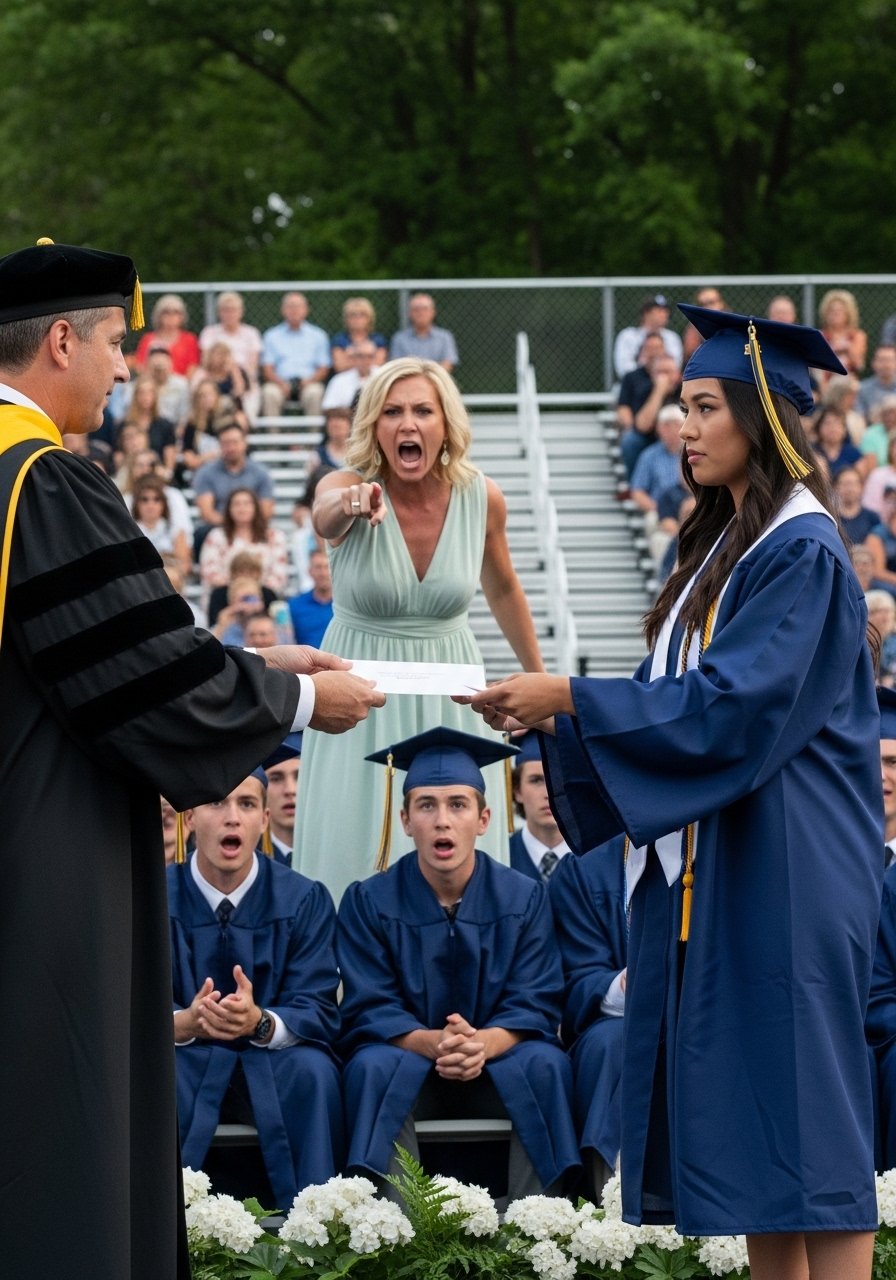
And that’s when Ariana jumped to her feet and screamed:
“STOP! She’s a fraud! She cheated her way through college!”
Three thousand people turned at once.
The band stopped mid-note. The dean froze at the podium. Phones lifted everywhere, recording.
My parents grabbed Ariana’s arms, trying to pull her down. She shook them off.
“She bought essays! She plagiarized! She’s been lying for four years!”
Her voice carried across the stadium, amplified by the acoustics and the shocked silence.
I could feel the entire room waiting to see if I would break.
People were staring. Whispering. Recording.
This was the moment Ariana had been building toward. The public humiliation. The final proof that I didn’t belong.
But I didn’t stop walking.
I didn’t cry. Didn’t defend myself. Didn’t turn around.
I walked straight to the stage, climbed the steps, and approached the dean.
Dean Richardson was a woman in her sixties who’d been at Reed for thirty years. She knew every graduate’s story. She’d signed my scholarship letters. She’d written my recommendation for graduate programs.
I reached inside my gown, pulled out the envelope, and placed it in her hand.
Then I leaned close and said one quiet sentence:
“Everything she just said is a lie. And this proves it.”
Dean Richardson looked at the envelope. Then at me. Then at Ariana, who was still standing in the VIP section, breathing hard, waiting for vindication.
The dean opened the envelope.
She pulled out the first page—Marcus’s report, with the IP address highlighted.
Then the second page—the forensic timeline.
Then the third—screenshots of the forum posts, traced back to the same source.
Her face changed. I watched it happen. The confusion became understanding. The understanding became anger.
She looked up at me. “Is this all documented?”
“Yes, ma’am. Two years’ worth.”
She glanced at Ariana again. Then back at me.
“Ms. Vance, would you please wait here for a moment?”
I nodded.
The dean walked to the edge of the stage and gestured to campus security. Two officers approached. She showed them the first page of the report and spoke quietly.
Then she returned to the microphone.
The stadium had erupted into noise—people talking, speculating, recording. The dean tapped the microphone twice.
“Ladies and gentlemen, may I have your attention.”
The noise dimmed.
“There has been a disruption. We will be pausing the ceremony briefly to address it.”
She gestured to the security officers. They moved toward the VIP section. Toward Ariana.
My sister’s face went white.
“The accusation made against Ms. Nora Vance is not only false, it is part of a documented pattern of harassment that has been reported to campus administration.”
Gasps rippled through the crowd.
“We take these matters very seriously. The individual responsible for the disruption will be escorted from the premises.”
Security reached Ariana. She tried to argue. Tried to pull away.
My parents stood frozen, mouths open, staring between Ariana and me.
Ariana was screaming now. “She’s lying! I have proof! She—”
But security was already guiding her toward the exit.
The dean returned to the microphone. “We apologize for the interruption. Nora Vance is graduating summa cum laude with a degree in Economics. She has been an exemplary student and a credit to this institution.”
She gestured for me to approach.
I walked forward, shaking.
The dean handed me my diploma. Then she did something I didn’t expect.
She hugged me.
“I’m sorry you had to go through that,” she whispered. “But I’m proud of you for standing up.”
When I turned to face the crowd, they were standing. All of them.
Not because of what Ariana had said. But because the dean had told them the truth.
The applause was thunderous.
I walked across the stage, diploma in hand, and descended the other side.
My phone was buzzing in my bag. I ignored it.
After
The ceremony continued. Names were called. Diplomas were handed out. But I barely heard any of it.
After we threw our caps, after the crowd dispersed, I found my parents in the parking lot.
They looked small. Confused. Ashamed.
“Nora,” my mother started. “We didn’t know—”
“Yes, you did,” I said. “I told you. Multiple times. You just didn’t want to believe it.”
“She’s your sister—”
“She’s been sabotaging me for two years. And you called me paranoid.”
My father cleared his throat. “What was in that envelope?”
“Proof. Documentation of every login attempt, every email impersonation, every forum post. All traced back to our home IP address.”
My mother’s face crumpled. “Why would she do that?”
“Because I was good at something,” I said simply. “And she couldn’t stand it.”
“We need to talk to her—”
“No. You need to talk to a lawyer. Because if she contacts me again, if she posts about me again, if she tries anything else, I’m filing a restraining order and a civil suit.”
My father looked shocked. “You’d sue your own sister?”
“She tried to destroy my reputation in front of three thousand people. Yes. I’d sue her.”
My mother was crying now. “Nora, please. We’re family—”
“Family doesn’t sabotage each other. Family doesn’t try to humiliate each other at graduation. Family doesn’t spend two years trying to prove you’re a fraud.”
I pulled out my phone. Showed them Marcus’s report. The timestamps. The IP logs.
“This is what Ariana did. Every single day for two years. And you told me I was being dramatic.”
They stared at the screen, faces pale.
“I’m moving to Boston,” I said. “I got accepted to a graduate program at BU. I’m leaving in three weeks. And I don’t want Ariana to have my new address.”
“Nora—”
“I mean it. If you give her my information, I’ll cut contact with all of you.”
My mother sobbed. My father looked away.
I walked to my car and drove away from my graduation, my family, and the girl I used to be—the one who stayed quiet to keep the peace.
Three Months Later
I’m in Boston now. Small apartment in Allston. Second floor, good light, walking distance to campus.
My parents call once a week. I answer sometimes. The conversations are strained but civil.
They don’t talk about Ariana unless I ask. And I don’t ask.
I heard through my mother that Ariana moved to Seattle. Got a job. Is “doing better.”
I hope that’s true. But it’s not my problem anymore.
Last week, I got a letter. Handwritten. Ariana’s handwriting.
I almost threw it away. But curiosity won.
Nora,
I know you probably don’t want to hear from me. I don’t blame you.
I’ve been in therapy. Working through a lot of stuff. My therapist says I need to take responsibility for what I did.
So here it is: I’m sorry.
I was jealous. I was angry. I felt like you were getting everything I should’ve had. And instead of dealing with that, I tried to tear you down.
It was wrong. All of it. And I don’t expect you to forgive me.
But I wanted you to know I’m trying to be better.
I’m proud of you. I should’ve said that a long time ago.
—Ariana
I read it twice. Then I put it in a drawer.
I’m not ready to respond. Maybe I never will be.
But at least she finally admitted it.
Present Day
I’m sitting in a campus coffee shop right now, working on a research paper for my graduate seminar.
Someone just asked to share my table. I said yes.
We started talking. She’s in the same program. We’re reading the same theorists.
“You’re really good at this,” she said after I explained a concept she’d been struggling with.
“Thank you.”
“Where’d you do undergrad?”
“Reed.”
“Oh wow. That’s competitive. You must be really smart.”
I smiled. Not the apologetic smile I used to give. The real one.
“I worked hard,” I said.
“I bet. I mean, Reed doesn’t just let anyone in.”
No. They don’t.
And neither does Boston University.
And neither will any of the places I’m going next.
Because Ariana spent two years trying to prove I was a fraud, and she failed.
Not because I’m perfect. But because I earned everything I have.
And no one—not my sister, not my parents, not anyone—can take that away from me.
The sister who screamed wanted to destroy me in front of everyone.
But all she did was prove that I’m strong enough to stand when someone tries to break me.
And that’s a lesson worth learning.
Even if it hurt like hell.
Website Disclaimer
The information provided on this website is for general informational and educational purposes only. While we strive to ensure that all content is accurate and up to date, we make no guarantees regarding the completeness, reliability, or accuracy of any information published.
The views and opinions expressed in articles belong to their respective authors and do not necessarily reflect the views of this website. Any action you take based on the information found on this website is strictly at your own risk. We will not be liable for any losses, damages, or inconveniences arising from the use of our content.
Some articles may contain opinions, third-party information, or external links. We do not endorse or guarantee the accuracy of content on external websites and are not responsible for their practices or policies.
All content on this website is provided in good faith and is intended for informational purposes only. Readers are encouraged to verify information independently and seek professional advice where appropriate.