There are certain sentences that don’t just sting when you hear them—they settle somewhere deeper, like they’ve been waiting for years to land.
My sister said one of those sentences at her engagement party.
She laughed—actually laughed—and lifted her champagne glass like she was delivering a clever joke, then said, “She’s just a failed soldier.”
And the worst part?
My parents didn’t even flinch.
My mom gave me that tight, polite smile she uses when she wants something to go away without addressing it. My dad, standing beside her near the kitchen island, just shook his head slightly and said, “Elena, don’t ruin the night.”
That was it. That was my welcome home.
Fourteen months overseas, and the first real conversation I had with my family boiled down to a warning: don’t make things inconvenient.
But I’m getting ahead of myself.
Because if you walked into that house earlier that day—before the guests, before the lights, before everything cracked open—you would’ve thought you were stepping into someone else’s life entirely.
I got home on a Tuesday afternoon, still carrying that mix of airport smell—disinfectant, recycled air, cheap coffee—and the kind of exhaustion that doesn’t really show on your face anymore, but sits somewhere behind your eyes.
The front door wasn’t locked.
That should’ve felt comforting. It didn’t.
It felt careless.
I pushed it open with my boot and almost tripped over a pile of designer shoe boxes stacked like they belonged in a boutique, not a house I’d grown up in. My duffel slipped off my shoulder and hit the floor with a dull, heavy sound that echoed more than it should have.
The floors were marble.
We didn’t have marble before.
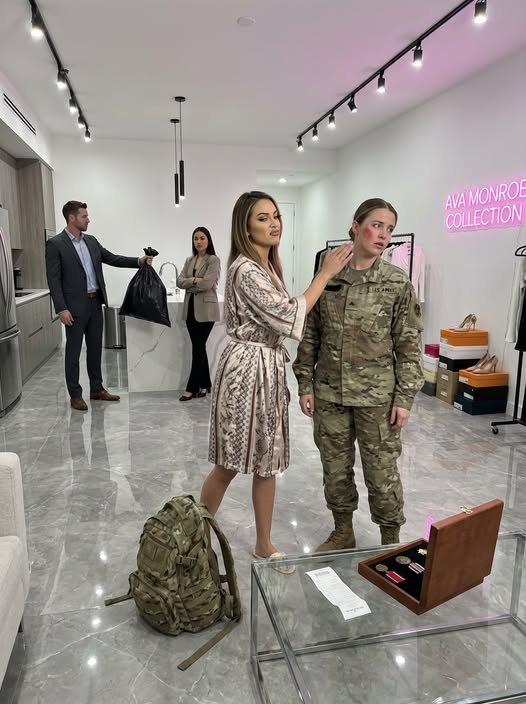
I stood there for a second, taking it in. Ring lights. Clothing racks. A mannequin wearing something silver and impractical. The house didn’t feel lived in—it felt staged.
“Hello?” I called out.
My mom answered from the kitchen, distracted, “One second!”
When she came around the corner, she hugged me, but it wasn’t the kind of hug that says I missed you. It was quick, careful—like she didn’t want to wrinkle her sweater.
“Oh, you’re back already,” she said. “You look… thinner.”
That’s what fourteen months in a combat zone gets you, I guess.
My dad didn’t even stand up. Just lifted his hand from his phone. “Hey, kid.”
And that was that.
No questions. No pause. No moment.
I told myself not to overthink it. That maybe I was expecting too much. That maybe real life just… kept moving while you were gone.
Then I walked down the hallway.
And realized my life hadn’t just moved.
It had been replaced.
My room—my actual room—was gone.
Not redecorated. Not adjusted. Gone.
In its place was what looked like a small fashion studio. Bright lighting, racks of clothing, boxes stacked everywhere, a giant neon sign on the wall that read:
“Ava Monroe Collection.”
My sister’s name.
Everything that had been mine—my bed, my desk, my books, even the stupid lamp I’d had since I was fifteen—had disappeared like it never existed.
“This is temporary,” my mom said quickly, stepping in behind me.
“Temporary?” I repeated.
My dad shrugged from the hallway. “She’s building a brand.”
I turned around slowly. “So you gave her my room?”
“You weren’t here,” he said.
“I was deployed.”
“Same difference.”
No. It wasn’t.
But I could already feel how this was going to go.
Then Ava showed up.
Perfect hair, perfect makeup, silk robe in the middle of the day like she lived in a lifestyle video. She looked at me like I was something she hadn’t ordered.
“Oh,” she said. “You came back like that?”
I looked down at my uniform. “Yeah. Like this.”
She wrinkled her nose. “It’s just… kind of heavy. Don’t bring that vibe tonight, okay? I have people coming over.”
That word again.
Vibe.
Like everything—people, history, sacrifice—was just aesthetic.
I didn’t argue. Not yet.
I asked where I was supposed to sleep.
They said the couch.
Of course they did.
So I sat there that night, staring at a ceiling that didn’t feel like mine anymore, and eventually I got up and went back to what used to be my room.
That’s when I found the box.
Small wooden chest. Scratched corner. Brass latch.
The only thing left that was still mine.
I opened it.
And felt something inside me go completely still.
It was empty.
You’d think I’d panic.
I didn’t.
The military teaches you something strange about stress—you don’t stop feeling it, you just… delay it. Stack it somewhere until you can deal with it later.
So instead of reacting, I started looking.
Drawers. Closets. Boxes.
Nothing.
Then I found the pawn receipt.
Two thousand dollars.
“For military medals, assorted.”
Assorted.
Like they were accessories.
Like they meant nothing.
When I confronted Ava, she didn’t even deny it.
She just shrugged.
“You weren’t using them.”
That’s what she said.
My mom tried to soften it. My dad tried to dismiss it. But no one—not one of them—acted like it mattered.
And that’s when something shifted.
Because it wasn’t just about the medals.
It was about the fact that my entire life—everything I had done, everything I had been through—meant so little in that house that it could be sold for cash without a second thought.
The argument escalated.
Of course it did.
Ava called me dramatic. Said I didn’t understand the “real world.” Said I hid in the military because I didn’t know how to succeed anywhere else.
And my parents?
They backed her.
Like always.
Until the moment she crossed the line.
She slapped me.
Hard enough to sting.
Not hard enough to knock me back.
But hard enough to show me exactly where I stood.
And my father’s response?
He handed me a trash bag.
Told me to leave.
So I did.
I didn’t cry.
Didn’t yell.
I just left.
And I went to the only person I trusted to look at the situation clearly.
Marcus.
Former military intelligence. The kind of guy who doesn’t react emotionally until he has facts.
I gave him the receipt.
And within an hour, everything got worse.
Because the medals weren’t the real problem.
They were just the beginning.
Ava hadn’t just stolen from me.
She had used my identity.
Loans. Credit lines. Financial documents.
Over $100,000.
All in my name.
And the worst part?
She had leveraged my parents’ house.
With forged authorization.
Meaning if things went bad—which they already were—the house could be taken.
“She’s not just reckless,” Marcus said quietly.
“She’s running.”
And he was right.
One-way ticket to Milan.
Three weeks.
She was planning to disappear.
And leave everything behind.
Including the consequences.
That’s when I made the decision.
Not emotional.
Not reactive.
Clean.
I reported everything.
And then… I went back.
By the time the engagement party started, the house looked perfect.
Lights. Music. Guests. Expensive everything.
Ava was glowing.
Like nothing had ever gone wrong.
Like she had already won.
She even handed me drinks to serve.
Told me to smile.
And I did.
Because sometimes the best way to expose the truth…
is to let someone keep talking.
When she raised her glass and made that joke—
“she’s just a failed soldier”—
the room laughed.
My parents nodded.
And that’s when the door opened.
The man who walked in didn’t belong to that world.
Uniform.
Medals.
Presence.
The kind that doesn’t need volume.
Everything went silent.
And he looked straight at me.
Not confused.
Not questioning.
Just steady.
And then he asked:
“Where are your medals, Sergeant?”
That question didn’t just land.
It detonated.
Because suddenly the room wasn’t a party anymore.
It was a stage.
And everyone realized they had been watching the wrong story.
Within minutes, everything unraveled.
Agents.
Warrants.
Evidence.
Ava’s confidence cracked first.
Then her composure.
Then everything else.
When they put the cuffs on her, she looked at me like I had betrayed her.
Like I had ruined something.
And maybe I had.
But not what she thought.
Because what I ruined…
was the illusion.
LESSON FROM THE STORY
People will often dismiss what they don’t understand, especially when it challenges the version of reality they’ve built for themselves. Real strength isn’t always loud, visible, or glamorous—it’s often quiet, disciplined, and overlooked until it’s too late. When someone underestimates you, it says more about their limits than yours. And sometimes, the hardest but most necessary thing you can do is stop protecting people from the consequences of their own actions.
Website Disclaimer
The information provided on this website is for general informational and educational purposes only. While we strive to ensure that all content is accurate and up to date, we make no guarantees regarding the completeness, reliability, or accuracy of any information published.
The views and opinions expressed in articles belong to their respective authors and do not necessarily reflect the views of this website. Any action you take based on the information found on this website is strictly at your own risk. We will not be liable for any losses, damages, or inconveniences arising from the use of our content.
Some articles may contain opinions, third-party information, or external links. We do not endorse or guarantee the accuracy of content on external websites and are not responsible for their practices or policies.
All content on this website is provided in good faith and is intended for informational purposes only. Readers are encouraged to verify information independently and seek professional advice where appropriate.