There is a particular kind of stillness that follows the worst moment of your life.
The world around you keeps moving. Carts roll past in hallways. Voices carry from distant rooms. Someone somewhere is laughing about something ordinary. And you stand in the middle of all of it completely unable to understand how any of it is still happening, because the thing that just occurred has made the continued motion of the world feel almost incomprehensible.
Ember stood in that stillness in a hospital corridor on the afternoon her husband Anthony died.
She had been married to him for nearly twenty-five years. She had sat beside his bed every single day of the two weeks he had been hospitalized, talking to him about neighbors and grocery lists and the kitchen faucet that had been dripping for longer than either of them wanted to admit.
She had kissed his forehead an hour before his surgery and made him smile with a joke about flirting with his surgeon for medical updates.
That joke had been the last full sentence he ever heard her say.
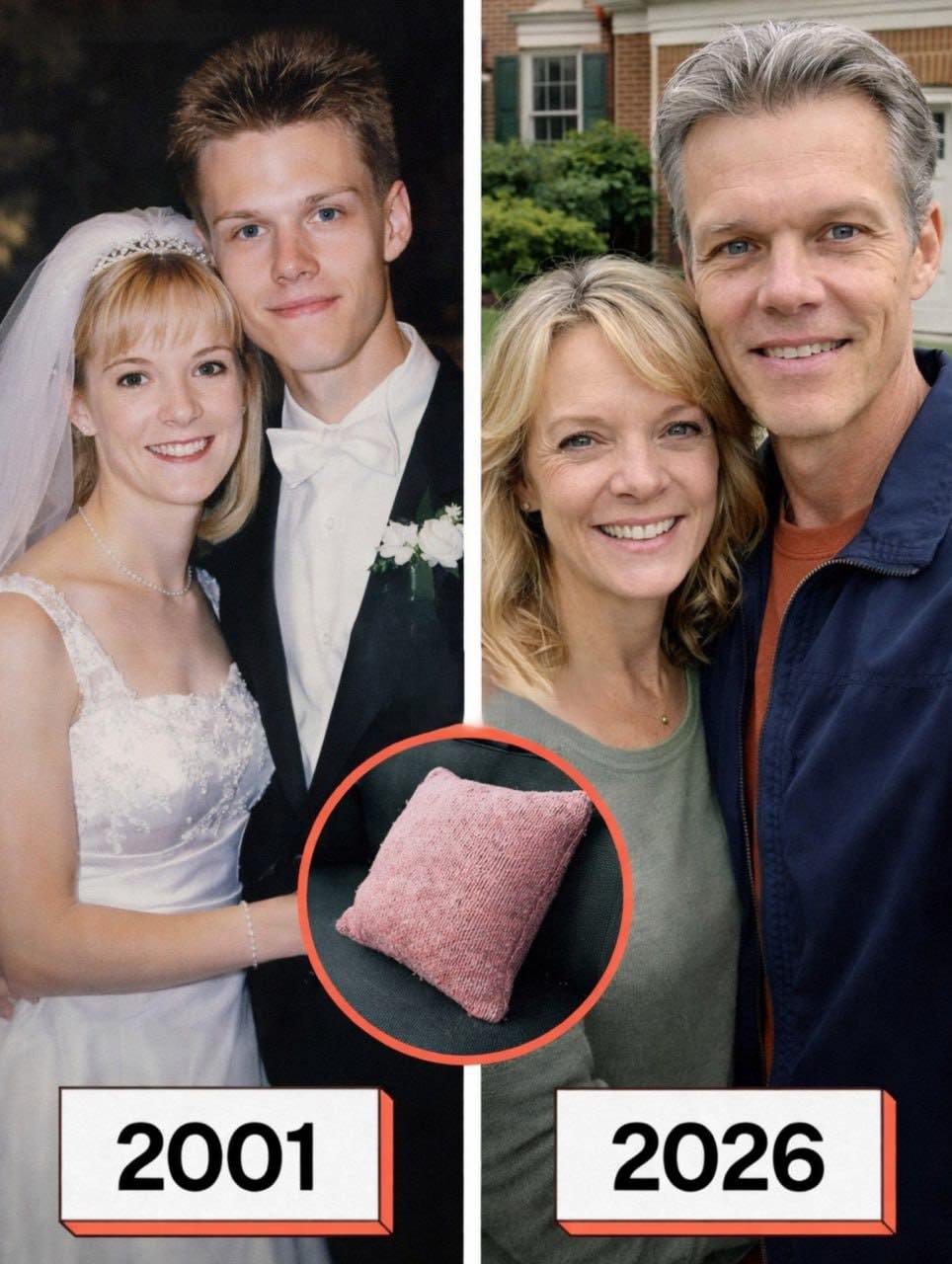
Now a nurse named Becca was standing in front of her holding a small, worn, pink knitted pillow, and telling her that Anthony had hidden it under his bed every single time Ember came to visit.
The Pillow That Did Not Belong
Ember’s first instinct was that there had been some kind of mix-up.
The pillow was soft and faded and clearly well-handled. It was the kind of decorative object Anthony had zero tolerance for in their home.
He bought his socks in bulk packages and referred to throw pillows as fancy clutter with the confidence of a man who had strong opinions about household objects that served no functional purpose.
This pillow did not look like anything that belonged to him.
But Becca was firm. He had kept it hidden under the bed. He had asked her, specifically and repeatedly, to make sure it disappeared before Ember arrived for each visit. And he had made Becca promise that if the surgery did not go as hoped, she would place it directly into Ember’s hands herself.
Ember asked why.
Becca told her it was because of what was inside.
She did not ask more questions. She was not sure she was capable of forming them at that moment. She took the pillow and held it against her chest the way you hold something when you are not yet sure whether it is going to steady you or break you completely.
Becca told her to open it when she was somewhere alone.
Ember does not remember the walk from the hospital corridor to the parking lot. She found herself in her car with the pillow resting on her lap and her purse tipped sideways on the passenger seat, receipts spilling out across the upholstery, and the zipper of the pillow just barely within reach of her fingers.
She sat there for a moment.
“I hate you a little right now,” she whispered into the quiet car.
Then she opened it.
Twenty-Four Envelopes and a Velvet Box
Inside the pillow were envelopes.
Twenty-four of them, tied together with a blue ribbon, each one labeled in Anthony’s unmistakable handwriting. Year One. Year Two. All the way through to Year Twenty-Four.
Beneath the envelopes, small and firm and undeniable, was a velvet ring box.
Ember sat with her hands completely still for a moment that stretched longer than she could measure.
Then she opened the first envelope.
He had written about their first year together. Their small apartment. The neighbor whose music came through the walls at all hours.
The evenings they ate spaghetti sitting on overturned milk crates and told each other it was romantic because neither of them could afford anything else. He thanked her for choosing him when he was still mostly just hope and ambition without much to show for either.
She laughed out loud, alone in a parking lot, and then immediately began crying.
She opened another.
Year eleven. He wrote about the day he lost his job. She had a clear memory of that afternoon. He had come home with a cardboard box of desk items and stood in the driveway saying he had failed her.
She had pulled him inside and told him they were not ruined. They were just scared, and they would figure it out.
She had said it because it was true and because he needed to hear it, and then she had largely moved on from that moment the way you move on from difficult days once they are resolved.
Anthony had been living inside those words for more than a decade.
He had written them down so she would know.
She kept reading.
Year four held a gentle and funny account of a minor household incident she had blamed on sunlight for reasons she no longer remembered.
Year eight held the quiet acknowledgment of a loss the two of them had never quite found the words to discuss fully at the time.
Year fifteen described the bakery she had once seriously considered opening and then set aside when the timing felt wrong and life moved in a different direction.
Year nineteen was a warmly affectionate portrait of the period when his mother had come to live with them, and the way Ember had managed it with a grace he had never stopped marveling at, describing her as a saint in orthopedic shoes in a way that made her laugh through tears in a parking lot.
She sat in the car reading pieces of her own life given back to her in her husband’s voice, watching herself through his eyes across twenty-four years, and understanding for the first time how carefully and completely he had been paying attention to all of it.
The Ring Box and What It Meant
When she finally opened the velvet box, she found a simple gold band set with three stones.
It was exactly her taste. Not elaborate or showy. Just right.
Tucked beneath the ring was a small note from the jeweler, dated six months earlier.
Their twenty-fifth wedding anniversary was three weeks away.
Ember sat with the ring box open in her palm and the understanding settling slowly into her.
He had been planning to ask her to renew their vows.
He had chosen a ring. He had ordered it made specifically for her. He had been carrying this plan through two weeks of hospital stays and daily visits and tired smiles and ordinary conversations about leaking faucets.
He had been holding this while she sat beside his bed talking about the neighbors.
She reached back into the pillow.
There was one more envelope.
Its label read simply: For when I cannot explain this in person.
The Letter She Was Never Supposed to Need
Her chest tightened as she unfolded the pages inside.
Anthony had learned, eight months before he died, that his condition had moved beyond the reach of treatment.
He had asked his doctors not to share that information with Ember. Not yet, he had told them. Not until he was ready.
He wrote, in the letter, that he had never quite become ready.
He told her why he had made that choice.
He wrote that she would have reshaped her entire existence around his illness. She would have slept in hospital chairs instead of their bed. She would have stopped making plans. She would have carried it every single waking moment, the way she carried everything she loved, with her whole self and nothing held back.
He had wanted, he wrote, a little more time in which she still believed he would be there for their anniversary. A little more time in which their daily life still felt like their daily life instead of a countdown neither of them had chosen.
He told her to be angry with him.
She whispered to the letter that she was. That she loved him completely and was furious with him simultaneously, and that both of those things were true at once.
She called Becca from the parking lot.
She asked whether he had asked everyone around him to keep this from her.
Becca told her no. Only his attending physician and his attorney had known. He had signed legal documents formalizing the arrangement.
Then Becca told her something that required a moment to absorb.
A week before the surgery, Anthony had decided he was going to tell Ember the truth. He had said the words out loud to Becca. Today is the day.
Ember asked what had happened.
Becca said she had come in that afternoon laughing. Telling him a story about something that had happened on the way to the hospital. He had watched her face while she talked, and then he had looked at Becca and said, not today. He said he wanted one more normal day with her.
He did not get the chance to choose a different day after that.
Ember sat in her car with the phone pressed to her ear and said, quietly and with complete certainty, that he had not had the right to make that choice for her.
That she would have stayed. She would have carried it alongside him. That was what twenty-five years of a life together meant, and he should have known that better than anyone.
Becca said softly that she knew.
And Ember said, just as softly, that he had chosen for her anyway.
What Else Was Hidden in the Pillow
She looked back into the pillow.
There were legal documents folded carefully at the bottom.
A trust agreement. A business account already established. A signed lease for a commercial property.
And a separate piece of paper documenting the sale of his father’s 1968 Mustang, which Anthony had loved since he was a teenager and which had lived in their garage for as long as Ember could remember.
He had sold it six months ago.
Handwritten notes were scribbled in the margins of the lease documents. Observations about the location and the space. A reminder to himself to repaint the interior and a note that she would hate whatever color it currently was, but that sage green would be right.
At the top of the lease, in letters he had written more boldly than everything else on the page, were two words.
Ember Bakes.
She pressed her hand over her mouth.
Twenty years earlier, she had told him about a dream she had of opening a bakery. She had described it with the particular enthusiasm of something she genuinely wanted but did not fully believe was possible. Life had moved forward and the dream had been set aside and she had not spoken about it in a very long time.
He had remembered every detail.
At the bottom of the final document, in the same handwriting that had filled twenty-four envelopes across twenty-four years, was one last note.
He thanked her for making ordinary days feel like something extraordinary.
He told her that if he could go back and do all of it again, he would choose her every time. In every version of the story. In every possible life.
The Morning She Opened the Door
The bakery opened several months after that afternoon in the parking lot.
The walls were sage green.
Ember had panicked on the first morning, not about the baking, which she knew how to do, but about the absence. About reaching the moment she had always imagined and finding that the person who had believed in it longest was not standing beside her to say he had known people would come.
A customer came in on that first day and noticed the framed pink pillow hanging on the wall behind the counter.
She asked whether it was something personal. Whether it had to do with family.
Ember told her yes. She said that was where her husband had kept the most important parts of their life together.
She looked around the room. The warm light. The smell of something baking. The customers finding their way through the door.
This part, she said quietly, she had chosen for herself.
What Anthony Understood About Love
Anthony Martin made a decision that reasonable people will disagree about.
He chose to carry a heavy truth alone rather than share it with the person he loved most, because he wanted to protect her from the weight of it for as long as he could.
Ember was right that he did not have the right to make that choice for her. She was right that she would have stayed, would have carried it with him, would have been exactly the partner she had been for twenty-four years across every hard thing they had faced together.
But she also understood, in the months that followed, the particular shape of what he had done and why.
He had spent eight months writing letters and planning a ring and arranging a lease and selling a car he treasured.
He had spent eight months making sure that when he was gone, the life she would build next would have a foundation underneath it that he had quietly assembled while she was busy believing they still had more time.
He was protecting her. Imperfectly, and without her consent, and in a way she had every right to feel conflicted about.
But also with the full force of everything he had.
For Anyone Carrying a Grief They Did Not See Coming
There is a kind of loss that arrives without adequate preparation, even when, in retrospect, there were things you might have seen differently.
The kind that leaves you standing in a hospital hallway holding an object you do not yet understand while the world continues its ordinary motion around you.
What Ember’s story offers is not a simple lesson about secrets or communication or the right way to love someone through an illness.
What it offers is something quieter than that.
The image of a man who spent the last months of his life making sure the woman he loved would have something to open her hands toward when he was no longer there to guide her toward it.
And the image of a woman who opened a pink pillow in a parking lot and found her whole life reflected back at her in twenty-four envelopes, and who took that love and that grief and that fury and that tenderness, and built something with it.
Something with sage green walls and her name above the door.
Something she chose.