The Woman Who Left Cold Water for Riders Every Summer — The Truth No One Understood Until It Was Too Late
The first bottle showed up sometime in early June, during that particular stretch of summer when the air in town stopped feeling like air and started feeling like something heavier — something that clung to the skin, thick and stubborn, as if the sun had decided to settle in permanently over the asphalt.
It was sitting on the low concrete ledge beside an abandoned coin laundry on Maple Avenue. The building itself had been closed for years, its faded sign barely hanging from rusted bolts, but the small wall out front still caught a pocket of shade during the early morning hours.
That was where the bottle appeared.
Cold.
Sweating.
Quietly waiting.
It was just an ordinary plastic water bottle, the cheap kind you could buy by the case at any grocery store, but the label had been peeled halfway off, leaving cloudy adhesive marks along the side. The condensation rolling down its surface made a small dark patch on the dusty concrete beneath it.
There was no note.
No explanation.
No box asking for money.
Just one cold bottle of water placed carefully where someone passing by would notice it.
And on Maple Avenue, the people most likely to notice anything unusual were the riders.
Motorcycles came through that stretch of road all the time because it connected two highways and cut fifteen minutes off a cross-town trip. By mid-morning in the summer heat, engines ran hot, helmets felt like ovens, and even the wind rushing past did little to cool a rider who had been on the road for hours.
So naturally, the bottle caught their attention.
At first, no one touched it.
Riders slowed down slightly as they passed, glancing at the ledge, exchanging curious looks through tinted visors, but no one stopped. Something about a free bottle of water sitting alone in the shade made people suspicious.
It looked like kindness.
But kindness from strangers often came with complications.
It wasn’t until late that morning that someone finally pulled over.
The rider was a kid — probably no older than twenty-two — with a matte black helmet and a bike that was clearly older than he was. He parked a few feet away, killed the engine, and walked over slowly as if approaching something fragile.
He picked up the bottle.
Turned it in his hand.
Checked the seal.
For a moment he stood there debating with himself, glancing around the empty street.
Then he twisted the cap open.
The crack of the seal was sharp and unmistakable.
He took a cautious sip.
Then a longer one.
And just like that, the tension melted from his shoulders.
The water was ice cold.
Real.
And after several hours of riding through ninety-degree heat, it felt like the best thing he had tasted in weeks.
Word spread faster than anyone expected.
By the following morning, riders passing through Maple Avenue were already looking toward the ledge.
And this time there wasn’t just one bottle.
There were three.
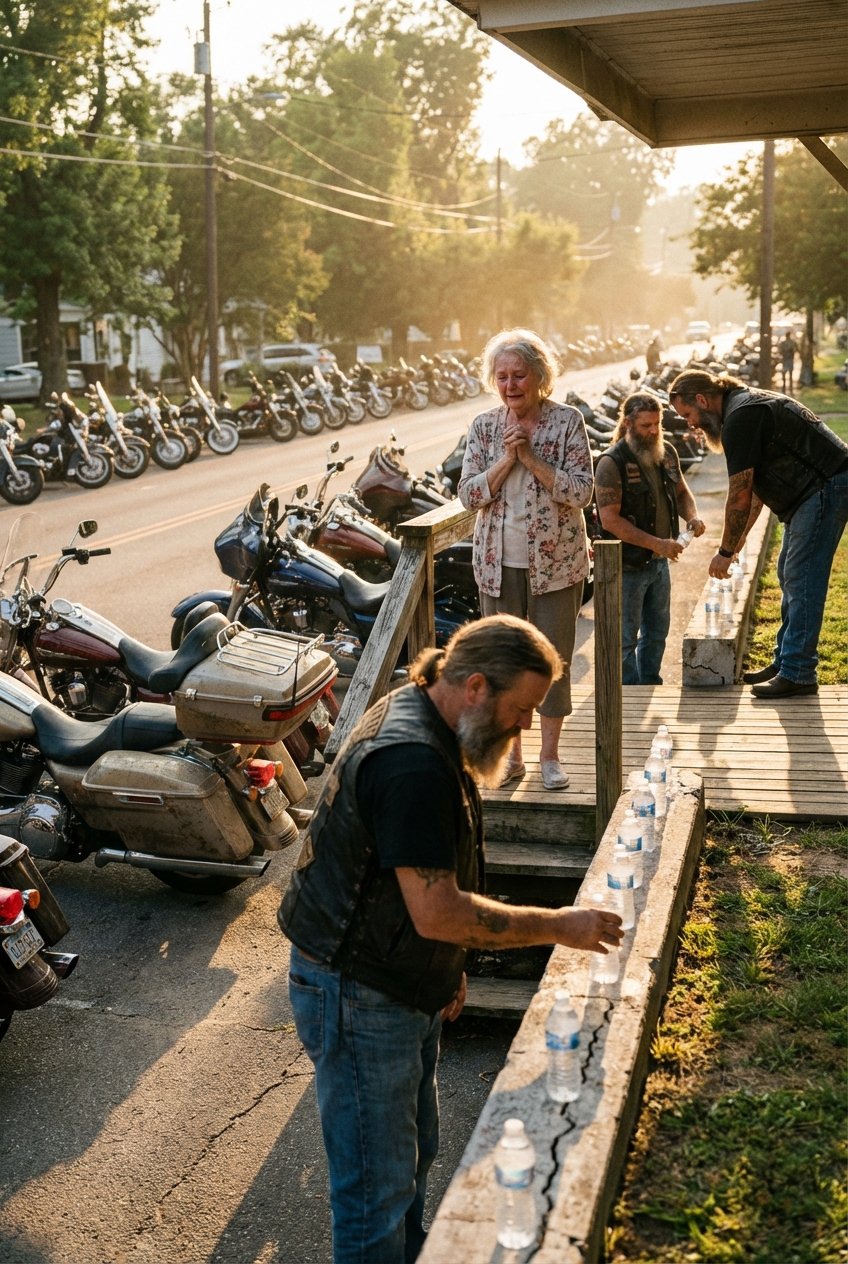
They were lined up neatly, spaced evenly apart, all sitting in the narrow band of shade created by the old laundry building. Condensation dripped slowly down their sides as the day warmed.
By noon they were gone.
The next day there were five.
Then seven.
No one ever saw who left them there.
But someone clearly had.
Across the street stood a small blue house that had probably been charming fifty years earlier but now looked tired in the way older homes sometimes do, like something that had simply outlived the energy required to keep itself bright.
The porch sagged slightly in the middle.
Wind chimes hung crooked beside the door.
And every morning, just before sunrise, a woman stepped out carrying a small white cooler.
Her name was Clara Whitaker, though none of the riders knew that for a long time.
She moved slowly but with quiet determination, as though each step required careful consideration. Her silver hair was usually pulled into a loose knot at the back of her head, and she wore the same soft gray cardigan nearly every morning regardless of the temperature.
Clara would cross the street.
Open the cooler.
And place the bottles along the concrete ledge one by one.
She always positioned them carefully so they wouldn’t roll off the uneven surface. Sometimes she adjusted them twice, making sure each bottle sat firmly in place.
Then she closed the cooler.
Turned around.
And went back inside without looking toward the road.
She never waved.
Never spoke.
Never waited around.
To the riders, she slowly became known by a nickname.
“The Water Lady.”
It wasn’t meant to be dismissive.
In fact, among the riding community, it became something closer to a badge of quiet respect.
Summer rides were brutal.
And those cold bottles had started to become something people looked forward to.
By mid-July, the heat had grown almost unbearable.
The kind of heat that made the horizon shimmer above the road and turned traffic lights into long, exhausting pauses beneath a relentless sun.
Motorcycles struggled through it.
So did people.
But every morning, without fail, the bottles appeared.
A few riders started leaving small folded bills under them.
They assumed whoever was providing the water might appreciate help covering the cost.
But every time someone returned the next day, the money was gone.
At first that seemed normal.
Then something strange happened.
One morning the money was still there.
Untouched.
The bottles were gone — riders had taken them — but the folded bills remained sitting on the ledge.
A few days later, someone left a thank-you note.
Just a scrap of paper held down by a small stone.
It disappeared by morning.
But no one ever saw Clara reading it.
Eventually, curiosity won.
One afternoon, a rider named Marcus Delgado decided he needed to say something.
Marcus had been riding for nearly thirty years and had the quiet confidence of someone who had spent most of his adult life on the road. His beard had gone mostly gray, and the leather vest he wore carried faded patches from places most people had only seen on maps.
He parked his bike across the street and waited.
Just before sunrise the next morning, Clara stepped out with her cooler.
Marcus walked slowly toward her so he wouldn’t startle her.
“Ma’am,” he said gently.
She paused, glancing up.
Her eyes were tired but kind.
“Yes?”
Marcus gestured toward the bottles she was setting on the ledge.
“I just wanted to say thank you.”
Clara blinked once as if the gratitude surprised her.
“Oh,” she said softly.
“Well… it’s hot out.”
Marcus chuckled.
“That’s true.”
She gave a small shrug.
“People get thirsty.”
Marcus hesitated.
He had expected more explanation.
But she seemed completely comfortable leaving it at that.
Still, something about her expression — the way she looked toward the road and then quickly away again — made him feel there was a story she wasn’t telling.
He nodded politely and returned to his bike.
But the brief conversation stayed with him.
August arrived like a hammer.
Temperatures climbed higher than usual that year, and the city issued multiple heat advisories warning residents to stay indoors during the afternoon.
Despite that, the bottles kept appearing.
Every single morning.
Even on days when the humidity felt so thick it was hard to breathe.
But Marcus began noticing small details that bothered him.
Clara walked slower now.
Sometimes she paused halfway across the street.
Once he saw her steady herself by placing a hand against the wall before finishing her routine.
Another morning she sat on her porch for nearly ten minutes afterward, breathing heavily.
Something wasn’t right.
Then one morning the bottles didn’t appear.
Riders slowed down as they passed the empty ledge.
A few circled back.
By noon there was still nothing.
Marcus rode over.
The small blue house looked quiet.
Too quiet.
He climbed the porch steps and knocked.
No answer.
He waited.
Knocked again.
Still nothing.
As he turned to leave, the door opened slightly.
Clara stood there wrapped in a blanket despite the heat.
Her face looked pale, almost translucent in the morning light.
“I was going to bring them,” she said quickly, before he even spoke.
“I just… couldn’t today.”
Marcus felt something twist inside his chest.
“Are you alright?”
She hesitated.
A long silence settled between them.
Then she sighed.
And said something she had clearly been holding inside for a long time.
“I have cancer.”
The words came quietly.
Almost casually.
“Stage four.”
Marcus didn’t know what to say.
Clara continued.
“They found it late,” she explained. “And by the time they did… well.”
She gave a soft shrug.
“I don’t have family anymore. My husband passed years ago. No children.”
Her voice trembled slightly.
“So I leave the water.”
Marcus frowned gently.
“Why?”
Clara looked across the street at the empty ledge.
“Because riders always looked… like they were going somewhere,” she said.
“And I liked the idea that maybe I helped someone get there.”
That evening something unusual happened on Maple Avenue.
Clara heard engines.
Dozens of them.
The sound rolled through the neighborhood like distant thunder.
She stepped onto the porch.
And froze.
Motorcycles lined the street.
At least fifty of them.
Riders stood quietly beside their bikes.
Marcus stepped forward holding a cooler.
“We talked,” he said gently.
“And we decided something.”
He placed the cooler on the ledge.
Opened it.
Inside were rows of cold bottles.
“This time,” he said softly, “we bring the water.”
Clara covered her mouth as tears filled her eyes.
From that day forward, she was never alone again.
Riders visited constantly.
They brought groceries.
Fixed her porch.
Drove her to appointments.
Sat with her during long afternoons.
And every morning, bottles appeared on the ledge.
Not from Clara.
But from them.
Months later, on a quiet autumn evening, Clara passed away in her home.
The next morning Maple Avenue was silent.
No bikes.
No bottles.
Just an empty ledge in the shade.
Then, around noon, engines returned.
Hundreds of riders came.
They placed water bottles across the entire wall.
Every inch of it.
And in the center sat a small wooden sign.
It read:
“For Clara — who gave kindness when she had nothing left to give.”
Lesson of the Story
Sometimes the smallest acts of kindness carry the deepest stories behind them. Many people quietly fight battles no one else sees, and what may look like a simple gesture can actually be someone’s way of holding onto purpose, dignity, or connection with the world. The riders thought they were receiving something from a stranger, but in truth Clara had given them something much larger — a reminder that compassion does not require wealth, strength, or even time. It only requires the willingness to care about someone else, even in the middle of one’s own hardship.
Website Disclaimer
The information provided on this website is for general informational and educational purposes only. While we strive to ensure that all content is accurate and up to date, we make no guarantees regarding the completeness, reliability, or accuracy of any information published.
The views and opinions expressed in articles belong to their respective authors and do not necessarily reflect the views of this website. Any action you take based on the information found on this website is strictly at your own risk. We will not be liable for any losses, damages, or inconveniences arising from the use of our content.
Some articles may contain opinions, third-party information, or external links. We do not endorse or guarantee the accuracy of content on external websites and are not responsible for their practices or policies.
All content on this website is provided in good faith and is intended for informational purposes only. Readers are encouraged to verify information independently and seek professional advice where appropriate.