For nearly two relentless years, Harrison Arden had not experienced what could honestly be called restful sleep, because exhaustion no longer guaranteed peace when the mind refused to loosen its grip on grief, guilt, and helpless frustration. His five year old daughter, Noelle Arden, had lived in a wheelchair ever since a violent neurological inflammation disrupted the delicate pathways connecting her brain to the muscles of her legs. The illness arrived suddenly, brutally, without warning, transforming a lively child who once raced through the halls into someone who now observed the world from seated stillness.
The Arden residence stood proudly along a quiet, tree lined street in Greenwich, Connecticut, where manicured lawns and immaculate hedges projected stability, wealth, and control. Harrison, founder of a highly successful technology logistics firm, had invested staggering sums into treatments, specialists, experimental therapies, and private consultations, yet each medical authority delivered variations of the same crushing conclusion. Improvement was uncertain. Recovery was improbable. Acceptance was essential.
On a cool autumn morning, Harrison prepared once again for another appointment at a renowned rehabilitation center in Manhattan. As his driver eased the car through the wrought iron gate, Harrison noticed a young boy standing near the entrance, his posture strangely composed for someone so small. The child appeared to be about eight years old, wearing a faded blue shirt and sneakers worn thin by miles of walking. His dark eyes were fixed not upon the car itself, but upon Noelle’s wheelchair visible through the open door.
Before the vehicle could move forward, the boy stepped closer, raising his hand politely yet confidently.
“Sir, may I speak with you for a brief moment, please?” the boy asked, his voice steady and remarkably clear.
Harrison hesitated, more surprised than irritated, then signaled for the driver to pause. He lowered the window slightly, curiosity overriding impatience.
“What is it that you want, young man?” Harrison asked, his tone restrained yet distant. “We are already running behind schedule this morning.”
The boy glanced toward Noelle, then back at Harrison with unwavering seriousness.
“I saw the little girl in the wheelchair,” he said calmly. “If you allow me, I can wash her feet, and she will walk again.”
For several seconds, silence filled the air before Harrison erupted into laughter, loud and incredulous, the reaction of a man who had spent fortunes battling reality only to be confronted with absurdity.
“That is an extraordinary claim,” Harrison replied between strained chuckles. “After consulting some of the most respected physicians in the country, you believe you can succeed where they have not?”
“It is not a trick, sir,” the boy answered gently, entirely unfazed by ridicule. “My grandmother taught me certain techniques using plants and pressure. She has helped many people in our neighborhood who struggled with pain and movement.”
Something in the boy’s expression gradually stilled Harrison’s laughter. There was no hint of desperation, no expectation of reward, only a quiet conviction that resisted dismissal.
Noelle, who had been observing silently, leaned forward with unexpected interest, her small fingers gripping the armrests.
“Daddy, who is he?” she asked softly, her voice fragile yet curious.
The boy smiled warmly, his composure softening.
“My name is Calvin Ortega,” he said kindly. “And you must be Noelle, because everyone talks about the brave girl who keeps smiling.”
Harrison’s body stiffened visibly.
“How do you know my daughter’s name?” he demanded cautiously.
Calvin shrugged lightly.
“People in town speak, sir,” he explained. “The cashier at the grocery store mentioned that the successful businessman’s daughter became ill. She said you were very sad.”
A dull ache tightened painfully within Harrison’s chest. He had believed suffering could be contained behind gates, schedules, and privacy agreements, yet grief had apparently seeped beyond his carefully guarded walls.
Noelle looked at Calvin with wide, hopeful eyes.
“Do you think he can help me, Daddy?” she asked quietly, innocence woven into every syllable.
Harrison inhaled deeply, torn between hardened skepticism and the unbearable pull of even the faintest hope. Years of disappointment had taught him caution, yet desperation has a peculiar ability to erode certainty.
“Sir,” Calvin continued gently, “you lose nothing by letting me try. I only need warm water and a few plants. If nothing changes, then nothing changes.”
Harrison remained silent for a long, conflicted moment. The engine hummed softly beneath the tension. Finally, with a voice weighted by exhaustion rather than belief, he spoke.
“Very well,” Harrison said quietly. “You may have ten minutes, but understand that I do not entertain illusions.”
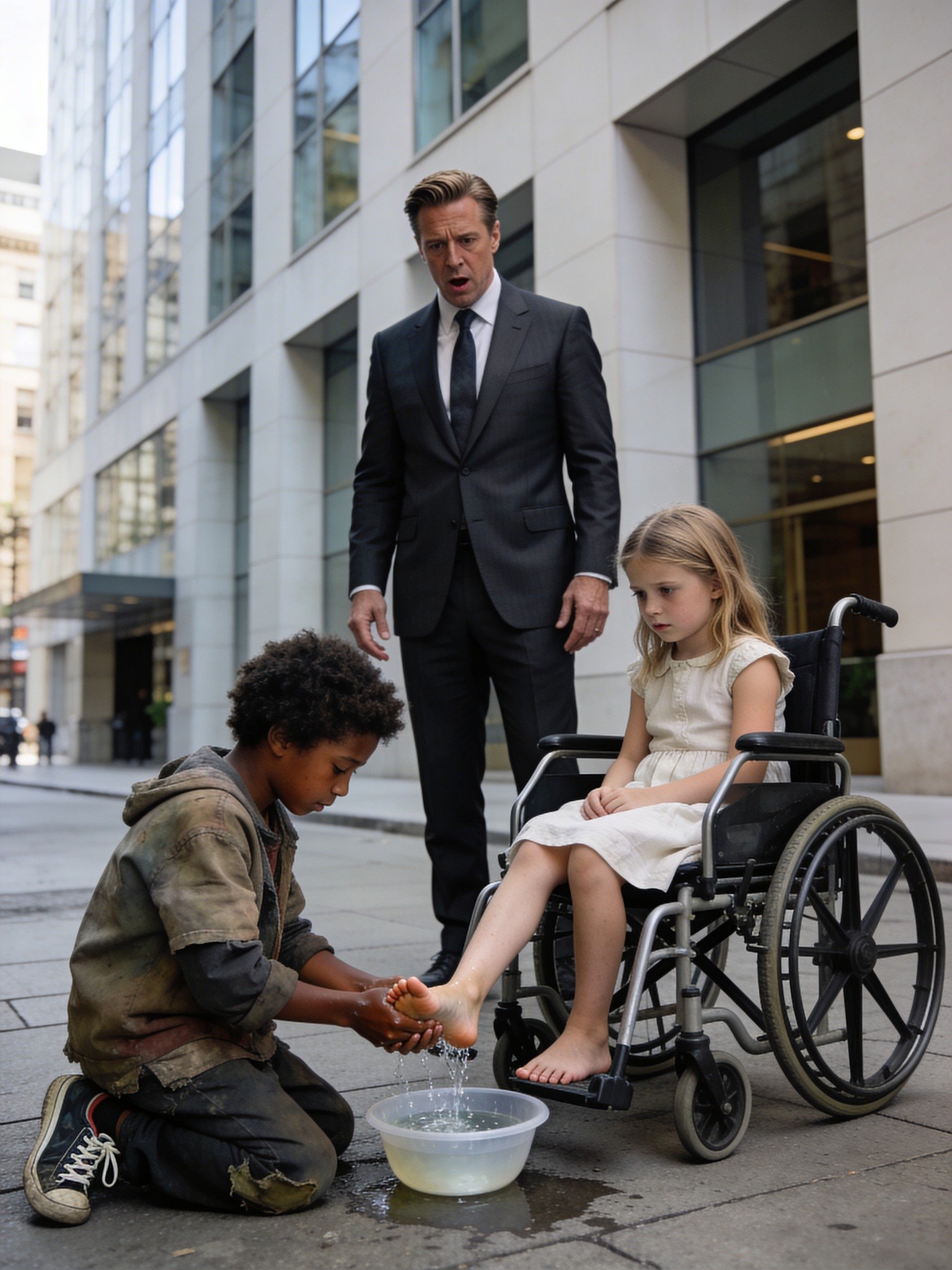
In the Arden garden, a housekeeper brought a basin of lukewarm water, her expression uncertain yet obedient. Calvin removed several dried leaves and a small root from a worn canvas pouch, rubbing them carefully between his palms before placing them gently into the water. A faint herbal fragrance drifted through the crisp morning air.
Noelle watched every movement with intense fascination rarely seen in recent months.
Calvin knelt before her with quiet respect.
“Tell me if anything feels uncomfortable,” he said softly.
Noelle nodded solemnly.
Calvin lifted her small feet into his hands, washing them slowly, applying measured, deliberate pressure along precise points. His movements carried an unexpected confidence that unsettled Harrison more than theatrics ever could. Harrison stood nearby, arms crossed tightly, waiting for disappointment, distraction, or deception.
Several minutes passed with nothing unusual occurring. Then Calvin paused.
“Noelle, please try moving your toes gently,” he instructed calmly.
Noelle concentrated, her brow furrowing with effort. Suddenly her eyes widened dramatically.
“Daddy,” she whispered. “I think something moved.”
Harrison leaned forward, breath suspended. There it was. A faint twitch, almost imperceptible, yet undeniably real.
“Try again, sweetheart,” Harrison murmured, his voice trembling uncontrollably.
This time the movement was clearer. Then both feet responded, hesitant yet obedient. Tears blurred Harrison’s vision as disbelief collided violently with fragile hope.
“This cannot be happening,” he whispered hoarsely.
Calvin remained composed, his tone gentle and reassuring.
“Sometimes the body remembers slowly,” he said quietly. “It only needs the right invitation.”
With careful guidance, Calvin helped Noelle place her feet upon the grass. She trembled slightly, yet her expression radiated astonished joy.
“Daddy,” she said breathlessly. “I can feel the ground.”
Harrison sank to his knees, overwhelmed by emotion too vast for language, his hands gripping his daughter’s as though anchoring reality itself.
“Calvin,” Harrison asked softly, voice breaking. “Who are you truly?”
Calvin offered a small, serene smile.
“I am simply someone who listened,” he replied gently. “My grandmother always said that feet remember paths long after fear forgets them.”
Harrison gazed upward at the pale Connecticut sky, his chest swelling with something he had not dared feel for years. He did not know whether Noelle would walk fully again. He did not understand what had just occurred.
But he knew with absolute certainty that the impossible, however briefly, had drawn breath that morning.
Website Disclaimer
The information provided on this website is for general informational and educational purposes only. While we strive to ensure that all content is accurate and up to date, we make no guarantees regarding the completeness, reliability, or accuracy of any information published.
The views and opinions expressed in articles belong to their respective authors and do not necessarily reflect the views of this website. Any action you take based on the information found on this website is strictly at your own risk. We will not be liable for any losses, damages, or inconveniences arising from the use of our content.
Some articles may contain opinions, third-party information, or external links. We do not endorse or guarantee the accuracy of content on external websites and are not responsible for their practices or policies.
All content on this website is provided in good faith and is intended for informational purposes only. Readers are encouraged to verify information independently and seek professional advice where appropriate.