Lena Whitaker’s hands shook so badly she could barely keep them steady on the steering wheel.
The narrow Alabama back roads blurred past her headlights as she drove faster than she ever had before, her heart hammering against her ribs. Every breath felt too shallow, too fast.
In the back seat, six-year-old Mila sat unnaturally still.
Tears slid silently down the child’s cheeks, catching the glow of passing streetlights. She hadn’t spoken a word in over three hours—not a sob, not a question, not even a whimper.
“Baby… please,” Lena begged softly, glancing into the rearview mirror. “Talk to Mommy. Tell me what hurts.”
Nothing.
Mila just stared straight ahead, her small body rigid, her hands clenched in her lap.
It had started the moment Mila returned from her weekend with her father.
Normally, Mila burst through the door with stories and laughter. This time, she’d stepped inside slowly, almost sideways, as if bracing herself. When Lena tried to hug her, the little girl had flinched—actually recoiled.
That was when fear first crept in.
At first, Lena told herself Mila was just tired. Weekends with Evan, her ex-husband, were chaotic. He loved Mila, but routines weren’t his strength. So Lena made Mila’s favorite dinner, ran a warm bath, and tried to ease her back into normal life.
That’s when everything shattered.
“Come on, sweetheart,” Lena had said gently, reaching to help Mila into the tub.
The scream that came out of her daughter wasn’t normal.
It wasn’t fear. It wasn’t fussiness.
It was pain—raw, desperate pain that made Lena’s blood run cold.
Mila refused to sit, refused to bend, shaking silently as tears poured down her face. When Lena tried to help her into the car seat, the child cried out again, panicked, so Lena let her kneel awkwardly, half-standing, whatever position didn’t hurt.
Now, racing toward County General Hospital, Lena’s mind spiraled.
Did she fall?
Did something happen this weekend?
Why won’t she tell me?
And beneath it all, a darker question whispered:
What if something really bad happened?
Lena called Evan.
Voicemail.
Again.
Voicemail.
“Pick up,” she whispered desperately. “Please.”
In the back seat, Mila finally made a sound—a faint whimper.
“We’re almost there, baby,” Lena said, pressing the gas harder. “I promise. Mommy’s got you.”
The hospital lights appeared like salvation.
Lena barely put the car in park before jumping out, rushing around to Mila’s door. As she lifted her daughter into her arms, Mila’s eyes fluttered shut.
“No—no—help!” Lena screamed, running through the automatic doors. “My daughter won’t wake up!”
Everything moved at once after that.
Doctors. Nurses. A gurney.
“I don’t know what happened,” Lena sobbed as they took Mila from her. “She couldn’t sit down. She wouldn’t talk. Her father won’t answer his phone.”
Then the doors closed, and Lena was left alone.
She sat in a small room smelling of disinfectant and stale coffee, filling out forms with trembling hands. Ten minutes later, a gray-haired doctor entered.
“I’m Dr. Harris,” he said calmly. “Your daughter is stable. But I need to ask you some questions.”
Where had Mila been?
Who was with her?
Had she complained of pain before?
When Lena mentioned the weekend with her father, the doctor’s expression shifted—subtle, but unmistakable.
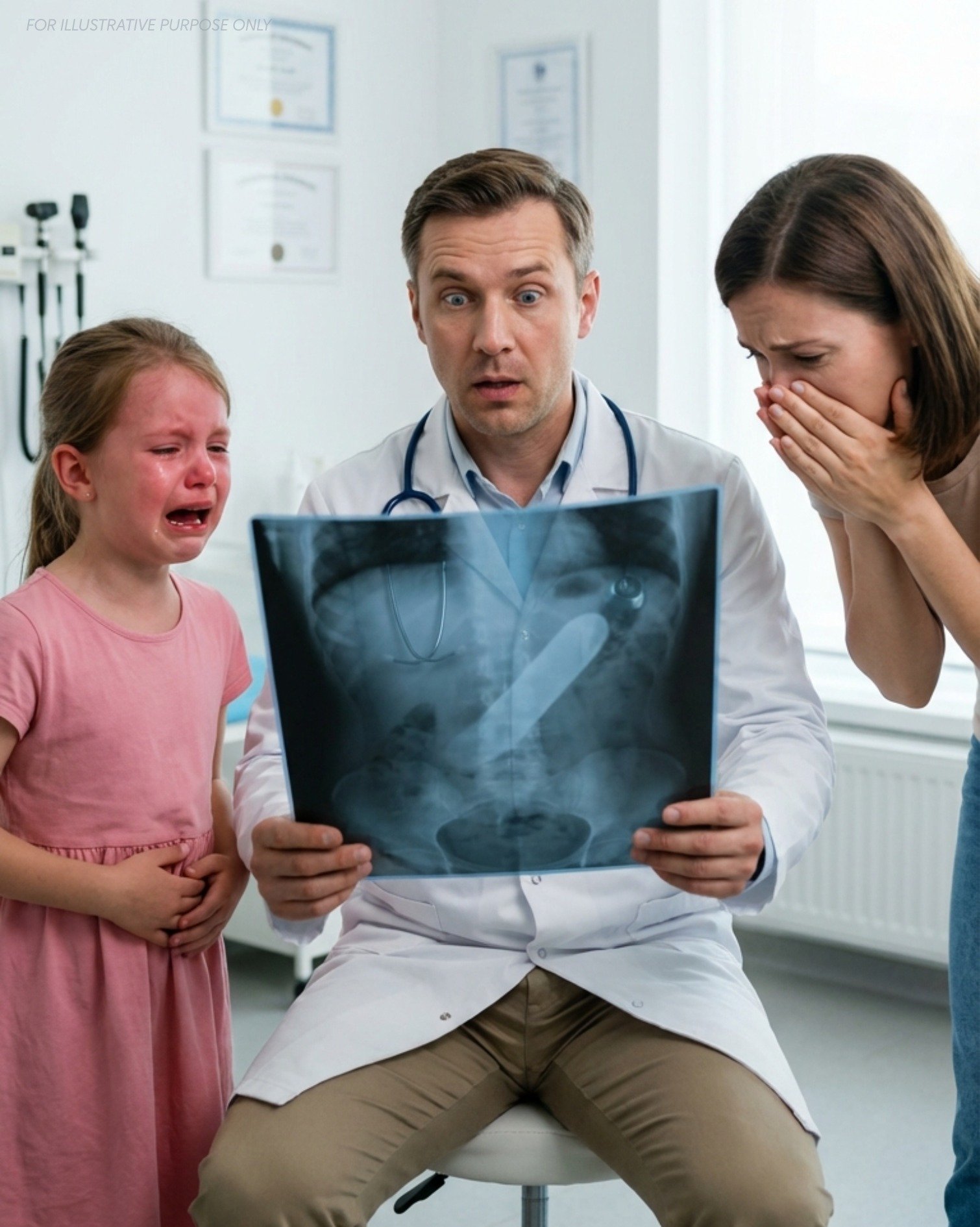
Moments later, Lena saw him reviewing X-rays under harsh light. His jaw tightened. He made a phone call, speaking quietly but urgently.
“I need additional support here,” he said. “Yes… and notify law enforcement.”
The word law enforcement made Lena’s knees weak.
Twenty minutes later, two officers entered the waiting room.
Detective Rachel Monroe spoke gently but firmly. “We need to ask you a few questions, Ms. Whitaker.”
“Why are the police here?” Lena demanded. “What’s wrong with my daughter?”
“We’re still determining that,” the detective said. “But the imaging shows something inside Mila’s body that shouldn’t be there.”
The room tilted.
“Inside her?” Lena whispered. “Like… she swallowed something?”
“This isn’t typical,” Monroe said carefully. “The location raises concerns.”
Lena’s phone finally rang.
Evan.
“What happened?” he asked, panicked.
“The police are here,” Lena said, her voice shaking. “They think something happened to Mila.”
Before Evan could respond, Detective Monroe took the phone.
“Mr. Carter,” she said firmly, “officers are on their way to speak with you. Please remain where you are.”
After the call ended, Lena broke.
“You think he did this,” she said. “You think I did this.”
“We’re investigating everyone,” Monroe replied. “That includes you.”
The next twelve hours blurred together—interviews, waiting rooms, whispered conversations behind closed doors.
Then everything changed.
A pediatric specialist, Dr. Elaine Porter, requested a second review. She asked strange questions.
“Does Mila ever eat things that aren’t food?”
Lena frowned. “What?”
“Paper. Chalk. Erasers. Small objects.”
A memory flickered.
The pink eraser. Mila chewing it like gum months ago.
“I thought it was just a phase,” Lena whispered.
Dr. Porter listened carefully. So did Evan, who admitted he’d once caught Mila chewing on a crayon.
By morning, they were going through old photos and videos together.
Birthday parties. Holidays. Park outings.
And there it was.
Mila, at four years old, slipping chalk into her mouth when she thought no one was watching.
Another video—wrapping paper.
Another—small stones tucked into her pocket.
They hadn’t seen it.
Or maybe they hadn’t wanted to.
Dr. Porter laid out the truth gently.
“Mila isn’t being harmed by anyone else,” she said. “She has a condition called pica—a compulsive disorder where children crave non-food items. It’s often linked to mineral deficiencies and stress.”
The object found inside Mila had been ingested days earlier—while she was at home.
Lena felt crushed by guilt.
“I failed her,” she whispered.
“No,” Dr. Porter said softly. “You missed something incredibly hard to detect. That doesn’t make you a bad mother. It makes you human.”
Child Protective Services paused their case.
The police closed the investigation.
And for the first time in days, Lena and Evan stood together, united by one goal:
Getting their daughter healthy—and bringing her home.
The road ahead would be long.
But this time, they were finally looking in the right direction.
Website Disclaimer
The information provided on this website is for general informational and educational purposes only. While we strive to ensure that all content is accurate and up to date, we make no guarantees regarding the completeness, reliability, or accuracy of any information published.
The views and opinions expressed in articles belong to their respective authors and do not necessarily reflect the views of this website. Any action you take based on the information found on this website is strictly at your own risk. We will not be liable for any losses, damages, or inconveniences arising from the use of our content.
Some articles may contain opinions, third-party information, or external links. We do not endorse or guarantee the accuracy of content on external websites and are not responsible for their practices or policies.
All content on this website is provided in good faith and is intended for informational purposes only. Readers are encouraged to verify information independently and seek professional advice where appropriate.