The scream came from somewhere deep in the building, sharp and panicked, the kind of sound that makes your body react before your mind has time to catch up. It echoed down the polished hallway of Oakridge Academy and lodged itself in my chest like a shard of glass.
I would hear that scream for the rest of my life.
Not because I failed to stop it in time, but because I had trusted the wrong people for far too long.
My name is Elena Vance. In courtrooms across the country, my name carries weight. Attorneys straighten their backs when I enter. Defendants go quiet. I am a federal judge, the kind who writes opinions that are cited for decades, the kind who dismantles corruption methodically, without raising her voice.
But at three thirty every weekday afternoon, none of that mattered.
At three thirty, I was just Sophie’s mom.
I parked in the pickup lane with the rest of the parents, gripping my steering wheel while children poured out of the stone entrance of Oakridge Academy. The school looked like something out of a brochure. Ivy climbing up pale brick walls. Tall arched windows. A flag snapping crisply in the breeze. Every detail whispered prestige and money and certainty.
For two years, I believed I had chosen the best place for my daughter.
I believed wrong.
By day, I wore black robes and issued rulings that made national headlines. By afternoon, I slipped into soft cardigans and sensible shoes, careful to dull every sharp edge of myself. I spoke gently. I smiled politely. I never corrected anyone when they assumed I was just another struggling single mother trying to keep up.
That disguise had been deliberate.
I wanted Sophie to be normal. I wanted her friendships to be real, not filtered through fear or advantage. I wanted teachers to see her for who she was, not as an extension of my authority. So I kept my professional life invisible.
At Oakridge, invisibility was a mistake.
Sophie knew I was a judge. She was proud of it in the quiet way children are proud of things they do not fully understand. But no one else did. To them, I was Mrs. Vance. The woman who drove a modest SUV instead of a luxury sedan. The mother who never chaired fundraisers or hosted wine tastings. The parent who did not belong to the unspoken inner circle.
Oakridge Academy claimed to shape future leaders. What it really taught was hierarchy.
The tuition alone could have paid for a small house. The parents wore wealth like armor. Last names mattered. Donations mattered more. The children absorbed those lessons quickly, even when no one spoke them aloud.
I had enrolled Sophie for academics, not status. She was brilliant. Curious in a way that startled adults. She read voraciously, asked relentless questions, solved puzzles meant for kids twice her age. I wanted her challenged, surrounded by minds that could keep up with her own.
Instead, I watched her fade.
At first it was subtle. She stopped talking about school at dinner. Then came the mornings when she clung to my leg, begging to stay home. Nightmares followed. Sudden flinches at loud sounds. A quiet sadness that did not belong in an eight year old’s eyes.
I told myself it was a phase.
I should have known better.
During our last parent conference, Principal Halloway sat across from me behind a wide mahogany desk, sunlight glinting off his cufflinks. His office smelled faintly of expensive cologne and old books.
“Mrs. Vance,” he said, folding his hands together, “we have concerns.”
My stomach tightened.
“Sophie seems disengaged,” he continued, his tone practiced and smooth. “She struggles to keep pace with our curriculum. Frankly, she may be slow for an institution like Oakridge.”
The word landed like a slap.
Slow.
I stared at him, my judicial instincts screaming in protest, but I stayed silent. I wore my civilian face. I nodded as though he were the expert.
“Perhaps an evaluation is in order,” he went on. “Or outside tutoring. We have standards here. We cannot allow one child’s limitations to affect the classroom dynamic.”
I sat there in my cardigan and listened while he reduced my daughter to a liability.
I should have pushed back. I should have demanded data, documentation, accountability. I had dismantled arguments far more sophisticated than his.
Instead, I thanked him for his time.
That was the moment I failed her.
The truth began to surface on a Tuesday afternoon.
I was at my kitchen table reviewing briefs for a federal case when my phone vibrated. The message was from Sarah Martinez, one of the few parents at Oakridge who spoke to me without calculation.
Elena. Come to the school now. I’m volunteering in the East Wing. I heard screaming near the janitor closets. I think it’s Sophie. Something is wrong.
The room tilted.
I read the message again, then a third time, my mind snapping into a cold, focused clarity that had served me well on the bench.
I grabbed my keys and drove.
As I pulled into the fire lane, I forced myself to slow down. Panic would help no one. If something was happening, I needed proof. Institutions like Oakridge did not fall on emotion. They fell on evidence.
The East Wing was quiet in the way abandoned places are quiet. Fluorescent lights buzzed overhead. The air smelled of dust and cleaning solution. My footsteps echoed too loudly.
Then I heard a voice.
“Stop crying.”
It was sharp, furious.
“You’re pathetic,” the voice continued. “This is why nobody wants you.”
My breath caught. I recognized the voice immediately.
Mrs. Gable.
Sophie’s homeroom teacher. Award winning. Beloved. Praised endlessly for her discipline and results.
I moved closer, my heart hammering.
“You’re stupid,” Gable spat. “Too stupid to learn. Too stupid to behave.”
A sound followed that made my knees weaken. A crack. Flesh against flesh.
I pressed myself against the wall beside the supply closet door and raised my phone, angling it through the narrow window. My hands were steady. My heart was not.
Inside, Sophie was curled into herself on the floor, surrounded by mops and buckets and chemical bottles. Her small body shook as she cried. Mrs. Gable loomed over her, fingers digging into Sophie’s arm hard enough to leave marks.
“You will stay here,” Gable said, her voice low and vicious, “until you learn how to act like a human being. And if you tell anyone, I will fail you. I will make sure you never succeed. Do you understand?”
Sophie nodded frantically, terror flooding her face.
I saved the recording.
Then I kicked the door open.
The lock shattered. The door flew wide. I stepped into that closet with a fury I had never allowed myself to feel in court.
Mrs. Gable jumped back, smoothing her skirt as if muscle memory could save her.
“Mrs. Vance,” she said brightly. “Sophie was having an episode. I was helping her calm down.”
I did not answer.
I crossed the room and gathered my daughter into my arms. She was trembling, her cheek red, her arm already bruising. She pressed her face into my neck and whispered, “I’m sorry, Mommy. I tried. I’m just dumb.”
Something inside me broke cleanly in half.
“This is abuse,” I said quietly.
“Discipline,” Gable corrected, crossing her arms. “Your daughter has behavioral issues.”
“Move,” I said.
She hesitated, then stepped aside.
We did not make it far.
Principal Halloway intercepted us in the corridor, flanked by a security guard. His face was calm, controlled.
“Mrs. Vance,” he said, “let’s discuss this in my office.”
“I’m taking my daughter home,” I replied. “I’m calling the police.”
His smile thinned.
“If you leave without authorization,” he said smoothly, “we may have to involve Child Protective Services. Sophie’s behavior suggests instability at home.”
The threat was clear.
I followed him.
In his office, Sophie sat quietly with my phone while Halloway and Mrs. Gable positioned themselves like judges passing sentence.
I played the video.
Halloway watched without visible reaction. When it ended, he leaned back and sighed.
“Context matters,” he said. “Mrs. Gable’s methods are effective. Your daughter is difficult.”
“Delete the video,” he added.
I stared at him.
He leaned forward. “If you release this, we will expel Sophie. We will ensure her record follows her. No private school will touch her. Do you understand how this works?”
Mrs. Gable smiled faintly. “Who will they believe? You or us?”
I stood slowly, lifting Sophie into my arms.
“So that’s your final word,” I said. “You’re threatening my child’s future to hide abuse.”
“Yes,” Halloway said calmly. “And before you call anyone, know this. The police chief sits on our board.”
I nodded once.
“Good,” I said. “He’ll be named too.”
He frowned. “Named in what?”
I looked at him, really looked at him, and felt something settle into place.
“Federal court,” I said.
And I walked out.
Three days later, the federal courthouse felt different.
I noticed it the moment I stepped through the revolving doors. There was a low hum in the air, a tension that seasoned reporters and veteran clerks recognized instinctively. Something was coming. Something that would ripple outward.
I moved through security without ceremony, my heels clicking softly against marble floors polished by a century of consequence. My robe waited for me in chambers, but I did not put it on. Not yet. Today, I needed to be seen first as a mother who had been pushed too far.
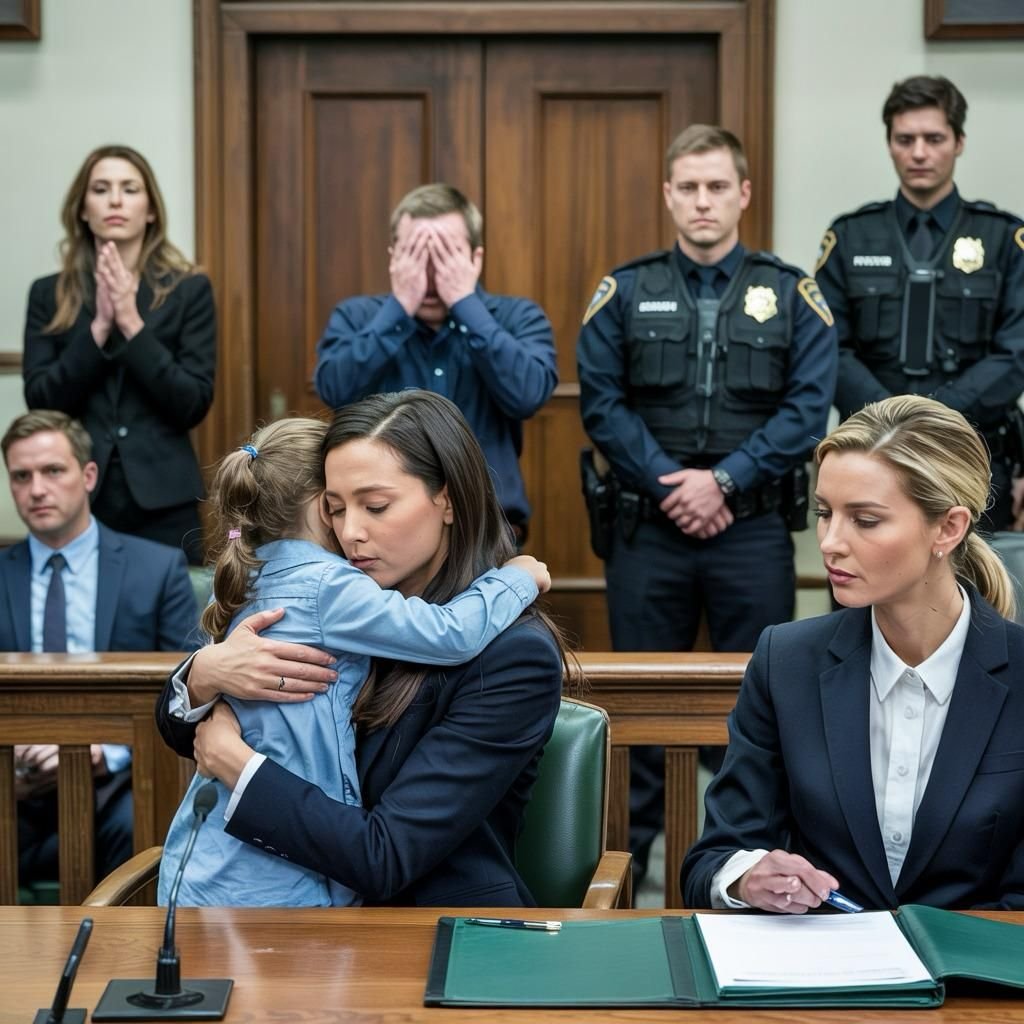
Inside the courtroom, the gallery was already filling. Reporters whispered to one another, notebooks poised. Camera lenses tracked every movement. Oakridge Academy had resources, influence, and a reputation that insulated it from ordinary scrutiny. But scrutiny had arrived anyway.
At the defense table, Principal Halloway sat stiffly in an expensive suit, irritation etched into his face. Mrs. Gable sat beside him, her hands clasped too tightly, knuckles pale. Their legal team took up most of the table space, three attorneys whose confidence radiated from years of winning through attrition and intimidation.
They did not see me yet.
I took my seat at the plaintiff’s table. Arthur Penhaligon settled in beside me, his presence alone enough to draw curious looks from the press. A district attorney did not appear at routine civil hearings unless something far more serious loomed.
Halloway leaned toward his lawyer, voice low but sharp. “Let’s end this quickly. She’s probably representing herself.”
His attorney nodded, distracted, already scanning filings with a faint frown.
“All rise.”
The courtroom stood as Judge Marcus Sterling entered. His expression was severe, his posture unyielding. He took his seat and surveyed the room with practiced efficiency.
“Case number 2024 CV 1847,” he read. “Vance versus Oakridge Academy et al.”
His eyes moved first to the defense.
Then to me.
His posture shifted subtly, almost imperceptibly, but everyone who knew him noticed.
“Good morning, Justice Vance,” he said evenly. “I see you have brought District Attorney Penhaligon.”
The room froze.
The silence was physical, pressing against skin and bone. Somewhere in the gallery, a pen slipped from nervous fingers and clattered to the floor.
Halloway turned slowly, confusion giving way to something far more fragile. Fear.
“Justice?” he whispered.
One of his attorneys went rigid. Recognition flooded his face, followed by pure, unfiltered dread. “Elena Vance,” he muttered. “Federal Circuit.”
Mrs. Gable’s breath hitched.
I met Halloway’s gaze at last. There was no anger in my expression now. Only clarity.
“I told you I knew enough about the law,” I said quietly. “I did not say how well.”
Arthur rose.
“Your Honor,” he began, voice steady, “based on evidence submitted by Justice Vance and corroborated by our investigation, the state is filing criminal charges.”
Mrs. Gable made a small sound, something between a gasp and a whimper.
“Felony child abuse,” Arthur continued. “Aggravated battery. Criminal confinement.”
The words fell one by one, heavy and final.
“And against Principal Halloway,” Arthur said, “we are filing charges of extortion, conspiracy, obstruction of justice, witness tampering, and operation of a criminal enterprise.”
One of the defense attorneys half stood. “Your Honor, this is a civil matter.”
Judge Sterling did not raise his voice.
“Not anymore,” he said. “The court finds probable cause.”
He turned to the bailiff. “Do not allow the defendants to leave.”
Federal marshals moved in with practiced efficiency.
Halloway’s composure collapsed. His face drained of color as reality closed in. He looked toward the back of the courtroom, where the police chief sat rigid, eyes fixed firmly on the floor.
Connections meant nothing now.
As Mrs. Gable was led past me in handcuffs, she glared with raw hatred.
“You ruined my life,” she hissed.
“You did that yourself,” I replied.
Halloway was worse. He begged. He offered scholarships, donations, favors he could no longer deliver.
“My daughter doesn’t need your institution,” I told him as the cuffs snapped shut. “She needed protection.”
The investigation that followed was swift and merciless.
Families came forward. Quiet stories spilled out at last. Children locked in closets. Bruises explained away. Parents threatened with expulsion and blacklisting if they spoke.
Oakridge’s board dissolved itself in panic. Donations evaporated. The school declared bankruptcy within weeks. Its gates closed permanently.
Mrs. Gable accepted a plea deal. Prison. A lifetime ban from working with children.
Halloway was sentenced to seven years.
Justice, when it arrived, arrived fully.
One year later, I stood outside a public school building with peeling paint and cheerful murals. Sophie skipped ahead of me, laughter bright and unguarded.
“Bye, Mom,” she called, already disappearing into a crowd of children who did not measure worth by last names or balance sheets.
I watched until she was gone.
Then I turned back toward my car, toward my robe, toward the work that waited.
Somewhere between cardigans and courtrooms, I had learned the most important truth of all.
Power hides best where it is least expected.
And justice is most devastating when it comes as a surprise.
After the Oakridge hearings, strangers began to stop me in courthouse corridors and grocery store aisles, their voices lowered as if speaking too loudly might summon the same kind of cruelty into their own lives.
Some were parents. Some were teachers. Some were simply people who had read the headline and felt the familiar, helpless anger that rises when you learn a child was harmed in a place that was supposed to keep them safe.
They asked the same question in different ways.
Why didn’t you tell them who you were?
Sometimes it came wrapped in admiration, sometimes in disbelief, sometimes in accusation. As if there had been an easy lever to pull all along, and I had refused to pull it out of stubbornness or pride.
I never had a neat answer prepared. The truth was not neat.
The first time someone asked, I was standing outside Roosevelt Elementary at dismissal, watching Sophie spill out with the other children, her backpack bouncing against her shoulders. The sun was low, turning the windows into sheets of copper. The air smelled like cut grass and sidewalk chalk. Parents talked in small clusters, not performing for one another, just existing.
Sophie spotted me and ran, face bright, cheeks flushed from play.
“Mom!” she called, as if the word itself was a promise.
I crouched instinctively, arms open. She collided with me and I caught her, laughing as her hair tickled my chin. She smelled like pencil shavings and apples and the faintly sweet soap the school used in the bathrooms.
“How was your day?” I asked.
“Good,” she said without hesitation. Then, as if remembering something important, she leaned in closer. “Ms. Rodriguez said my story had the best ending.”
“You wrote a story?” I asked, and I felt a quiet thrill in my chest, the kind that comes when you realize a child’s imagination is breathing freely again.
Sophie nodded, eyes wide. “It was about a dragon who thought he was scary, but he was just lonely, so the town made him a garden.”
“That’s a very good ending,” I said, and meant it.
She squeezed my hand, sticky with something she had eaten too fast. “Can we go get hot chocolate?”
“We can,” I told her. “With extra marshmallows.”
She cheered softly, then began skipping beside me, the motion loose and natural. No flinch at a slamming car door. No panicked glance down the sidewalk. No tightness in her shoulders like she was bracing for a blow that might come from anywhere.
A mother nearby recognized me. I saw it happen in her face, the way recognition changes posture. She approached slowly, careful, as if she didn’t want to startle something fragile.
“Justice Vance,” she said.
I turned to her, polite but guarded. I had learned, in the months since Oakridge, to pay attention to tone. Some people wanted to see a hero. Others wanted to see a spectacle.
“I’m just Elena,” I said.
Her eyes flicked to Sophie, then back to me. “I read everything. I’m so sorry.” Her voice shook with contained emotion. “I just… I don’t understand why you didn’t go in there as a judge from the beginning. Wouldn’t that have stopped it?”
Sophie was now a few steps ahead, humming to herself, dragging the toe of her sneaker along the sidewalk in a lazy line. She looked small against the wide sky.
I watched her for a moment before answering.
“If I’d walked in as a judge,” I said, “they would have behaved like people being observed. Like people being graded. They would have put on the version of themselves they show when consequences are certain.”
The woman frowned slightly, as if trying to fit the idea into something she recognized.
“But Sophie would still have been surrounded by them,” I continued, my voice quieter now. “And the moment my back was turned, they would have gone right back to who they really were. Only they would have learned to hide it better.”
The woman’s mouth parted, then closed. The air between us filled with the hum of traffic and distant laughter.
I did not tell her the other truth, the one I rarely spoke aloud because it sat in my throat like a stone.
I had been afraid.
Not of them. Not really.
I had been afraid of the way power changes people’s gaze. Afraid that if they knew who I was, Sophie would be treated like a fragile object instead of a child. Afraid she would become a symbol, a story, a cautionary tale. Afraid that every friendship would be measured for usefulness.
So I had chosen secrecy. And in doing so, I had given Oakridge exactly what it needed: a mother it could underestimate.
Power announces itself in a hundred ways. In a ring that glints at a fundraiser. In the casual drop of a last name. In the assumption that rules will bend. Oakridge did not need my résumé to harm children. It needed only the belief that no one important would stop it.
When Halloway threatened to blacklist Sophie, his certainty was almost serene. He did not think he was doing something monstrous. He thought he was preserving order. He thought he was protecting an institution built to serve families like his.
That kind of certainty is one of the most dangerous things in the world.
After the arrests, the details came out in waves, each more nauseating than the last. The federal investigators moved through Oakridge like light through a darkened room, revealing corners that had been kept carefully shadowed.
Families who had left quietly, who had changed schools in the middle of the year with vague explanations, began to speak. Some of them cried in interview rooms. Some stared straight ahead with the flat calm of people who had learned not to expect anyone to help. Several parents confessed they had signed non disclosure agreements without truly understanding what they were signing, only that refusal would mean retaliation. A few admitted they had believed their children were exaggerating, because a teacher’s word had carried more weight than a child’s fear.
It was not one cruel classroom. It was a system. It had been designed that way.
Children were isolated, punished where no one would see, then told they were to blame. Parents were pressured, warned, threatened with permanent marks on a record that Oakridge treated like a branding iron. A century of reputation had been used like a shield, not for education, but for protection from consequence.
The board moved quickly when the evidence became undeniable. Statements were issued. Consultants were hired. Resignations piled up like papers in a storm. Police Chief Miller quietly stepped down from his board role, his face too often caught in photos in the back of the courtroom, looking older every time a camera found him.
Oakridge’s donors fled. The parents who had once worn the school’s crest like a badge now acted as if they had never heard of it. The gates closed. The final day was almost surreal, a procession of families carrying boxes of belongings through the same doors they had once entered with pride. A few teachers stood outside, crying. Others avoided the cameras, heads down, as if shame could be escaped by refusing to be seen.
I visited the building once after it was emptied. It was a gray afternoon, light thin as paper. The courtyard fountain was turned off, the basin lined with dead leaves. Inside, the hallways smelled of stale air and floor polish. My footsteps echoed. I walked past framed photographs of graduating classes, rows of smiling faces preserved in time, unaware of what the adults around them had been doing behind closed doors.
I did not go to the East Wing. I did not need to.
Sophie did not ask to see it again, either. She was already turning her gaze toward places that felt safer, warmer, alive.
Healing was not sudden. It did not arrive with a gavel strike.
In the weeks after Oakridge, Sophie startled easily. She slept with a small lamp on. She clung to me in public spaces, her fingers twisting into the fabric of my sleeve as if anchoring herself. Once, at the grocery store, a man’s raised voice in the next aisle made her freeze so completely that I had to kneel and bring her back with quiet words and slow breathing.
At night, I would sit on the edge of her bed and stroke her hair until her eyelids fluttered closed. Sometimes she asked questions in the dark.
“Am I really smart?” she whispered once, voice barely audible.
I swallowed hard. “Yes.”
“Even if I mess up?”
“Yes.”
She breathed out shakily. “Mrs. Gable said my brain was broken.”
I felt my jaw tighten, heat rushing up my neck. I kept my voice soft, because Sophie did not need my rage. She needed my steadiness.
“Your brain is not broken,” I said. “Your brain is yours. It works the way it works. It asks questions. It makes stories. It notices things. That’s a good brain.”
There was a pause. Then, quieter, “She said Daddy left because I’m bad.”
My chest ached in a way I could not put into words. I held Sophie’s hand in both of mine, feeling the small bones and warmth.
“Your father left because of choices he made,” I told her. “Not because of you. Never because of you.”
She didn’t respond right away, but her fingers loosened slightly. A tiny release. A tiny shift.
Little by little, the nightmares retreated. The flinching eased. Her laughter returned in sudden bursts, startling at first, as if she wasn’t sure she was allowed to make that much joy.
Roosevelt Elementary helped. It was not perfect. It did not have stone arches or glossy brochures. But it had something Oakridge never did. It had adults who saw children as people, not as investments.
Ms. Rodriguez met Sophie at the door every morning with the same steady smile. She spoke to Sophie as if her thoughts mattered. When Sophie struggled with a concept, Ms. Rodriguez did not punish her for it. She tried another way. Then another. She treated learning like a door you opened together, not a gate you locked to prove who deserved entry.
The first time Sophie raised her hand in class again, Ms. Rodriguez emailed me that evening.
Sophie shared an idea today. She looked nervous at first, but she did it. I’m proud of her.
I read the message three times, my vision blurring.
In court, I had watched hardened men weep when sentenced. I had watched families break apart and rebuild. I had watched justice land like thunder. But the simple fact of my child raising her hand again felt like the purest victory I had ever witnessed.
A year after Oakridge collapsed, the building reopened under different ownership and a different purpose. The city partnered with community organizations. The polished arrogance was stripped away. The classrooms were repainted. The heavy doors were opened wide.
It became a community center.
On the day it opened, Sophie and I drove past slowly. The old crest had been removed. In its place, above the entrance, clean letters read: A Place for Everyone.
Sophie craned her neck to read it, then leaned back in her seat.
“That’s better,” she said simply.
I parked and we walked in. The lobby, once hushed and intimidating, was now bright with noise. Kids chased one another toward after school programs. A volunteer handed out flyers for tutoring sessions and music lessons. Someone had hung paper lanterns that swayed gently in the air conditioning, turning the light soft and warm.
Sophie stood near the doorway for a moment, taking it all in, and I watched her face. Not fear. Not dread. Just cautious curiosity.
She reached for my hand.
We walked farther in together.
In the months that followed, Oakridge became a case study. Law schools assigned it not because it was sensational, but because it was instructive. It was a map of how institutions protect themselves and how they fracture when someone insists on evidence, insists on procedure, insists on light.
I returned to the bench with a new kind of vigilance. I had always cared about the vulnerable, but now I carried a particular attentiveness to the language of power, the subtle turns of phrase that hide harm behind “policy” and “standards.” I listened for the way adults talked about children, about women, about anyone they deemed inconvenient.
And every afternoon, at three thirty, I returned to the pickup line again. Cardigan, soft voice, familiar smile.
The two lives were still there, still separate in the eyes of strangers. But inside me, something had fused. I no longer believed there was a clean boundary between who I was in court and who I was at home.
Both roles required the same thing.
To see what was real.
To name it.
To act.
There were nights, after Sophie fell asleep, when I sat alone at my kitchen table and let the memories come. The closet. The slap. The way Sophie’s voice had sounded when she apologized for being “dumb.” The calm on Halloway’s face when he threatened to ruin her future.
I would sit with it until the ache dulled, until my breathing slowed, until the present became solid again.
Sometimes, the anger still flared, sharp and hot, and I let it. Not because it controlled me, but because it reminded me what love looks like when it has teeth.
People like to believe monsters are obvious. That cruelty wears a snarl, that abuse announces itself with drama. Oakridge taught me otherwise.
Sometimes monsters wear awards. Sometimes they speak in gentle tones about discipline and excellence. Sometimes they hide behind institutions built to inspire trust.
Sometimes the only way to catch them is to let them believe you are small.
To let them assume you have no leverage, no reach, no voice that matters.
And then, when they finally show you who they are, to become exactly what they feared you were not.
Justice delayed can feel unbearable. But justice delivered at the moment the corrupt believe they are safe does something else. It does not just punish. It exposes.
It teaches.
It frees the next child.
On a cold morning near the end of autumn, Sophie stood at the kitchen counter stirring cocoa powder into warm milk, tongue sticking out in concentration. The radio murmured softly in the background. Sunlight spilled across the tiles in pale rectangles.
She glanced up at me.
“Mom?”
“Yes, sweetheart?”
“Do you think Mrs. Gable is still mad at you?”
I paused, measuring my answer the way I measured words in court, not because Sophie needed legal precision, but because she deserved honesty without burden.
“I think she’s mad she got caught,” I said.
Sophie nodded slowly, accepting it in the simple way children sometimes accept truths adults complicate.
Then she said, “I’m glad you caught her.”
I walked over and kissed the top of her head. Her hair was still damp from the shower, smelling like strawberries.
“So am I,” I whispered.
She returned to stirring, humming under her breath, entirely absorbed in the small miracle of making something sweet.
And in that ordinary moment, in the warmth of our kitchen, I felt what I had wanted all along.
Not revenge. Not headlines. Not spectacle.
Safety.
A child who could breathe.
A child who could learn.
A child who could laugh without looking over her shoulder.
That was the only empire worth protecting.
Website Disclaimer
The information provided on this website is for general informational and educational purposes only. While we strive to ensure that all content is accurate and up to date, we make no guarantees regarding the completeness, reliability, or accuracy of any information published.
The views and opinions expressed in articles belong to their respective authors and do not necessarily reflect the views of this website. Any action you take based on the information found on this website is strictly at your own risk. We will not be liable for any losses, damages, or inconveniences arising from the use of our content.
Some articles may contain opinions, third-party information, or external links. We do not endorse or guarantee the accuracy of content on external websites and are not responsible for their practices or policies.
All content on this website is provided in good faith and is intended for informational purposes only. Readers are encouraged to verify information independently and seek professional advice where appropriate.