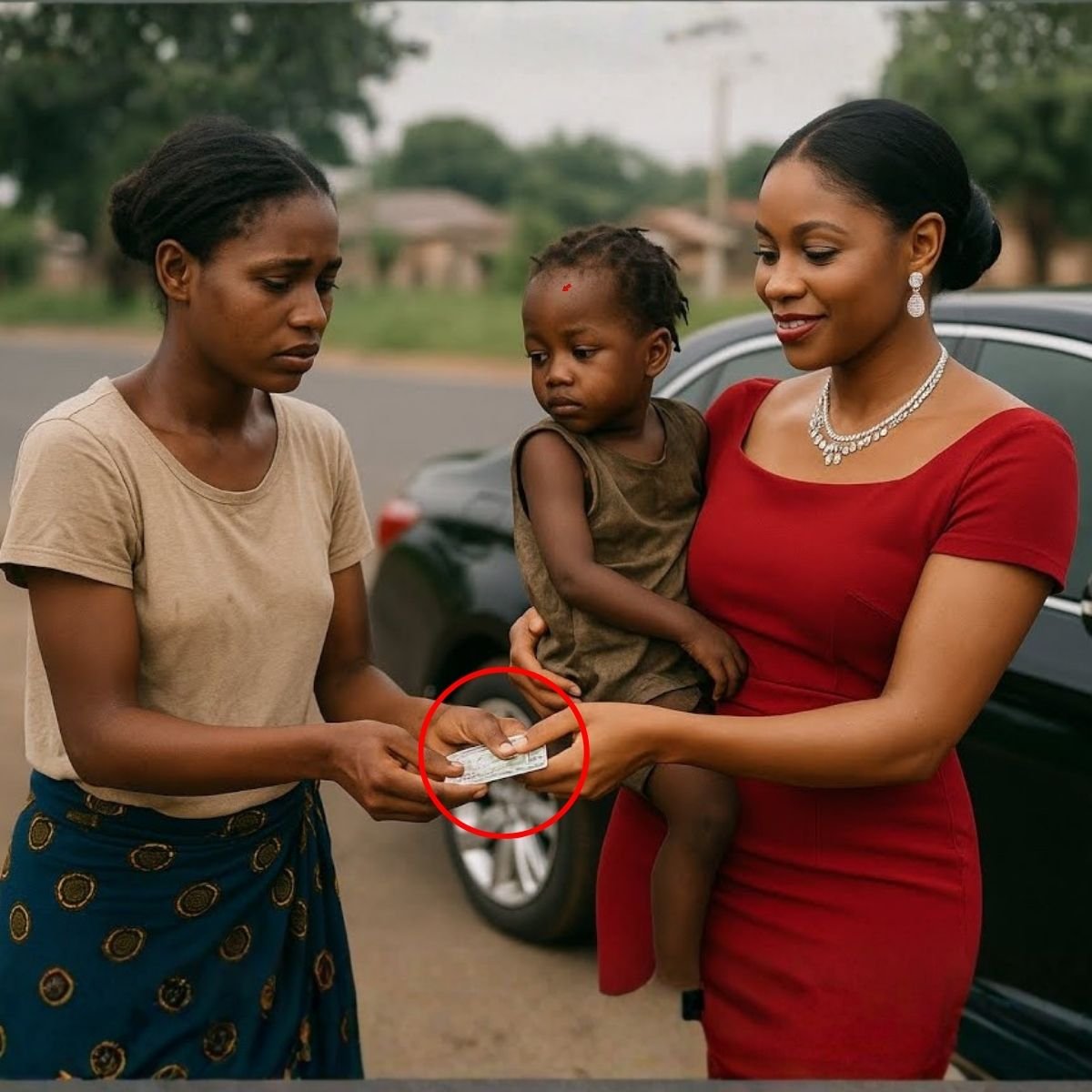
She sold her only daughter to a rich woman who could not have children out of desperate hunger—and that was the biggest mistake of her life.
Angela had always been a fighter. Life had never been kind to her. She was only 25 when her husband, Vincent, died suddenly in a factory accident, leaving her alone to raise their three-year-old daughter, Sonia.
It happened on a rainy Tuesday morning. Vincent kissed her goodbye before work, promising Sonia, “Daddy will bring you a candy bar when I get home.” But he never came home.
Three months later, Angela sat in their tiny kitchen, surrounded by bills spread all over the table. The rent notice, electricity, and water bills all screamed the same words: “Pay now or lose everything.”
She opened her purse and counted her money again.
$3.20.
Twenty cents.
That was all she had left.
“Mama, I’m hungry,” Sonia said softly from the doorway. Her little dress was too tight and her shoes had holes.
Angela’s chest ached. She checked the cabinets—empty. The fridge—nothing.
“Come here, my baby,” Angela said, forcing a smile. She hugged Sonia tightly. “We’ll figure something out.”
But she had no idea what to do.
She had begged for jobs everywhere, asked neighbors for help, and even gone to the church. Nothing worked. And now the landlord, Mr. Daniel, came knocking every day. Yesterday he shouted, “You have three days to pay $800 or you and that little girl will sleep outside.”
Angela had cried quietly in the bathroom so Sonia wouldn’t see her tears.
That night, after putting Sonia to bed, Angela sat staring at the bills again. No food, no rent, no hope.
Her eyes fell on a photo of Vincent holding baby Sonia and smiling.
“Vincent,” she whispered, “I don’t know what to do. I’m scared. I’m failing our little girl.”
The next morning, loud knocking startled her. Her heart raced. Was it Mr. Daniel coming to throw them out?
When she opened the door, a woman she’d never seen stood there. She wore elegant clothes and jewelry that sparkled in the sunlight.
“Hello,” the woman said sweetly. “I’m Catherine Wilson. I heard about your situation. May I come in? I think I can help.”
Angela looked at her shiny car parked outside, then at her empty kitchen. With nothing left to lose, she said, “Please come in.”
Sonia peeked out shyly from behind her mother’s leg.
“And this must be Sonia,” Catherine said with a warm smile. “She’s even more beautiful than I heard.”
Angela frowned slightly. How does this woman know about my daughter?
She offered her a seat. “Can I get you some water?”
“No, thank you,” Catherine said, sitting down. Her eyes moved around the small apartment. “Angela, I know things have been very hard since your husband died. You can’t pay your bills or even buy food for your daughter.”
Angela blushed in shame. “How do you know that?”
“In a city like Lagos,” Catherine said smoothly, “news travels fast—especially when it’s about a young mother trying so hard to survive.”
Sonia was staring at Catherine’s shiny necklace.
“Do you like my necklace, princess?” Catherine asked.
She took out a candy bar from her purse and handed it to Sonia. Sonia looked at her mother for permission. Angela nodded, and the child quickly unwrapped it.
“Thank you, pretty lady,” Sonia said happily as she ate.
Catherine smiled, but Angela noticed her eyes stayed cold.
Then Catherine leaned closer.
“Angela, I have something very important to tell you. Something that can change both your lives forever.”
Angela’s hands trembled. “What do you mean?”
“I’m a rich woman,” Catherine began softly. “But God did not bless me with children. My husband and I have tried for 15 years. Then I saw your daughter. She’s smart, beautiful, and well-behaved. She deserves more than this life.”
Angela’s chest tightened. We may be poor, but Sonia is loved. That’s what matters.
“Of course,” Catherine said quickly. “But love doesn’t pay for food or school. Look around. She’s growing up with nothing. I can give her everything—food, clothes, toys, education, a home.”
Angela shook her head. “She’s my daughter. She’s all I have left of Vincent.”
Catherine pulled an envelope from her purse. It was thick with money.
“This is $50,000,” she said calmly. “Enough to pay your debts and start over. And Sonia will live a good life with me.”
Angela’s eyes widened. She had never seen that much money before.
Her heart pounded painfully in her chest.
“I need time to think,” she whispered.
“Of course,” Catherine said, standing up. “But remember—Mr. Daniel comes tomorrow. What happens when you both have nowhere to go?”
She paused at the door.
“I’ll come back tomorrow morning for your answer. And Angela,” Catherine said softly before leaving, “I really hope you’ll make the right choice—for Sonia’s sake.”
When the door closed, Angela sank to the floor and pulled Sonia into her arms.
“Mama, who was that pretty lady?” Sonia asked in her tiny voice.
“Just someone who wanted to meet you,” Angela said, forcing a shaky smile.
“She was nice. She gave me candy,” Sonia said happily.
Angela hugged her tighter, whispering, “I love you so much, my baby—more than anything in this world.”
“I love you too, Mama,” Sonia said, resting her head on Angela’s shoulder.
That night, Angela couldn’t sleep. She sat by her daughter’s bed, watching her sleep peacefully, not knowing that tomorrow might change everything.
The next morning, loud banging shook the door.
“Angela! Open this door right now!”
It was Mr. Daniel’s angry voice. Angela’s heart jumped. She checked the clock.
7:00 a.m.
She rushed to wake Sonia. “Stay quiet.”
“Okay,” Sonia whispered.
When Angela opened the door, Mr. Daniel stood there with two big men behind him.
“Time’s up, Angela,” he said coldly. “Where’s my money?”
Her hands trembled. “Please, Mr. Daniel, just give me one more day. I’m expecting some money today.”
He laughed harshly. “I’ve heard that lie too many times. Boys, start taking her things outside.”
“No, please!” Angela cried, dropping to her knees. “My daughter—she’s just a little girl. Where will we go?”
“That’s not my problem,” he snapped. “You should have thought of that before.”
The men began carrying out their few belongings—old clothes, Sonia’s broken doll, even Vincent’s framed photo.
“Mama, what’s happening? Why are they taking our things?” Sonia cried, clinging to her mother.
Angela tried to be strong, but tears filled her eyes.
Then suddenly, a car engine roared outside. A shiny black car stopped in front of the house.
Catherine stepped out, dressed like she’d come from a movie—expensive gown, sparkling jewelry, confident smile.
“Good morning, Angela,” she said sweetly. “I see you’re having some trouble.”
Mr. Daniel turned to her, surprised.
“And you are?”
“A friend,” Catherine said smoothly, pulling out a thick envelope of cash. “How much does she owe you?”
Mr. Daniel’s eyes lit up. “$800 rent and $200 for damages. $1,000 total.”
Catherine counted the money calmly. “Here’s $1,200 for your trouble.”
He grinned greedily, pocketed the money, and waved his men off. “Well, I guess she can stay after all. Sorry for the misunderstanding.”
They hurried away.
Angela stood frozen.
“Why? Why did you do that?” she asked.
“Because I care about you and Sonia,” Catherine said kindly. “But Angela, this only solves your problem for now. What happens next month when rent is due again? When Sonia gets sick?”
Angela had no answer.
She looked at her daughter, who was now hugging Catherine’s legs.
“The pretty lady saved us,” Sonia said, smiling brightly.
Catherine bent down, stroking Sonia’s hair. “Hello, my beautiful princess. Did you sleep well?”
“Yes! I dreamed about candy and toys and a big house,” Sonia giggled.
Catherine looked up at Angela. “Dreams can come true, you know.”
Angela’s stomach twisted. She knew what Catherine meant.
“Sonia, go play in your room for a bit,” Angela said softly. “Mama needs to talk.”
When the girl left, Catherine sat at the table.
“Angela, the money I paid the landlord came from the $50,000 I offered you yesterday. Now there’s only $49,000 left.”
Angela’s heart sank. “But I never agreed to anything.”
“I know,” Catherine said gently. “I help because I care. But Angela, you can’t keep living like this. You can’t do it alone.”
Angela stared toward Sonia’s room, where she could hear her daughter singing.
“If I do what you’re asking,” she whispered, “will I ever see her again?”
Catherine’s face softened, but her voice was firm. “If you truly love Sonia, you’ll let her go completely. She needs to grow up safe and happy—not confused between two mothers.”
“So I’d lose her forever?” Angela asked, tears spilling down her cheeks.
“You wouldn’t lose her,” Catherine said. “You’d be giving her the best gift—a chance for a better life.”
Angela buried her face in her hands. “I can’t. She’s my baby. She’s all I have left.”
“Angela, look at me,” Catherine said firmly. “Can you give her food every day? Can you pay for school or medicine if she gets sick? Can you keep a roof over her head?”
Each question broke Angela a little more, because deep down she knew the answer was no.
“But I love her,” Angela whispered.
“I know,” Catherine said softly. “And because you love her, you want the best for her.”
Catherine’s tone became gentle but persuasive. “My husband and I have been praying for a child for 15 years. We can give Sonia everything she needs—school, clothes, a bright future.”
From the next room, Sonia’s laughter echoed faintly.
“I need more time,” Angela whispered.
“Of course,” Catherine said, standing. “But tonight, when Sonia goes to bed hungry again, ask yourself: are you keeping her because it’s best for her—or because it makes you feel better?”
Angela froze. The question hit her like a knife to the heart.
Was she being selfish? Was she holding on to her daughter only to watch her suffer?
After Catherine left, Angela sat alone in the kitchen. The $1,000 was gone to pay the rent, but the table was still covered with other bills—electricity, water, groceries—all demanding the same thing: Pay now.
She opened the refrigerator—empty. The cabinets—empty. Her purse—empty too.
“Mama, can we have lunch?” Sonia asked quietly, walking in.
Angela’s heart broke again. “We don’t have food right now, baby. Maybe later.”
Sonia frowned. “But I’m really hungry, Mama. My tummy hurts.”
Angela knelt and hugged her. “I know, sweetheart. Mama’s trying to fix it.”
That afternoon, Angela took Sonia to the park so she wouldn’t think about being hungry. They sat under a big tree and watched other children play.
Angela’s eyes filled with sadness as she saw how thin her daughter had become. Her dress hung loose and her shoes had holes. The other children wore new clothes and shiny shoes. Their mothers laughed and fed them snacks.
Angela had nothing to give her child except love.
And for the first time, she wondered if love was enough.
“Mama, look at that little girl,” Sonia said, pointing. The girl wore a pink dress and new shoes, her mother pushing her on the swing as they laughed together.
“She’s pretty,” Angela said softly.
“I wish I had a dress like that,” Sonia whispered. “And shoes without holes.”
Angela felt her heart twist painfully. Her little girl was only three, yet she already understood they were different.
That evening, Angela searched every corner of the apartment and gathered a few coins—just enough to buy a small piece of bread.
She gave it to Sonia, watching her eat slowly, trying to make it last.
“Aren’t you going to eat, Mama?” Sonia asked.
“I’m not hungry,” Angela lied.
Her stomach ached, but seeing her daughter eat was worth more than food.
That night, when Sonia was asleep, Angela sat by the window staring at the city lights. Somewhere in that city, Catherine sat in her mansion waiting for her answer.
Angela picked up Vincent’s photo and whispered, “What should I do? What would you want me to do?”
But the picture gave no answer. She was alone with the hardest decision a mother could ever make.
Tomorrow, she would have to choose: keep her daughter and lose everything, or give her away so she could have everything.
The next morning, Sonia’s cough woke her. Angela rushed over. Sonia’s forehead was hot.
“Mama, I don’t feel good,” she whispered weakly.
Angela’s heart raced. Her little girl was burning up with fever.
She tried cooling her with water and a damp cloth, but the fever grew worse. Sonia shivered even while sweating.
“Mama, my throat hurts,” she cried softly.
Angela panicked. She needed a doctor, but she had no money. She searched every pocket, every drawer, and found only $2.15.
Wrapping Sonia in a blanket, she carried her to the free clinic across town.
They waited in line for hours. When it was finally their turn, the nurse frowned.
“This child is very sick,” the nurse said. “She needs medicine and a real doctor.”
“Please,” Angela begged. “I’ll pay you back somehow. She’s all I have.”
The nurse sighed sadly. “I wish I could help, but we don’t have the medicine. You must take her to the main hospital.”
Angela hurried to the big hospital downtown. The building was bright and full of doctors. At the front desk, a woman asked, “Do you have insurance?”
“No,” Angela said quietly.
“Can you pay for the visit?”
“I… I only have $2,” she whispered.
The woman’s face hardened. “I’m sorry. We can’t admit patients who can’t pay. There’s a charity clinic 10 kilometers away.”
Angela’s voice cracked. “Please, my daughter is very sick.”
“I’m sorry. That’s our policy.”
Angela stood there holding her burning child, surrounded by families who could afford treatment.
She walked outside and sat on the hospital steps, tears falling down her face.
“Mama, I’m scared,” Sonia whispered weakly.
“Don’t be scared, baby,” Angela said, though she was terrified too.
Then her phone rang. It was Catherine.
“Angela, have you made your decision yet?” came Catherine’s calm voice.
Angela’s voice trembled. “Sonia is very sick. She has a high fever and I can’t afford a doctor.”
There was a pause. Then Catherine said quickly, “Oh no. Where are you right now?”
“At the big hospital downtown, but they won’t see her,” Angela said.
“Stay there,” Catherine ordered. “I’m coming right now.”
Twenty minutes later, her sleek car pulled up. Catherine rushed over, her perfume and jewelry shining like hope.
“Let me see her,” she said, touching Sonia’s forehead. “She’s burning up. We need help immediately.”
Inside the hospital, everything changed the moment they saw Catherine.
“How can I help you?” the receptionist said with a smile.
“This child needs the best doctor you have,” Catherine said, pulling out her card. “Money is not a problem.”
In minutes, Sonia was in a clean room. The doctor gave her medicine for her fever and infection. Nurses brought juice and crackers.
“She’ll be fine,” the doctor said. “She just needs rest and fluids.”
Angela watched in shock. In one moment, Catherine had done what she couldn’t do all day.
When they left, Sonia was already feeling better.
In the car, Angela whispered, “Thank you. I don’t know how to repay you.”
Catherine looked at her calmly. “Angela, if Sonia were my daughter, she’d never have to suffer like this. She’d always have the best care.”
Angela’s eyes filled with tears. “I know.”
“What if this happens again?” Catherine said softly. “What if it’s worse next time and I’m not there?”
Angela looked back at her sleeping daughter.
Catherine’s voice became gentle. “I can see you love her. But sometimes love means making the hardest choice. Sometimes it means letting go.”
That night, Angela sat alone at the kitchen table. Now there was a new bill—the hospital fee—$800 that Catherine had paid.
In just two days, Catherine had spent over $1,800 on them.
Angela realized how powerless she was.
She remembered how quickly the hospital had opened its doors when Catherine arrived. How easily she could give Sonia what Angela could not.
She went to check on Sonia, who was sleeping peacefully. Her fever was gone. She looked small, fragile, perfect.
“I love you so much,” Angela whispered. “But maybe… maybe that’s not enough anymore.”
The next morning, Sonia woke up smiling. “Mama, I feel good today.”
Angela smiled weakly. “That’s good, sweetheart. Mama just needs to make a phone call.”
Her hands trembled as she dialed Catherine’s number.
“Hello, Angela,” Catherine answered. “How’s Sonia feeling?”
“She’s better. The medicine worked. Thank you.”
“I’m glad to hear that.”
Angela’s voice cracked. “Catherine, if I let you adopt Sonia… will you promise to love her like your own? To take care of her?”
There was silence. Then Catherine said softly, “I promise she’ll be loved, protected, and given every opportunity. She’ll never lack anything.”
Angela wiped her tears. “And… I can’t see her again?”
“It would confuse her,” Catherine said gently. “But Angela, you’ll always be her mother. Nothing will change that.”
Angela looked at Sonia playing with her broken doll, not knowing her world was about to change.
“When would you take her?” Angela whispered.
“Today,” Catherine said quietly. “It’s better to do it quickly—less painful for both of you. Everything’s ready. A room, toys, clothes—everything she could want.”
Angela’s heart pounded painfully. “I’m not ready,” she said.
“There’s no easy way,” Catherine replied. “You’re doing the right thing, Angela. You’re being a good mother.”
After Angela ended the call, she fell to the floor and cried harder than she ever had in her life.
In just a few hours, she would have to say goodbye to her daughter forever.
She sat there for a long time, holding Sonia’s tiny clothes in her hands, wondering how a mother could explain something so impossible.
How do you tell a child that you’re giving her away out of love, not rejection?
How do you make her understand that this heartbreak is supposed to save her?
At noon, Angela sat beside Sonia on their small couch. Her hands trembled as she spoke.
“Sonia, sweetheart, Mama needs to talk to you about something very important.”
“Okay, Mama,” Sonia said innocently, looking up with big, trusting eyes.
“Do you remember the pretty lady who gave you candy and helped you when you were sick?”
“Yes, Miss Catherine. She’s very nice,” Sonia said, smiling.
Angela swallowed hard. “Miss Catherine has a big, beautiful house with lots of toys, yummy food, and nice clothes. And she wants you to come live with her.”
Sonia frowned. “But I live with you, Mama.”
“I know, baby,” Angela whispered. “But Miss Catherine can give you things Mama can’t. She can send you to school, buy you pretty dresses, and make sure you’re never hungry again.”
Sonia’s lips trembled. “But I don’t want to go. You’re my Mama.”
Angela pulled her close, hugging her tightly. “I will always be your Mama, my love. Nothing will ever change that. But sometimes mamas have to make hard choices to help their children.”
“I don’t understand,” Sonia said softly, tears filling her eyes.
“Miss Catherine will take good care of you,” Angela continued gently. “She has everything you’ll ever need, and she’ll love you very much.”
“But who will take care of you?” Sonia asked, her voice cracking.
Angela almost broke. Her baby, barely three, was worried about her.
“Mama will be okay,” Angela lied. “I just want you to be happy and healthy.”
“Can I visit you?” Sonia asked.
Angela closed her eyes and took a deep breath. “Baby, when you go live with Miss Catherine… that will be your new home.”
Sonia’s face turned pale.
Angela couldn’t speak. She only nodded and hugged her daughter tightly.
“No!” Sonia cried. “I don’t want to go! I don’t care if we’re poor. I just want my Mama!”
Angela’s tears fell freely. “Oh, baby. I want you to stay too—more than anything. But what if you get sick again and I can’t help you?”
“I don’t care!” Sonia sobbed. “I just want you!”
They held each other and cried until they had no strength left.
At exactly 3:00 p.m., a car stopped outside. Angela froze.
“Is that her?” Sonia whispered, holding her mother’s arm tightly.
“Yes, baby,” Angela said weakly.
There was a soft knock.
“Angela, it’s me,” Catherine’s calm voice called.
Angela opened the door slowly. Catherine stood there smiling, holding a new doll and a big bag of clothes.
“Hello, Sonia,” she said warmly. “I brought you some presents.”
But Sonia hid behind her mother’s legs, trembling.
“She’s just scared,” Angela said quietly.
“That’s okay,” Catherine replied, stepping in. “Look, sweetheart. This doll is for you.”
It was the most beautiful doll Sonia had ever seen—long curly hair and a pink dress that sparkled.
“And look at these clothes,” Catherine said, opening the bag. “See this blue dress? It’s just your size.”
Sonia’s eyes widened. She had never owned anything so lovely.
“They are pretty,” she whispered.
“Do you like them?” Catherine asked gently.
Sonia nodded, but she still clung to her mother.
“Angela,” Catherine said softly, “have you packed her things?”
Angela looked around their small home at the old clothes, the broken toys, the empty shelves.
“She doesn’t have much,” she said sadly.
“That’s fine,” Catherine said kindly. “She won’t need any of these old things. I have everything she could ever want.”
Those words stabbed Angela’s heart.
“But what about my teddy bear?” Sonia asked suddenly.
It was the worn-out bear Vincent had bought for her when she was a baby.
Catherine frowned. “Oh, sweetheart. I’ll get you better toys. You don’t need that old thing.”
“But it’s for my daddy,” Sonia said, hugging the teddy bear tightly.
Angela’s voice trembled. “She can keep it. It’s important to her.”
Catherine smiled thinly. “Of course. If it helps her adjust.”
Then she stretched out her hand. “Are you ready, Sonia?”
Sonia’s eyes filled with fear. “Mama, I changed my mind. Please don’t make me go.”
Angela knelt down, tears streaming down her face. “Baby, I need you to be very brave for Mama. Okay? You’re going to have a wonderful life with Miss Catherine. You’ll go to school, have toys, pretty clothes.”
“But I’ll miss you,” Sonia sobbed.
“I’ll miss you too, my love,” Angela whispered. “Every single day. But remember this—Mama loves you more than all the stars in the sky. Can you remember that?”
“I love you more than all the stars in the sky too, Mama,” Sonia cried.
Angela kissed her forehead and stood up quickly before she lost her courage.
“Take good care of her,” she told Catherine, her voice shaking. “She’s the most precious thing in the world.”
“I will,” Catherine promised, taking Sonia’s tiny hand.
Sonia looked back one last time. “Mama, are you sure I can’t stay?”
Angela wanted to scream, “Yes!” But instead, she said softly, “Go on, baby. Be good for Miss Catherine.”
Catherine lifted Sonia into her arms and walked toward the car. Sonia reached back, crying, “Mama, Mama.”
Angela followed them outside, tears falling uncontrollably.
Catherine placed Sonia in the back seat and buckled her in.
Through the window, Sonia pressed her small hand against the glass. Angela pressed hers on the other side as if she could still hold her.
“I love you, Sonia,” she whispered.
“I love you too, Mama,” Sonia cried.
Catherine started the car.
As it drove away, Angela ran after it for a few steps, but then stopped—breathless in the middle of the road.
She stood there, watching the car disappear around the corner, taking her daughter, her heart, and her whole world with it.
When Angela returned to her empty apartment, the silence hit her like a heavy weight. For the first time in three years, she was completely alone.
She looked around at the small space that used to be filled with her daughter’s laughter. Now it felt cold and lifeless.
She picked up Sonia’s tiny dress from the floor and pressed it to her face. It still smelled like her baby.
That night, Angela sat in Sonia’s empty room and cried until her body shook. She had done what she thought was best—giving her daughter a better life. But it felt like someone had ripped her heart out.
She didn’t know this was only the beginning of her pain. The hardest part was still coming.
If you are enjoying this story, please hit the like button and share with your friends and also subscribe to our channel for more interesting emotional stories like this one.
Two weeks later, Angela couldn’t take it anymore. She had to see Sonia, just to know she was okay.
She took a bus across town to Catherine’s neighborhood—a place filled with big, beautiful houses, perfect gardens, and shiny cars.
When she reached Catherine’s mansion, her jaw dropped. It looked like a palace—tall gates, security guards, and walls so high they could hide the sky.
Angela hid behind a tree across the street and waited.
After an hour, she saw Catherine’s car drive in. The gates opened slowly and Angela caught a glimpse inside.
There was Sonia.
She looked like a little princess in a white dress and shiny shoes, her hair styled neatly.
But something was wrong.
Sonia wasn’t smiling. She wasn’t playing. She walked quietly beside Catherine, her head down like she was scared to make a sound.
Angela’s hands shook. She wanted to run to her daughter, hold her tight, and take her home—but she remembered her promise to stay away.
The next day, Angela went back again. She told herself it was just to make sure Sonia was happy.
This time, she saw her in the backyard. There were toys everywhere—balls, dolls, even a little swing.
But Sonia wasn’t playing.
She sat on the grass hugging her old teddy bear, the one her father had bought for her as a baby.
Angela’s eyes filled with tears.
Her daughter had everything now—clothes, food, toys—but she looked lonely.
For the next month, Angela came back every few days. Watching from a distance became her only comfort, her only way to breathe.
Then one afternoon, while she was standing behind her usual tree, a cold voice came from behind her.
“I thought I might find you here.”
Angela spun around.
It was Catherine.
Her heart started pounding.
“I—I was just—”
“You were spying on my daughter,” Catherine said sharply.
“She’s my daughter,” Angela said, her voice trembling but firm. “I just wanted to see how she’s doing.”
“She’s fine,” Catherine replied flatly. “She’s adjusting well. But your lurking around here isn’t helping her move on.”
Angela’s face hardened. “She’s only three years old. She doesn’t understand why her mother isn’t there anymore.”
Catherine smirked cruelly. “You didn’t leave her. You sold her for money. Don’t pretend it was anything noble.”
Those words hit Angela like a knife.
“It wasn’t like that,” she said weakly. “I was trying to help her.”
“Help her or help yourself?” Catherine’s eyes gleamed.
For the first time, Angela saw the truth. This woman wasn’t kind. She wasn’t generous. She was controlling, heartless, and proud of it.
“I want her back,” Angela said suddenly, her voice shaking but strong.
Catherine laughed coldly. “You want her back? You can’t just change your mind, Angela. You signed the papers. You took my money. Sonia is mine now.”
“I don’t care about the papers,” Angela snapped. “She’s unhappy. I can see it.”
“She’s adjusting,” Catherine said stiffly. “It’s been six weeks.”
Angela shouted, “If she was really happy, she wouldn’t look so sad!”
“Lower your voice,” Catherine hissed. “You’re making a scene.”
“I don’t care,” Angela cried. “I want my daughter back!”
Catherine’s face turned stone cold. “Let me explain something to you, Angela. You gave up all rights to that child. If you cause trouble, I’ll have you arrested for harassment and stalking.”
Angela froze. “You can’t stop me from seeing her.”
“Oh, I can,” Catherine said with a thin smile. “I have power, connections—things you’ll never understand. One phone call and you’ll be in jail. And who will take care of your precious Sonia then?”
Angela’s stomach twisted in fear.
She had made the worst mistake of her life.
She hadn’t just given Sonia to a wealthy woman—she had given her to a woman who would do anything to keep what she wanted.
“Stay away from my house,” Catherine said coldly. “Stay away from my daughter. If I see you here again, you’ll regret it.”
Then she turned and walked back toward her mansion, her heels clicking against the driveway.
Angela stood there on the street, trembling and helpless, watching the gates close behind her.
She went back to her tiny apartment, the same empty silence waiting for her, and sank to the floor.
She had lost her daughter forever—and this time there was nothing she could do about it.
Three days later, Angela went back to Catherine’s neighborhood. But this time she was careful. She hid behind different trees, watching from far away.
She saw Sonia again, sitting quietly on the porch with her teddy bear. All around her were expensive toys—shiny dolls, a swing, even a small bicycle.
But Sonia wasn’t playing with any of them. She just sat there hugging her teddy, staring at the ground.
Angela’s heart ached.
Her daughter had everything money could buy, but not the one thing she truly needed: love.
Just as Angela was about to leave, she heard sirens.
Two police cars stopped right on the street where she was standing.
“We need you to come with us,” one of the officers said, walking toward her.
Angela froze. “What? Why?”
“You’re under arrest for stalking and harassment,” the policeman said, pulling out handcuffs.
“What? No, I wasn’t doing anything wrong!” Angela cried. “I was just walking down the street!”
“We received a complaint from Mrs. Catherine Wilson. She says you’ve been watching her house and threatening her family.”
Angela looked toward Catherine’s mansion and saw her standing at the window, smiling coldly as the officers cuffed her.
“That’s not true!” Angela shouted desperately. “She has my daughter. I gave her my daughter, but now I want her back!”
The policeman exchanged looks. “You need to calm down. You’re not making sense.”
“Please, you have to listen to me,” Angela begged as they pushed her toward the car. “That woman took my daughter. I made a mistake and now she won’t let me see her.”
“According to our records, you legally gave up your parental rights. The child now belongs to Mrs. Wilson.”
As the police car drove away, Angela looked back.
At the window, Sonia had appeared. She pressed her little face against the glass, watching her mother being taken away.
Angela’s heart shattered all over again.
The jail cell was small, cold, and smelled of metal. Angela sat on the hard bench, her hands shaking.
How could watching her own child be against the law?
The next morning, a man in a suit came to see her.
“Mrs. Angela,” he said in a cold, business-like voice, “I represent Mrs. Wilson.”
Angela sat up quickly. “Please tell her I’m sorry. I just wanted to see my daughter.”
“My client is willing to drop the charges,” the lawyer said. “Under one condition.”
“What condition?” Angela asked, hopeful.
“You must sign this document promising never to contact Mrs. Wilson or the child again. You must also agree to leave the city within 24 hours.”
Angela’s face went pale. “Leave the city? But this is my home. My husband is buried here. My daughter is here.”
“That child is no longer your concern,” the lawyer said coldly. “You made your choice when you accepted Mrs. Wilson’s money.”
Angela’s voice shook. “I changed my mind. I want her back.”
“It doesn’t work that way,” the man said. “You signed the papers. The adoption is final.”
“But she’s not happy,” Angela cried. “Anyone can see she’s not happy!”
“That’s not for you to decide anymore,” the lawyer said flatly. “Sign the paper, or Mrs. Wilson will make sure you spend the next 20 years in prison.”
Angela stared at him. “Twenty years for what?”
“Stalking, harassment, trespassing, making threats. Mrs. Wilson has powerful friends. She can make your life very difficult.”
Angela felt trapped. If she signed the paper, she’d lose Sonia forever. But if she refused, she might spend years in prison and still lose her daughter.
“I need time to think,” she whispered.
“You have one hour,” the lawyer said, standing up.
Angela sat there shaking. Both choices meant losing Sonia. But at least if she signed, she’d still have her freedom—what little of it was left.
When the lawyer came back, Angela stood up slowly.
“I won’t sign,” she said firmly.
The lawyer raised an eyebrow. “Are you sure? Mrs. Wilson doesn’t take no easily.”
“I’m sure,” Angela said, tears in her eyes. “I won’t promise to stay away from my own child.”
“Very well,” the lawyer said, gathering his papers. “Don’t say you weren’t warned.”
Two weeks later, Angela stood in a courtroom. Catherine was there, sitting beside her expensive lawyer, dressed in her usual fine clothes. Angela stood alone. She couldn’t afford a lawyer.
“Your honor,” Catherine’s lawyer began smoothly, “my client has been terrorized by this woman. Mrs. Angela refuses to accept that she legally gave up her parental rights.”
The judge turned to Angela, frowning. “Mrs. Angela, according to these documents, you willingly signed away your rights in exchange for money. Now you’re harassing the family who legally adopted your child.”
Angela’s mouth went dry. When the judge said it like that, it sounded so terrible.
“Given your refusal to respect the legal adoption,” the judge said, lifting the gavel, “this court sentences you to 20 years in prison.”
Angela gasped. “Twenty years? Please, your honor, I didn’t mean any harm.”
But it was too late. The gavel struck the desk.
Catherine smiled faintly as Angela broke down in tears. The woman who once claimed to save her daughter had just destroyed her completely.
Twenty years later, Angela walked slowly out of the prison gates. She was now 45 years old. Her once dark hair had gray streaks, and her eyes carried the sadness of everything she had lost.
The city outside looked nothing like the one she remembered. New roads, new buildings, new faces.
Everything had changed—except the emptiness inside her.
She went to where her old apartment used to be, but it was gone. In its place stood a shiny shopping mall filled with bright lights and laughter.
Angela stood there quietly, feeling invisible. She had nowhere to go, no one waiting for her. Twenty years gone—all because she had loved her daughter too much.
For weeks, Angela searched for work. She walked from one place to another—restaurants, shops, offices, factories.
“Sorry, we can’t hire you,” people said again and again. “We need someone with recent experience.”
No one wanted to give a job to a woman who had spent 20 years behind bars.
She was running out of the small amount of money the prison had given her. Soon she would be homeless again—just like she had been two decades ago.
One afternoon, while walking through the city, she noticed a sign outside a tall glass building:
CLEANERS WANTED. APPLY INSIDE.
Angela looked up at the massive skyscraper that reached for the sky. The glass walls reflected the sunset. It was the most beautiful building she had ever seen.
The sign said: Williams Corporation.
Angela didn’t know it belonged to the same family that had destroyed her life. She only knew she desperately needed a job.
Inside, the lobby was like a palace—marble floors, gold decorations, and a huge chandelier that sparkled above her head.
She walked up to the front desk.
“Excuse me,” she said softly. “I saw the sign about cleaning jobs.”
The receptionist looked at her from head to toe, frowning at her cheap old clothes. “Human Resources is on the 15th floor.”
Angela thanked her and took the elevator up.
On the 15th floor, she met Mrs. Daniel, the woman in charge of hiring cleaners.
“Have you ever worked as a cleaner before?” Mrs. Daniel asked.
“Yes,” Angela said carefully. “In the place I was staying for the past 20 years.” She didn’t want to say the word prison.
“Do you have any references?”
Angela shook her head sadly. “No, but I’m a hard worker. I’ll do anything you ask.”
Mrs. Daniel looked at her closely. There was something honest in Angela’s eyes—something strong.
“The job doesn’t pay much,” Mrs. Daniel said finally. “You’ll work nights cleaning offices after everyone leaves. The hours are long and the work is hard.”
“I’ll take it,” Angela said immediately. “Thank you.”
“You start tomorrow night at 8. Don’t be late.”
That night, Angela used her last few coins to buy a small meal and rent a tiny room in a crowded boarding house. It wasn’t much, but at least it was a roof over her head.
The next evening, she arrived early for her first shift. She was given a blue uniform, cleaning tools, and a list of rooms to clean.
She emptied trash cans, scrubbed windows, mopped floors, and dusted desks.
Everywhere she went, she saw family photos—smiling parents, happy children. Each one reminded her of Sonia.
Was she still alive? Was she happy? Did she ever think about her mother?
Angela worked hard every night. She spoke little and stayed late, making sure every office sparkled.
Weeks turned into months. Slowly, she began to feel a small sense of peace. She had a job, a place to sleep, and enough money for simple meals. It wasn’t much, but it was better than nothing.
One evening, Angela was cleaning the top floor—the executive level—offices that were large and full of expensive furniture.
She was dusting near the big corner office when she heard the elevator doors open. She looked up.
A young woman stepped out carrying a briefcase. She was beautiful—long curly hair, bright eyes, and a confident but gentle expression.
“Oh, hello,” the young woman said with a kind smile. “I didn’t know anyone was still here.”
“I’m just a cleaner,” Angela said quietly. “I can come back later if you need to work.”
The young woman shook her head. “No, no—please go ahead. I’m the one working late.”
She smiled again. “I’m Sonia Williams, the CEO here.”
Angela froze.
Sonia Williams.
Her heart skipped a beat, but she quickly hid her reaction.
“I’m Angela. I’ll stay out of your way.”
“Thank you, Angela,” Sonia said warmly. “You’re very thorough. Everything is always spotless here.”
“It’s my job,” Angela said softly, her voice trembling slightly.
From that night on, their paths began to cross often. Sonia always worked late and Angela always cleaned the same floor.
At first, they exchanged polite greetings. But soon, Sonia started asking little questions.
“How long have you been working here, Angela?”
“About three months now.”
“Please call me Sonia,” the young woman said kindly. “And thank you for the amazing work you do. I notice everything. You take great care of this place.”
Angela smiled faintly. “Thank you.”
It had been years since anyone had said something kind to her.
Every time Sonia smiled at her, Angela felt something warm grow quietly inside her—something she hadn’t felt in two decades.
Hope.
One quiet night, Angela was cleaning Sonia’s office when she noticed something unusual. Sonia looked tired and sad. Her eyes were red and her smile was missing.
“Are you okay, Miss—” Angela asked gently, forgetting to sound formal.
Sonia looked up, surprised that the cleaner had noticed her mood.
“Oh, I’m fine. Just a long day.”
But Angela could see the truth. Sonia was not fine.
“Sometimes a cup of tea helps when I’m feeling down,” Angela said softly. “I could make you one if you’d like.”
Sonia’s eyes suddenly filled with tears at this small act of kindness.
“That’s very sweet of you, Angela. I would like that very much.”
Angela nodded and went to the small kitchen.
When she returned with a steaming cup of tea, Sonia took a sip and smiled for the first time that evening.
“This is perfect. Thank you.”
“You’re welcome,” Angela said warmly. “We all need someone to care about us sometimes.”
From that moment, something changed between them. They both felt a quiet connection neither could explain.
Over the next few weeks, their conversations grew longer. Sonia began waiting for Angela in the evenings, and Angela found herself cleaning slower just to talk a little longer.
One evening, Sonia asked softly, “Angela, do you have children?”
Angela’s heart tightened. She paused, then answered honestly.
“I had a daughter once… but I lost her many years ago.”
Sonia looked at her with compassion. “I’m so sorry. That must be so painful.”
Angela nodded, tears shining in her eyes. “It was my fault. I thought I was doing what was best for her… but I lost her forever.”
Without thinking, Sonia reached out and touched Angela’s hand.
“That must be hard to live with.”
Angela froze. It had been over 20 years since anyone had touched her hand with kindness.
That night, something shifted between them. They weren’t just worker and boss anymore. They were two lonely souls who understood each other’s pain.
As months passed, their friendship grew stronger. Angela started staying a little later each night—not because she had more cleaning to do, but because she enjoyed talking to Sonia. And Sonia began working later too—not because of deadlines, but because she looked forward to seeing Angela.
“You know, Angela,” Sonia said one night, “talking to you is the best part of my day. You have such wisdom and such a kind heart.”
Angela smiled softly. “And you have a beautiful soul, Miss Sonia. Any mother would be proud to have a daughter like you.”
Neither of them realized they were describing the very bond they had lost 20 years ago.
Angela noticed that Sonia never spoke warmly about her mother.
“My mother is a very successful woman,” Sonia would say. “She gave me everything—education, comfort, opportunity.”
But whenever she said it, her voice sounded flat—like she was repeating words she had been trained to say, not words from the heart.
One evening, Angela brought a small potted plant to the office.
“I thought this might brighten up your desk,” she said shyly.
Sonia looked surprised. Then her eyes filled with tears.
“No one has ever given me a gift just to make me happy,” she whispered. “Thank you, Angela. I’ll treasure it.”
Angela smiled. “Everyone deserves to feel special sometimes.”
That night, when Angela left, Sonia sat at her desk looking at the little plant and feeling something new—something warm and peaceful. For the first time in her life, she felt loved by someone who wanted nothing in return.
And as Angela walked home through the quiet streets, she felt something she hadn’t felt in 20 years.
She felt like a mother again.
Neither of them knew that they were slowly healing each other’s broken hearts. Neither of them knew that they were rebuilding the bond that had been stolen from them long ago.
But someone else had noticed—someone who would do anything to destroy it.
Three months into Angela’s job, Catherine Wilson decided to visit the company. She rarely came to the office anymore, preferring her luxurious mansion. But that day, she wanted to see how things were going.
She walked into the building like a queen. Her expensive heels clicked loudly on the marble floor as people whispered and greeted her nervously.
“Good afternoon, Mrs. Wilson,” the receptionist said quickly. “Is Sonia in her office?”
“Yes,” Catherine asked sharply. “She’s just finishing a meeting.”
Catherine took the elevator to the top floor.
Website Disclaimer
The information provided on this website is for general informational and educational purposes only. While we strive to ensure that all content is accurate and up to date, we make no guarantees regarding the completeness, reliability, or accuracy of any information published.
The views and opinions expressed in articles belong to their respective authors and do not necessarily reflect the views of this website. Any action you take based on the information found on this website is strictly at your own risk. We will not be liable for any losses, damages, or inconveniences arising from the use of our content.
Some articles may contain opinions, third-party information, or external links. We do not endorse or guarantee the accuracy of content on external websites and are not responsible for their practices or policies.
All content on this website is provided in good faith and is intended for informational purposes only. Readers are encouraged to verify information independently and seek professional advice where appropriate.