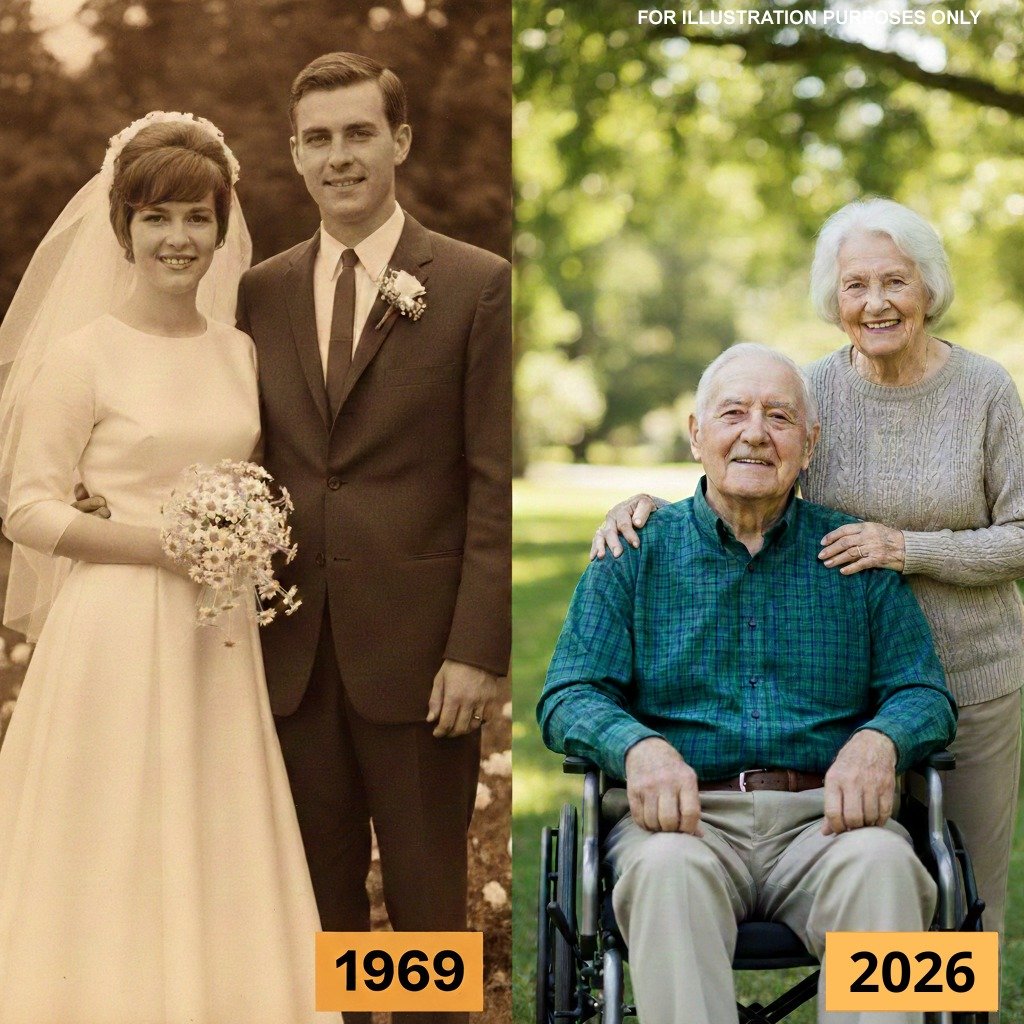
For fifty-seven years, my grandfather brought my grandmother flowers every Saturday like it was as necessary as breathing, and a week after he died a stranger showed up with a bouquet and a letter that made my grandma grip the doorframe as if the truth inside could knock her over.
I grew up believing I understood their love because it never tried to impress anyone. It didn’t announce itself with grand gestures or dramatic speeches. It lived in ordinary places—kitchen counters, quiet mornings, the soft clink of a vase being set down before the coffee finished brewing.
Every Saturday, without fail, my grandfather—Thomas—would wake before sunrise, slip out of bed while Grandma Mollie still slept, and return with fresh flowers as if the world owed her that beauty and he intended to collect it on her behalf.
Sometimes it was a bundle of wildflowers gathered from the roadside, uneven and stubbornly bright. Other times it was tulips from the farmer’s market, still damp from morning mist. On anniversaries and hard weeks, it was roses from the little florist in town, wrapped carefully, chosen slowly, never rushed.
No matter what he brought, the flowers always ended up in the same place: a vase on the kitchen table, waiting like a quiet greeting when Grandma opened her eyes.
When I was small, I asked him why he kept doing it, as if love needed explaining.
He smiled the way he always did when he spoke about Grandma—soft at first, then fuller, like his face forgot how to be anything else. “Because love isn’t only what you feel,” he told me. “It’s what you decide to do again and again, even when nobody’s watching.”
I remember rolling my eyes at the simplicity of it, insisting it was “just flowers,” and him gently correcting me like I’d missed the whole point.
“It’s never just flowers,” he said. “It’s proof. It’s a reminder that she’s chosen, still, after all this time.”
Grandma always played surprised, even though the ritual never changed. She’d inhale their scent as if she were tasting a memory, arrange them carefully, and kiss his cheek with the kind of gratitude that doesn’t wear out, no matter how many years pass.
“You spoil me, Thomas,” she’d say.
He’d shake his head as if the concept didn’t apply to her. “That’s not possible.”
And then—quietly, cruelly—cancer arrived.
It moved the way it often does in the beginning: subtle, almost polite. A little fatigue. Weight loss explained away by stress. A cough that lingered. He didn’t complain, not once. He simply grew smaller in ways we tried not to notice until we couldn’t pretend anymore.
When he died, Grandma held his hand through the final minutes, refusing to let go, her thumb rubbing the back of his knuckles as if she could smooth the moment into something less final. I sat beside them, watching the man who had taught me what devotion looks like slip away, and the silence that followed felt too large for any room to hold.
After the funeral, days blurred into practical tasks and quiet grief. I stayed with Grandma to help her sort through the small pieces of him that were still everywhere—his reading glasses on the nightstand, the worn sweater he insisted wasn’t worn, the books he’d half-finished with a bookmark folded like a promise.
The house felt wrong without him, as if it had forgotten its purpose.
And then Saturday came.
For the first time in fifty-seven years, the kitchen table was empty.
Grandma sat in the same chair, staring at the vase like it had betrayed her, and I made tea she didn’t drink because she was busy mourning something so small it shouldn’t have mattered—and yet it did, because grief is often the loudest in the places where love used to repeat itself.
“It’s strange,” she whispered, barely more than breath. “How something so simple can feel like the whole world.”
A week later, on the next Saturday, there was a knock at the door.
I wasn’t expecting anyone. Grandma looked up sharply, as if her heart had recognized a rhythm before her mind could.
When I opened the door, a man stood on the porch in a long coat, holding a bouquet and a sealed envelope. He didn’t smile. He didn’t hesitate. He looked like someone completing a duty that mattered.
“Good morning,” he said gently. “Thomas asked me to deliver this… after.”
My hands tightened around the bouquet without realizing it, the flowers suddenly heavy, too alive for a house still learning how to be without him.
“Grace?” Grandma called from the kitchen, her voice cautious. “Who is it?”
I walked in and placed the flowers down as if they might dissolve if I moved too fast. Grandma’s face drained of color the moment she saw them.
“Where did those come from?” she asked, almost afraid of the answer.
I handed her the envelope. “He… he arranged it.”
Her fingers trembled so hard I thought she might tear it by accident. She opened it slowly and began to read, and I watched her mouth form the words like she didn’t trust them.
“My darling Mollie,” the letter began, “I’m sorry I didn’t tell you sooner, but there’s something I kept from you for a long time, and you deserve to know. Please go to this address.”
An address was written at the bottom.
Grandma stared at it until her eyes filled. Her voice broke in the way fear always breaks people open. “Grace,” she whispered, “what if… what if he was hiding something awful from me?”
I felt my own stomach twist, because grief makes even the strongest love feel fragile.
“What if there was someone else?” she continued, words rushing now. “What if those Saturdays weren’t only flowers? What if the flowers were… guilt?”
I wanted to shut down the thought immediately, but I couldn’t stop my mind from remembering that for the last few years Grandpa had insisted on going alone, disappearing for longer than seemed necessary, returning with bouquets and a smile that never wavered, as if time didn’t matter as long as he came home to her.
We drove anyway.
Not because we were brave, but because uncertainty is a worse poison than truth, and Grandma needed to know whether the love she’d lived inside was real or a story she’d been allowed to believe.
The address led us out past familiar streets and into a quieter stretch of road lined with trees, until we turned into a small cottage tucked back from the lane, peaceful in a way that felt almost staged.
Grandma’s hands stayed clenched around the letter. “I can’t do this,” she whispered, voice shaking. “I can’t walk into a place that ruins him for me.”
I reached for her. “You won’t do it alone.”
When we knocked, a woman in her fifties opened the door and went still the moment she saw Grandma, as if she had been preparing for this exact face.
“You must be Mollie,” she said softly. “I’ve been waiting for you. Please… come in.”
Grandma’s spine stiffened. “Who are you?” she asked, and the question was loaded with every fear she’d carried in the car.
The woman shook her head immediately, almost pained. “Nothing like that,” she said. “He loved you—truly. He asked me to help him with something he wanted you to see.”
She led us through the cottage, past a neat little kitchen and a hallway that smelled faintly of soil and sunlight, then opened the back door.
And suddenly the air changed.
A garden stretched out behind the house—wide, careful, breathtaking—packed with rows of flowers in colors so vivid it felt unreal, as if someone had painted a memory into the earth: tulips, roses, wild lilies, daisies, sunflowers, peonies, and patches of wildflowers that looked intentionally untamed.
Grandma made a sound I’d never heard from her before, a small broken exhale that turned into a sob, and her knees buckled so quickly I had to grab her arm to keep her from falling.
“What is this?” she whispered, eyes wide, voice trembling.
The woman turned to us, her own eyes wet. “Your husband bought this place three years ago,” she said. “He wanted to build a garden for you—an anniversary gift he didn’t want you to see until it was perfect.”
Grandma pressed a hand to her chest like she couldn’t find her breath.
“He came here whenever he could,” the woman continued. “He chose the flowers personally. He’d bring pictures of you. He’d point at different spots and say, ‘This corner needs to feel like her laughter,’ or ‘These roses have to be worthy of Mollie.’ He left instructions for everything—what to plant, where to place it, how it should look in each season.”
My throat tightened.
Grandma stepped forward slowly, as if she didn’t trust the ground to hold her. She ran her fingers over petals, over leaves, over stems, trembling as if she were touching his hands through the flowers.
The woman spoke again, softer now. “Near the end, when he knew time was running out, he asked us to finish it if he couldn’t. He said he didn’t want you to think the Saturdays ended when he did. He wanted you to discover that he’d been leaving you flowers in a way that could outlast him.”
Then she handed Grandma another envelope.
“He wrote this just days before he passed,” she said. “He wanted you to read it here.”
Grandma opened it, and I read over her shoulder as her tears fell onto the paper.
“My dearest Mollie,” it said, “if you’re reading this, then I’m gone, but I couldn’t stand the thought of leaving you only with silence. Every bloom in this garden is a Saturday morning I promised you. Every petal is a choice I made to love you out loud, even when it was quiet.”
Grandma clutched the letter against her chest and cried the way people cry when a fear finally loosens its grip.
“I’m sorry,” she whispered into the air, not to the woman, not to me, but to him, wherever he was. “I was so scared you’d left something terrible behind.”
But he hadn’t.
He’d left something living.
We went back to the cottage again the next Saturday, and the one after that. Grandma brought tea, and folding chairs, and sometimes she just sat in the middle of the flowers and let the sunlight hit her face like it was a blessing she didn’t have to earn.
When she picked a small bouquet of wildflowers and placed it in the vase on her kitchen table, she smiled through tears and said, “He’s still keeping his promise.”
And for the first time since the funeral, the house didn’t feel like a place where love had ended.
It felt like a place where love had simply learned a new way to bloom.
In the weeks that followed, something subtle but steady returned to Grandma’s life, not happiness exactly, but a sense of being held by the days instead of pushed through them. Every Saturday morning, she woke a little earlier, brewed tea the way Grandpa liked it, and chose which flowers in the garden needed water or trimming, speaking to them softly as if they might carry her words somewhere he could hear. She stopped calling the house “too quiet” and started calling it “peaceful,” and sometimes, when sunlight hit the kitchen just right, she would pause and smile to herself, convinced she’d felt his presence pass through the room like a familiar breeze.
And I realized then that grief doesn’t always end with letting go—it sometimes ends with learning how to stay connected without breaking. The garden didn’t replace Grandpa, and it didn’t erase the ache of missing him, but it gave Grandma a place to put her love when it had nowhere else to go. Love, I learned, doesn’t vanish when someone dies; it simply changes form, waiting patiently for us to notice that it’s still growing, quietly, faithfully, exactly where it was planted.
Website Disclaimer
The information provided on this website is for general informational and educational purposes only. While we strive to ensure that all content is accurate and up to date, we make no guarantees regarding the completeness, reliability, or accuracy of any information published.
The views and opinions expressed in articles belong to their respective authors and do not necessarily reflect the views of this website. Any action you take based on the information found on this website is strictly at your own risk. We will not be liable for any losses, damages, or inconveniences arising from the use of our content.
Some articles may contain opinions, third-party information, or external links. We do not endorse or guarantee the accuracy of content on external websites and are not responsible for their practices or policies.
All content on this website is provided in good faith and is intended for informational purposes only. Readers are encouraged to verify information independently and seek professional advice where appropriate.