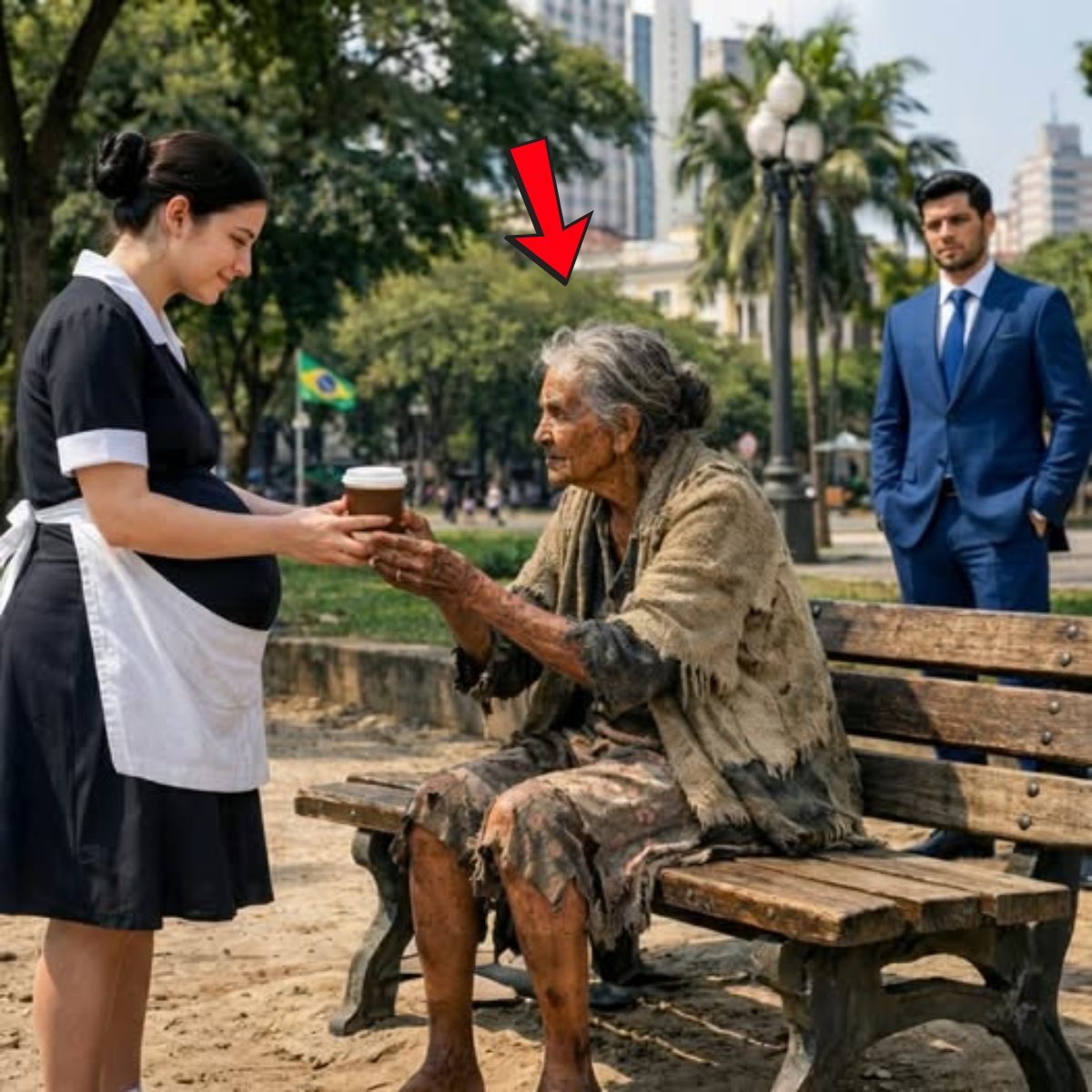
Every morning, before the city had fully shaken off its sleep, there was a corner of the square that seemed to live at a different rhythm. The air smelled of damp earth, of freshly opened bread from a nearby bakery, and of the warm exhaust of the first buses. Among vendors setting up their stalls and hurried people with their eyes glued to the clock, a young woman crossed the street with a steady stride—impeccable black uniform, bag over her shoulder… and a cup of hot coffee in her hand.
Julia did not walk like someone doing a random favor. She walked like someone keeping a promise.
On the usual bench waited a hunched old woman, her clothes worn, her skin marked by cold and by life itself, her trembling hands resting on her lap. People passed by her as if she were part of the scenery—just another shadow of the city, a story that makes people uncomfortable and that they learn to ignore. But Julia did not ignore her. She stopped, carefully extended the coffee—as if offering it to someone important—and the old woman received it with a rough “thank you,” a broken voice that still sounded like shelter.
The scene lasted less than a minute. A simple gesture. Silent. Repeated.
And yet, from the opposite sidewalk, a man watched it all as if he were witnessing something impossible.
Antonio had spent years accustomed to being in control. To things being done his way, to the world adjusting to his will as easily as a luxury watch being set. He was a businessman, a widower, owner of a huge company where people greeted him with a mix of respect and fear. He wore suits that never wrinkled, walked with the confidence of someone who had never had to ask permission to exist. He paid well—well enough that a cleaning employee should not be “wasting time” with strangers.
But there was Julia, every day, in the same square, in front of the same woman.
Antonio clenched his jaw when their eyes met. Julia saw him. She knew it the instant the weight of his gaze fell on her like a stone. She lowered her eyes, adjusted her bag, turned around faster than usual, and walked away among the trees without saying a word. Antonio stood still, watching her disappear, and something he didn’t understand—something like an old unease—began to throb in his chest.
That night he tried to bury himself in emails, numbers, scheduled meetings. It didn’t work. The scene kept coming back: the cup of coffee, the trembling hands, the “thank you” no one heard, the sadness in Julia’s eyes.
And then, as the city lights glowed from his balcony as if nothing truly mattered, Antonio made a silent decision: the next day he would return. He would ask. He would understand—without imagining that, in that attempt to “understand,” he was about to shatter the life he believed he had so carefully put together.
At dawn, Antonio didn’t go straight to the office. He had the driver stop two blocks from the square, got out, and walked as if he were doing something forbidden. The city was still stretching awake. On the usual bench, the old woman was already there. Antonio stayed across the street, leaning against a post, observing with a patience uncharacteristic of him.
Fifteen minutes later, Julia appeared.
The coffee in her hand seemed to steam more than usual. Or maybe it was the cold. Or maybe it was nerves. She approached, greeted with a brief gesture, handed over the cup. The old woman murmured something. Julia smiled—but it wasn’t a happy smile. It was the kind used so the world won’t notice you’re about to break. She lingered a second longer than usual, looking at the woman as if trying to memorize her, as if fearing she might disappear at any moment.
When Julia left, Antonio waited until she turned the corner and crossed toward the bench.
“Good morning,” he said, trying to sound casual.
The old woman raised her gaze with an ancient weariness, the kind sleep can’t fix.
“You again?” she replied, as if she had seen this coming from day one.
Antonio swallowed his irritation. He wasn’t used to being received like that.
“The young woman who brings you coffee… do you know her?”
The old woman took an unhurried sip.
“I do. So what?”
“I’m her boss. I have a right to know what she’s doing.”
The woman let out a dry, almost soundless laugh.
“A boss has no right over anyone’s kindness.”
The words struck Antonio where he didn’t expect. He was left speechless for a second.
“She comes every day,” he insisted. “Why?”
“Ask her,” said the old woman, staring ahead again as if he no longer existed.
Antonio left with wounded pride and a head full of questions. The scene trapped him all day. Contracts, calls, the city from the high floor—everything lost importance. Suddenly, the only thing on his mind was a cleaning employee and an old woman on a bench.
At the end of the afternoon, he called reception.
“Send Julia up.”
When Julia entered his office, the space seemed to grow even larger. She wore her uniform, hands marked by work, gloves peeking from her pocket. She stayed near the door, as if any step inside might become a trap.
“I saw you in the square,” Antonio said.
Julia lowered her gaze.
“I was on my way to work, sir.”
“You were bringing coffee to that woman.” He stepped closer. “Who is she?”
“No one… just someone who needs help.”
“Every day?”
Julia nodded, fingers clasped tightly.
“Why?”
Julia lifted her face. In her eyes was a mix of pain, pride, and something like guilt.
“Because I can.”
“That’s not an answer.”
“It’s the only one I have.”
Antonio felt frustration rising—but also something strange. It wasn’t anger. It was… compassion. And that feeling made him uncomfortable, like a garment that doesn’t fit.
“I can’t force you,” he murmured at last, more to himself than to her. “You may go.”
Julia didn’t wait for a second invitation. She left quickly, as if the air in that office were suffocating.
That night Antonio didn’t sleep. He poured himself whiskey, paced his apartment, looked down at the city, and for the first time in years felt small—not from pride, but from awareness. He considered hiring an investigator. It would be easy: pay, know, close the matter. But he remembered Julia’s unspoken plea—please don’t force me—and something in him resisted. He didn’t want bought answers. He wanted… to truly understand. And in his mind, that difference began to matter.
The next day he arrived at the square earlier. At six-thirty it was almost empty, inhabited by the cold and by people with no home to return to. The old woman was there, as always, on the same bench. Antonio sat far away, waiting.
Julia arrived with the coffee—and this time she didn’t just hand it over. She sat beside the woman. They talked. The words couldn’t be heard, but the intimacy was visible in their gestures: Julia touching her shoulder, listening closely, leaning in slightly, as if clinging to the conversation to keep from getting lost. Before leaving, she pulled a white envelope from her bag and gave it to the old woman.
Antonio felt his stomach tighten.
When Julia left, he crossed again. The woman slipped the envelope under her clothes with a quick motion.
“You again,” she said without surprise.
“I need answers,” Antonio repeated, but his voice was no longer as firm.
“If you really want to understand,” the old woman said harshly, “stop asking like a boss and start looking like a human being.”
“Looking at what?”
She tilted her chin toward the empty space Julia had left.
“At her pain. The weight she carries every day. You think she brings coffee. But she brings something much heavier than that.”
Antonio didn’t know what to say.
“What’s your name?” he asked, almost on impulse.
The old woman hesitated.
“Dalva.”
Antonio repeated the name silently, as if it mattered to keep it safe, and watched her walk away with her worn bag, disappearing among the trees. He stayed seated on the bench, feeling for the first time that life in that place didn’t resemble his office, his suits, his meetings. It was raw, human… inevitable.
The days that followed became a quiet obsession. Antonio changed his routine, passed by the square before work, observed from afar. And the more he watched, the more he understood it wasn’t charity he saw in Julia. It was recognition. It was love. It was a loyalty that cannot be negotiated.
One afternoon he went down to the floor where Julia worked. He found her cleaning a meeting room, her hands moving with precision, as if external order could calm internal chaos.
“Julia,” he said from the doorway.
She turned, alert.
“I just… want to apologize,” Antonio said. “For pressuring you.”
Julia blinked, surprised.
“You don’t have to.”
“I do. I had no right to step into your life like that.”
There was silence. Julia studied him, as if deciding whether this was real.
“Why do you care so much?” she finally asked softly.
Antonio opened his mouth and realized he had no elegant answer. No explanation. Only a confused truth.
“I don’t know,” he admitted. “But I do care.”
Julia took a deep breath. Her eyes shone as if it hurt to speak.
“She… is my mother.”
Antonio felt the world stop for a second.
Julia spoke quickly, as if every word cost her. She told him Dalva had raised her alone, worked her whole life to give her a chance, until one day everything fell apart: she lost her job, then her home, then her faith. Julia told him she too had been unemployed, and when she finally found work… it was already too late. Dalva was already sleeping on a bench, had already learned to survive with pride, had already turned the street into her trench.
“I tried to get her out of there,” Julia said, tears slipping free. “I tried to rent something, insisted, begged… but she wouldn’t. She says she doesn’t want to be a burden. That I have to live. As if she weren’t my life.”
Antonio was speechless. There was no business speech for that. No quick fix. Only a pain you could touch.
That night Antonio felt small again, but from awareness. He realized he had always walked past stories like Dalva’s, convinced they weren’t his concern. And now one of those stories had a name, a face… and eyes like Julia’s.
The next day he called his lawyer. Prepared documents. Called a real estate agency. And that same afternoon he sought out Julia again.
“I have an apartment,” he said. “Empty. Furnished. I want you and your mother to live there.”
Julia looked at him as if he’d said something insane.
“I can’t accept that.”
“I’m not asking for payment.”
Julia shook her head, her voice trembling.
“No one helps for free. No one.”
Antonio understood the distrust. Weeks earlier, he would have thought the same.
“Then I’ll do it the only way that lets you believe me,” he replied. “I’ll sign a contract. No conditions. No expiration. No fine print.”
Even then, Julia didn’t say yes. She took refuge in work, like someone hiding behind a wall. For the first time, Antonio didn’t push. He did what he’d never done: he waited. He approached with small gestures, not power. He brought her coffee, asked how she was, talked about the weather, the day—simple things. And in the process, without realizing it, Antonio changed places: from boss to person, from untouchable man to someone who, for the first time, wanted to earn someone’s trust.
Until one day Julia looked at him differently and asked, almost surrendered:
“Is the apartment… still available?”
Antonio felt his heart pound hard, as if it weren’t his.
“Yes,” he said. “Take all the time you need.”
Two days later Julia appeared in his office.
“I talked to my mom,” she said. “She doesn’t want to… but she’s listening.”
“Let’s talk to her,” Antonio suggested.
And they went. Without a driver. Without spectacle.
Dalva received them with the same sarcasm.
“So now you want to be a hero?” she spat.
Antonio sat beside her as if that bench were a meeting room—without emotional armor.
“I don’t want to be your hero,” he said. “I want you not to be cold. I want your daughter to sleep without fear.”
Dalva pressed her lips together.
“Dignity doesn’t live in a borrowed apartment.”
“Dignity also lives in accepting love,” Julia intervened, broken. “Mom… for me. If not for you, for me.”
Dalva looked at her daughter, and something cracked—not weakness, but love. That tired love only mothers who have truly survived know.
“Alright,” she whispered. “But if he tries anything… I’m leaving.”
Antonio nodded without offense. He understood the condition was her way of protecting the only thing she had: her daughter.
That day he took them to the apartment. It wasn’t luxurious, but it was clean, safe, dignified. When Julia entered and saw the two bedrooms, the kitchen, the bathroom, the silence that doesn’t scare… she covered her mouth and cried. Dalva stood in the middle of the living room with her worn bag, as if her body didn’t know how to inhabit a place without danger.
“Thank you,” Julia whispered.
Antonio found no words. He only felt. And he left to give them space—but before closing the door, he heard both of them crying: a cry of relief, of mourning what was lost, of hope for what could still be.
From then on, everything changed slowly. Not like a fairy tale that erases the past, but like real life: with fears, doubts, small steps. Dalva took time to trust. Julia took time to believe it was real. And Antonio… Antonio took time to recognize himself.
He found himself going down to Julia’s floor more often just to see her, inventing clumsy excuses. She noticed and confronted him with the dignity of someone who has had to defend herself alone.
“Don’t follow me,” she said. “I don’t need a savior. I just need to work and take care of my mother.”
Antonio swallowed his shame.
“I know,” he replied. “But I also know that being strong shouldn’t mean being alone.”
And there, without promising impossibilities, without pressure, he asked for something simple:
“Let me help… as someone who cares.”
Julia hesitated, but one day she accepted a coffee with him outside the company. They talked—about fears, loneliness, what hurts when no one looks. Antonio confessed that since the day he saw her in the square, he could no longer be the same. Julia was afraid of what she felt, because love, when you’ve suffered so much, seems more dangerous than familiar sadness.
That night she talked with her mother.
“And what do you feel?” Dalva asked.
“I don’t know,” Julia said. “I’m afraid. I’m afraid he’ll get tired.”
Dalva squeezed her hand.
“Daughter… you have always been enough. But only you decide if it’s worth the risk.”
The next morning Julia arrived early at work and found Antonio waiting outside, sleeves rolled up, tie loosened, eyes tired.
“Did you sleep?” she asked.
“Hardly at all,” he admitted. “I thought maybe I ruined everything.”
Julia took a deep breath.
“You didn’t ruin it… but I need to know if you’re serious.”
Antonio looked at her with calm certainty.
“I am. And if I have to prove it with actions for the rest of my life, I will.”
Julia didn’t say yes like someone jumping into the void without looking. She said yes like someone learning to walk again—slowly, without rush, without pressure.
What followed wasn’t perfect, but it was real: evening walks, conversations that healed, simple dinners where the luxury was laughing without fear. Dalva, always alert, watched until she was sure of one thing: Antonio didn’t look down on them. He looked straight at them.
One night, in the apartment kitchen, Dalva confronted him bluntly:
“If you hurt my daughter, I’ll find you.”
Antonio smiled faintly.
“I understand. And I don’t plan to hurt her.”
Dalva saw sincerity and, without saying “I approve,” stopped fighting the inevitable: her daughter had light in her eyes again.
Time did the rest. Antonio took Julia to see a beach house inherited from his parents. There, with the sea in the background and the breeze through the windows, he asked her to be “officially” together, without hiding. Julia cried—not from weakness, but from the emotion of being chosen without conditions. Later came a simple ring, a proposal in a kitchen with half-washed dishes and laughter mixed with tears. A small wedding, without ostentation, with Dalva in the front row wearing a new dress and holding her pride as one holds an entire life.
And yet, the most important thing wasn’t the romantic love. It was what that love set in motion.
Because Julia didn’t forget the square. Didn’t forget the bench. Didn’t forget the cold biting her hands as she carried coffee and the fear of being too late. Antonio didn’t forget either. And together, over time, they began to change the company from within: support programs for employees, opportunities for those from the bottom, spaces for those who just needed a first door opened. Dalva, with her hard-earned experience, helped build social projects with a voice no one dared ignore.
Years later, one day they returned to the square—not because it was necessary, but because remembering is also a way of giving thanks.
Julia’s daughter—a little girl with big eyes—ran nearby, laughing, while Dalva, calmer now, watched her from the bench. Julia held Antonio’s hand and felt her chest fill with something she used to see only in movies: peace.
“Do you regret anything?” Antonio asked.
Julia looked around. She saw the same place where there had once been so much sadness, and now there was laughter.
“Not for a second,” she said.
The girl approached, curious.
“Mom, why do we always come here?”
Julia stroked her hair.
“Because everything started here, love. Here I learned that a small gesture can change an entire life.”
The girl frowned, as if the idea were too big for her age.
“So we come to remember?”
“Yes,” Julia smiled. “To remember where we come from… and to not forget to help.”
As the sun began to set, Julia looked at her mother, her daughter, and Antonio. She thought of all the pain, all the cost—and understood something that sometimes takes years to become clear: kindness doesn’t always receive applause, but it always leaves marks. True love doesn’t always arrive with flowers and songs; sometimes it arrives in the form of a cup of hot coffee, offered with hands trembling with fear and hope.
And if one dares to look—really look—one discovers that the world can change through things as simple as that.
A coffee. A promise. A daughter who doesn’t give up. A mother who learns to accept. And a man who, for the first time, stops living to control… and starts living to love.
Website Disclaimer
The information provided on this website is for general informational and educational purposes only. While we strive to ensure that all content is accurate and up to date, we make no guarantees regarding the completeness, reliability, or accuracy of any information published.
The views and opinions expressed in articles belong to their respective authors and do not necessarily reflect the views of this website. Any action you take based on the information found on this website is strictly at your own risk. We will not be liable for any losses, damages, or inconveniences arising from the use of our content.
Some articles may contain opinions, third-party information, or external links. We do not endorse or guarantee the accuracy of content on external websites and are not responsible for their practices or policies.
All content on this website is provided in good faith and is intended for informational purposes only. Readers are encouraged to verify information independently and seek professional advice where appropriate.