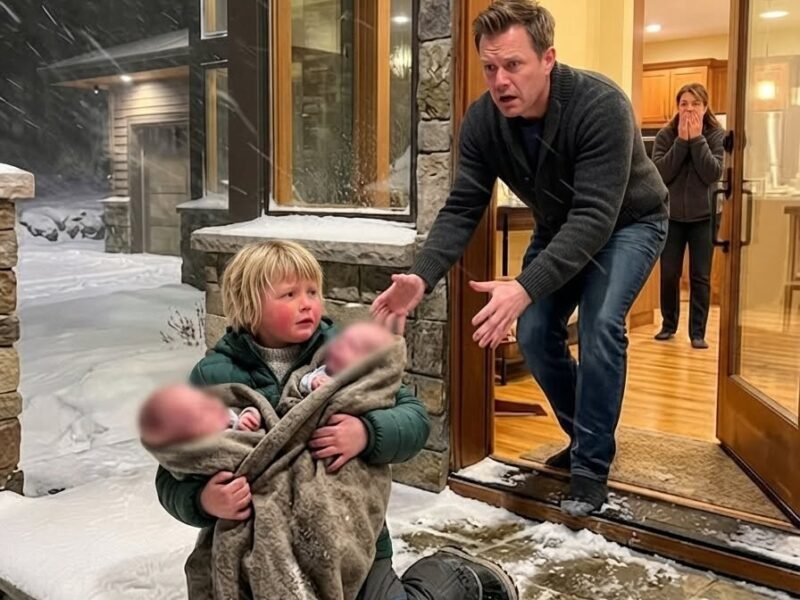
I had just finished a twelve-hour hospital shift when I turned into our driveway and felt something inside my chest quietly collapse, not with a sharp crack, but with that slow, sinking absence that creeps in before your mind is ready to admit fear, the kind that makes the world feel oddly muted, as if reality itself is holding its breath.
The hospital had taken everything out of me that day. Twelve hours of relentless noise and sterile light, of families clinging to hope in waiting rooms, of doctors speaking in careful tones that carried the weight of life-altering consequences. By the time I drove home, my hands were stiff from gloves and disinfectant, my head throbbed, and my body moved on memory alone. I was exhausted in a way that felt cellular, as if sleep itself might not be enough to undo it.
All I wanted was to walk into my house and let the ordinary wrap around me.
I wanted to hear my daughter’s voice asking what we were having for dinner. I wanted to lift my baby son and feel his warm, familiar weight settle against my shoulder. I wanted proof that after a day spent watching things go wrong, my own world was still intact.
My daughter, Aria, was seven years old—bright-eyed, thoughtful, the kind of child who noticed when adults were pretending everything was fine. She read books well above her age and asked questions that sometimes stopped me cold. Her little brother, Micah, was sixteen months old, still discovering gravity and balance, still trusting completely that the arms holding him would never fail.
They were my anchor.
That morning, I had left them with my parents, like I had dozens of times before. My husband, Thomas, was out of town for work, and my parents had insisted they were happy to help. I kissed my children goodbye without hesitation, waved from the driveway, and drove to the hospital believing, foolishly, that some things in life were too familiar to ever go wrong.
So when I pulled into the driveway that evening and saw it empty, a small voice inside me whispered that something wasn’t right.
No car. No lights. No sound from inside the house.
I stood there longer than I should have, trying to reason it away. Maybe they went out. Maybe they lost track of time. Maybe I was just tired and imagining problems where none existed. I picked up my bag and was about to walk toward the front door when movement near the trees behind the house caught my eye.
Our backyard bordered a dense stretch of woods, the kind that felt harmless in daylight but swallowed sound once the sun dipped low. We had strict rules about it. Aria knew them by heart. Never go near the woods alone. Never take Micah with you. Never.
My heart stumbled when I saw a small figure push through the brush.
Bare feet touched the grass.
And then I saw her face.
I don’t remember dropping my bag. I don’t remember how fast I ran. I only remember the way time warped as I crossed that distance, how every detail burned itself into my mind—the dirt streaked across her legs, the blood smeared along her feet, the way her arms were locked tight around her baby brother as if letting go might undo everything she had done to keep him alive.
She didn’t cry when she saw me.
She didn’t even look relieved.
She just kept walking until she was close enough that I could see her trembling.
I reached for Micah, panic roaring through me, but Aria flinched back, her grip tightening.
“I have him,” she whispered, her voice hoarse, like she had screamed herself empty hours ago.
I dropped to my knees in front of her, ignoring the ache in my own body, forcing my voice into something soft and steady. I told her she was safe. I told her she did so good. I told her Mommy was here now, and she could let go.
Her lips quivered. Tears finally spilled over, cutting clean lines through the dirt on her face.
“I didn’t let him fall,” she whispered. “I didn’t let him go, even when my arms hurt.”
When she finally loosened her hold, her legs gave out. I caught her, wrapping both of my children against me as we sank into the grass. Micah whimpered weakly but breathed. Aria clung to me, her entire body shaking now that she no longer had to be strong.
Inside me, something shattered beyond repair.
Later, in fragments and broken sentences, she told me what happened.
Grandma parked the car and said she would be right back. Aria waited. Micah cried. The sun got hot. She pressed buttons, screamed for help, held her brother and told him stories to keep him quiet. When Grandpa came later, he wasn’t Grandpa anymore. His voice was wrong. His hands were rough. His eyes didn’t recognize her.
So she ran.
She ran into the woods because she remembered what I told her—run where adults can’t follow fast. She hid. She carried Micah when he couldn’t walk. She found water and wet her fingers to touch his lips. She stayed quiet when she heard her name being called in a voice that didn’t feel safe.
She walked until her feet bled.
She carried her brother until her arms went numb.
And when she thought she couldn’t go any farther, she stood up anyway.
Emergency services came. Reports were made. Doctors examined wounds no child should have. My parents were found hours later, lost inside illnesses we hadn’t wanted to see, their mistakes leaving scars that could never fully fade.
There was no intention to harm.
But intention doesn’t erase consequence.
Aria went to therapy. She had nightmares. She checked on Micah constantly. Some days she seemed older than her years, her childhood folded inward around something fragile and fierce.
But slowly, she came back to herself.
Today, she is eleven. Micah is five. He laughs easily, unaware of how close he came to being lost. Aria still remembers the woods, but she also remembers that she survived them.
Sometimes I watch her and feel something heavier than fear and stronger than grief.
My daughter was seven years old, terrified, injured, and alone—and she chose to protect someone smaller than herself.
She didn’t have strength meant for adults.
She had love.
And that love carried them both home.
Website Disclaimer
The information provided on this website is for general informational and educational purposes only. While we strive to ensure that all content is accurate and up to date, we make no guarantees regarding the completeness, reliability, or accuracy of any information published.
The views and opinions expressed in articles belong to their respective authors and do not necessarily reflect the views of this website. Any action you take based on the information found on this website is strictly at your own risk. We will not be liable for any losses, damages, or inconveniences arising from the use of our content.
Some articles may contain opinions, third-party information, or external links. We do not endorse or guarantee the accuracy of content on external websites and are not responsible for their practices or policies.
All content on this website is provided in good faith and is intended for informational purposes only. Readers are encouraged to verify information independently and seek professional advice where appropriate.