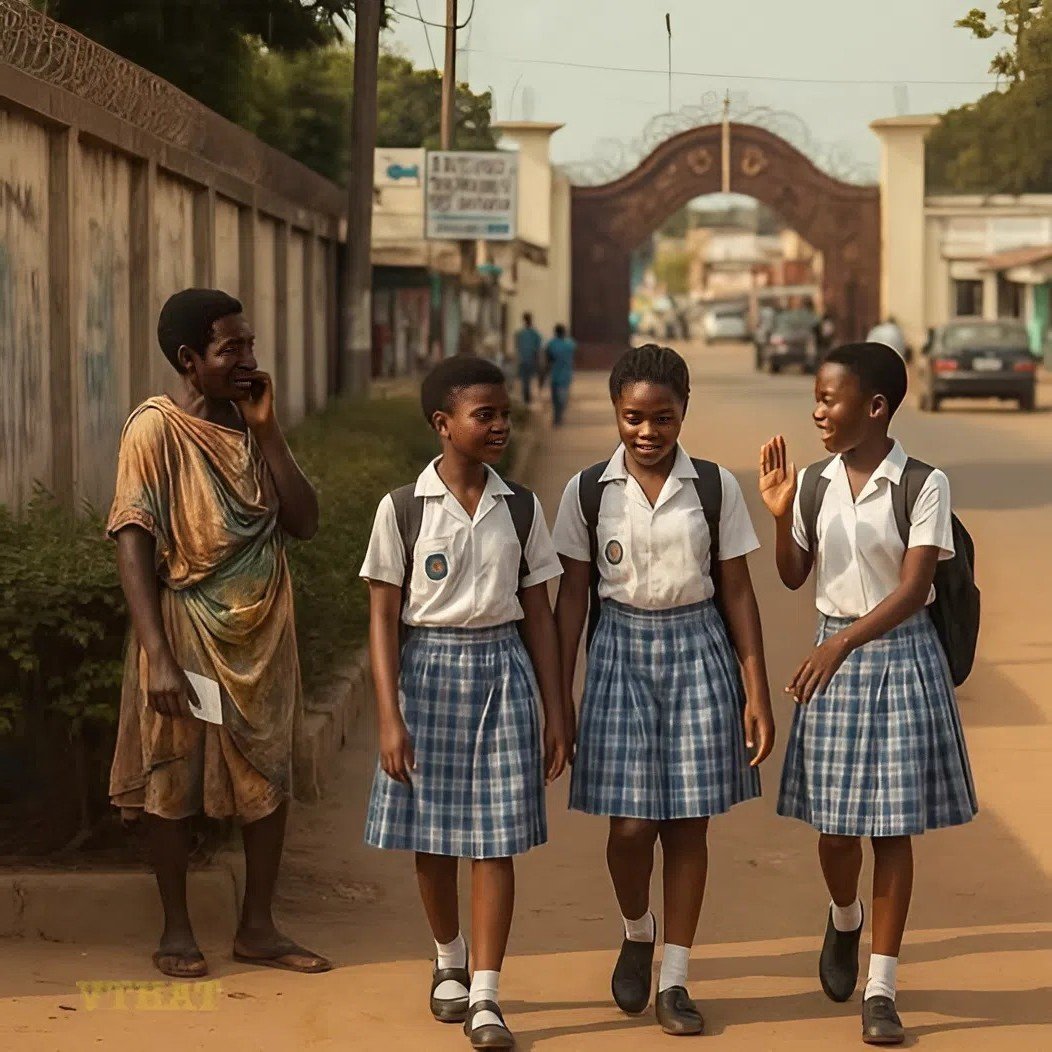
Barefoot, with tangled hair and torn wrappers, the woman would smile gently and whisper:
At first, the children laughed. They called her “the mad woman of the corner.”
But as the days passed, the laughter faded, replaced by unease. Because no matter the weather — rain or shine — the woman was always there, waiting.
And she spoke only to Eunice.
A Rich Child and a Street Phantom
Eunice came from one of the wealthiest families in the city. Her father, Mr. Dominic, was a business magnate who owned several real-estate firms. Her mother, Mrs. Clara Dominic, was a celebrated philanthropist — the kind of woman whose name appeared on billboards for charity galas.
Their mansion was the largest on Hillview Estate, and Eunice attended Bright Future Academy, an elite private school where students arrived in luxury SUVs driven by chauffeurs.
But Eunice, wanting to appear humble and “normal” among her friends, had begged her parents to let her walk home instead of being picked up.
They reluctantly agreed — unaware that the decision would change everything.
“She Says She’s Your Mother!”
It began innocently enough. The first time Eunice noticed the strange woman was on a Friday afternoon.
The woman stood under a tree, smiling at her with eyes that looked oddly familiar.
“Eunice,” she whispered, “my daughter, come to me.”
Eunice froze. Her friends laughed. “Who’s that crazy woman?” one asked.
“I don’t know,” Eunice said, shaking her head. “She’s probably mad.”
From that day, it became a pattern. Every afternoon, the woman appeared, calling her name, smiling, and whispering that she was her real mother.
Eunice tried to ignore her, but her friends kept teasing her.
“Maybe she really is your mom!” one joked. “Maybe your parents picked you from the gutter!”
Eunice forced a laugh, but something inside her twisted with discomfort.
The Shame and the Anger
Weeks passed, and the woman’s persistence grew.
Sometimes she followed them halfway down the road, barefoot, pleading softly, “Eunice, please… listen to me. Let me explain.”
Each time, Eunice’s embarrassment turned to anger.
She started snapping at her friends whenever they mentioned the woman.
At home, she considered telling her parents, but she feared they would scold her for walking alone. Besides, she convinced herself it wasn’t worth bothering them over a madwoman’s nonsense.
Until one fateful afternoon.
That day, as Eunice walked past the old gate by the road, the woman stepped forward suddenly and blocked her path. Her voice shook as she said,
“Please, my child, just one minute. Let me show you proof. I am your mother — the woman they took you from.”
Her hands trembled as she reached into the folds of her wrapper.
But Eunice, furious and frightened, shouted, “Leave me alone! You’re crazy! I’m not your daughter! My real parents are rich and alive — not a dirty madwoman like you!”
The words sliced through the air like knives.
The woman stopped. Tears filled her eyes.
She whispered only one sentence before turning away:
“Then one day, you’ll know the truth.”
The Next Afternoon — Silence
The next day, the roadside was empty.
No ragged figure. No whisper. No familiar presence under the mango tree.
Eunice’s friends cheered.
“Good! You scared her away!” one said, giving her a high-five.
They joked all the way home, but Eunice didn’t laugh.
That night, lying in bed, she stared at the ceiling and replayed the woman’s words.
“They took you from me.”
It sounded insane… but something about the woman’s eyes — the shape, the depth — had felt hauntingly familiar.
The News That Shattered Everything
A week later, Eunice woke up to an unusual atmosphere at home. The housemaids whispered. Her parents looked pale and tense.
At breakfast, her mother forced a smile. “Eunice, darling, don’t walk home from school anymore. The driver will pick you up.”
“Why?”
“Because… there was an accident yesterday,” her father said quietly. “A woman was hit by a car near your school. She—”
He hesitated.
“She died instantly,” her mother finished, her tone too calm to be real. “You don’t need to worry about it.”
Eunice felt the blood drain from her face.
“Was she… the mad woman?”
Her parents exchanged a glance.
“How do you know about her?” her mother asked sharply.
“She—she used to talk to me. She said she was my mother.”
Her father’s spoon clattered against his cup. “That woman was crazy! Don’t ever say that again, do you hear me?”
But Eunice noticed the flicker of fear in his eyes.
The Letter Hidden in the Drawer
Days passed. The house returned to its quiet routine, but Eunice couldn’t shake the feeling that something wasn’t right.
Her parents avoided the topic, but servants whispered behind closed doors.
One evening, while searching her mother’s study for art paper, Eunice opened a locked drawer. Inside, under a pile of old letters, she found a yellowing envelope labeled:
“PROPERTY OF MRS. CLARA DOMINIC — PRIVATE & CONFIDENTIAL”
Her hands trembled as she pulled out the papers inside.
The first line made her gasp.
“Certificate of Adoption — Eunice Chiamaka, Female, 3 years old.”
The date matched her birth year.
The signature at the bottom was her parents’.
And clipped to the certificate was an old photo — a woman in a hospital gown, holding a newborn baby.
The woman’s face — even under exhaustion and tears — was unmistakable.
It was her. The madwoman by the roadside.
Eunice’s knees buckled. The room spun.
The Secret Buried in Wealth
When her parents returned that night, she confronted them, trembling and furious.
“Why didn’t you tell me? Who was she?”
Her mother paled. “Eunice, please—”
“Was that woman really my mother? The one who died?”
Silence.
Her father rubbed his temples. “Listen, sweetheart… yes. You were adopted. But it’s not what you think.”
“Then what happened?” she cried.
He exhaled slowly. “She was a patient at Saint Mary’s Hospital. Years ago, she suffered a mental breakdown after your birth. The doctors said she was unfit to raise a child. We wanted a family — and she agreed to the adoption.”
“Did she?” Eunice whispered. “Or did you just take me?”
“Eunice!” her mother snapped. “We gave you everything! Education, comfort, love! You think we’re villains because we tried to save you from poverty?”
Tears streamed down the child’s face.
“I didn’t need saving,” she said quietly. “I just wanted the truth.”
The Man Who Knew Everything
A few days later, Eunice skipped school and went to Saint Mary’s Hospital.
She found the oldest nurse there, an elderly woman named Sister Bernadette, who still remembered her case.
“Yes,” the nurse said sadly. “Your mother’s name was Ngozi. She wasn’t always mad. She was a kind woman — a teacher before life broke her. Her husband died in a factory explosion when she was eight months pregnant. She lost everything. After childbirth, depression consumed her. The hospital contacted a wealthy couple for adoption. That’s how you left here.”
Eunice’s throat closed. “Did she ever recover?”
“For a while,” Sister Bernadette said softly. “But when she realized you were gone, she relapsed. She escaped the hospital one night, and… well, you know the rest.”
The nurse reached into a drawer and handed Eunice a small box.
“She left this behind. I always hoped someone would come for it.”
Inside was a tiny silver bracelet engraved with one word:
EUNICE.
The Guilt That Haunts
That night, Eunice couldn’t sleep.
Her mind replayed every cruel word she had thrown at the woman who had given her life.
“I can never be a daughter to a mad useless woman.”
The phrase echoed like a curse.
Her adoptive mother tried to comfort her, but Eunice withdrew. She stopped eating, stopped talking. At school, her grades dropped.
Finally, one evening, she went to her parents’ room and said quietly, “I forgive you. But I need to visit her grave.”
The Grave Beside the Mango Tree
They took her to a small public cemetery at the edge of the city.
Under a mango tree — the same kind she had walked past every day — stood a simple headstone:
Ngozi Chiamaka (1986–2023)
“She loved her child more than life itself.”
Eunice knelt, touching the soil with trembling fingers.
A breeze brushed her cheek. For the first time, she didn’t feel fear or shame.
Only love — a strange, aching kind of love that transcended everything.
She whispered, “I’m sorry, Mama. I didn’t know.”
Tears fell freely as she placed the silver bracelet on the grave.
And though no one else saw it, she swore she felt warm arms wrap around her shoulders — invisible but real — as if the wind itself forgave her.
The Letter That Changed Everything
Months later, a lawyer arrived at their mansion.
He handed Mrs. Dominic an envelope. “This was left in Miss Ngozi’s file,” he said. “She requested it be delivered to the girl if anything happened to her.”
Eunice opened it slowly.
My little star,
If you’re reading this, it means I’m gone. Please don’t hate the people who raised you. They gave you what I couldn’t — safety. But never forget who you are. You came from love, not madness. And no matter where life takes you, know that every sunrise I ever saw, I prayed you were smiling somewhere.
— Mama
Eunice folded the letter against her heart and sobbed quietly.
Years Later — The Girl Who Built a Home
Fifteen years passed. Eunice grew into a compassionate young woman, a social worker who helped children in foster care and orphans searching for identity.
She founded the Ngozi Foundation for Lost Children, dedicated to reuniting families and supporting mothers with mental health challenges.
At every event, she wore a silver bracelet around her wrist — the one her mother had left behind.
During one public speech, she said:
“I once thought madness meant weakness.
But sometimes, madness is just love that has nowhere left to go.”
The crowd rose in applause.
Somewhere deep in her heart, Eunice felt peace at last — the kind her biological mother had never found.
Epilogue — The Photo on the Wall
In her office hung a framed photo: a little girl holding hands with a smiling woman in rags under a mango tree.
It wasn’t a real photograph, but a painting Eunice had commissioned from memory — the mother she never truly met, the one the world had called mad, but who, in her heart, had always been simply Mama.
Every morning, before heading out to work, Eunice would pause before that picture and whisper:
“Thank you for waiting for me… I finally came home.”
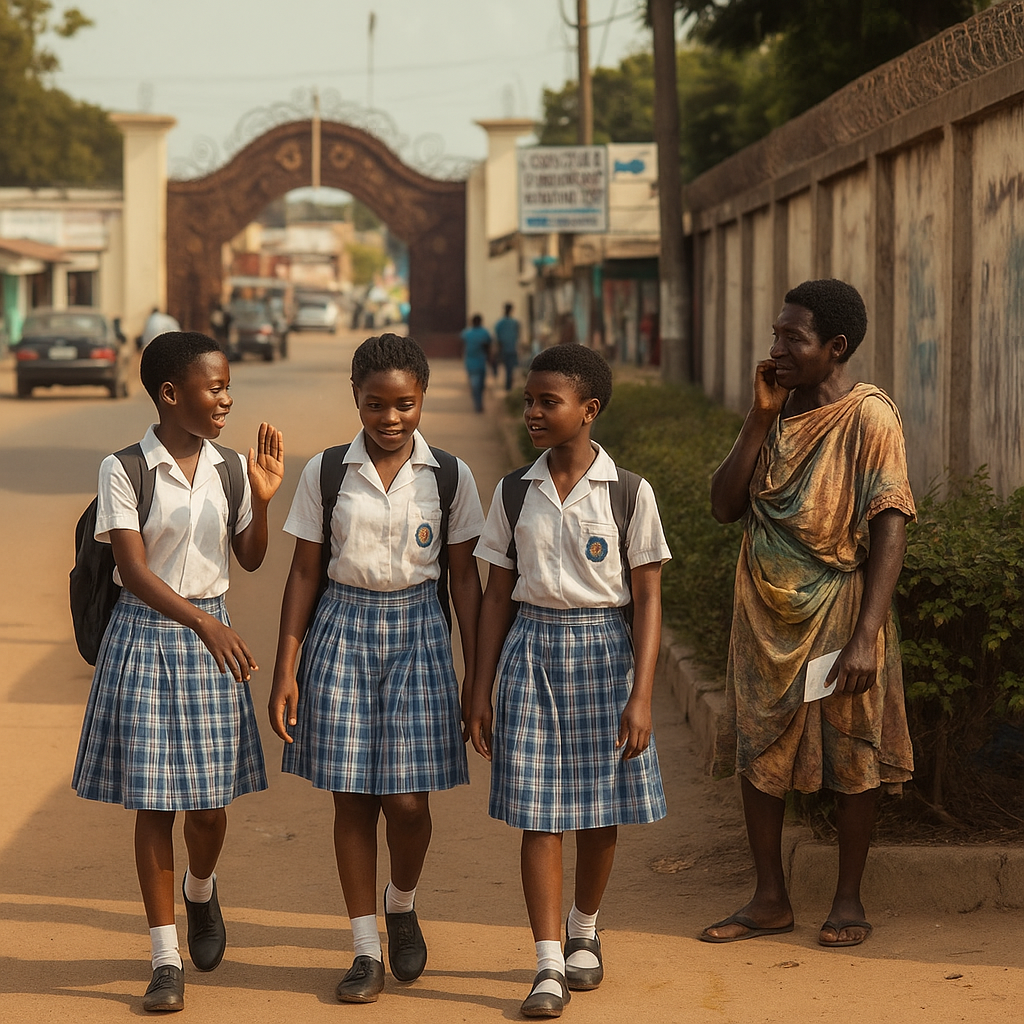
The world called her mad, but madness was not what she carried.
She carried grief — deep, relentless, raw.
Her name was Ngozi Chiamaka, once a bright schoolteacher in a small community outside Lagos.
Her life had been ordinary — simple classroom mornings, laughter echoing through wooden desks, and chalk dust that clung to her fingers like dreams.
And then she met Kenechukwu, a factory worker with gentle eyes and hands that smelled of metal and soap. They married, and for a time, happiness bloomed like the hibiscus in front of their rented room.
They didn’t have much, but they had love — enough to paint hope across cracked walls and leaking ceilings.
Until the day the factory exploded.
The Day the Sky Fell
Ngozi was eight months pregnant when it happened.
The explosion was so loud it rattled every window in their neighborhood.
She ran barefoot to the gates, pushing past the smoke and screaming families, searching for Kene.
She found only his helmet, twisted and blackened.
Her screams were not the kind that faded.
They were the kind that broke the world open.
Neighbors held her as she collapsed, her arms wrapped around her belly, crying for both her husband and the unborn child who would never know him.
That night, under the yellow hospital lights, she gave birth to a baby girl.
The doctors said the shock had been too much. Her blood pressure dropped. She drifted in and out of consciousness, whispering, “Kene… she has your eyes.”
When she finally woke again, three days later, the baby was gone.
The Disappearance
At first, they told her the child was in the nursery.
Then they said the baby had been taken to another ward for observation.
Then came silence.
Ngozi screamed, cried, begged.
No one answered.
When she tried to leave her hospital bed to search, two nurses restrained her.
They said she was “unstable.”
They said she was “losing her mind.”
But she wasn’t losing it — she was fighting for it.
In her heart, she felt the bond, the invisible thread between mother and child. She could still feel her baby’s warmth, still hear her cry in dreams.
But to the doctors, she was simply a grieving widow on the verge of psychosis.
So they sedated her.
And when she woke again, the papers had been signed.
Her baby was gone — adopted by a wealthy couple from the city.
The Breaking
She left the hospital weeks later, her body healed but her soul in ruins.
Her tiny home was empty, filled only with her husband’s faded shirt and a broken cradle.
At night, she sat on the floor, singing lullabies to the silence.
Each day, she went to the hospital, begging for answers.
Each day, they told her to go home and “accept fate.”
But acceptance was impossible.
When she tried to report it to the police, they laughed.
“No one steals a baby from a hospital,” they said.
“Go and rest, woman.”
And so, little by little, the world turned its back on her.
When hunger came, she begged.
When rejection came, she wandered.
When grief became too heavy, she screamed at the sky.
And when people saw her screaming, they pointed and said, “There goes the mad woman.”
The Road to the City
Years passed.
Her hair turned to knots, her skin to dust.
But her memory never faded.
She remembered the hospital’s words — the city name on the adoption papers she had glimpsed before they were taken away.
“Dominic.” That was the name she remembered.
So she began to walk.
From village to village, from market to market, she searched.
People mocked her, threw stones, stole the few coins she had.
But nothing could break her will.
Until one day, years later, she saw her.
A little girl, dressed in a crisp white school uniform, laughing with friends, her backpack bouncing as she walked.
Something inside Ngozi’s chest cracked open.
Her heartbeat quickened, her breath trembled.
She knew.
She didn’t need a photograph or proof.
A mother knows her child — even after ten years, even through time, even through madness.
The First Encounter
The first day she saw Eunice, she couldn’t speak.
She just stood by the roadside, clutching her dirty wrapper, whispering, “My baby… my baby.”
But the next day, when she gathered courage to speak, the words spilled out like rain:
“Eunice, it’s me. I’m your mother.”
The children laughed. They called her crazy.
Eunice frowned, embarrassed.
Still, Ngozi returned every day, waiting by the mango tree after school.
She would smile and wave, even when the sun burned her skin.
And each evening, when the little girl disappeared down the road, she would whisper to herself,
“Tomorrow, maybe she’ll believe me.”
The Proof
After weeks of rejection, Ngozi decided to show Eunice the only thing she had left — the hospital bracelet from the day of birth, with the words “Baby Chiamaka – Girl” etched on it.
She wrapped it in a torn handkerchief and waited by the road again.
When Eunice passed that afternoon, Ngozi stepped forward, pleading softly, “My daughter, please, I have proof. Look—”
But the girl’s face hardened.
Anger flashed in her eyes.
“I’m not your daughter!” she shouted. “Stay away from me! You’re just a mad, useless woman!”
Ngozi froze. The words hit harder than stones.
She wanted to scream that she wasn’t mad, that she had once been a teacher, a wife, a dreamer.
But what came out instead was a choked whisper:
“Then one day, you’ll know.”
Tears burned her cheeks as she turned away.
That night, she slept under the bridge, clutching the hospital bracelet to her chest, whispering lullabies into the dark.
The Last Day
The next morning, she decided to try one more time.
She didn’t care if the girl screamed again. She just wanted to say she loved her — once, before it was too late.
As she crossed the road toward the school, holding the little handkerchief tightly, she heard the sound of an engine — loud, fast, furious.
A flash of light.
A horn.
Then silence.
People screamed.
When they ran to her, she was lying motionless on the ground, blood pooling beside the bracelet she had dropped.
But even as her body grew cold, her lips still moved, forming a single word:
“Eunice.”
The Aftermath
In the morgue, a young mortuary attendant found the bracelet in her hand and slipped it into her file, writing “Unknown woman.”
But to Ngozi, even in death, she wasn’t unknown.
She was still a mother.
Her spirit didn’t leave immediately.
For days, it lingered — in the rustle of the mango leaves, in the wind that brushed Eunice’s cheek as she passed the empty roadside.
And when Eunice finally found her grave years later, the breeze that touched her hair carried the faintest whisper:
“I forgive you, my daughter.”
Years After — The Spirit’s Peace
Time flowed on.
In the quiet beyond the world, where pain dissolves and memories shine like stars, Ngozi watched.
She saw her daughter grow, study, and one day stand before a crowd, speaking words that made the heavens themselves pause.
“I once thought madness meant weakness,” Eunice said. “But sometimes, madness is just love that has nowhere left to go.”
Ngozi smiled.
That was her child — brave, kind, wise.
In that moment, the restless wind around her stilled.
Her heart, which had been searching for a decade, finally rested.
She whispered into the light:
“Now I can sleep. My baby found her way home.”
And the world — cruel, beautiful, unforgiving — continued to spin.
But somewhere, under an old mango tree, wild flowers grew around a nameless grave, swaying gently as if cradling an invisible lullaby.
Epilogue — The Woman in the Painting
Years later, when Eunice opened her foundation’s headquarters, she unveiled a painting of her mother at the entrance.
In it, the ragged “madwoman” was standing barefoot by a dusty road, holding a small silver bracelet, smiling through tears.
At the bottom, a single inscription read:
“She was never mad — only heartbroken.”
Visitors would often pause before the painting, feeling something shift deep inside them. Some said they could almost hear a faint voice whispering from it — a voice filled with love and longing:
“Every mother deserves to be heard.”
And on quiet evenings, when Eunice stayed late in her office, she sometimes felt a soft wind circle her chair, smelling faintly of hibiscus and rain.
Then she would smile, place her hand over her heart, and whisper,
“Rest now, Mama. Your story is safe with me.”
Website Disclaimer
The information provided on this website is for general informational and educational purposes only. While we strive to ensure that all content is accurate and up to date, we make no guarantees regarding the completeness, reliability, or accuracy of any information published.
The views and opinions expressed in articles belong to their respective authors and do not necessarily reflect the views of this website. Any action you take based on the information found on this website is strictly at your own risk. We will not be liable for any losses, damages, or inconveniences arising from the use of our content.
Some articles may contain opinions, third-party information, or external links. We do not endorse or guarantee the accuracy of content on external websites and are not responsible for their practices or policies.
All content on this website is provided in good faith and is intended for informational purposes only. Readers are encouraged to verify information independently and seek professional advice where appropriate.