Poland has announced plans to create a no-fly zone along its border with Ukraine, following repeated incursions into its airspace blamed on Russia, officials said on Wednesday.
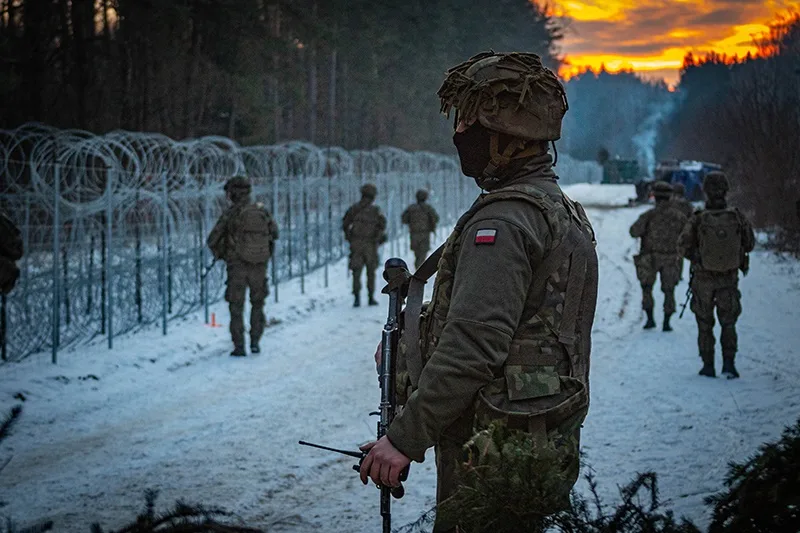
Deputy Defence Minister Cezary Tomczyk said the government was preparing a decree to establish the zone, which he hoped would take effect by the end of December or early January. The move comes after a series of alarming incidents in which Russian missiles and drones crossed into Polish territory during attacks on Ukraine.
The Incidents That Forced Warsaw’s Hand
The most serious incident came overnight on 19 and 20 November, when three Russian Kh-101 cruise missiles landed in undeveloped ground in south-eastern Poland during a large-scale Russian strike on western Ukraine. The missiles came down near Nowy Lipowiec, Rudnik nad Sanem and Mołodycz. No injuries were reported, and there was no significant damage, but the fact that Russian cruise missiles had struck NATO territory sent shockwaves through Warsaw.
According to reports, the missiles spent roughly three minutes in Polish airspace before impact. Poor weather prevented Swedish-flown Gripen fighters from confirming what they were looking at in time to intercept them.
Then, late on 23 November, a Russian reconnaissance drone entered Polish airspace over the Lublin region at about 11 p.m., flying roughly 20 kilometres inside and staying for about nine minutes. Polish forces were authorised to shoot it down but chose not to, fearing damage on the ground, after the drone turned back east. An air-attack alert was lifted about an hour later.
What the No-Fly Zone Will Do
Speaking on Wednesday at the opening of a new military satellite imaging centre, Tomczyk announced that his department would ask the government to establish a no-fly zone on the country’s eastern border, to ensure Poland’s security.
The proposed zone would stretch for a distance of between a dozen and a few dozen kilometres from the border, Tomczyk said, with some reports putting the figure at up to 50 kilometres. A relevant regulation had already been submitted to the government and would be processed in the coming weeks, he added.
The purpose is practical: to make it easier for Polish pilots to shoot down Russian missiles and drones that violate Polish airspace. Under a recently introduced procedure, Polish pilots can already identify and potentially engage aerial targets based on radar information, intelligence from allies, altitude and speed, rather than requiring visual identification. Tomczyk said the no-fly zone would be an additional factor supporting the operations of the Polish Air Force.
“When a Polish fighter pilot knows that an aircraft is entering Polish airspace from Ukraine, is flying at a certain altitude and speed, is entering the no-fly zone and is detected on radar, this constitutes grounds for shooting down such an object,” he said. “We will also urge NATO as a whole to establish such a rule on the eastern flank.”
NATO’s Response So Far
NATO held an extraordinary session of its North Atlantic Council in Brussels on 23 November. The alliance’s Supreme Allied Commander Europe authorised the forward deployment of an AWACS early-warning aircraft to Poland, which the deputy defence minister described as a very serious capability that gives Poland enhanced situational awareness. Secretary-General Mark Rutte, asked whether the incursion had been intentional, said he would never speculate.
Poland has also raised a bolder question: whether NATO should shoot down Russian missiles over Ukraine when they are heading towards alliance territory. Foreign Minister Radosław Sikorski said on 25 November that shooting down Russian missiles over Ukraine at Kyiv’s request could constitute an act of self-defence. However, the defence ministry acknowledged that NATO is so far opposed to the idea.
Tomczyk denied that Poland intended to seek NATO’s permission to target Russian missiles and drones over Ukrainian airspace heading towards the Polish border, drawing a distinction between acting over Polish soil and acting over Ukraine.
A Border Already Tightly Controlled
Poland already restricts flights near its eastern border below an altitude of roughly three kilometres during the day, and flights are generally prohibited in the area between sunset and sunrise, with exemptions for essential medical operations. The new no-fly zone would tighten those controls further and give military commanders clearer rules of engagement.
This is not the first time Poland has had to confront Russian aerial incursions. In September 2025, Poland shot down Russian drones that entered its airspace during a large-scale Russian attack on Ukraine, the first time a NATO member had engaged Russian aerial targets since the start of the full-scale war.
Warsaw has steadily tightened protection of its eastern airspace as Russian missiles and drones increasingly approach or enter NATO territory. Following the 20 November incident, NATO began examining whether additional forces and equipment should be moved to Poland.
What Comes Next
The no-fly zone is expected to be in place around the turn of the year, but it does not answer every question. It clarifies the rules of engagement over Polish territory, yet it does not close the detection gap that allowed three cruise missiles to spend three minutes over Polish soil undetected, and it does not resolve the harder question of whether NATO will authorise engagement of missiles while they are still over Ukraine.
For now, Poland’s message is clear: its airspace is not open ground, and the next Russian missile or drone that crosses the border will meet a military that has been given explicit permission to shoot it down.
Website Disclaimer
The information provided on this website is for general informational and educational purposes only. While we strive to ensure that all content is accurate and up to date, we make no guarantees regarding the completeness, reliability, or accuracy of any information published.
The views and opinions expressed in articles belong to their respective authors and do not necessarily reflect the views of this website. Any action you take based on the information found on this website is strictly at your own risk. We will not be liable for any losses, damages, or inconveniences arising from the use of our content.
Some articles may contain opinions, third-party information, or external links. We do not endorse or guarantee the accuracy of content on external websites and are not responsible for their practices or policies.
All content on this website is provided in good faith and is intended for informational purposes only. Readers are encouraged to verify information independently and seek professional advice where appropriate.