Nigeria’s anti-drug agency has dismantled an industrial-scale methamphetamine laboratory in the southeastern state of Enugu, seizing more than 1.5 tonnes of the drug and arresting five Mexican nationals and a Nigerian businessman, officials announced on Wednesday.
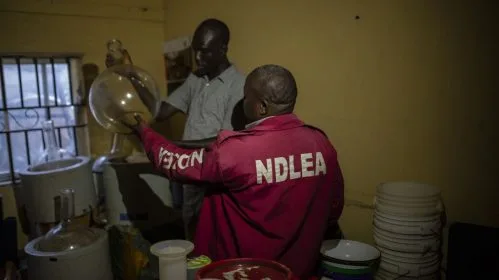
The National Drug Law Enforcement Agency, known as the NDLEA, said the drugs recovered were worth an estimated 227 million dollars, or around 304 billion naira, making it one of the largest drug busts in the country’s history. The haul included finished methamphetamine as well as drugs still being produced, along with nearly seven tonnes of precursor chemicals.
A Seven-Month Investigation Across Four Countries
Announcing the breakthrough at a press conference in Abuja on Wednesday 25 November, NDLEA chairman Brigadier General Mohamed Buba Marwa described it as one of the most carefully planned, intelligence-led operations the agency has ever carried out.
According to Marwa, the investigation began in April 2026 with intelligence identifying a Nigerian suspect as a specialist in setting up clandestine methamphetamine laboratories. The trail then stretched across Mexico, Colombia, France and the Republic of Benin before ending at an industrial complex in Enugu.
Marwa said the operation began in faraway Mexico, ran through Colombia, France and the Republic of Benin, crossed into Lagos, and ended in an industrial complex in Enugu. More than 200 officers from the agency’s Strike Force and its Enugu State Command were eventually deployed in the raid.
The Nigerian Baron and His Mexican Experts
The Nigerian suspect was named as 63-year-old Chuks Enoch Ezeike, a businessman also known as “Over Size”, who holds the traditional title of Ebekuo Dike na Nanka in his community in Anambra state. Ezeike was arrested in Room 106 of Adig Suites, a hotel on Nwafor Orizu Street in Enugu, during simultaneous raids on 11 November.
The five Mexicans were arrested at the laboratory itself while production was under way. The NDLEA identified them as Oscar Ramos-Cardenas, described as the alleged leader and chief specialist, Juan Antonio Sarabia-Cabrera, Luis Enrique Garcia-Amador, Jose Alejandro Renteria-Reyes and Salomon Cabanillas-Torres.
Investigators say Ezeike had recruited the five men, all described as methamphetamine experts, to manufacture the drug on Nigerian soil. The laboratory was hidden behind the San Savanna Oil Company complex on the Abakaliki Expressway at Emene, Enugu, and included living quarters for the Mexicans so they could live and work in the same place without being seen in town.
Forged Passports and a Second Attempt to Enter
The story of how the Mexicans reached Nigeria reads like a thriller. The NDLEA first intercepted them when they arrived in Abuja on 28 August 2026, and they were denied entry on the basis of intelligence about their alleged plans.
Undeterred, Ezeike and his collaborators arranged a new route. The five men were flown from Bogotá, Colombia, through Paris, France, to the Republic of Benin, while Ezeike procured forged Argentine, Colombian and Chilean passports and sent them by driver to Cotonou, where the Mexicans handed over their genuine passports and took on new identities.
On 19 September, the agency was alerted that the five men had arrived in Cotonou and intended to slip into Nigeria through the land border. Rather than stopping them, the NDLEA allowed them to enter under surveillance, so that investigators could track the entire network and identify its financiers, production specialists and facilities.
Weeks of Surveillance
Operatives monitored the suspects throughout September and October, tracking their movements between the San Savanna complex, where the Mexicans lived and worked, and Adig Suites, where Ezeike stayed. Ezeike moved between the locations in three vehicles: a blue Toyota Corolla, a red Toyota RAV4 and a Lexus RX 350.
By 7 November, the agency said it had gathered enough intelligence to establish the full scope of the network. Four days later, on 11 November, operatives from the Special Operations Unit, the Strike Force, the Forensic Directorate and the Enugu State Command carried out simultaneous operations at the laboratory and at Ezeike’s hotel.
The haul was enormous: 1,512 kilogrammes of methamphetamine, finished and in production, with an estimated value of 226.8 million dollars, alongside 6,680 kilogrammes of 20 different types of precursor and essential chemicals and an array of industrial equipment. The cartel’s production cycle was expected to yield drugs worth the full 227 million dollars.
A Growing Problem in the South
Marwa said Nigeria has now dismantled four industrial-scale meth-producing laboratories, all of them located in the country’s south. The agency dismantled another meth syndicate in May this year, arresting ten suspects, including three Mexicans.
The agency has not identified the Mexican cartel it suspects was involved, nor said whether the six suspects have yet been formally charged. The Mexicans had reportedly been due to leave Nigeria on Friday 13 November, just two days after the raid, which suggests the operation was timed to catch them before they could disappear.
For the NDLEA, the Enugu bust is a showcase of what months of patient surveillance can achieve. For Nigeria, it is also a reminder of how far international drug networks are willing to go, flying specialists across three continents and through forged passports to build a factory in a quiet corner of the southeast.
Website Disclaimer
The information provided on this website is for general informational and educational purposes only. While we strive to ensure that all content is accurate and up to date, we make no guarantees regarding the completeness, reliability, or accuracy of any information published.
The views and opinions expressed in articles belong to their respective authors and do not necessarily reflect the views of this website. Any action you take based on the information found on this website is strictly at your own risk. We will not be liable for any losses, damages, or inconveniences arising from the use of our content.
Some articles may contain opinions, third-party information, or external links. We do not endorse or guarantee the accuracy of content on external websites and are not responsible for their practices or policies.
All content on this website is provided in good faith and is intended for informational purposes only. Readers are encouraged to verify information independently and seek professional advice where appropriate.