When my father died, the world went quiet. The house filled with flowers and condolences, people whispering things like “He was such a good man,” as if their words could fill the void he left behind. But what stood out most wasn’t the grief — it was the small, rusted blue toolbox sitting beside his favorite chair.
It wasn’t worth anything. The paint was chipped, the handle worn to metal, the lock fused by age. It looked more like junk than inheritance. Yet, that’s all he left me — no savings, no car, just that box.
“Maybe it’s symbolic,” my aunt offered. “He built things. Maybe it represents how he built your life.”
I nodded, but I knew better. My father didn’t do metaphors. If he wanted to tell me something, he’d have said it. Still, the box made me uneasy. I left it by the door, half planning to throw it in the garage later, half afraid to touch it.
Three days after the funeral, the doorbell rang. Standing there in her perfect pink coat, holding a tray of muffins, was my stepmother, April.
She’d been in my life for over twenty years — always polite, always polished. The kind of woman who smiled wide enough to hide whatever she really felt.
“Oh, Marla, sweetheart,” she said softly. “Just checking in. How are you holding up?”
I lied, like everyone does after a funeral. “I’m fine.”
Her eyes drifted past me, landing on the toolbox. For a second, her perfect mask slipped. “Oh my,” she said, forcing a laugh. “That old thing? What an eyesore.”
“It was Dad’s,” I replied.
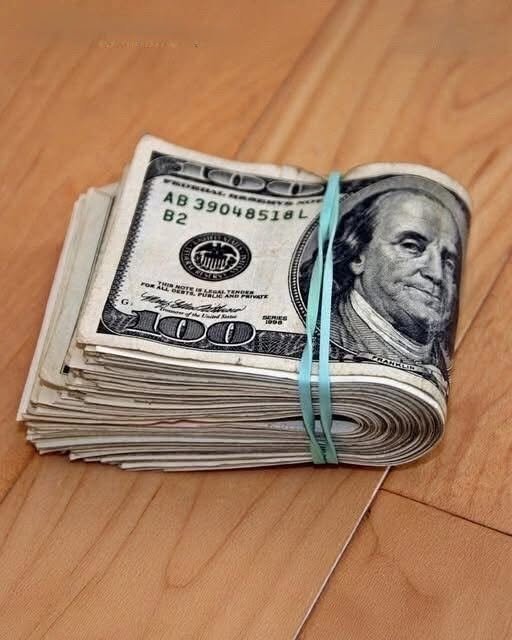
“I’ll give you five thousand dollars to get rid of it.”
I stared at her. “Excuse me?”
She smiled that rehearsed, honey-sweet smile. “It’s silly, I know, but that box always made me uncomfortable. I just don’t like having it around.”
Five thousand dollars — for a rusty toolbox. Every instinct in me screamed.
I forced a laugh. “It’s just a box, April.”
Her tone cooled. “Suit yourself,” she said, brushing imaginary lint from her sleeve. “It’s not like you even have the key.”
And that’s when I knew — she wanted what was inside it.
That night, I couldn’t stop staring at the box. I traced the lock with my fingers, whispering, “What are you hiding, Dad?”
Then I remembered something — April’s jewelry box. She’d always kept it locked, guarding it like treasure. Maybe, just maybe, that’s where the key was.
The next morning, I drove to her house while she was out. It didn’t take long. In her dresser, beneath layers of pearls and perfume, I found it — a tiny brass key, labeled “J.L.” My father’s initials.
The lock on the toolbox clicked open like a sigh. Inside was order — neat rows of tools, cleaned and arranged the way my father always did. It looked normal. Disappointingly normal.
Then I saw it — a sealed plastic sleeve hidden beneath the second tray. Inside, an envelope in my father’s handwriting: For Marla — when she’s ready.
My hands trembled as I opened it.
Divorce Decree: John Lawson and Susannah Carter-Lawson.
My breath caught. My mother’s name. The woman I’d been told died when I was two. But the date on the decree proved otherwise — they divorced three years later.
She’d been alive.
The room tilted. Every memory — the silence whenever I’d asked about her, the way April would change the subject — slammed together into one truth: they had lied. My entire life was built on a lie.
Inside the envelope was a letter, written in my father’s shaky hand.
“If Marla ever learns the truth, tell her it wasn’t her fault. Tell her her mother loved her — in her own way. I just couldn’t protect them both.”
I pressed the paper to my chest and cried. Loved me in her own way. What did that mean? Had she been dangerous? Sick? Or had he simply been afraid?
When I called April, her voice was sugar-smooth. “Marla, darling, have you thought about my offer?”
“I found the key,” I said.
A pause. “You went through my things?”
“You lied,” I snapped. “You told me my mother was dead.”
Her voice hardened. “Your father did what he had to. She wasn’t well. You were better off.”
“Better off not knowing who I am?”
“Better off safe,” she said coldly. “If you’d known her, you might’ve ended up like her.”
“Maybe,” I said quietly, “or maybe I would’ve known the truth.”
I hung up.
That night, surrounded by my father’s secrets, I made a decision. If my mother had been alive, someone had to know where she’d gone. I started searching records, newspapers, hospital databases — anything that could lead me to her.
Three sleepless nights later, I found her.
Susannah Carter-Lawson — deceased, 2021. She’d lived just two hours away, in a small town called Brookhaven. She’d worked as an artist at a community center.
There was a photo. Gray hair, paint-stained hands, eyes that looked just like mine.
I drove there the next morning.
Her grave sat beneath an oak tree, simple and quiet: Beloved Daughter, Dreamer, Free Spirit. No mention of mother. No sign anyone had visited. I knelt in the damp grass, laying down white roses.
“I’m sorry,” I whispered. “I should’ve found you sooner.”
“Marla?” a voice said behind me.
I turned. An older woman stood there with a bouquet of daisies. “You look just like her,” she said softly. “Like Susannah.”
She introduced herself as Tanya — my mother’s sister.
We sat on a bench while she told me everything.
My mother had struggled with severe depression after I was born. My father loved her but feared her illness. The treatments back then were crude, cruel even. They argued over me constantly until he left, taking me with him.
“She thought she’d get better and bring you home,” Tanya said. “But April blocked her letters, her calls. Your mother thought you wanted nothing to do with her.”
Tanya reached into her bag and handed me an envelope, yellowed and soft. My name was written across it in looping handwriting. “She wrote this for you every year on your birthday,” Tanya said. “She never knew where to send it.”
Inside was a letter.
“My dearest Marla,
If you’re reading this, the world has given me a second chance. They may have told you I left, but I never did. I loved you more than anything. Every night I paint the stars and imagine you under the same sky.
Live fully. Forgive gently. And never let anyone tell you that you are less than enough.
— Mom.”
By the time I finished, I was shaking. Tanya squeezed my hand. “She never stopped loving you.”
Driving home, the sky was streaked with gold and violet. For the first time, I felt something I hadn’t felt since the funeral — peace.
I opened the toolbox one last time. Inside, I placed my mother’s letter beside my father’s. Two truths, side by side. Two people who had loved me the best they could — imperfectly, but honestly.
The box no longer felt like a weight. It felt like closure.
Months later, I began volunteering at my mother’s old community center. Her murals still covered the walls — wild colors, swirling suns, faces full of light and sorrow. One afternoon, a little girl pointed to a painting and asked, “Who made this?”
I smiled. “Someone brave.”
And as sunlight spilled across the paint, I understood what my father had really left me. The box wasn’t for fixing things — it was for mending myself.
That rusted metal, once a symbol of loss, had become something else entirely.
An inheritance — not of money or property, but of truth.
And in that truth, I finally found freedom.
Website Disclaimer
The information provided on this website is for general informational and educational purposes only. While we strive to ensure that all content is accurate and up to date, we make no guarantees regarding the completeness, reliability, or accuracy of any information published.
The views and opinions expressed in articles belong to their respective authors and do not necessarily reflect the views of this website. Any action you take based on the information found on this website is strictly at your own risk. We will not be liable for any losses, damages, or inconveniences arising from the use of our content.
Some articles may contain opinions, third-party information, or external links. We do not endorse or guarantee the accuracy of content on external websites and are not responsible for their practices or policies.
All content on this website is provided in good faith and is intended for informational purposes only. Readers are encouraged to verify information independently and seek professional advice where appropriate.