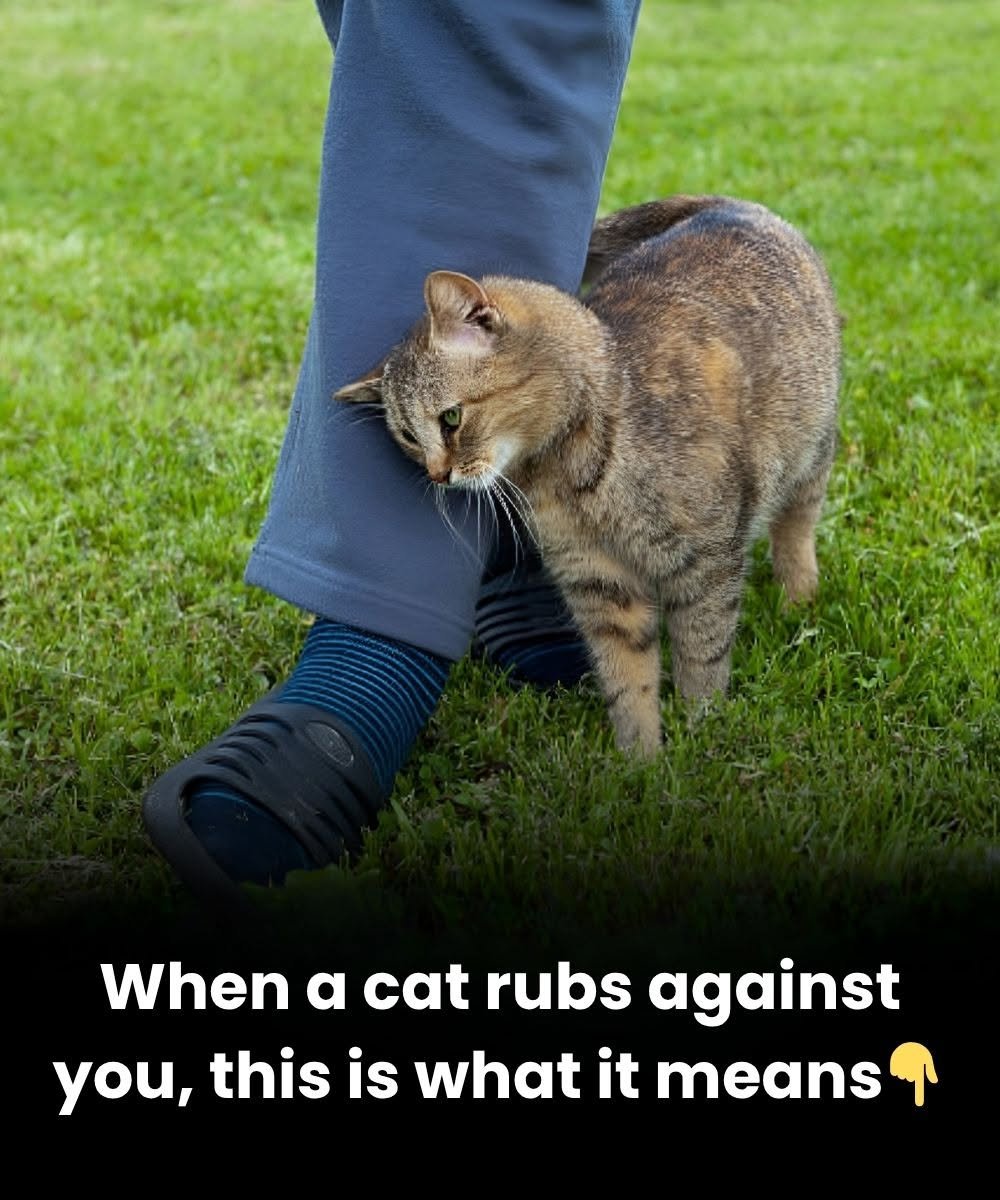
If you live with a cat, you know the moment well. You’re standing in the kitchen, sitting at your desk, or relaxing on the couch—and suddenly, that familiar brush of fur grazes your leg. It might seem like a small thing, a simple act of affection or curiosity. But in a cat’s world, that brief touch can carry a meaningful message.
Cats communicate in ways that are often subtle. Unlike dogs, which may express excitement through obvious gestures, cats frequently rely on body language, scent, and small physical interactions to communicate with the people around them.
So, what does it mean when your cat rubs against your legs?
1. Your cat is marking you as familiar and safe.
One of the most common reasons cats rub against people is scent marking. Cats have scent glands around their cheeks, forehead, and other parts of their bodies. When they brush against your legs, they can leave behind familiar chemical signals that help them recognize their surroundings.
This behavior is sometimes described as marking you as part of their social group. It doesn’t mean your cat believes it owns you in the human sense. Rather, your scent and the scent it leaves behind become part of a familiar environment.
For a cat, familiarity can bring comfort. Your presence becomes associated with safety, routine, and home.
2. It’s often a sign of affection and trust.
When a cat approaches you voluntarily and rubs its body against your legs, it may be showing that it feels comfortable around you.
Cats don’t express affection in exactly the same way humans do. Some enjoy sitting in your lap, while others prefer to remain nearby or briefly touch you as they pass. A gentle rub can be one way your cat maintains social contact without demanding constant attention.
Pay attention to the rest of its body language. A relaxed posture, upright tail, soft eyes, and gentle movements often suggest that your cat is comfortable and friendly.
If your cat rubs against you and then walks away, don’t take it personally. Some cats simply enjoy brief moments of contact before returning to whatever has captured their attention.
3. Your cat may be greeting you.
Have you noticed that your cat rubs against your legs when you return home?
This can be a form of greeting. Cats may approach familiar people, lift their tails, rub their cheeks against them, and sometimes circle around their feet.
These behaviors can help reinforce familiarity and social bonds. Your cat may also be responding to your arrival as an important change in its daily routine.
In other words, that little greeting might be your cat’s way of acknowledging that you’re back.
4. Sometimes, your cat wants something.
Not every affectionate rub is simply about affection.
Cats quickly learn that certain behaviors get results. If rubbing against your legs is followed by food, playtime, or attention, your cat may repeat it when it wants the same thing again.
You might notice this behavior becoming especially persistent near mealtimes. Your cat may rub against you, meow, walk toward its food bowl, and then look back to see whether you’re following.
Some cats also use this behavior to request petting or interaction.
The key is to observe the pattern. If the rubbing regularly happens at the same time or near a particular object, your cat may be communicating a specific need.
5. Your cat is combining scent and social bonding.
Cats have an excellent sense of smell, and scent plays an important role in how they understand their environment. When cats that are familiar with one another rub against each other, they may exchange scents and reinforce social familiarity.
When your cat rubs against your legs, a similar combination of scent and social contact may be taking place.
Some cats also perform a behavior called bunting, in which they gently press or rub their head against a person or object. This involves scent glands around the head and is often associated with familiar, comfortable interactions.
Although we can’t know exactly what a cat is thinking, these behaviors offer useful clues about how it experiences the world.
6. Your cat may be asking for attention without making a sound.
Cats can be remarkably good at getting our attention through small gestures. A brush against your ankle may be followed by a glance, a raised tail, a quiet meow, or a gentle nudge with the head.
Your cat might want you to stop what you’re doing and acknowledge its presence.
Sometimes, a brief scratch behind the ears is all it wants. Other times, it may be inviting you to play or simply encouraging a moment of connection.
Learning your individual cat’s habits can help you understand these requests more accurately.
What if your cat suddenly starts rubbing against you more often?
Changes in behavior deserve attention, especially when they occur suddenly.
A cat that becomes unusually clingy may simply be responding to changes in its routine, seeking reassurance, or asking for more interaction. However, increased rubbing accompanied by excessive vocalization, restlessness, appetite changes, or other unusual symptoms may indicate that something else is going on.
If the behavior is new, persistent, or accompanied by signs of illness or distress, consider contacting a veterinarian.
It’s also important to distinguish ordinary body rubbing from repetitive head pressing. If a cat persistently presses its head against a wall or other hard surface rather than gently rubbing against you, that can signal a serious medical problem and warrants urgent veterinary attention.
The little gesture that says a lot
The next time your cat brushes against your legs, take a moment to notice what happens afterward. Is its tail held high? Does it look up at you? Does it head toward the food bowl, settle nearby, or gently press its forehead against your hand?
Those small details can help you understand what your cat is communicating.
A simple rub may be a greeting, a request, a scent-marking behavior, or a combination of these things. It isn’t proof that your cat is expressing one particular emotion, but it can be an important part of the relationship you share.
Cats don’t always announce their feelings loudly. Sometimes, they communicate through a quiet approach, a soft purr, or a brush of fur against your ankle.
And when your cat chooses to come close, that small moment is worth appreciating.
Because living with a cat often means learning a different language—one made of tiny gestures, familiar scents, and the quiet trust built between two very different creatures.
Website Disclaimer
The information provided on this website is for general informational and educational purposes only. While we strive to ensure that all content is accurate and up to date, we make no guarantees regarding the completeness, reliability, or accuracy of any information published.
The views and opinions expressed in articles belong to their respective authors and do not necessarily reflect the views of this website. Any action you take based on the information found on this website is strictly at your own risk. We will not be liable for any losses, damages, or inconveniences arising from the use of our content.
Some articles may contain opinions, third-party information, or external links. We do not endorse or guarantee the accuracy of content on external websites and are not responsible for their practices or policies.
All content on this website is provided in good faith and is intended for informational purposes only. Readers are encouraged to verify information independently and seek professional advice where appropriate.