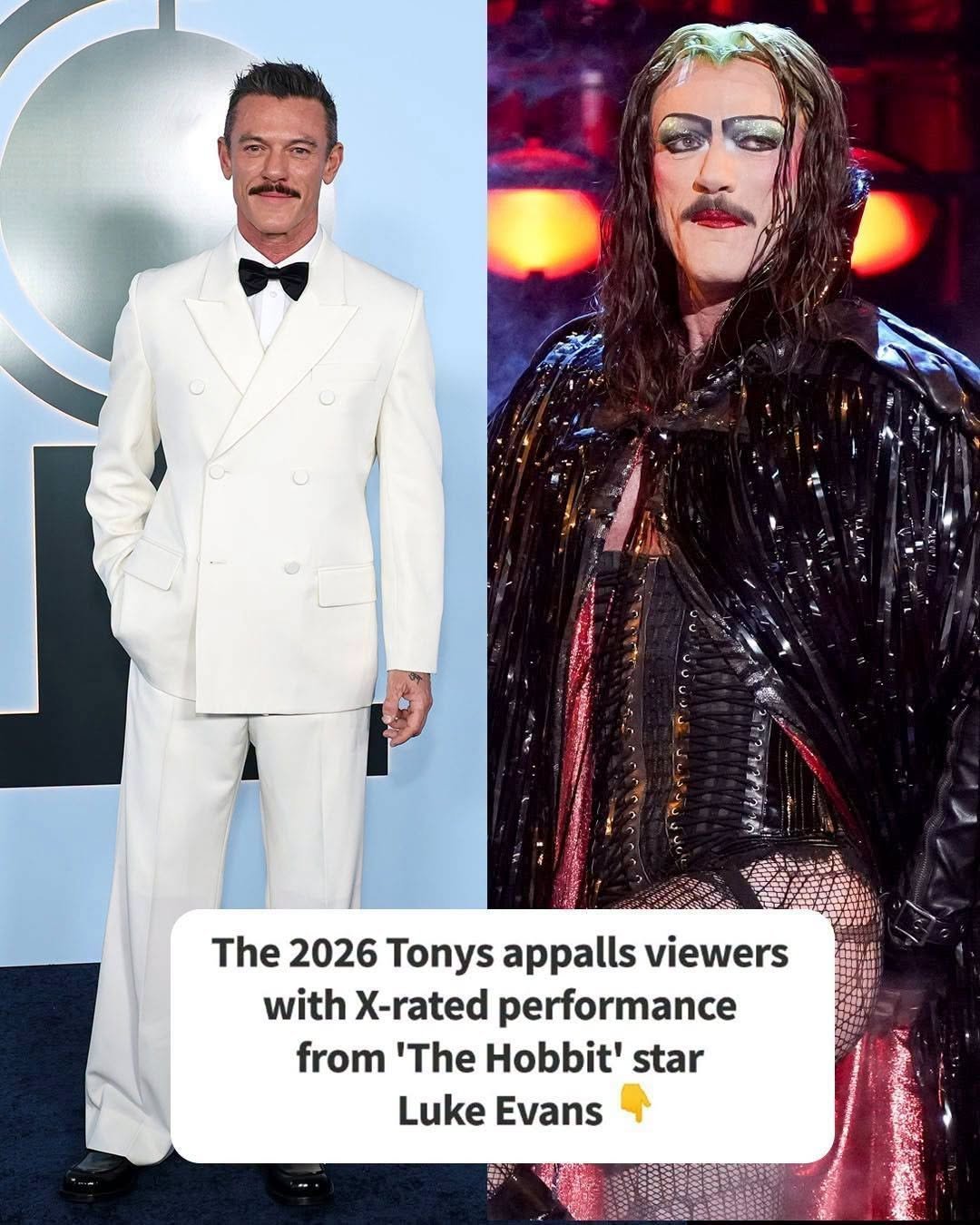
Luke Evans Stuns Audiences as Dr. Frank-N-Furter — His Bold Transformation Sparks Praise, Outrage, and Debate
Everything seemed to stop when Luke Evans stepped onto the stage in a look few viewers expected from the actor best known for playing powerful, traditionally masculine characters on screen. Wearing a corset, fishnet stockings, and high heels, Evans transformed himself into Dr. Frank-N-Furter, the flamboyant central character from The Rocky Horror Show. The performance sparked intense reactions, with some viewers celebrating his confidence and others questioning whether such a provocative character belonged on mainstream television.
Within moments, the conversation moved beyond the costume itself. Social media filled with contrasting opinions, ranging from enthusiastic praise for Evans’s theatrical transformation to criticism from viewers who considered the appearance too shocking. For some, it was a celebration of artistic freedom. For others, it challenged personal and cultural expectations about masculinity, gender expression, and entertainment.
But beneath the headlines and heated reactions was a more personal story.
For Evans, portraying Frank-N-Furter represented something far more meaningful than an opportunity to shock an audience. It connected him to a character and a musical that had helped shape his understanding of himself long before he became an internationally recognized actor.
A role that came full circle
Growing up, Evans was a closeted teenager trying to understand where he belonged. Like many young people who feel different from those around them, he had questions about identity, acceptance, and whether he could eventually live openly without fear of judgment.
The music and spirit of The Rocky Horror Show offered a glimpse of a world where individuality was celebrated rather than hidden.
The production, created by Richard O’Brien, has challenged conventional expectations since its debut in the early 1970s. Its blend of rock music, outrageous costumes, camp humor, and unconventional characters helped it become a lasting cult phenomenon.
At its center is Dr. Frank-N-Furter, a charismatic, gender-bending character whose extravagant appearance and unapologetic confidence challenge traditional ideas about identity and sexuality.
For someone like Evans, discovering that world could be liberating. The story suggested that people did not have to fit neatly into society’s expectations to deserve happiness or belonging.
Years later, Evans returned to that influence from a completely different position. He was no longer a teenager watching from the sidelines. He was an accomplished performer stepping into one of musical theater’s most recognizable roles.
That transformation gave the performance an emotional dimension that went beyond its provocative wardrobe.
Why the costume became such a talking point
Frank-N-Furter’s appearance has always been an essential part of the character. The corset, heels, makeup, and fishnets are not simply decorative choices; they contribute to a theatrical identity built around excess, confidence, and the rejection of conventional rules.
For performers taking on the role, the challenge is not just to wear the costume but to embody the character’s attitude.
Evans’s willingness to embrace the physical demands of the part invited audiences to reconsider the difference between an actor’s public image and the characters an actor can portray.
His previous roles often featured heroic figures, imposing villains, and characters associated with conventional masculinity. Seeing him inhabit such a dramatically different persona challenged the assumption that performers must remain within a narrow range of appearances to satisfy their audiences.
For supporters, that contrast was precisely what made the performance exciting.
They praised his commitment to the role, his stage presence, and his willingness to embrace theatrical vulnerability. Rather than treating the costume as a joke, they viewed it as part of a carefully constructed performance.
Critics, meanwhile, focused on the revealing outfit and the character’s provocative presentation. Some expressed discomfort with the imagery, while others questioned whether the performance was appropriate for a broad television audience.
Those reactions revealed how differently people can interpret the same artistic choice.
The lasting power of The Rocky Horror Show
More than five decades after its creation, The Rocky Horror Show continues to attract audiences because it refuses to behave like conventional musical theater.
Its story deliberately plays with familiar horror and science-fiction tropes, turning them into an irreverent celebration of self-expression. Its characters blur boundaries, its humor challenges social expectations, and its music encourages audiences to participate rather than remain passive observers.
The show’s cultural influence extends far beyond the stage. Its film adaptation, The Rocky Horror Picture Show, became famous for midnight screenings where fans dressed as characters, shouted responses at the screen, and developed traditions that transformed moviegoing into a communal event.
For generations of fans, that environment offered something more meaningful than entertainment. It provided a space where people who felt excluded elsewhere could discover a sense of belonging.
That history helps explain why casting choices and performances connected to the production can generate such strong reactions.
To some viewers, the show represents freedom and acceptance. To others, its deliberate rejection of traditional conventions remains uncomfortable.
Both responses contribute to the continuing conversation surrounding its cultural significance.
When performance becomes personal
What makes Evans’s connection to the role particularly compelling is the distance between the teenager he once was and the performer he became.
A young person who once found comfort in a musical about refusing to conform eventually had the opportunity to embody one of its most recognizable characters in front of a much larger audience.
That is a powerful full-circle moment.
It also illustrates why representation can matter, especially for people who are still figuring out how they fit into the world. Seeing someone embrace an identity or expression that once seemed frightening or impossible can offer reassurance that a different future is available.
For Evans, taking on the role meant revisiting a story that had helped him imagine greater freedom.
For viewers who recognized that personal history, the performance could feel inspiring rather than merely provocative.
It was a reminder that entertainment can influence people in ways that are difficult to measure. A song, a character, or a theatrical moment can stay with someone for years, helping them find language for feelings they have struggled to express.
Why the debate continues
The reactions to a performance like this reveal a broader tension in popular culture.
Audiences often develop strong attachments to actors because of the characters they have played. When those actors take on unexpected roles, some viewers celebrate the change while others struggle to separate the performer from the image they already know.
Gender expression adds another layer to that conversation. Costumes and performances that challenge conventional ideas about masculinity can be interpreted as artistic experimentation by some and as a challenge to established values by others.
Yet theater has always provided a place to explore unfamiliar identities, exaggerate social conventions, and question assumptions that might otherwise go unchallenged.
That does not mean every audience member must enjoy every performance. People are free to dislike a production, criticize its artistic choices, or decide that it is not for them.
But disagreement over a theatrical character also invites a larger question: should performers be expected to remain within the boundaries of the public image that first made them famous?
Evans’s transformation offers a reminder that acting requires the freedom to become someone else, sometimes in ways that surprise or unsettle an audience.
And perhaps that is part of the point.
The most memorable performances do not always make everyone comfortable. Sometimes, they force us to confront our assumptions about identity, art, and the people standing in front of us.
For Luke Evans, Dr. Frank-N-Furter represented more than a dramatic costume or an unexpected stage appearance. The character connected his adult career to a story that had once helped a young man imagine a future in which he could live more openly.
Whether audiences responded with admiration, criticism, or simple curiosity, the discussion revealed that The Rocky Horror Show still has the power to provoke a reaction.
And that may be the enduring legacy of the production: not that everyone agrees with its message, but that it continues to create space for conversations about self-expression, belonging, and the courage to be seen.
Because sometimes, the performance people debate most fiercely is the one that reminds someone else they don’t have to hide who they are.
Website Disclaimer
The information provided on this website is for general informational and educational purposes only. While we strive to ensure that all content is accurate and up to date, we make no guarantees regarding the completeness, reliability, or accuracy of any information published.
The views and opinions expressed in articles belong to their respective authors and do not necessarily reflect the views of this website. Any action you take based on the information found on this website is strictly at your own risk. We will not be liable for any losses, damages, or inconveniences arising from the use of our content.
Some articles may contain opinions, third-party information, or external links. We do not endorse or guarantee the accuracy of content on external websites and are not responsible for their practices or policies.
All content on this website is provided in good faith and is intended for informational purposes only. Readers are encouraged to verify information independently and seek professional advice where appropriate.