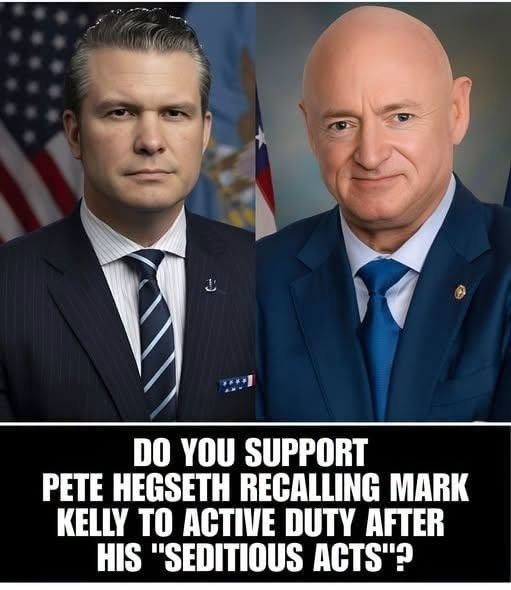
Political Firestorm Erupts Over Pete Hegseth and Mark Kelly
The political world erupted in controversy after reports circulated that Defense Secretary Pete Hegseth wanted Senator Mark Kelly recalled to active military duty over what critics described as an extraordinary dispute involving military service, political speech, and the limits of government authority.
Within minutes, the story became a flashpoint for fierce debate. Supporters of Hegseth argued that military discipline and accountability must be taken seriously, while Kelly’s defenders warned that using military authority against a political opponent could raise serious constitutional concerns.
At the heart of the controversy was a question that quickly moved beyond the two men themselves: Where should the line be drawn between military discipline and a public official’s right to speak freely?
Kelly is a retired Navy captain and former astronaut who later entered politics. His military background has long been an important part of his public identity, making any dispute over his service especially sensitive. The suggestion that a retired officer could face renewed military obligations because of controversial statements immediately attracted attention from veterans, legal commentators, lawmakers, and ordinary Americans.
What Sparked the Dispute?
The controversy stems from a video in which Kelly and five other Democratic lawmakers with military or intelligence backgrounds reminded service members that they are obligated to refuse unlawful orders. The Trump administration criticized the message, arguing that it could undermine military discipline. Kelly maintained that he was defending the Constitution and the established rules governing military service.
The dispute escalated in January 2026, when Hegseth formally censured Kelly and initiated proceedings that could affect his retired military rank and pension. Kelly challenged the action, saying he would fight what he considered an attempt to intimidate him.
The Legal Battle Takes Center Stage
The confrontation took a significant turn in February 2026, when a federal judge ordered the Pentagon to halt its disciplinary proceedings against Kelly. The judge concluded that the administration had infringed on Kelly’s First Amendment rights. The ruling also blocked enforcement of the censure while the legal dispute continued.
The case raised difficult questions about the authority military officials retain over retired service members, particularly when those individuals become elected representatives. It also highlighted the tension between military discipline and constitutional protections for political expression.
A Debate Far Bigger Than Two Politicians
For many Americans, the dispute became a test of how far executive authority should extend when a former military officer criticizes government policy. Others argued that military personnel must be careful not to undermine the chain of command, even when discussing controversial government decisions.
The central issue remains whether the government’s response to Kelly’s statements can be justified under military law without crossing constitutional boundaries.
One important clarification: The available reporting supports the earlier recall threat, the January censure, and the February court ruling. It does not establish that Hegseth issued a new recall demand today, October 10, 2026. That specific claim should be verified before being presented as breaking news.
Ultimately, the Kelly-Hegseth confrontation is about more than political rivalry. It touches on the responsibilities of military service, the limits of government power, and the protections that remain essential in a democratic society.
Website Disclaimer
The information provided on this website is for general informational and educational purposes only. While we strive to ensure that all content is accurate and up to date, we make no guarantees regarding the completeness, reliability, or accuracy of any information published.
The views and opinions expressed in articles belong to their respective authors and do not necessarily reflect the views of this website. Any action you take based on the information found on this website is strictly at your own risk. We will not be liable for any losses, damages, or inconveniences arising from the use of our content.
Some articles may contain opinions, third-party information, or external links. We do not endorse or guarantee the accuracy of content on external websites and are not responsible for their practices or policies.
All content on this website is provided in good faith and is intended for informational purposes only. Readers are encouraged to verify information independently and seek professional advice where appropriate.