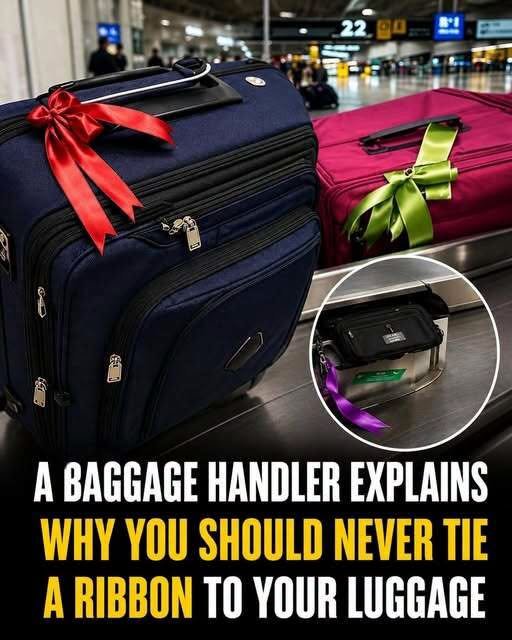
Why baggage handlers say you should never tie a ribbon to your suitcase
Baggage handlers and airport staff often advise against tying ribbons to suitcases, even though many travelers use them to easily recognize their luggage.
Modern airports rely on automated scanning systems that read baggage tags quickly as suitcases move through conveyor belts. If a ribbon hangs near or over the tag, it can interfere with scanning and make the label harder to read.
When a tag can’t be read properly, the bag may need to be processed manually. This slows it down and increases the chance it could miss connecting flights or be delayed.
Another issue is physical interference. Loose ribbons can get caught in conveyor belts, rollers, or sorting machines. Even small snags can cause delays in the system or require staff to stop and fix the issue.
Handlers also note that ribbons can sometimes flip over baggage tags or tangle with other bags, increasing the risk of misrouting.
Although travelers often use ribbons to make their bags easier to spot at baggage claim, airport systems don’t rely on visual markers. They track luggage through barcode scans and digital records instead.
Because of this, experts recommend safer alternatives like distinctive luggage straps, unique suitcase covers, or sturdy tags that don’t hang loosely or interfere with handling equipment.
In short, while ribbons may seem helpful, they can actually cause more problems than they solve in modern airport systems.
Website Disclaimer
The information provided on this website is for general informational and educational purposes only. While we strive to ensure that all content is accurate and up to date, we make no guarantees regarding the completeness, reliability, or accuracy of any information published.
The views and opinions expressed in articles belong to their respective authors and do not necessarily reflect the views of this website. Any action you take based on the information found on this website is strictly at your own risk. We will not be liable for any losses, damages, or inconveniences arising from the use of our content.
Some articles may contain opinions, third-party information, or external links. We do not endorse or guarantee the accuracy of content on external websites and are not responsible for their practices or policies.
All content on this website is provided in good faith and is intended for informational purposes only. Readers are encouraged to verify information independently and seek professional advice where appropriate.