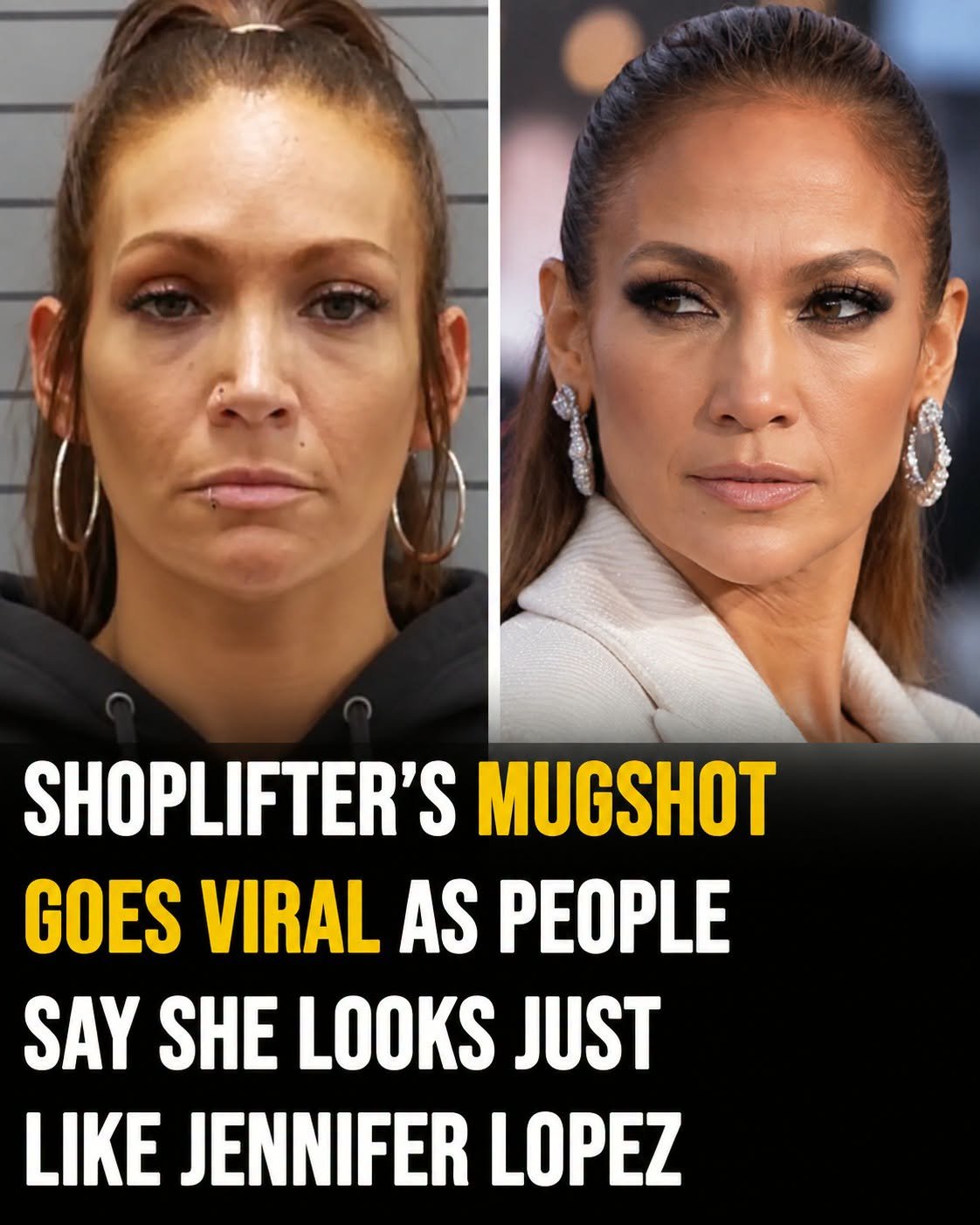
The story became stranger when an important detail emerged: not every viral image being shared online was authentic. A fact-check by Lead Stories found that a widely circulated New York Post post on X had used an AI-generated or manipulated version of Quast’s mugshot, making her look even more like Lopez. The genuine booking photograph, provided by the Wright County Sheriff’s Office, was different.
That distinction matters because the internet was no longer simply reacting to a real arrest photo—it was reacting to an altered image that amplified the celebrity resemblance. The original story was already unusual, but the manipulated image pushed it into another level of virality, showing how quickly an ordinary criminal case can become distorted once social media takes control of the narrative.
According to reports, Quast was arrested on August 30 after a store employee recognized her from an earlier alleged theft. Police were contacted, and she was subsequently booked into the Wright County Jail on a gross-misdemeanor theft charge before being released the following day.
Online, however, the alleged theft became almost secondary. Commenters turned the Lopez resemblance into a running joke, referencing “Jenny from the Block” and inventing variations such as “Jenny from D-Block.” Others joked that she could have worked as a celebrity lookalike or Hollywood stand-in. Not everyone agreed with the comparison, though, with some users saying they saw little or no resemblance at all.
And that may be the most uncomfortable part of the entire episode. A real person was arrested over an alleged theft, yet millions of strangers encountered her not through the facts of the case, but through a viral photograph and a celebrity comparison. Within hours, a potentially serious legal matter had been transformed into a source of jokes, memes and entertainment.
The episode is also a reminder that viral images deserve scrutiny. Once a photograph begins circulating across social platforms, it can be cropped, edited, enhanced—or even artificially generated—while still being presented as authentic. In this case, fact-checkers specifically identified one widely shared version as manipulated, while confirming that a different photograph was the actual booking image.
For Quast, the attention is likely to last far longer than the brief jail stay itself. What began as an alleged $580 battery theft in a Minnesota store became an international internet spectacle because strangers thought the suspect looked like one of the world’s most recognizable entertainers.
And perhaps the biggest lesson isn’t about Jennifer Lopez at all. It’s about how quickly the internet can take one person’s worst day, add a famous face, and turn it into a story millions of people think they already understand.
Website Disclaimer
The information provided on this website is for general informational and educational purposes only. While we strive to ensure that all content is accurate and up to date, we make no guarantees regarding the completeness, reliability, or accuracy of any information published.
The views and opinions expressed in articles belong to their respective authors and do not necessarily reflect the views of this website. Any action you take based on the information found on this website is strictly at your own risk. We will not be liable for any losses, damages, or inconveniences arising from the use of our content.
Some articles may contain opinions, third-party information, or external links. We do not endorse or guarantee the accuracy of content on external websites and are not responsible for their practices or policies.
All content on this website is provided in good faith and is intended for informational purposes only. Readers are encouraged to verify information independently and seek professional advice where appropriate.