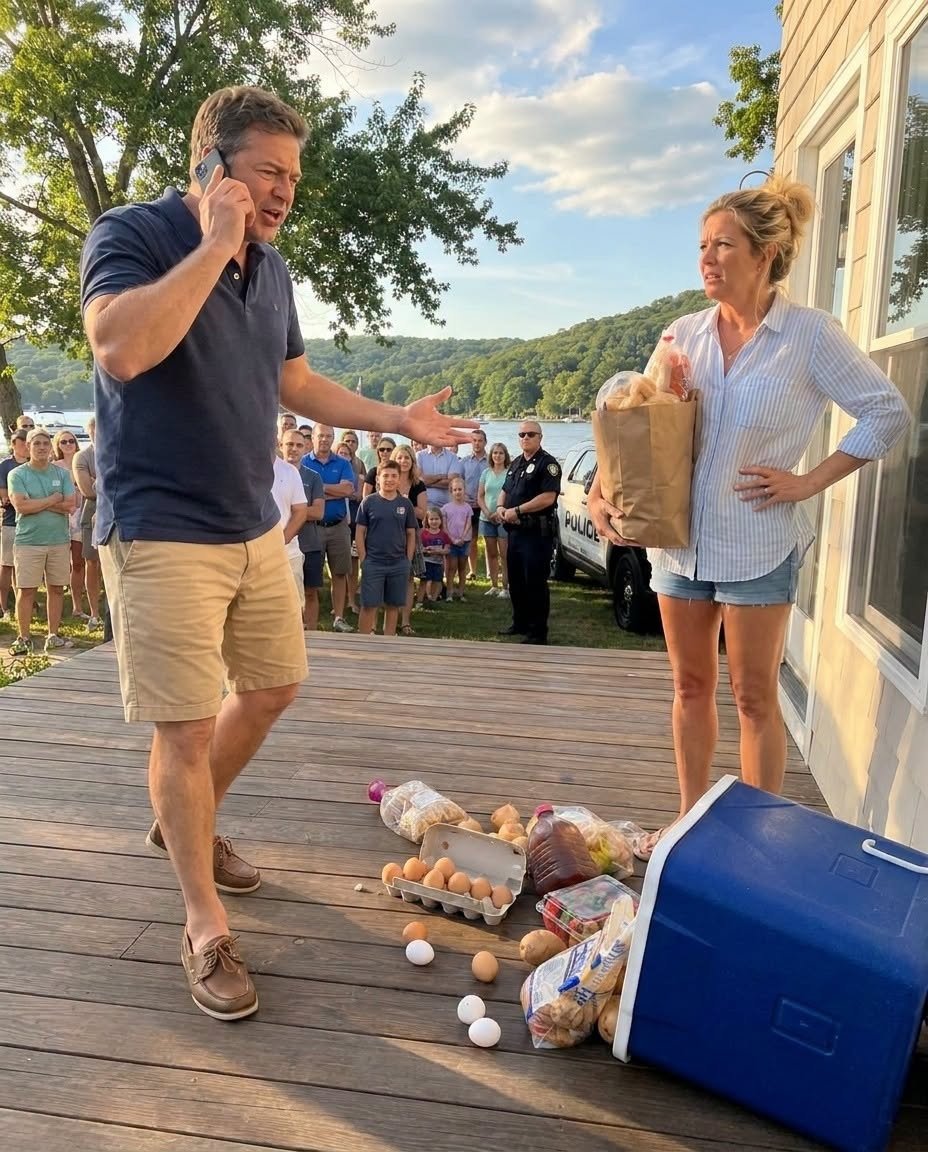
I had just finished a twelve-hour hospital shift when my phone lit up with forty missed calls and a message from my father demanding to know what I had done to the lake house. Through the security cameras on my laptop, I could see twenty people crowded onto the porch near Devils Lake, grocery bags in hand, cars packed along the gravel road, and my mother standing beside the front door as though enough indignation might make the new lock open. My father was pacing with his phone pressed to his ear, furious that the keypad no longer worked and the garage had been disabled. Then a sheriff’s cruiser turned onto the road. Across from the property, my seventy-one-year-old neighbor Margaret stepped onto her porch with her dogs beside her, watching the whole scene unfold. I told my father that everyone could leave peacefully now or explain to the deputy why they were trying to enter a house they did not own. For the first time that morning, he stopped shouting.
The house had never been family property. I had bought it four years earlier after six years of overtime, double shifts, and apartments where privacy always felt temporary, then repaired the dock myself, painted the rooms, furnished it carefully, and built the kind of quiet life I needed after spending my workdays around emergencies. My parents had already used it without permission four times. The last unauthorized visit had ended with beer cans in the hot tub, a cracked mudroom window, and evidence that the garage keypad had been forced. I had spoken to them repeatedly, but every conversation ended the same way: my mother treated my objection as hurtful, my father minimized it, and everyone moved on until the next violation. So when Dad announced in the family group chat that they would be bringing twenty guests for the weekend and Mom instructed me to stock the refrigerator, I answered with one word: “No.” Then I changed every lock, disabled the garage access, activated continuous camera recording, notified the sheriff’s office in writing that no one else had permission to enter, and asked Margaret to keep an eye on the property.
The confrontation on Friday was the first time my family discovered that “no” had practical consequences. Dad tried ordering me to open the house, then switched to guilt, reminding me that people had driven for hours and insisting the whole situation was embarrassing. I reminded him that the embarrassment belonged to the people who had planned a vacation at somebody else’s home after being explicitly refused. When the deputy reached the porch, she confirmed what the deed already established: I was the sole owner, and anyone remaining without permission could be treated as trespassing. The crowd changed instantly. Bags were picked up, cars were started, and the people who had arrived expecting a pleasant family weekend began leaving under the quiet supervision of law enforcement. My father stood on the porch longer than everyone else, staring at the new lock and the camera above the door before finally walking away. Later he told me I could have “just talked” to them. I told him I had been talking for four years; this was simply what happened when talking stopped working.
The legal side was uncomplicated because ownership was never actually disputed: the title and mortgage were solely in my name, I had documented earlier unauthorized entries, and the locksmith’s prior report supported the history of forced access. The harder work came afterward. My father called two days later and, for once, asked to understand rather than command. My mother took three weeks longer, beginning with the accusation that I had humiliated them before eventually admitting she had not understood what repeated unauthorized use of the house meant to me. My younger brother Kyle, who had originally treated the whole situation as a joke, started calling me privately and gradually stopped seeing the family dynamic as entertainment. I also began therapy, where I finally recognized how easily years of accommodation had taught everyone—including me—that my limits were negotiable. Months later, I invited my parents back myself for one quiet weekend. They arrived as guests, not owners, and for the first time my father stood on the dock, looked at what I had built, and seemed to understand that the place was not a rejection of the family but something I had created to preserve enough of myself to remain part of it.
The lake house is still exactly where it was, locked at the end of the gravel road, with Margaret across the way and the fir trees reflected in the water every morning. What changed was my relationship to the word “no.” For years I had believed that saying it clearly should have been enough, then blamed myself when people treated it as the beginning of a negotiation. I learned that a boundary is not simply an opinion about what you would prefer; it is a line backed by action when someone decides your preference does not matter. The most important thing I refused that Friday was not my family. I refused the version of family in which love required me to disappear inside everyone else’s expectations. Once that version was gone, something more respectful had room to take its place.
Website Disclaimer
The information provided on this website is for general informational and educational purposes only. While we strive to ensure that all content is accurate and up to date, we make no guarantees regarding the completeness, reliability, or accuracy of any information published.
The views and opinions expressed in articles belong to their respective authors and do not necessarily reflect the views of this website. Any action you take based on the information found on this website is strictly at your own risk. We will not be liable for any losses, damages, or inconveniences arising from the use of our content.
Some articles may contain opinions, third-party information, or external links. We do not endorse or guarantee the accuracy of content on external websites and are not responsible for their practices or policies.
All content on this website is provided in good faith and is intended for informational purposes only. Readers are encouraged to verify information independently and seek professional advice where appropriate.