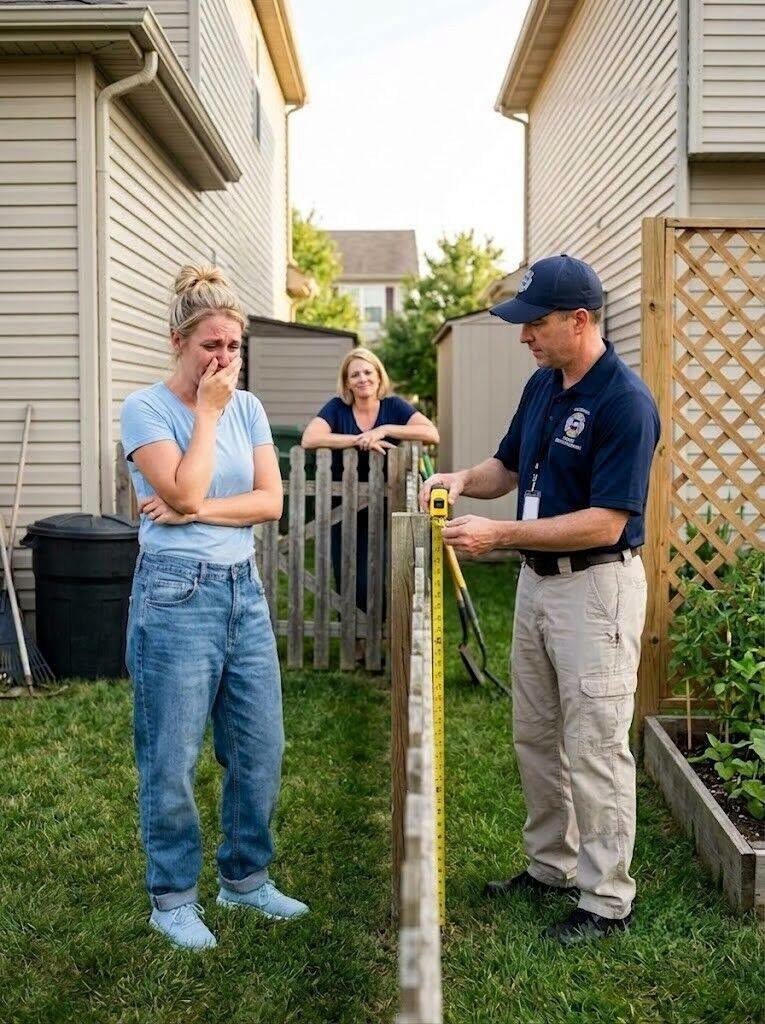
The Inspection
I have lived in the same house for almost five years, and in that time I have come to understand something about the particular pleasure of a quiet street. It is not the absence of life. Quiet streets have dogs and children and lawn mowers and the occasional argument that drifts through an open window on a summer evening, the ambient noise of people going about the business of living. What they have that noisy streets do not is a shared agreement, mostly unspoken, that your neighbors are not your audience and you are not theirs, that the proximity of houses does not constitute an invitation to manage each other’s choices, and that the ordinary business of maintaining a home and a life can proceed without commentary from the people on either side.
My street had been like that. Past tense, as of about four months ago.
My name is Daniel Reyes. I am forty-three years old, I work as a senior project manager for a civil engineering firm, I have two dogs named Biscuit and Pepper who require more walks than I sometimes have energy for, and I have spent the better part of five years quietly and systematically improving a house that needed considerable improvement when I bought it. New roof in year two, after the first hard winter revealed some compromised flashing that I had missed in the inspection. Deck rebuilt in year three, when the existing deck finally reached the point where I stopped trusting it to hold weight and decided that postponing the project had become more expensive than doing it. The kitchen updated last summer, which required six weeks and nearly broke me financially and was worth every dollar. A bathroom renovation is planned for next spring, the budget already accumulated, the contractor already selected.
Severe Joint Pain? Do This The Moment You Wake Up
More…
225
56
75
Severe Joint Pain? Do This The Moment You Wake Up
More…
868
217
289
12 Awkward Celebrity Moments That Were Actually Caught On Camera On The Moment
More…
132
33
44
I tell you this not to establish myself as a competent homeowner, though I am that, but to give you a sense of the kind of person I am. I pay attention to the details of a property. I understand what things cost and what they are worth. I believe in doing things correctly, which includes understanding what the rules are before proceeding, because the cost of understanding the rules in advance is always lower than the cost of finding out after the fact that you got something wrong.
I am not a combative neighbor. I wave when I see people. I bring in their packages when it rains. I once shoveled the sidewalk in front of three houses during a storm because I was already out there and it was not much additional effort. I do not play loud music or have parties that run late or let my dogs bark without intervention. I keep my trash cans in a recessed space at the side of the house. I have been, by any objective measure, a reasonable and considerate resident of this street for five years.
I mention all of this because I want you to understand the specific quality of the irritation I felt when Claudia Fenn arrived and within six days had knocked on my door twice to complain about things that had been perfectly ordinary for five years.
But I am getting ahead of myself.
The fence had been here when I bought the house. Cedar, well-built, running along the left boundary of my yard from the front corner of the property to the rear, separating my yard from the Hendersons’ yard next door. It was original to the property, installed sometime in the early 2000s by the previous owner, Roger Bellamy, who had lived here for twelve years before selling to me and who had been, by everything I could gather, a meticulous and organized person. The permit files I received at closing were extensive and well-organized. Every significant improvement to the property had its paperwork, neatly filed, and the fence permit was in there with the rest, complete with the city’s approval and the inspection sign-off.
I had read through those files when I bought the house and then filed them and not thought about them since, because nothing about the fence had ever prompted me to think about them. The Hendersons, who were kind and easy-going people, had never once mentioned it. It had simply been there, doing what fences do, holding its ground in the unchanging way of solid cedar construction.
The Hendersons moved in October to be closer to their daughter in Denver, and their departure left a gap on the street that I felt more than I anticipated. Tom Henderson had been the one who noticed when my car battery was dead and had pulled alongside with jumper cables without being asked. Evelyn Henderson had brought over a pot of soup when I was sick with the flu two winters ago, left it on the porch with a note that said get better soon, and said nothing more about it. They were the kind of neighbors who make ordinary life slightly easier without making any particular point of it, and their absence was its own kind of presence for several weeks.
The house went on the market and sold quickly, and the new neighbor moved in on a Friday in early November, and by the following Tuesday she had knocked on my door twice, and by the following Saturday she had knocked a third time, and by the following Monday she had apparently called the city, and I was reading a code violation notice attached to my mailbox with the orange clip the city uses for such things.
But I am still getting ahead of myself.
The first visit was about my trash cans.
I keep them in a recessed space at the side of the house, a shallow alcove between the house wall and the beginning of the fence, just visible from the street if you are standing at a particular angle and looking specifically for them. This is not a design feature I installed. It is simply where the alcove is, where Roger Bellamy kept his cans, and where I have kept mine since I moved in. The city has no ordinance that I am aware of about the positioning of trash receptacles so long as they are not blocking a sidewalk or creating a hazard, and not one neighbor in five years had mentioned them. I had given them exactly as much thought as they deserved, which was none.
Claudia introduced herself by standing at my door at seven-thirty on a Tuesday evening in November, which is technically a reasonable hour but is also the evening of a workday when a person has been working since eight in the morning and is disinclined to receive visitors. She told me her name and that she had just moved in next door and that she was pleased to meet me, and both of these things seemed true, and then she said she wanted to mention, since we were neighbors, that she could see the tops of my trash cans from her living room window, and that she found it unsightly.
I thanked her for letting me know and said I would look into it.
She seemed to want something more concrete than that, a specific commitment, an apology perhaps, or a timeline for action. When she did not receive any of these things, she held her smile for an extra beat and then said she looked forward to being good neighbors, and left.
I moved the trash cans six inches toward the wall, which put them entirely behind the fence line and out of any sightline. This took approximately forty-five seconds. I did it not because I was obligated to but because it was a minor adjustment with no cost to me, and because I had genuinely not thought about it before and did not particularly object to the change.
The second visit, three days later, was about the wind chimes.
I have a set of bamboo wind chimes on my front porch, a gift from my sister Marta, who had brought them back from a trip to Bali four years ago. They are perhaps twelve inches long, a cluster of tubes of varying lengths, and in a moderate breeze they produce a soft, irregular sound, wooden and hollow, entirely unlike the metallic ringing of some wind chimes, which can be sharp and carrying. These are gentle. They are the sound of a summer porch, or in November, a fall porch. I have always found them pleasant.
Claudia did not find them pleasant.
She came on a Thursday evening, again around seven-thirty, and stood on my porch and explained, carefully and with the precision of someone who has composed their thoughts in advance, that the sound of the wind chimes carried into her bedroom window, which faced my house, and disturbed her when she was trying to sleep. She said this with the air of someone making a reasonable request between reasonable adults.
I told her I would look into it.
She left. I went back inside. I stood in my kitchen and thought about the wind chimes and about whether the complaint had merit, and I decided that it might, in certain wind conditions, the chimes could theoretically be audible from a neighboring window, and that it was possible Claudia genuinely found them disruptive. I also thought about the fact that it was November and the windows were closed and I had a strong suspicion that wind chimes audible through closed double-pane windows in a residential neighborhood would have to be considerably louder than bamboo to accomplish this. But I thought: I will give her the benefit of the doubt. New neighbor, getting settled, maybe sensitive to sounds. I left the wind chimes where they were, because they had caused no issues for five years and because moving them to satisfy a complaint of this magnitude felt like establishing a precedent I was not willing to establish.
The third visit was that Saturday morning, the fence.
I have told you about this already. She knocked at nine, I came to the door, she said it looked a little tall. I said it had been there since before I bought the house. She rolled her eyes, muttered something, left.
I stood in my doorway after she left and thought about the pattern. Three visits in six days, each one about something visible from her property, each one delivered in the register of a person who considers themselves to be making a reasonable observation rather than lodging a complaint. The trash cans. The wind chimes. The fence. Three things that had been perfectly ordinary for years, brought to my attention in rapid succession by a woman who had lived next door for less than a week.
The pattern told me something.
There are two categories of complaining neighbor. The first is the neighbor who has a specific, genuine grievance, something that is actually causing them a problem, that is outside the norm, that a reasonable person in their position would find difficult. These neighbors are relatively rare and, when encountered, relatively easy to work with, because the grievance is specific and therefore solvable.
The second category is the neighbor who complains as a management strategy. They are not responding to specific problems. They are establishing territory, asserting dominance over the shared environment, communicating through the frequency and confidence of their complaints that they are to be taken seriously, that their preferences matter, that the people around them are expected to accommodate them. The complaints themselves are almost secondary. What the complaints are about is less important than the fact of complaining.
Claudia, I had concluded by Saturday morning, was the second kind.
This is not, necessarily, a hopeless situation. The second kind of complaining neighbor can become, with the right response, a manageable neighbor. The mistake most people make with this category is to treat each complaint individually, as if it were a genuine and specific grievance requiring resolution, which perpetuates the behavior by rewarding it. The more effective approach is patience and consistency and the quiet maintenance of your own standards, which eventually communicates that you are not a useful target, and the energy finds somewhere else to go.
I was prepared to be patient. I am, professionally and temperamentally, a patient person. What I was not prepared for was the notice on my mailbox.
When I came home that Monday and saw the orange clip and the city form, my first feeling was not anger. It was something more specific and colder than anger. It was the feeling of having been, very deliberately, pushed.
There is a difference between a neighbor who knocks on your door with a complaint and a neighbor who files an official complaint with the city. The first is a social act, an appeal to your goodwill and your willingness to cooperate. The second is an escalation, a decision to bring the authority of government regulation into a dispute that has not yet risen to the level that authority requires. It says: I have decided to stop appealing to your goodwill, because your goodwill is insufficient, and to use an instrument that compels your compliance.
Claudia had been my neighbor for less than two weeks.
I stood in my driveway reading the notice. The inspection was scheduled for Thursday. I had nine days.
I went inside and called Roger Bellamy. Roger was retired in Florida now, playing golf twice a week, and he picked up on the second ring.
“Daniel,” he said. “Everything all right?”
I explained the situation. There was a brief silence in which he appeared to be locating the fence in his memory.
“That fence,” he said, “I put up in 2003. Pulled the permit, had it inspected when it was done. Six feet exactly, because the limit was six feet and I wasn’t going to go an inch over. It’s all in the documentation I gave you at closing.”
I found the folder that evening and went through it carefully, the way I read contracts at work. The permit was dated April 2003. The city zoning office’s approval was signed. The inspection sign-off from June of that year confirmed compliance with the residential fence height ordinance. Case number, inspector’s name, everything. Complete.
I photographed every page. Printed fresh copies. Made two sets, one for the inspection and one to refile. On Wednesday evening, I walked the perimeter with a tape measure and measured twelve sections of fence. Seventy-two inches at every point. Six feet. Exactly.
I went back inside and stood at the kitchen window for a moment looking at the fence in the cold November dark, and I thought about Tuesday morning, about Claudia’s voice carrying across the driveway: rules are rules. And I thought about the fence, which had been compliant since 2003 and which was going to continue to be compliant on Thursday regardless of who had filed what.
The following morning I was out early to my car when she called across from her driveway, coffee cup in hand, watching me the way someone watches when they have been waiting to be seen.
“Rules are rules,” she said. “Maybe next time you’ll think before breaking them.”
“Good morning,” I said, and got in my car.
The drive to work was not entirely calm. The irritation was there, specific and cold: the feeling of having done nothing wrong and having someone use official channels to make you prove it. The complaint was not about the fence. The fence was the instrument. What she wanted was the result, the demonstration that her attention had teeth. I understood this, and understanding it did not eliminate the irritation, but it organized it into something more manageable than simple anger. It became information.
Thursday morning was cold and clear. I made a large coffee, put on my heavy jacket, and was on my front porch with the permit folder at eight-fifty.
She had been there, I could see from my porch, since at least nine, which was when I had first gone outside with my coffee. She was wearing a heavier jacket than she had been in when she came to my door on Saturday, and she had clearly positioned herself at the corner of her yard nearest my fence, which gave her a direct sightline to the inspector’s work. She had a coffee cup. She was ready.
Gerald Hooper introduced himself, examined my permit documentation without much visible reaction, and then began measuring. He was systematic. He started at the front corner of the fence and worked his way toward the back, measuring each panel, making notes. The measuring took about fifteen minutes. During those fifteen minutes, Claudia asked twice whether the fence was over the limit.
The first time, Gerald said, “I need to finish measuring before I can say anything.”
The second time, he said the same thing in exactly the same tone, which suggested to me that he had a lot of practice with neighbors who stood nearby during inspections and asked premature questions.
I said nothing. I drank my coffee. I watched Gerald work. Biscuit and Pepper were inside because I had not wanted to manage two dogs while also managing an inspection, and from inside the house Pepper had been barking at Gerald’s truck for the first five minutes before apparently deciding it was not a threat and settling down.
Gerald finished. He closed his notebook. He looked at his measurements. He looked at the permit documentation I had provided. He made one more note.
Then he looked at Claudia.
“Everything here is perfectly compliant,” he said. “The fence is at the permitted height. There’s no violation.”
Claudia’s coffee cup lowered about three inches, involuntarily, the way things lower when the hand holding them stops receiving proper instructions from the brain.
“That can’t be right,” she said.
“I measured every section twice,” Gerald said. “The permit is on file and the construction meets the permitted specifications. There’s no violation.”
There was a moment of silence.
The smile Claudia had been wearing, the smile I had seen from my window that morning when she arranged herself at the edge of her yard, the smile of someone who has launched a process and is waiting for it to produce results, was gone. What was in its place was something that ran through several emotions quickly, disbelief and frustration and the particular tight-faced expression of a person recalibrating their expectations.
Then Gerald Hooper did something I had not anticipated.
He paused. He was already beginning to turn toward the street, the motion of a man who has completed his task and is preparing to leave, but he paused mid-turn and looked toward Claudia’s yard with a small, thoughtful frown, the frown of a man who has noticed something and is deciding whether to mention it.
“There is one thing,” he said. “If you don’t mind, I’d like to take a look at your yard.”
He looked at Claudia when he said it.
Claudia’s expression went through another rapid sequence.
“My yard?” she said.
“Just a quick look,” Gerald said, in the pleasant, non-confrontational tone of a man who is very good at his job and understands that the tone matters.
I followed the inspector through the gap in the property lines to Claudia’s yard. Not triumphantly. Not with any visible satisfaction. Simply because the inspector had invited me and I was curious and there was no reason not to. Claudia followed too, though she walked slightly behind, the posture of someone who is participating in something they are no longer controlling.
Gerald walked the perimeter of Claudia’s yard with the same methodical pace he had brought to mine. I walked with him, hands in my jacket pockets, looking at what he was looking at. Claudia walked on the other side, her coffee cup held with both hands now, not drinking from it.
What Gerald had noticed from his position at my fence, I understood as we walked, was the arbor.
Claudia had an arbor installed along her back fence, the kind of decorative garden structure with a latticed top through which plants are meant to grow. It was a solid, well-built arbor, and it had clearly been there for some time, the wood weathered to a silver that suggested at least several seasons of exposure. It extended over the fence line itself, the latticed roof cantilevering perhaps eight inches over the property boundary, and it rose, from the ground to the peak of its latticed roof, to what my experienced eye estimated at somewhere around seven feet.
Gerald measured it.
He was as methodical with the arbor as he had been with my fence, measuring in four places, annotating carefully, crouching to look at the base of the posts and then standing back to sight along the structure from various angles with the professional eye of someone who has spent years learning what violations look like before the tape measure confirms them. He measured the height from the base posts to the peak of the latticed roof. He measured the horizontal extension of the latticed canopy over the fence line. He noted the weathering of the wood, which indicated the structure had been in place for at least several seasons, and he photographed it from three angles with the small camera clipped to his clipboard.
He made more notes than he had made on my fence. This was telling.
Then he straightened up and looked at Claudia.
“This structure,” he said, “is above the permitted height for an accessory structure in this zone by approximately eleven inches. The maximum permitted height is seventy-two inches. This structure measures eighty-three inches at its peak.” He paused. “Additionally, the lattice roof section extends approximately eight to nine inches over the property line, which is a separate issue from the height.”
Claudia looked at the arbor. She was very still. I had not seen her still before. She was a person in constant motion, usually, motion of the body or the face or the hands, always doing or evaluating or preparing to comment. The stillness had a different quality. It was the stillness of someone whose options have suddenly narrowed.
“It was here when I moved in,” she said.
“That’s quite possible,” Gerald said. His voice remained the same throughout, the same pleasant, even, entirely undramatic tone. He was not enjoying this. He was not performing anything. He was simply doing his job, which was to observe and report accurately, regardless of the circumstances that had brought him here. “But there’s no permit on file for this structure in our system. Without a valid permit, the code violation is active from the date of my inspection, which is today.” A brief pause. “I would also note that unpermitted structures are typically required to be disclosed in residential property transactions. If this structure was present when you purchased the property and was not disclosed, that may be a matter you’ll want to look into with the seller or their agent.”
“So what happens now?” Claudia said.
“I’ll issue a formal notice within the week. You’ll have thirty days to either obtain a retroactive permit, if the structure can be brought into compliance through modification, or to bring it into compliance by other means. If the structure can’t be modified to meet code, removal may be required.” He looked at the arbor with the brief, evaluative look of someone taking a practical inventory. “In my experience, structures like this can often be modified. It depends on the design.”
He closed his notebook. He made one final note. He looked at us both in turn with the professional courtesy of a man wrapping up a site visit.
“The city’s permit office is generally helpful with the retroactive process,” he said. “You can call them directly. They’ll tell you what documentation they need.”
He nodded, not unkindly, and walked back through Claudia’s yard to the front and to his truck and drove away.
The sound of the truck faded.
Claudia and I stood in her yard in the November cold beside the arbor that had just become, without any deliberate action from either of us, a code violation. A blue jay landed briefly on the arbor’s lattice, surveyed the situation, and departed.
I looked at the arbor. I could see what Gerald had seen from my fence that had drawn his attention: the peak of the lattice roof was clearly above the fence line, visible from a distance, and the cantilevered section extending over the property boundary was visible if you were standing at the right angle looking from my yard. It was not subtle once you knew what to look for. The previous owner of the house had apparently either not known or had not been concerned, and whoever had built the structure, which appeared to have been someone competent at the work if not at the regulatory dimension of it, had either not applied for a permit or had applied and been denied and proceeded anyway.
I thought it was a genuinely lovely structure. Whoever had built it had taken care with it. The joinery was solid, the lattice was evenly spaced, and the whole thing had a handmade quality that factory-built garden structures rarely achieve. The clematis wrapped through it in its bare winter state, just the brown woody tendrils now, but you could imagine what it looked like in June or July, the whole thing covered in purple or white flowers, a proper garden feature.
“I’m sorry about the arbor,” I said. And I meant it.
She turned to look at me. The look she gave me was not any look I had seen from her before. In the months since she had moved in, the looks had been consistent: watchful, assessing, carrying the forward lean of someone who is always about to make a point. This look was different. It was open, in the way that faces become open when the thing they were braced against has already happened and there is nothing left to brace against.
“You did this,” she said.
She said it without the force that the accusation would have required to be convincing. She said it the way people sometimes say the thing they were going to say while simultaneously realizing it isn’t accurate.
“I didn’t report your arbor,” I said. “Gerald noticed it while he was measuring my fence. He’s an inspector. He notices things.”
She looked at the arbor again.
“My fence is fine,” she said. It was not framed as a question. It was the acknowledgment of a fact she had been incorrect about, stated plainly, without additional commentary. In the context of Claudia, this was considerable.
“Yes,” I said. “It’s been fine since 2003.”
The November cold was settling more firmly around us. A car passed on the street in front of the house. Biscuit had begun barking from inside my house at something, probably a squirrel, probably nothing, and then had stopped.
“I have the original permit in my files,” I said. “I found it the same day you mentioned the fence to me. Roger Bellamy, the previous owner, pulled it himself and had the fence inspected when it was completed. Everything was documented.”
She absorbed this.
“You knew,” she said. “Before the inspection.”
“I verified,” I said. “Because you told me you thought it might be a problem, and I’m the kind of person who checks rather than assumes.”
She was quiet for a moment.
“I assumed,” she said.
“Yes.”
I put my hands in my jacket pockets. The wind had picked up slightly, coming from the north now, carrying the metallic smell of a sky that might produce snow later.
“For what it’s worth,” I said, “the retroactive permit process is more accessible than it sounds. If the arbor can be modified, brought under the height limit and moved back from the property line, there’s a reasonable path to getting it permitted. The city’s permit office is actually quite helpful about it. I’ve dealt with them on a couple of my own projects.”
She looked at me with an expression that went through something as I said this, a small visible recalibration.
“Why would you tell me that?” she said.
I thought about how to answer this honestly.
“Because you’re my neighbor,” I said. “You’re going to be my neighbor for as long as you live next door, which may be a long time, and the math of that situation strongly favors us getting to something like a functional relationship. Also because fighting a code violation is time-consuming and stressful and if there’s a path that avoids the worst of it, it’s worth knowing about.”
She looked at the arbor one more time. Then she looked at me.
“I didn’t know the fence was permitted,” she said. “I assumed it probably wasn’t because of the height.”
“You didn’t ask,” I said.
“No,” she said. “I didn’t.”
I said good morning and went back through the gap in the property lines to my yard, and I heard the gate settle behind me, and I went inside and scratched Biscuit behind the ears and stood at the kitchen window for a while looking at my fence, which had been there since 2003, which would be there next year and the year after, exactly the same.
The notice arrived at Claudia’s mailbox on Saturday morning. I saw her reading it in the driveway, standing in the same posture and roughly the same position I had been in when I read mine, and I had the thought that a notice from the city, orange-clipped to your mailbox in the morning, has a way of producing a particular kind of reading stance regardless of who is doing the reading.
I did not go outside to observe.
I fed the dogs, started the coffee, and got on with the floor refinishing project that had been waiting in the third bedroom for two weekends. It was satisfying work, the kind that is physical and methodical and produces a visible result, and I was absorbed in it when the knock came at the door at eleven.
Claudia was on my porch in jeans and a vest, her hands at her sides, her posture different from the tracksuit visits. Those had been postures of delivery. This was a posture of approach.
“The retroactive permit,” she said. “You said you knew something about the process.”
“I do,” I said.
“Would you be willing to explain it?”
I considered this for a moment. The trash cans and the wind chimes and the fence report and the coffee cup smile on Monday morning ran through my mind in quick sequence. I thought about standing in the November cold while Gerald Hooper measured my fence section by section because this woman had decided my fence was her business on the basis of a visual impression and an assumption.
I thought about what kind of person I wanted to be, and about the Hendersons, and about what it cost to live next door to someone for years versus what it cost to live next door to someone for a week and a half.
I held the door open. “Come in.”
She came in. I could see it surprised her, the simple and implicit trust of the gesture, the threshold crossing. She had knocked on my door three times and I had stood in it each time, keeping her outside. This was different. She came in carefully, the way people enter a house they have not been in before and are trying to take in while also being polite about it.
I showed her into the kitchen, which was the room with the tablet and the table to sit at, and I got the city’s code enforcement website pulled up while she sat down. She looked around my kitchen the way people look around rooms when they are being let into something new, not intrusively, just taking in the fact of it. The coffee maker. The dogs’ water bowls. The photograph of Marta and me from her trip to Bali, the one she had sent framed as a birthday gift the year before she went, before she went and brought back the wind chimes.
I showed her the retroactive permit section and walked her through it. She asked good questions. Not the kind of questions that are really complaints dressed up in question form, but practical, specific questions from someone who is trying to understand a process well enough to navigate it. What documentation the city needed. What the typical timeline was. Whether structures with property line issues could be addressed through modification or required removal. What happened if a retroactive permit was denied.
I answered all of them. I gave her Steve Waring’s number and told her what I knew of his experience with the city’s permit office, which was based on my own two projects and the straightforward way he had managed both of them.
She took notes on her phone. She was thorough.
When we had gone through everything, she put her phone away and sat for a moment with her hands on the table.
“I owe you an apology,” she said.
“Yes,” I said.
She nodded, as if confirming that she had expected this response and had prepared for it.
“I moved here from a place where there were a lot of disputes,” she said. “Property lines, noise complaints, people building things without permits and then being aggressively surprised when it caught up with them. I lost most of my fights there. Spent a year dealing with a neighbor’s deck that encroached on my property by eighteen inches, and the process was miserable and expensive and ultimately resolved in a way that left everyone unhappy.” She paused. “I moved here and I think I came looking for the same thing before it could find me.”
“And decided my fence was probably the thing,” I said.
“It was the tallest fence I’d seen. It seemed like a reasonable assumption.”
“It was six feet,” I said. “The maximum permitted height. Installed in 2003 with a permit pulled and an inspection passed.”
“I know that now.”
We sat for a moment. Outside the window, Biscuit had settled onto the back porch in a square of midday sun with the complete commitment of a dog who has found the ideal spot and intends to defend it.
“The wind chimes,” she said. “They genuinely don’t bother me. I was looking for something to raise.”
I had known this. I did not say I had known. Instead I said, “They’re bamboo. Very gentle. My sister brought them from Bali.”
She glanced at the photograph on the shelf. “Your sister?”
“Marta. She travels a lot.”
“She seems happy,” Claudia said, looking at the photograph.
“She is,” I said. “She’s very easy to be around.”
This was the first thing approaching ordinary conversation that we had had. It arrived awkwardly, the way first ordinary conversations do between people who have been positioned as adversaries and are trying to recalibrate. But it arrived.
She left a few minutes later. I walked her to the door and watched her go back across the gap between our properties with a posture that was different from the one she had brought to my door three times before. The forward lean was gone. She moved more quietly. The slight easing of a person who has put something down and is adjusting to the change in their own weight.
I went back to the floor refinishing. Biscuit had moved from the porch to the kitchen when I came back inside, probably having followed the warmth, and he settled at my feet while I worked. Pepper was somewhere in the house. I could hear him occasionally, the soft impact of his paws on the hardwood as he moved from room to room doing whatever dogs do when they are in the house alone with nothing specific demanded of them.
I thought about Claudia and her previous neighborhood and the year she had spent fighting an eighteen-inch deck encroachment. A year. That is a long time to be in a dispute with the person you live next to. A long time to be permanently alert to the boundary between your property and another person’s. A long time to train your attention to notice everything on the other side of the fence and to approach everything you notice as a potential problem.
I thought about what that kind of vigilance does to you over time, and about the fact that it had apparently not stayed in the neighborhood that trained it. She had moved it here with her furniture and her opinions and her tracksuit and her willingness to be up at seven-thirty on a Tuesday evening to tell a neighbor about their trash cans.
I thought about how much energy that kind of attention must consume, and about what it would feel like to put it down.
In December, there was a knock at my back gate.
I was in the yard with Biscuit and Pepper, an afternoon in early December when the temperature had dropped enough to see your breath but not enough to make being outside unpleasant if you had a decent jacket. The dogs were doing their December yard circuit, the one that involves running at considerable speed for ninety seconds and then sitting down and looking at me with the expression of dogs who have reconsidered their enthusiasm for the cold.
Claudia was at the gate with a plate.
I had not heard from her since she had come to my door a few weeks earlier. We had exchanged brief acknowledgments across our driveways twice, the nod-and-wave that signals we have reached the neutral zone, but nothing more.
She held out the plate.
“I made too many cookies,” she said.
The plate had a dozen or so chocolate chip cookies on it, homemade from the smell of them, properly sized, not the thin commercial kind.
“Thank you,” I said.
“It’s not,” she started, and then stopped, and started again. “I know you’re probably thinking this is a delayed apology in cookie form.”
“I wasn’t thinking that,” I said.
“I already apologized,” she said. “This is just cookies.”
“Then I accept just cookies,” I said. “Thank you.”
Biscuit had arrived at my side during this exchange and was pressing his hundred-and-ten pounds against my leg with the gentle insistence of a dog who has noticed that something edible is nearby and wants to be part of whatever transaction is occurring. Claudia looked at him.
“He’s enormous,” she said.
“He is. He thinks he’s a lapdog.”
She put her hand out tentatively, the way people do when they are not sure about dogs and are also not sure how to say they are not sure, and Biscuit assessed the hand for about half a second and then wagged his entire back half with the comprehensive enthusiasm of a dog who has no reservations about anyone. Claudia laughed. It was an unguarded laugh, surprised out of her, the kind that happens before the person doing it has decided whether laughing is appropriate.
She gave Biscuit a better pat, less tentative. Biscuit leaned into it. Pepper arrived from the other side of the yard to assess the situation and find it acceptable.
“What are their names?” she asked.
“Biscuit and Pepper.”
“Which is which?”
“Biscuit is the one leaning on you. Pepper is the one who will be offended if you don’t acknowledge him.”
She reached down and acknowledged Pepper, who accepted the acknowledgment with the measured dignity of a dog who is not going to be undignified about it but is pleased.
She handed me the plate.
“Merry Christmas,” she said.
“Merry Christmas,” I said.
She went back through the gate, which she latched carefully behind her. I stood in the December yard with a plate of chocolate chip cookies and two dogs who had already decided that Claudia was fine, that she had always been fine, that they had never had any doubts, which is a perspective available only to creatures who do not hold grudges and who greet every morning as though whatever happened before it is no longer relevant.
I went inside and put the cookies on the kitchen counter and stood there for a moment thinking about the fence. About the permit from 2003. About Roger Bellamy pulling it himself because he was not going to go an inch over the limit. About Gerald Hooper measuring twelve sections of fence and finding seventy-two inches at every point. About the particular stillness of Claudia’s face when he said the words no violation.
About what it takes, sometimes, for things to get to where they should have been to begin with.
Not much, usually. Some documentation. Some patience. A tape measure. A city inspector who does his job properly and notices things. A woman willing to knock on the door of a neighbor she has been fighting and say I owe you an apology.
And occasionally, a plate of cookies.
Steve Waring called Claudia the following week. I knew this not because she told me directly but because I saw his truck in her driveway one afternoon and recognized it, and the following morning she mentioned it across the gap between our cars in the tone of someone making a neutral observation.
“The contractor came to look at the arbor,” she said.
“What did he say?”
“He can modify it. Twelve inches off the peak and reposition the lattice to clear the property line. He said the structure itself is sound, just the dimensions.”
“And the clematis?”
“He said to cut it back and it will come back in spring. Probably stronger.”
I nodded.
“Good,” I said.
She nodded back.
We got into our respective cars and went about our respective days. This was, I recognized, progress. Not the warm ease of the Hendersons, but a functional working arrangement, a kind of armistice reached by people who have been through something together and come out the other side having learned something about each other that might not have been learnable any other way. It was not nothing. It was, in fact, quite a lot.
The modification work was done in March, two days of careful carpentry. Steve and his crew cut the peak, repositioned the top lattice section, and rebuilt the overhang to clear the property line. The structure, modified, was neat and clean and still clearly the thing it had been built to be, just within the rules now, properly so, permitted and documented.
The clematis was cut back hard. It did not look like it would survive. These things rarely do look like they will survive, in late winter, when they are bare and chopped and there is still cold in the air.
In February, the city sent me a letter confirming the closure of the complaint against my fence, no violation found, case closed. I put it in the folder with the original permit, the folder that went back to 2003, twenty-two years of a fence doing its job without incident, interrupted briefly by an inspection it passed without difficulty and a neighbor who had moved in expecting conflict and had found accuracy instead.
I filed the letter and did not think much more about it.
On the first warm Saturday in April, I was on my deck with coffee and the dogs and the newspaper. Biscuit was lying in the first real sun of the year with the relaxed inevitability of a dog who has decided this is exactly the right place to be and intends to remain here. Pepper was investigating the fence line with the focused attention he brings to everything at ground level.
From the other side of the fence came the sound of Claudia in her yard. She was on the phone. I could not hear the words. I could hear the tone, which was different from the tone I had first associated with her, the tone of someone who is managing a situation and is alert to everything around them. This was a different tone. Lighter. More settled. The tone of someone who is simply in a conversation rather than conducting one.
After a while, the talking stopped.
A silence, the comfortable kind, the kind that doesn’t need filling.
“Good morning,” she said from her side of the fence.
“Good morning,” I said.
Another silence.
“The clematis is coming back,” she said. “I wasn’t sure it would.”
“It will,” I said. “Clematis is tough. Cut it back and it returns. Usually fuller than before.”
“That’s what Steve said.”
“He was right.”
The wind moved through the yard. The bamboo wind chimes on my front porch made their soft, irregular sound, just audible from where I was sitting, the sound of small tubes of different lengths moved by air, gentle and unhurried and entirely inoffensive.
Nobody said anything about them.
The morning continued in the quiet, productive way of good April mornings, the light getting warmer, the dogs doing their dog things, the newspaper getting read, the coffee getting finished and then replaced. The fence stood at six feet, exactly, as it had stood since 2003, holding the boundary between two properties with the uncomplicated certainty of a thing built correctly and left in peace.
This, I thought, was what a street was supposed to feel like.
Not the absence of history or difficulty. Not the pretense that neighbors are simply décor for each other’s lives. But the arrival, after whatever process was required, at the basic agreement that the space between houses is shared and that sharing requires a generosity of interpretation and a willingness to let things be as they are when they are as they should be.
The fence had always been as it should be.
It had taken an inspector with a tape measure, a woman with a code violation notice, and a plate of chocolate chip cookies to make anyone understand that.
But here we were.
Website Disclaimer
The information provided on this website is for general informational and educational purposes only. While we strive to ensure that all content is accurate and up to date, we make no guarantees regarding the completeness, reliability, or accuracy of any information published.
The views and opinions expressed in articles belong to their respective authors and do not necessarily reflect the views of this website. Any action you take based on the information found on this website is strictly at your own risk. We will not be liable for any losses, damages, or inconveniences arising from the use of our content.
Some articles may contain opinions, third-party information, or external links. We do not endorse or guarantee the accuracy of content on external websites and are not responsible for their practices or policies.
All content on this website is provided in good faith and is intended for informational purposes only. Readers are encouraged to verify information independently and seek professional advice where appropriate.