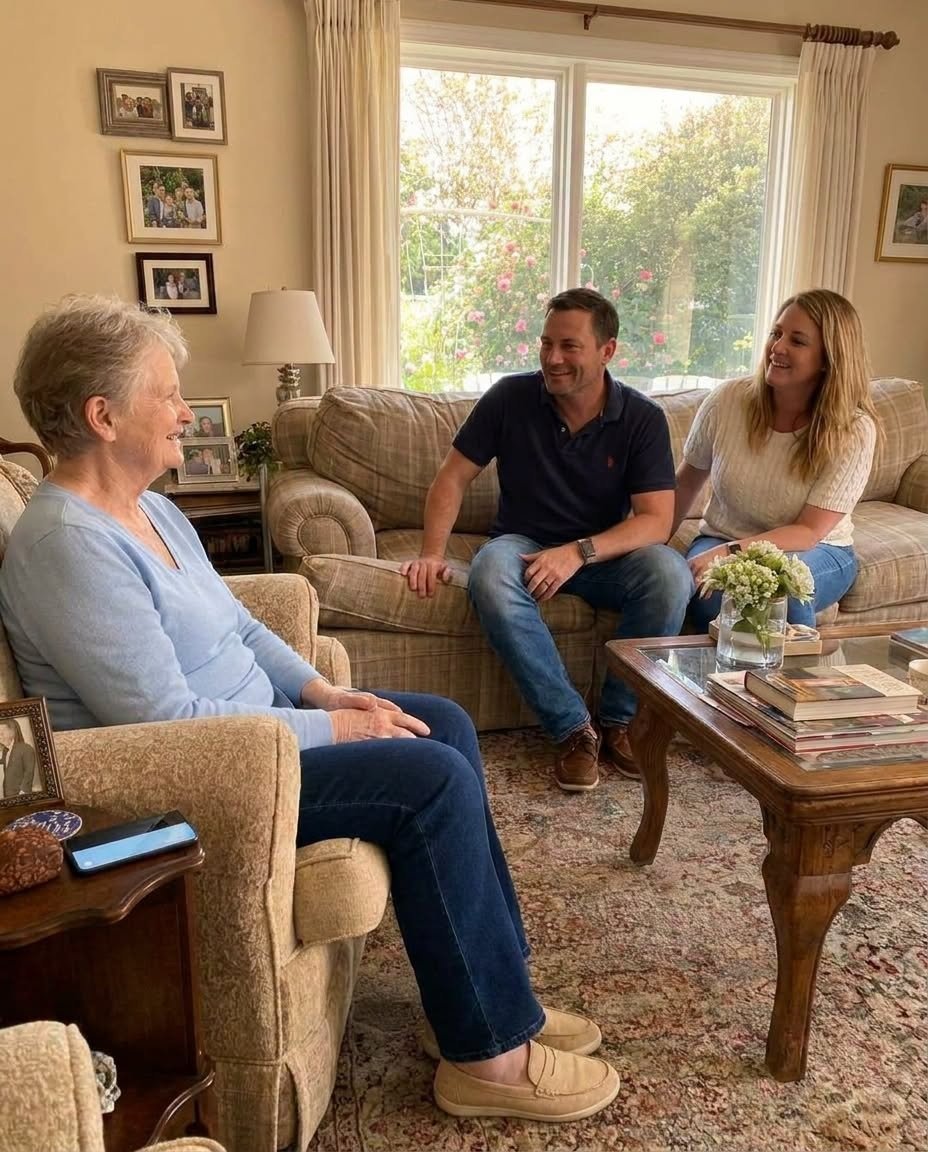
“The money is gone, Mom,” my daughter said, smiling beneath the reading glasses my late husband had left on his study desk. Arthur had been dead only a few weeks, and I was still making coffee for two each morning before remembering there was only one cup to fill. Sarah and her husband Patrick sat on my sofa with the composed satisfaction of people announcing a victory rather than confessing a betrayal. They had used documents I signed while exhausted with grief to transfer $100,000 from a joint account into Patrick’s business. Sarah told me they were building their future and that I had already enjoyed mine with her father. Then she suggested selling the house because, without the money, I supposedly had few choices left. I opened the front door, told them to leave, and remembered Arthur’s final warning: do not panic—just watch.
Arthur and I had been married for forty-three years, and he had spent the last two of them quietly preparing for the possibility that grief might leave me vulnerable. Sarah had visited only three times during his final illness, always accompanied by Patrick, who asked detailed questions about accounts, property, and paperwork. After the funeral, their sudden attentiveness arrived wrapped in phrases about protection and unfinished financial matters. I signed what they described as authorization forms because I was seventy-one, exhausted, and still unable to move his glasses from the place where he had last set them down. What Sarah and Patrick did not know was that Arthur had deliberately kept the visible joint account separate from everything that truly secured my future. He had placed the primary assets into accounts held solely in my name, a lifetime trust, rental properties owned through a holding company, and a life-insurance arrangement they had never discovered.
In the bottom drawer of Arthur’s desk, I found a leather binder labeled, “For Eleanor, When the Time Comes.” His letter explained that the joint account was bait and that any transfer would trigger a notification protocol with our bank manager, Gerald Marsh, and attorney, James Whitfield. As I read, Gerald called to confirm that the movement of funds had activated the safeguards Arthur established fourteen months earlier. The transaction had not exposed my real financial security; it had exposed the people who believed the accessible account represented all I possessed. Arthur had hoped our daughter would never touch it, but he had prepared evidence, account restrictions, and legal authority in case she did. The money they believed had made me helpless had instead created the record that would hold them accountable.
James initiated a civil recovery action, and the funds were returned within three weeks after Patrick’s business account was frozen. The circumstances surrounding my signature, his misrepresentation of authority, and the transfer mechanics also supported a criminal referral involving potential wire fraud and elder financial abuse. I instructed counsel to recover every dollar and document the conduct formally so that no one could later rewrite what had happened. When Sarah called after speaking with investigators, she admitted Patrick had assumed I was too old to fight. I told her the legal process would continue without my interference and that I would decide the future of our relationship only when I was ready. Arthur’s trust protected my lifetime income and directed the remaining estate toward charities we had supported together, leaving neither Sarah nor Patrick access to the properties, insurance proceeds, or principal assets they had expected to control.
That morning, I made one cup of coffee and carried it to the porch, where Arthur’s roses were blooming despite two years of illness, neglect, and hard weather. His binder contained more than financial instructions; it held the practical shape of a love that continued working after the person who created it was gone. Near the back was the number of a travel agent and a note about the trip to Italy we had always postponed. Arthur had written that I should go with someone who made me laugh, and beneath it he had listed my friend Catherine. I returned to the study, picked up his glasses for the first time since his death, and placed them carefully inside the empty drawer where the binder had been. Sarah believed she had taken the last useful part of my life, but Arthur had left me security, time, and the freedom to choose what came next. He no longer needed his glasses, and I finally had things of my own to see.
Website Disclaimer
The information provided on this website is for general informational and educational purposes only. While we strive to ensure that all content is accurate and up to date, we make no guarantees regarding the completeness, reliability, or accuracy of any information published.
The views and opinions expressed in articles belong to their respective authors and do not necessarily reflect the views of this website. Any action you take based on the information found on this website is strictly at your own risk. We will not be liable for any losses, damages, or inconveniences arising from the use of our content.
Some articles may contain opinions, third-party information, or external links. We do not endorse or guarantee the accuracy of content on external websites and are not responsible for their practices or policies.
All content on this website is provided in good faith and is intended for informational purposes only. Readers are encouraged to verify information independently and seek professional advice where appropriate.