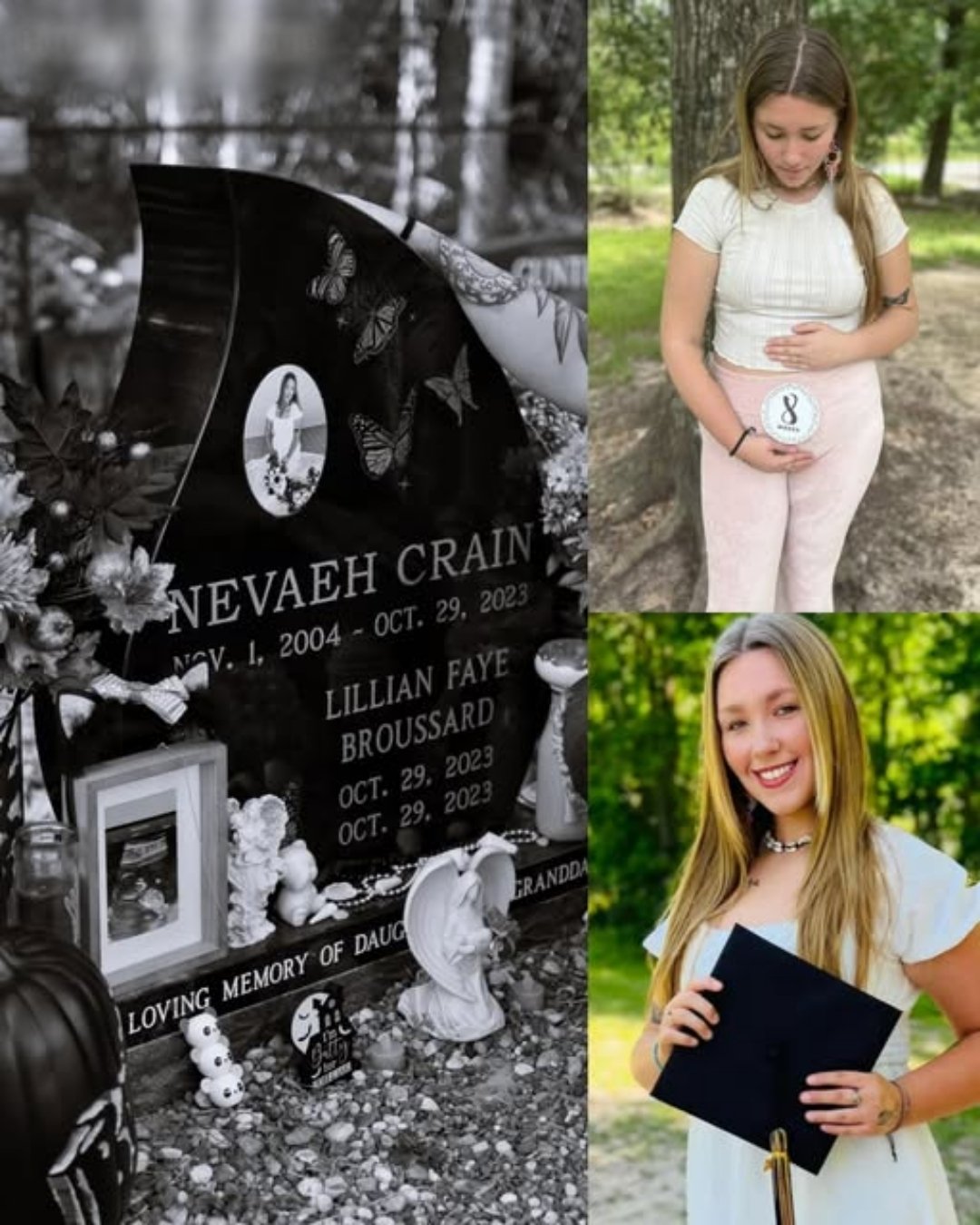
Nevaeh Crain was only eighteen.
A girl on the cusp of womanhood, her life was just beginning.
She had dreams that stretched far beyond her small-town world — a love for art, for dance, for animals, for laughter that filled every room she entered.
And she had a secret joy glowing inside her — she was going to be a mother.
She named her unborn daughter Lillian.
She talked about her constantly — about how she couldn’t wait to see her little face, to hold her tiny hands, to feel her heartbeat against her own.
To her, being a mother was not a burden; it was her greatest blessing.
But fate had other plans.
It started as what seemed like a simple illness.
A fever, vomiting, a weakness that felt like gravity itself was pulling her down.
Her stomach hurt so badly that she couldn’t stand up straight.
She knew something was wrong — not just wrong, but terrifying.
Her family rushed her to the emergency room.
She was pale, trembling, holding her belly as if to protect the child inside.
The doctors examined her quickly and diagnosed her with strep throat.
They gave her medicine and sent her home.
They didn’t listen when she whispered that the pain in her stomach was unbearable.
Hours later, her condition worsened.
Her fever spiked, her heart pounded, her skin turned clammy.
Her mother begged her to go back — and they did, this time to another hospital.
There, at last, a doctor realized she was suffering from sepsis — a life-threatening reaction to infection.
Her body was turning against itself.
It should have been a moment for swift action — antibiotics, fluids, intensive monitoring.
But there was one thing that stopped them: her unborn child still had a heartbeat.
Because she was pregnant, they delayed care.
Because they feared liability, they waited.
Because of hesitation, they lost time.
Nevaeh pleaded for help.
She wanted to live.
She wanted to protect her baby.
But she was told to go home.
By the time she reached the third hospital, she was barely conscious.
Her blood pressure had crashed.
Her lips were turning blue.
Her eyes, once bright and full of life, looked distant, as though she were drifting somewhere far away.
And still, procedures came before compassion — two ultrasounds to “confirm fetal demise.”
Minutes passed.
Then hours.
Her mother held her hand, praying for a miracle.
When they finally began treating her, her body was already shutting down.
The infection had spread.
Her organs began to fail, one by one.
And in that cold, sterile hospital room, Nevaeh’s light faded away.
She was pronounced dead on October 29, 2023.
Eighteen years old.
Six months pregnant.
Gone — along with the child she had dreamed of for so long.
The days that followed were a blur of disbelief and grief.
Her family was left shattered, sitting in silence that no words could fill.
Her mother replayed every moment — every plea for help, every hospital visit, every time they were told,
“She’s fine.”
But she wasn’t fine.
She was dying — and no one listened.
Now, Nevaeh and baby Lillian rest together, side by side.
Two souls bound by love, silenced by a system that failed them both.
Nevaeh’s story has since become more than a tragedy.
It has become a call to action.
Advocates have shared her name in rallies and vigils across the country, calling for stronger protections for pregnant women facing medical emergencies.
Her case is being cited by those demanding that compassion must come before hesitation.
For her family, that fight is deeply personal.
They know that Nevaeh’s death wasn’t inevitable — it was preventable.
If only someone had acted faster.
If only someone had looked at her and seen not just a patient, but a daughter, a mother-to-be, a life worth saving.
Before her passing, Nevaeh had just graduated from Vidor High School.
She was the first in her family to earn her cosmetology license before graduation — a testament to her determination and talent.
She had dreams of opening her own salon one day.
Her friends remember how she loved doing their hair before dances and how she laughed when they called her “the future beauty queen of Vidor.”
But beneath the sparkle and confidence, she carried deep kindness.
She would rescue stray animals, bring home wounded birds, feed neighborhood cats.
She was patient, gentle, the kind of person who could make even the most broken creature feel safe again.
Her mother said, “If Nevaeh loved you, you never forgot it.”
She was also a dancer — graceful, passionate, full of rhythm and emotion.
When music played, she came alive, her body moving with effortless joy.
And when she talked about becoming a mom, that same joy filled her voice.
“She already loved Lillian more than life itself,” her friend said.
“She used to say she couldn’t wait to see who her baby would become.”
Now, her room remains just as she left it.
The baby clothes still folded.
The small pink blanket untouched.
The ultrasound photo taped to the mirror, where her smiling reflection once stood.
For her mother, every corner of that room is sacred.
Every tiny pair of socks, every note in her handwriting, every scent that lingers in the air — a reminder of the life that should still be there.
Some nights, she sits on Nevaeh’s bed, whispering, “I hope you’re both safe now.”
She imagines her daughter holding little Lillian in her arms, rocking her gently somewhere beyond pain and fear.
And though grief has no end, love has no limit.
Nevaeh’s community continues to honor her.
Vidor High School held a candlelight vigil, where classmates shared memories of her laughter, her loyalty, and her kindness.
Her teachers spoke about her creativity, how her artwork brightened the classroom walls.
One of her friends said softly, “She wasn’t just beautiful — she made others believe they were beautiful, too.”
Even strangers, upon hearing her story, have reached out.
Messages from across the country have poured in — from mothers, nurses, and women who have faced the same fear of being unheard.
They see in Nevaeh a reflection of their own vulnerability, their own battles for care and recognition.
Her story has become a voice for many who no longer have one.
In life, she was light.
In death, she became a spark that ignited change.
Her name means “Heaven” spelled backward — and perhaps that was destiny’s cruel poetry.
For Nevaeh, heaven was never far away.
Her legacy now lives through the stories told by those who loved her.
Through her mother’s tears.
Through the laughter of her friends as they remember her quirks and her kindness.
Through the movement she inspired, pushing for compassion, accountability, and reform.
Nevaeh’s story is one that reminds us of a truth too often forgotten: that every life — every heartbeat — deserves to be treated as sacred.
That hesitation can kill.
That care, delayed, can become cruelty.
And yet, even through tragedy, love endures.
Her love for her daughter.
Her family’s love for her.
And the world’s love for a young woman who should still be here, dancing, laughing, holding her baby close.
She is gone — but her light remains.
It glows softly in every life she touched, in every change her story inspires.
And somewhere beyond the horizon, we can almost see her — Nevaeh, cradling little Lillian, surrounded by peace at last.
Website Disclaimer
The information provided on this website is for general informational and educational purposes only. While we strive to ensure that all content is accurate and up to date, we make no guarantees regarding the completeness, reliability, or accuracy of any information published.
The views and opinions expressed in articles belong to their respective authors and do not necessarily reflect the views of this website. Any action you take based on the information found on this website is strictly at your own risk. We will not be liable for any losses, damages, or inconveniences arising from the use of our content.
Some articles may contain opinions, third-party information, or external links. We do not endorse or guarantee the accuracy of content on external websites and are not responsible for their practices or policies.
All content on this website is provided in good faith and is intended for informational purposes only. Readers are encouraged to verify information independently and seek professional advice where appropriate.