I came home intending to sit quietly in the back row of my father’s veterans’ ceremony and leave unnoticed.
That was the whole plan.
No speech.

No reunion.
No correction of every rumor that had grown legs in the months since I had last driven past the Georgia county sign.
I had one cold paper coffee cup in the console, pine shadows moving across the windshield, and damp heat making my sweater cling at the wrists.
The cinnamon smell from the lid had turned stale somewhere after the last gas station.
I told myself that was fine.
I had lived through harder things than a small-town ceremony.
Small towns do not forget.
They just wait until you come home so they can repeat the story to your face.
By 3:18 p.m., I had already heard mine twice.
The first time was at the coffee shop off Main, where the bell over the door gave its tired little jingle and Miss Bev looked up from the register like she had seen a ghost ordering coffee.
“Emily Parker?”
“Hi, Miss Bev.”
I kept my voice light because I did not want to hand anyone proof that they had hurt me.
Two men in seed caps sat by the window with their hands wrapped around paper cups.
One said, “Heard she left the Navy.”
The other laughed into his cup.
“Guess she couldn’t handle it.”
I paid for my coffee.
I smiled.
Then I walked back into the afternoon with my jaw locked so hard it ached behind my ears.
There are things service teaches you that never show up on ceremony programs.
How to stand still while someone misreads you.
How to answer disrespect with silence until the right person asks the right question.
How to keep both hands steady when your whole body wants to throw something.
My father’s house looked smaller than I remembered.
The mailbox leaned a little toward the ditch, and a small American flag hung from the porch bracket, sun-faded at the edges.
The front door was open before I knocked because Gloria had never believed in private entrances when there was a chance someone might see her being gracious.
The entryway smelled of lemon polish and warm pie.
On the kitchen island, seating charts were spread in careful rows.
Event programs sat stacked beside blue ribbon, a tape dispenser, and a grocery-store bakery box she had moved onto a nice tray so nobody would see the label.
Gloria looked me up and down before she said hello.
“That’s what you’re wearing?”
I glanced at my jeans, my sweater, and the road dust near my coat.
“I’ve been driving all day.”
“Tonight is important,” she said.
She smoothed the front of her dress as if even the fabric had to obey her.
“There will be donors, local officials, church leaders. Your father wants everything perfect.”
What she meant was simple.
Do not remind anyone you belong to this family unless you can make us look good.
My father came into the kitchen then, one hand braced on the counter.
Robert Parker had survived deployments, layoffs, knee surgery, and the kind of grief men from his generation treated like a locked drawer.
He had gone grayer since I had last seen him.
Not old, exactly.
Just worn down in the places pride used to cover.
“Emily,” he said.
“Hi, Dad.”
His smile was small, but real.
“You made it.”
“I said I would.”
For one second, we almost found our way back to each other.
Then Gloria stepped between us with a stack of programs.
“Emily will sit quietly in the back tonight.”
I nodded.
“That was the plan.”
Gloria had entered my life when I was sixteen, after my mother had been gone long enough for people to stop bringing casseroles but not long enough for me to stop expecting her voice in the laundry room.
She came in with new curtains, new rules, and a gift for making cruelty sound like household management.
She learned the alarm code.
She took over the Christmas card list.
She told my father she was helping him heal, and maybe he needed to believe that badly enough not to notice what she did with the authority he gave her.
She never yelled at me when he could hear.
That was her gift.
She could turn a room against you with a smile and a sentence soft enough to pass for concern.
At 4:06 p.m., my father took a phone call in the hallway.
I saw his shoulders straighten before I heard him say, “Yes, sir. Thank you. We’ll be ready at six.”
Gloria noticed me noticing.
She folded a ribbon tighter than necessary.
“And please,” she said, “don’t wear anything military-related tonight. You’ll only confuse people.”
I looked at her.
She leaned closer.
“I heard you left the Navy.”
Her voice dropped just enough to keep my father from hearing.
“At least it sounded impressive while it lasted.”
There it was.
The version of me she had been feeding people.
Not reassigned.
Not working in Virginia.
Not still serving.
Failed.
It was a neat word.
Short.
Easy to repeat.
Conveniently missing every fact.
I could have corrected her right there beside the pie and the seating chart.
I could have opened the personnel email on my phone and watched her mouth tighten when she realized the rumor had never belonged to her.
Instead, I picked up another event program and folded it on the crease.
Some people mistake silence for surrender because they have never seen discipline up close.
By evening, the Veterans Hall was packed so tight the folding chairs seemed to breathe together.
American flags lined the walls.
Coffee hissed from the urns.
Old men in service caps clasped shoulders and traded stories they had probably told for thirty years.
Their wives arranged cookies on paper plates and pretended not to monitor every conversation.
A church lady touched my sleeve near the doorway.
“Emily, honey. Your daddy must be happy you’re home.”
“He is,” I said.
I hoped it was true.
Then her eyes moved over my plain coat.
“Are you still with the Navy?”
Before I could answer, Gloria appeared with a tray of drinks and a smile sweet enough to rot teeth.
“There you are,” she said loudly.
A few guests turned.
“We need help serving.”
I looked down at the tray.
Paper cups of lemonade.
Coffee.
Ice already sweating through the bottoms.
“If you’re not sitting with family,” she added under her breath, “you might as well make yourself useful.”
For one ugly second, I imagined letting the whole tray tip forward.
Coffee on her polished shoes.
Lemonade on the hem of that perfect dress.
Ice scattering across the floor while the entire room finally looked at her instead of me.
I took the tray instead.
“Sure.”
The back row had been my choice.
Being turned into hired help had not.
Humiliation is easiest to sell when you wrap it in manners.
Gloria knew that.
She had been doing it since I was sixteen.
I moved through the room with the tray balanced in both hands.
People accepted cups without looking at me twice.
A man with a veteran’s pin nodded at my father across the room and said, “Robert’s girl, right?”
“Yes, sir.”
“Heard you came home from the Navy.”
The word home sat there with teeth.
“I work in Virginia,” I said.
He blinked.
Before he could ask another question, the emcee stepped onto the stage and tapped the microphone.
The sound cracked through the speakers.
Every head turned.
“Ladies and gentlemen,” he said, reading from the program in his hand, “we’d like to recognize a very special guest joining us tonight.”
The rear doors opened.
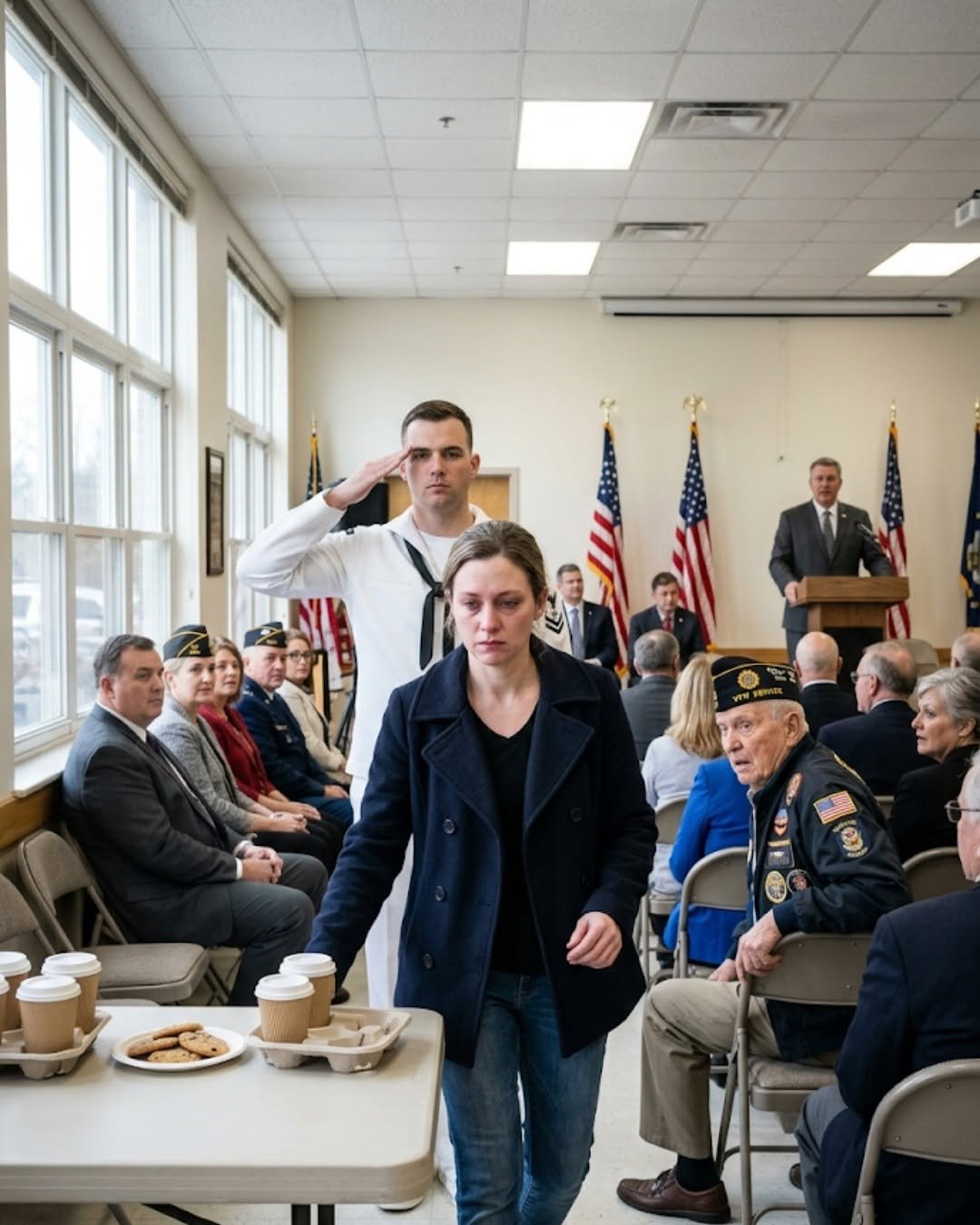
A senior Navy officer in full dress whites walked into the hall.
Conversations died so quickly it felt physical.
Veterans straightened.
A few men pulled their service caps from their knees and held them like they had forgotten what hands were for.
Gloria’s smile widened at first.
Of course it did.
She assumed the important man had come for the stage.
He walked down the center aisle, toward the front, toward my father.
Then he stopped.
His eyes swept the room once, calm and exact.
They landed on me near the back, standing beside a tray of paper cups.
My heartbeat kicked once against my ribs.
The officer turned away from the stage.
One step.
Then another.
The hall froze around him.
Forks paused over slices of pie.
Coffee cups hovered halfway to mouths.
A napkin slid from an old veteran’s knee and landed silently on the floor while nobody bent to pick it up.
Near the front, Gloria’s fingers tightened around her program until the paper bowed.
Nobody moved.
I set the tray down because my hands had started to feel too visible.
The officer stopped directly in front of me.
His face held no pity.
No confusion.
No search for the girl everyone had already decided I was.
He raised his hand in a formal salute.
Every eye in the room shifted from him to me.
I returned the salute because my body knew what to do before my mind could catch up.
Then he lowered his hand.
“Commander.”
The word landed in the hall like a dropped plate.
Somewhere near the cookie table, a woman gasped.
Gloria’s smile held for half a second too long, and then it began to fail from the edges inward.
“Sir,” I said.
The officer reached under his arm and opened a leather folder.
“The program appears to be missing its addendum,” he said.
The emcee’s face went pale behind the microphone.
My father’s head turned slowly toward Gloria.
She did not look at him.
The officer removed one folded sheet.
It had been creased for travel, but the official formatting was clear enough from where I stood.
My full name was printed on the first line.
Emily Parker.
Below that was my rank.
Below that was the assignment Gloria had been calling failure all afternoon.
“This hall was informed at 2:11 p.m. that Commander Parker was to be recognized before the general remarks,” the officer said.
His voice was not loud.
It did not need to be.
“The omission appears to have been clerical.”
Nobody in that room believed him.
That was his mercy.
He gave Gloria the gift of a word she did not deserve.
Clerical.
My father gripped the back of a folding chair.
“Gloria,” he said.
It was barely more than breath.
She whispered, “Robert, I didn’t know.”
But her hand was still crushing the program she had stacked herself on the kitchen island.
The officer looked at her for one clean second.
Not angry.
Worse.
Official.
Then he turned back to me.
“Commander Parker, your command requested that this recognition be made in person while you were home for your father’s ceremony.”
My father sat down without meaning to.
The chair scraped against the floor.
In that sound, I heard every missed phone call, every awkward holiday, every time he had chosen peace in the house over truth in the room.
The officer continued.
“Your service record does not indicate a failure to complete duty.”
The room was so quiet I could hear the coffee urn spit.
“It indicates reassignment, selection, and continued service.”
A man in the second row took off his cap.
Then another did.
Slowly, like the truth had weight and they had to make room for it.
Gloria said, “This is inappropriate.”
Her voice trembled on the last word.
The officer did not raise his tone.
“Ma’am, the inappropriate part occurred before I entered.”
That was when the room changed.
Not loudly.
Not all at once.
But every shoulder adjusted.
Every face that had been turned toward me with pity now tried to find somewhere else to look.
Miss Bev was near the back doors, one hand pressed to her mouth.
The two men from the coffee shop stood beside the windowed wall, both suddenly fascinated by the floor.
My father looked up at me.
“Emily,” he said.
I knew that voice.
It was the voice he used when a repair cost more than expected, when the doctor called with test results, when he had to admit he should have done something sooner.
I wanted to make it easy for him.
Old habits are hard to kill.
A daughter learns early how to protect a father’s comfort, even when he has not protected her dignity.
I did not make it easy.
“Not yet, Dad,” I said quietly.
His face folded.
The officer asked if I would join him at the front.
I could feel every stare on my back as we walked down the aisle.
The tray stayed on the table behind me.
So did the version of me Gloria had been carrying around all day.
At the stage, the emcee stepped aside with a look that said he wished the floor would open.
The officer read the formal lines.
He did not embellish.
He did not humiliate anyone for sport.
That was what made it worse for Gloria.
Facts have a way of sounding cruel when they interrupt a lie.
He said I had continued to serve.
He said I had been selected for a position in Virginia.
He said my command had asked that the recognition be tied to my father’s ceremony because service in our family had not ended with one generation.
My father covered his mouth.
That nearly undid me.
Not Gloria’s silence.
Not the whispers reversing direction.
My father.
Because for all his failures, I had once been a little girl sitting on the garage floor while he polished his old service shoes for Memorial Day.
I had once believed he could fix anything with a socket wrench and a quiet promise.
When the officer finished, the hall applauded.
At first, it was hesitant.
Then stronger.
Veterans stood.
Not all at once, but enough.
A line of old men rising on bad knees has a sound you do not forget.
Metal chair legs scraped.
Hands came together.
Someone near the back said, “Well, I’ll be.”
Gloria did not clap.
She stood with her program crumpled in one hand and her mouth pressed into a line so tight it looked painful.
I stepped down from the stage after the recognition.
My father met me near the front row.
He looked smaller than he had that afternoon.
“I should have asked you,” he said.
“Yes.”
The word came out softer than he deserved and harder than he wanted.
He swallowed.
“She said you didn’t want to talk about it.”
I looked over his shoulder at Gloria.
She was already gathering her purse, already preparing an exit that could pass for offense.
“She says a lot of things.”
He closed his eyes.
“I let her.”
That was the first honest thing he had said all day.
My father reached for my hand, then stopped himself.
Good.
He had to learn that not every wound could be touched just because he was finally sorry.
“I was proud of you,” he said.
“Were you?” I asked.
He flinched.
I did not enjoy it.
But I did not take it back.
He looked toward the back of the hall, where the tray still sat with two cups tipped against each other.
“I think I was proud when it was easy,” he said.
The answer hurt because it was true.
Gloria came toward us then.
Her cheeks were bright.
“I will not be embarrassed in front of this town,” she said.
My father stood slowly.
“No, Gloria,” he said.
His voice was quiet, but it carried.
“You embarrassed my daughter in front of this town.”
The sentence stopped her.
Not because it was loud.
Because it was his.
For years, Gloria had been able to count on my father choosing the smoother road.
That night, in a hall lined with flags and folding chairs and people who loved a clean rumor until it turned back on them, he chose the harder sentence.
She stared at him.
Then she looked at me.
For a moment, I saw the calculation behind her eyes.
An apology would have served her.
A tear might have softened the room.
A joke could have tried to turn the moment sideways.
But there are rooms where manipulation has nowhere left to stand.
She said, “I was trying to protect your father.”
I almost laughed.
“From what?”
She did not answer.
The officer closed the leather folder with a soft snap.
That sound ended the conversation more cleanly than shouting would have.
The ceremony resumed because public rooms always try to recover their shape.
The emcee stumbled through the next introduction.
People clapped too loudly.
Miss Bev brought me a fresh cup of coffee without asking and whispered, “I owe you an apology.”
I took it.
I did not tell her it was fine.
It had not been fine.
After the ceremony, my father and I stood outside near the porch lights of the hall.
The air smelled like cut grass, coffee, and rain that had not arrived yet.
Gloria waited by the car with her arms crossed.
For once, nobody hurried to comfort her.
My father looked at me and said, “Can I call you tomorrow?”
“You can call,” I said.
“I may not answer right away.”
He nodded.
“I’ll keep calling.”
That mattered more than an apology delivered while everyone watched.
Promises made in public are easy.
Repair happens later, when there is no audience left to reward you.
I drove back to my hotel with the window cracked.
My phone buzzed twice on the passenger seat.
One message was from my father.
I’m sorry. I should have stood up for you long before tonight.
One message was from an unknown number.
Miss Bev gave me your number. This is Martha from the veterans committee. We found the original addendum in the folder Gloria brought this afternoon.
I pulled into the hotel parking lot and sat there under the yellow light.
The original addendum.
So it had not been missing.
Not misplaced.
Not clerical.
Gloria had seen my name, my rank, and the reason the officer was coming, and she had still handed me a tray.
I did not cry then.
Instead, I took one screenshot, forwarded the message to my father, and turned the phone face down.
That was the part Gloria never understood.
Silence was not weakness.
Silence was often documentation waiting for the right moment.
The next morning, my father called at 7:42.
I let it ring twice before I answered.
His voice sounded rough.
“She took it out,” he said.
“I know.”
“I found the copy in her purse.”
I looked out the hotel window at a pickup rolling past with a toolbox rattling in the bed.
“And?”
He breathed in.
“And I told her she needs to stay with her sister for a while.”
I did not ask whether that meant a week or a marriage.
That was his road to walk.
Mine had already been long enough.
“I’m not asking you to fix this for me,” he said.
“Good.”
A tired little laugh broke in his throat.
“You sound like your mother.”
For once, the comparison did not hurt.
It felt like someone had opened a window in a room that had been closed too long.
Later that day, before I drove back to Virginia, I stopped at the cemetery.
I brushed grass from my mother’s stone.
I told her about the hall, about the officer, about Dad finally saying the sentence he should have said years earlier.
Then I sat there for a while with my coffee cooling in my hand.
Small towns do not forget.
But sometimes, when the truth arrives in dress whites and walks straight past the stage, they learn a new story to repeat.
I did not leave Georgia healed.
Life is not that tidy.
I left with my name returned to me in public.
I left with my father trying, too late but honestly.
I left knowing Gloria could no longer sell the town a version of me I had not approved.
And when I crossed the county line, pine trees leaning over the road exactly as they had when I came in, I did not feel like the girl in the back row anymore.
I felt like the woman everyone had been forced to stand up and see.
Website Disclaimer
The information provided on this website is for general informational and educational purposes only. While we strive to ensure that all content is accurate and up to date, we make no guarantees regarding the completeness, reliability, or accuracy of any information published.
The views and opinions expressed in articles belong to their respective authors and do not necessarily reflect the views of this website. Any action you take based on the information found on this website is strictly at your own risk. We will not be liable for any losses, damages, or inconveniences arising from the use of our content.
Some articles may contain opinions, third-party information, or external links. We do not endorse or guarantee the accuracy of content on external websites and are not responsible for their practices or policies.
All content on this website is provided in good faith and is intended for informational purposes only. Readers are encouraged to verify information independently and seek professional advice where appropriate.