The highway that afternoon felt like a living creature — roaring, relentless, refusing to pause for anything or anyone. Cars tore past in blurs of steel and sound, each one a reminder that the world rarely slows down long enough to notice the small, fragile things trying to survive within it.
But somehow, through all that chaos, one flash of orange caught Katie Zelenika’s eye.
It was so quick she wasn’t sure she’d really seen it. Just a tiny lump of fur beside the median, barely noticeable next to the concrete and metal. Could’ve been debris. Could’ve been nothing.
But something inside her whispered: Look again.
And when she glanced back — really looked — she knew.
It was a cat.
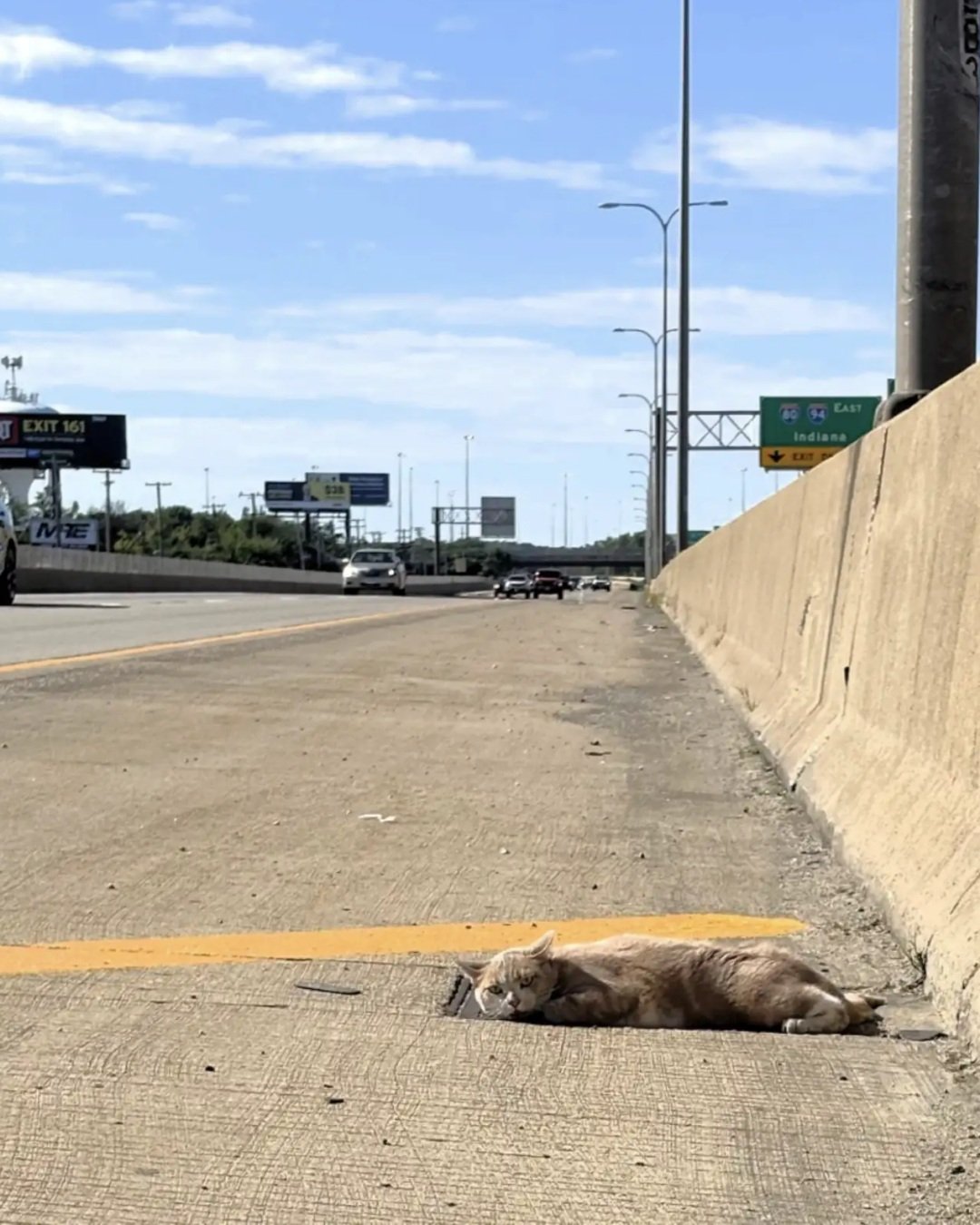
A small, bright-orange body lying motionless on the strip of concrete between two roaring rivers of traffic.
She kept driving — because what else do you do on a highway at 70 miles an hour? But even as she moved forward, her heart lurched backward. The image wouldn’t leave her. She imagined him trying to stand, only to fall. Imagined headlights. Tires. A body too small to be seen in time.
“There’s no way he’s going to make it,” she said aloud to herself. “No one else is going to stop.”
And right there, in the middle of her route to Chicago, she made a decision.
She turned around.
It took her nearly ten minutes to find the next exit, loop back and fight her way toward the spot where she’d seen him. Ten minutes of gripping the wheel, checking the clock, feeling panic crawl up her throat.
What if he’s moved? What if he’s gone? What if I’m too late?
When she finally pulled onto the shoulder and stepped out, the sound of passing cars hit her like a wall of heat and noise. She scanned the median.
Then she saw him.
A tiny orange cat, lying on what looked like a sewer grate — limp, still, his body curled in a way that didn’t look right.
“I wasn’t sure if he was still alive,” she said.
For a moment she just stood there, frozen. Traffic blasted past at terrifying speed, the wind knocking strands of hair into her face. She took one cautious step forward.
And then it happened.
His eyes opened.
Barely — just a flutter, just a sliver of gold reflecting the harsh afternoon sun. But it was enough.
Enough to tell her he was alive.
Enough to make her kneel down right there on the highway shoulder.
Enough to make her promise, silently:
I’m not leaving without you.
But the danger wasn’t over. The cat wasn’t aggressive — he was just petrified. So petrified that any sudden movement could send him bolting into traffic.
Katie softened her voice until it was barely a whisper.
“It’s okay, buddy. I’m here. I’m not going to hurt you.”
Twenty minutes passed.
Then thirty.
Katie moved slowly, inching closer on hands and knees, speaking softly every few seconds so he wouldn’t forget she was there to help. The cat’s tiny body trembled. He didn’t hiss. He didn’t growl.
He just watched her with big, exhausted eyes — too tired to flee, too scared to trust.
Finally, she remembered the sweatshirt in her car.
She pulled it off, moved forward inch by inch, and draped it gently over him. As soon as the fabric touched his body, he sagged into it — as if relief itself weighed him down.
She scooped him up, feeling his frail trembling through the cotton, and carried him to the car.
She named him Sunny.
Because even on the darkest highway, he’d still had a spark of light.
At the vet, pieces of his story began to surface.
He didn’t have a microchip.
He had been declawed — leaving him defenseless outdoors.
His paw pads were burned raw from walking on blistering pavement in the August heat.
“All of his paw pads were burnt off from walking,” Katie recalled.
It broke her heart.
Someone had left him.
Someone had thrown him away without the tools he needed to survive.
And yet, somehow, he had made it long enough for her to find him.
At home, he was nervous, hiding in corners, flinching at small sounds. Trauma lingers in the body — especially when that body has known fear for far too long.
But Katie never pushed him.
She sat on the floor near him. She left treats nearby. She whispered encouragement without expecting anything back.
And slowly, Sunny began to unfold.
One day he took a step toward her.
Another day he sniffed her hand.
Then, unbelievably, he sprawled on his back and asked for belly rubs — the universal sign of trust from a cat who once clung to life on a highway median.
“He really opened up,” she said. “He just wanted to be playful. He did air biscuits all the time.”
Air biscuits — the sign of a heart healing.
For two months, Katie watched Sunny transform from a frightened stray into a warm, affectionate companion who followed her from room to room and curled beside her every night.
And then the day came when a family stepped forward, ready to adopt him through the Michiana Humane Society.
Katie knew she’d been preparing for this moment — that she was just a safe place on his way to a forever home. But knowing didn’t make it easy.
She held him for a long time before letting go.
She remembered the sewer grate. The trembling. The eyes opening just enough for him to say, Help me.
And she remembered how it felt to whisper back, I’m here. I’ve got you.
As hard as it was, she handed him over with a heart full of love.
Because he deserved a calm, beautiful life.
Because he deserved safety.
Soft blankets.
Full meals.
Windowsills.
Naps in sunbeams.
People who adore him.
Today, Sunny is living that life.
He no longer hides.
He no longer trembles.
He no longer struggles to survive.
Instead, he naps by windows glowing with warmth. He stretches his healed paws. He kneads the blankets of a home that finally loves him back. He purrs deeply, living the peaceful life he almost never got the chance to have.
All because one driver saw something orange on the highway — and chose to turn around.
All because his eyes opened at the right moment.
And someone chose not to look away.
Website Disclaimer
The information provided on this website is for general informational and educational purposes only. While we strive to ensure that all content is accurate and up to date, we make no guarantees regarding the completeness, reliability, or accuracy of any information published.
The views and opinions expressed in articles belong to their respective authors and do not necessarily reflect the views of this website. Any action you take based on the information found on this website is strictly at your own risk. We will not be liable for any losses, damages, or inconveniences arising from the use of our content.
Some articles may contain opinions, third-party information, or external links. We do not endorse or guarantee the accuracy of content on external websites and are not responsible for their practices or policies.
All content on this website is provided in good faith and is intended for informational purposes only. Readers are encouraged to verify information independently and seek professional advice where appropriate.