The silence woke me before the pain did. It was not the ordinary hush of a large house before dawn, not the soft expensive quiet created by thick rugs, sealed windows, and years of learning how to live alone without admitting it. It was a stranger silence, a silence with intention in it, as if the air itself were waiting to see how I would react once I understood what had been done to me. For a few drifting seconds I lay very still beneath my linen sheets, my body heavy with the odd sluggishness of sleep too deep to be natural. Then I lifted a hand toward my head, meaning only to brush back the silver hair I had worn like a final flag through the long campaign of my life, and my fingers met skin. Bare skin. Tender, abraded, raw in patches. My palm moved again, faster now, searching for what could not possibly be gone, but there was nothing. Only the strange close warmth of scalp where thick silver hair should have been, and the sting of nicks, and the smell—sharp, medicinal, cheap, invasive—like discount antiseptic and bad intentions.
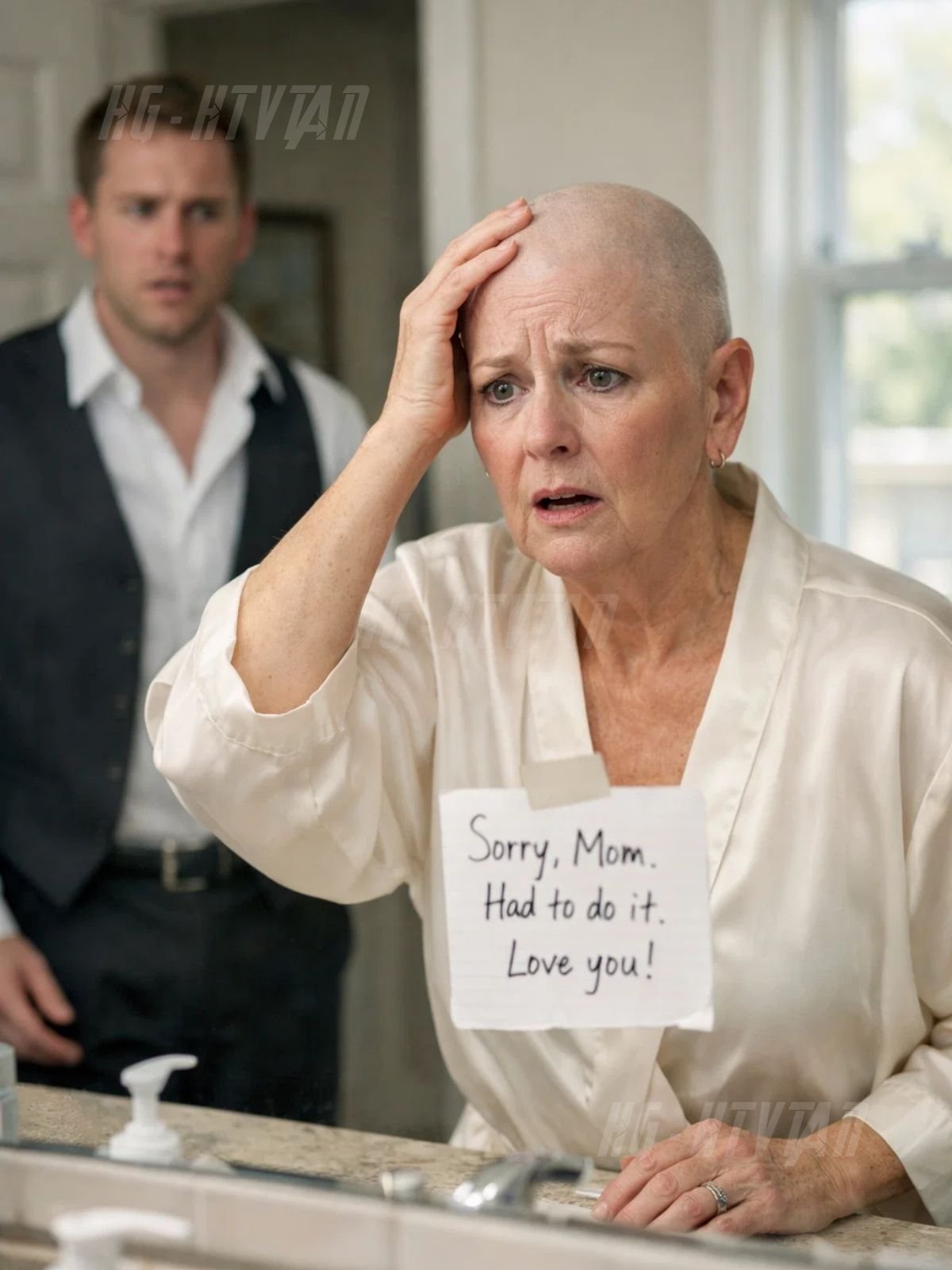
I sat up so suddenly the room tilted. The pale morning light from the harbor was just beginning to press through the curtains, laying a cold stripe across the carpet. On the duvet around me lay clumps of hair. My hair. Silver in the dimness, almost white where the light touched it. It looked unreal at first, like wool torn from some old coat, until I saw the uneven edges where it had been hacked away and the hollow shapes where longer strands had curled against the fabric before falling still. I remember thinking, with a clarity that almost made me laugh, that even cruelty has texture. It leaves debris. It rearranges the room. It does not simply happen and vanish.
There was a note propped against my bathroom mirror. I knew it was there before I even crossed the room because some acts of malice are so childish they carry their own staging. I walked barefoot over the carpet, every nerve in my body alert now despite the lingering drugged heaviness behind my eyes, and found the card leaning where my lipstick tray usually sat. Thick cream paper. Black ink from one of those fountain pens that cost more than the first rent I ever paid. A message written in a confident slant I recognized immediately.
Congratulations—you finally have a hairstyle that suits your age. Enjoy my wedding day! —Sabrina
Beneath the signature was a tiny heart, drawn with the lazy flourish of a woman who had never once mistaken cruelty for anything but wit.
I read it twice. Then a third time, not because the meaning was unclear but because my mind needed to step through each word and place it where it belonged. By then the pain in my scalp had sharpened from abstract outrage into a living burn. I touched one particularly raw spot near the crown and came away with a bright sting in my fingertips. Someone had shaved my head while I slept. Someone had entered my home, my bedroom, my bedchamber as the old novels called it, and stood over me long enough to strip from me the one vanity I had preserved through widowhood, hunger, ambition, betrayal, age, and success. And they had not done it to rob me, or even to frighten me. They had done it to humiliate me. To reduce me. To turn me into a joke before the wedding of the son for whom I had built my entire life out of the ashes of another.
I did not scream. I did not call the police. I did not collapse against the sink and weep into my hands like the women in advertisements for anti-aging cream or luxury tissue paper. I looked at myself in the mirror and saw a stripped-down version of the woman I had been avoiding for years: sixty-seven, tall, narrow-faced, still upright, scalp shining where silver curls should have softened the severe lines of age. I looked older without hair, yes, but I also looked harsher, clearer, more like the truth. For an instant that unnerved me more than the attack itself.
Then I went to the wall safe in my dressing room, knelt, entered the code with steady fingers, and took out the thick envelope containing the transfer documents for twenty-two million dollars.
I had meant to present them that afternoon after the speeches, after the champagne and photographs and insincere blessings, as my final grand gesture of maternal devotion. Twenty-two million dollars in liquid assets, structured carefully to minimize tax consequences and maximize freedom, the product of thirty-three years of relentless work. It was not a whimsical amount, not some rich widow’s indulgent flourish. It was the condensed force of my entire adult life—every predawn train, every property deal, every dinner eaten standing over a sink because there was no time for sitting, every loneliness disguised as professionalism, every woman-smile I had forced in rooms full of men who called me sweetheart until I owned the building they rented offices in. Twenty-two million dollars. My last promise to my son. My farewell to the era in which I believed giving more would solve what love had failed to reach.
I held the envelope in both hands and knew, before the thought fully formed, that the gift was dead.
That realization did not feel like revenge at first. It felt like oxygen.
My name is Beatrice Langford, and if you had met me at thirty-two, the morning after my husband Richard died on our kitchen floor with his coffee still warm on the table, you would not have predicted empire. You would have seen a woman in a stained blouse, eyes swollen from crying, hands trembling over insurance forms she barely understood, with six hundred dollars in the checking account and a mortgage already gasping for mercy. You would have seen a thin twelve-year-old boy asleep on the couch because he was afraid if he slept in his own bed his father would die again somewhere he could not see. You would have seen grief so dense it felt architectural, like the house itself had been built out of it overnight. Empire was not in the room that day. Hunger was. Fear was. Shame, old and familiar from my own childhood, sat down with us as though she had always intended to stay.
I had married Richard because he was gentle and funny and believed I was brighter than the small life my family considered suitable for a girl who knew how to keep a ledger and fry onions at the same time. He sold office equipment, read poetry badly, and kissed the inside of my wrist when he thought I looked tired. We were not wealthy, though we had our moments of pretending. We had a small house with drafty windows and one bathroom that rattled in winter. We had Sunday pancakes and overdue bills and a way of laughing together that made insufficiency feel temporary. Then one Tuesday morning he pressed a hand to his chest halfway through coffee, frowned as if annoyed by the inconvenience, and died before the ambulance reached us. There are women who say widowhood arrived like weather. Mine arrived like eviction.
Michael asked me that night where his father had gone, and because I had been taught all my life that mothers must convert terror into certainty, I told him his father was with God. What I wanted to say was that his father had gone where paychecks go when they stop, where plans go when the body defects, where protection goes when the person embodying it simply vanishes between one breath and the next. But children deserve lies of mercy before they earn the truth, so I gave him one and tucked him beneath an old quilt on the couch because he said he could still smell Dad there.
After he fell asleep clutching Richard’s reading glasses, I sat on the floor beside him and made the vow that ruined me before it saved me. Michael would never know fear if I could prevent it. Michael would not grow up counting coins for milk, as I had. Michael would not wear shoes with cardboard in the soles. Michael would not learn to make himself smaller in any room because money was scarce and adults were tired. I had failed to keep his father alive. I would not fail at the rest.
Women have built dynasties from worse vows.
The first year after Richard died was not heroic; I dislike how memory polishes suffering into virtue. It was ugly, exhausting, humiliating work. I cleaned office buildings from four to eight in the morning, the fluorescent lights turning every corridor into an accusation. Then I took Michael to school and went downtown to a real estate office where I answered phones, typed letters, filed leases, and listened. Listening saved me before any mentor did. Men reveal astonishing things in front of women they assume are decorative or temporary. I learned cap rates, zoning loopholes, tenant behavior, lien patterns, the smell of a bad investment dressed in confident language. At night, after Michael slept, I studied property law from library books and old continuing-education manuals I begged off agents who thought I was amusing. I drank coffee until my hands shook and learned how cities breathe through real estate—where they expand, where they decay, where neglect is not failure but opportunity waiting for one stubborn person with nerve and timing.
Michael never saw me cry unless I could blame onions or allergies. When the power was cut off one winter because I miscalculated a payment schedule, I told him we were having a camping adventure indoors and lit candles in jelly jars. When dinner was peanut butter on toast three nights running, I called it a “budget challenge” and made him rate my creativity as though deprivation were a game show. When he needed sneakers I could not afford, I polished secondhand ones until they gleamed and convinced him vintage was cooler than new. He believed me because children believe their mothers until the world teaches them otherwise. I built his safety partly from labor and partly from theater. Looking back, I can see that performance was my first lesson in the power and danger of making comfort look effortless.
By the time Michael turned sixteen, the sharpest edge of poverty had receded. I had borrowed recklessly against an impossible future to buy my first duplex in a neighborhood everyone else dismissed as tired. I spent weekends scraping wallpaper, painting walls, replacing fixtures, negotiating with contractors who tried to overcharge the widow because they assumed desperation meant weakness. I learned how to stare back. Then I bought a six-unit building, then a small mixed-use property where the upstairs tenants paid enough to float the downstairs storefront until I found the right business to lease it. By the time the men at the office stopped calling me honey and started calling me Ms. Langford, I had learned the one rule that matters in property: the person willing to wait through inconvenience usually wins.
Success did not arrive as luxury at first. It arrived as fewer emergencies. Then as choice. Then as margin. Michael’s first car was a used BMW I bought at an auction and had restored because I wanted him to step into adolescence without the sour knowledge that he was behind. His college tuition was paid in full. When he wanted to major in business despite showing no particular appetite for discipline, I wrote checks, hired tutors, and smiled when professors implied he was more polished than prepared. I told myself there was time for him to grow into responsibility. Plenty of sons bloom late, I reasoned. Plenty of boys raised without fathers take longer to discover the shape of manhood. I mistook postponement for patience. I mistook indulgence for investment.
The truth, which I only learned much later, was that deprivation had taught me to overcorrect in the direction of abundance, and abundance without consequence is just another form of neglect.
At twenty-eight Michael brought Sabrina into my life with the delighted tension of a man unveiling something he hoped would validate him. “Mom, you’re going to love her,” he said as if love were a social accomplishment we might perform over roast chicken. He arrived at my Beacon Hill townhouse carrying a bottle of wine he had not paid for and wearing the self-conscious ease of someone standing inside the version of himself he wanted admired.
Sabrina stepped in behind him like a woman entering a lobby she already assumed belonged to her. She was beautiful in the disciplined manner of people who confuse aesthetic control with character: honey-blonde hair arranged to appear accidental, skin so even it must have been assisted by science, a body carved by private trainers and public ambition. Her dress was simple in the expensive way simple things become when they are cut by the right hands. Her smile, when she gave it to me, was precise enough to be measured.
“Mrs. Langford,” she said, extending manicured fingers that were cool and dry in mine, “Michael has told me so much about you. Self-made, isn’t that right? I think that’s just extraordinary.”
There are pauses that speak louder than nouns. The slight suspension before self-made told me everything. She was filing me immediately into a category: woman who began with nothing, woman who had probably once ironed uniforms for men like her father, woman who should be admired at a safe distance for industriousness but never confused with those born to power. I felt the insult in my bones because I had spent decades learning its dialects. Still, Michael stood beside her shining with approval, and I had long ago trained myself to swallow instinct when it threatened his happiness. So I smiled and said, “I’ve had a busy life,” which is what women say when they do not wish to embarrass their sons by naming the truth.
Over the next two years, Sabrina did not attack so much as erode. She had the social intelligence of a predator who knows a direct strike wastes energy when pressure applied consistently at the margins can accomplish more. She would suggest restaurants for family dinners where, she claimed, I would feel “more comfortable,” meaning quieter, cheaper places where my age and self-made elegance could be interpreted as quaint instead of competitive. She complimented my jewelry as “wonderfully vintage,” my clothes as “classic,” my opinions as “refreshingly straightforward.” She had a gift for making contempt sound like inclusion. When business came up, she would ask Michael to explain basic concepts to me in a tone designed to display both his sophistication and my presumed limitations. He never noticed, or pretended not to. Men raised on admiration often become astonishingly resistant to subtext if seeing it would cost them comfort.
And Michael changed. Gradually, then all at once. The boy who once spent Saturdays helping me paint stairwells in my early buildings became a man who complained when the trust distributions I had set up for him were delayed by tax-season paperwork. The young professional who used to ask my advice on acquisitions started repeating phrases Sabrina favored—brand alignment, lifestyle optimization, curation—as though life were not lived but staged for private investors. He called less unless he needed something. And he always needed something.
“Mom, Sabrina’s birthday is coming up and she’s always dreamed of Paris. We’re thinking business class. You can help, right?”
“Mom, we’re ring shopping and the good stones start where the saleswoman says real value begins.”
“Mom, the venue won’t hold the date without a nonrefundable deposit. We should move quickly.”
No please. Rarely thank you. Just assumption, dressed in filial warmth when necessary and impatience when it wasn’t. Every time I told myself it was temporary. He was in love. He was trying to impress a difficult woman. He would settle. He would remember himself. The most dangerous lies are the ones mothers tell in defense of their children.
Then came the wedding planning, a year-long opera of extravagance funded by my labor and conducted by Sabrina’s appetite. St. Andrew’s for the ceremony because only old stone and stained glass would produce the photographs she wanted. The Grand Harbor Hotel for the reception because she liked the ballroom’s chandeliers and the view over the river. Flowers imported. Crystal rentals. Musicians flown in from New York. Guest list expanded to include a hundred people neither bride nor groom liked but both considered useful. At every stage I wrote checks and told myself I was purchasing my son’s future happiness. In reality I was underwriting a theater production in which I had been cast as benefactor, obstacle, and eventual target.
The twenty-two million dollar gift grew in my mind during those months like a final absolution. I would give them a foundation large enough to quiet all future demands. They could travel, invest, ruin themselves, learn, recover—whatever they chose—but it would be my last major act of financial motherhood. I did not yet understand that people who see generosity as weakness never interpret abundance as completion. They only see room to take more.
The morning I woke bald, I called Lucia before I allowed myself to feel anything else. Lucia had cut and colored my hair for twenty years and possessed the grave discretion of priests and high-end stylists, those professions most trained to witness human humiliation without making it worse. She arrived within half an hour carrying cases, tools, scarves, and three wigs. She took one look at my scalp, inhaled once through her nose, and said, “Sit down.” Not What happened. Not Who did this. Just the imperative of survival.
She cleaned the cuts, murmuring practical things, and fitted a silver wig so skillfully that I almost frightened myself in the mirror. The hair was perhaps a shade smoother than my own had been, the style a little more commanding, but the overall effect was not disguise so much as escalation. I looked less softened, less maternal, more like the woman bank presidents apologized to when paperwork lagged. Lucia fastened the final comb and met my eyes in the mirror. “Whoever did this,” she said quietly, “made a mistake.”
I slipped a digital recorder into my purse before she left. I cannot claim clairvoyance; I only knew that the note on the mirror belonged to the kind of woman whose cruelty would not end at one performance. Something in me had gone colder than rage. Evidence, I thought. If I was going to destroy what needed destroying, I would do it with proof.
The drive to St. Andrew’s should have felt triumphant. Mothers are supposed to glide toward their sons’ weddings wrapped in nostalgia and silk, clutching speeches about how yesterday he was in Little League and today he is a man. Instead I felt as if I were driving toward a public execution and was unsure whether I was the victim or the witness. The church sat on its hill above the river in all its respectable Boston grandeur, old stone weathered to authority. Inside, white roses spilled from urns and candlelight flickered against polished wood. Two hundred guests filled the pews—developers, attorneys, old-money matrons, politicians who had once requested campaign contributions over crab cakes in my dining room. They smiled at me with the warm greed reserved for women whose money has improved many lives at a tasteful distance.
I took my place in the front pew and watched the machinery of celebration arrange itself. Michael looked handsome in his custom tuxedo, though too often he checked his phone. Sabrina floated somewhere behind closed doors amid satin and cosmetics and female laughter sharpened into strategy. The organist rehearsed a phrase twice. The coordinator hissed into a discreet headset. I sat very still and thought of all the times I had carried my son’s fear so he would not have to feel it himself.
A few minutes before the ceremony began, Michael slipped out into the side corridor with his phone pressed to his ear. I do not know what made me follow. Maybe the recorder in my purse had turned me into a hunter. Maybe some maternal part of me was still searching for an innocent explanation large enough to save us. The corridor was lined with stone saints whose carved faces seemed appropriately disappointed in all human arrangements. I paused near a pillar and heard my son speak in a voice low enough to suggest secrecy and familiar enough to break me.
“Tessa, not now. I told you to wait until after the ceremony.”
Tessa. His assistant from the firm, if assistant was all she had been. Dark-haired, quick, watchful. I had met her twice and dismissed the tension I sensed between them as professional. Mothers ignore too much when the alternative is accusation.
He continued, pacing, his shoes clicking softly on the stone floor. “After I get the money from my mother, everything changes. We won’t have to hide anymore. We won’t have to sneak around. Just be patient.”
I felt the cold of the pillar against my spine as if I needed masonry to remain upright.
“You know how she is,” he said with a weary little laugh I had heard him use on vendors and waiters, the laugh of a man performing patience. “Always trying to please me. Always terrified I’ll disappear. Once she signs this afternoon, we’re done pretending. Honeymoon first, then I’ll handle the divorce. No, Sabrina won’t see it coming. That’s the point.”
The recorder in my purse captured every syllable while my mind tried to locate the boy who had once cried because a robin flew into our window.
He said more. Enough to remove any lingering ambiguity. He spoke of freedom, of starting over, of finally building the life he wanted once my money cleared. He spoke of me as one speaks of a difficult but predictable financial instrument. Not mother. Not woman. Resource. Leverage. Sentiment in expensive shoes.
When he ended the call and walked back toward the sanctuary, adjusting his cuffs, he passed within a few feet of where I stood hidden and did not notice me. That, more than the betrayal itself, nearly undid me. He no longer looked for me. I had become so fixed in his life as a source rather than a person that he moved through the world assuming my witness absent unless summoned.
I returned to my seat with my face composed and my insides scoured clean. By the time the music swelled and Sabrina appeared at the back of the church in lace and calculated innocence, I no longer felt grief in the way I expected. Grief had been replaced by an almost surgical clarity. The marriage proceeding down that aisle was not a love story gone wrong; it was a set of intersecting frauds and I, at last, had stopped being willing prey.
The ceremony itself was beautiful if one has any appetite for beautiful lies. The priest spoke of covenant and sacred joining while Michael promised fidelity to a woman he intended to abandon and Sabrina promised loyalty to a man she had already reduced to strategy. They turned toward each other with faces arranged in reverent emotion. Guests dabbed tears. Someone behind me whispered that no one looked more in love. I thought: of course not. Skilled liars understand staging better than honest people do. Honest people imagine truth radiates on its own. It does not. It must be protected, sometimes armed, sometimes dragged onto the dance floor by force.
When they kissed, applause burst through the sanctuary like released pressure. I clapped too. My palms met with measured civility. No one watching would have known that by then the twenty-two million dollars in my purse had transformed from wedding gift to ammunition.
At the Grand Harbor Hotel the ballroom glittered obscenely. Crystal chandeliers hung like frozen cascades of captured light. White roses and peonies towered from mirrored stands on every table. Silverware flashed. Champagne moved on trays through the crowd carried by young men and women who earned more in poise than in tips. Boston’s social engine had arrived to celebrate what it believed was a union of polish and pedigree. I moved among them smiling with the ease that years of business had taught me. Several people complimented my “beautifully styled” hair. One woman asked for Lucia’s number. I gave it to her and very nearly laughed.
During the reception I excused myself and took a corridor toward the restrooms partly because I needed air and partly because I had learned that secrets cluster near closed doors during expensive events. That is how I came upon the bridal suite, the door slightly ajar, Sabrina inside with her bridesmaids and enough champagne in her bloodstream to dissolve prudence.
“You know what the best part is?” she said, her voice bright with intoxicated triumph. “In a few hours I’ll have access to the whole thing. Twenty-two million dollars. Well, not literally in my account this second, but enough. Once it’s transferred, it becomes marital, and then we all know how these stories go.”
A spray of laughter.
One bridesmaid asked, “Do you really think he won’t suspect anything?”
“Michael?” Sabrina scoffed. “Please. He thinks wanting me is the same thing as understanding me. He’s so busy trying to prove he’s not his mother’s son that he never notices when someone smarter is two moves ahead.”
My hand slid into my purse and found the recorder again.
“I already spoke to a divorce attorney,” Sabrina continued. “Quietly. Very discreet. I won’t stay married longer than I have to. Why would I? He’s needy, he has no spine, and that mother of his hovers over everything like some self-made queen who thinks hard work makes her royalty. Once the money lands, I walk with half and start over somewhere warmer. Maybe Miami. Maybe London for a year.”
Another wave of laughter, uglier this time.
“And what about his mother?” someone asked. “She’ll lose her mind.”
Sabrina lowered her voice to a vicious intimacy that carried perfectly through the cracked door. “Please. I’ll convince him she needs care. An upscale place, obviously, so he doesn’t feel guilty. One of those residences with gardens and piano recitals and women in cashmere cardigans waiting to die politely. Park her there, get her out of the house, get her out of the company, and let someone else manage her emotional dependence. Six months, maybe less. Michael does whatever the last woman speaking to him suggests.”
The room erupted. Glass clinked. Someone said, “You are terrible.” Sabrina answered, “I’m practical.”
I stepped back before any of them could see me, my pulse steady now in that strange way it becomes when shock has burned itself down into purpose. Between the church corridor and the bridal suite door, I held enough truth to ruin every lie in the room. The question was not whether I would use it, but how completely.
At my place at the head table sat the envelope. Twenty-two million dollars in transfer documents. I touched it once through my purse and felt, not sorrow, but relief so deep it made me almost dizzy. There is a point in certain betrayals when grief becomes inefficient. Once the beloved has revealed themselves willing to sell you, the transaction clarifies everything. You are no longer negotiating affection. You are dealing with price. And once price is visible, self-respect has a chance.
Dinner passed in a blur of speeches that sounded like satire to my ears. Michael’s college friend called him loyal. Sabrina’s father praised her grace. The best man described their love as “undeniable” while I sipped water and watched the couple exchange smiles over a secret each believed securely hidden. I have sat through hostile acquisitions with less hypocrisy.
Then the emcee—a glossy man hired for charm and timing—tapped his microphone and announced that the groom’s mother would like to say a few words. His tone implied sentiment. The room warmed into expectation. Michael beamed at me with that public smile children reserve for parents they assume remain safely in role. Sabrina lifted her chin and composed her features into respectful affection. She thought I was about to bless her.
I stood slowly, taking care with every movement. I set down my champagne flute. I felt the weight of the recorder in one hand, the envelope in the other, and understood with calm certainty that this was the last time I would ever perform maternal gratitude for being used.
“Thank you,” I began, and my voice carried farther than I expected because rage had given it ballast. “Thank you all for coming to celebrate Michael and Sabrina today. As Michael’s mother, I have spent a great deal of time thinking about what this day means.”
There were nods, small smiles, the rustle of napkins settling into laps. Everyone loves a mother speech as long as the mother knows her function.
“Thirty-three years ago, when my husband died suddenly, I was left with a twelve-year-old son, six hundred dollars, and no clear idea how to save either of us. I made a promise that night. I promised that my son would never know the insecurity I knew growing up. I promised him safety. Opportunity. Support. Every advantage I could build with my own two hands.”
A hush of approval. The older guests knew parts of my story. They liked this version of it: grief redeemed by work, hardship turned into wealth, motherhood sanctified through sacrifice.
“I kept that promise,” I said. “Perhaps too well.”
A few people laughed softly, assuming modesty. Michael shifted in his chair.
“Today, I intended to present Michael and Sabrina with a wedding gift. The culmination of a lifetime’s work. Twenty-two million dollars.” Gasps moved through the ballroom like wind through dry grass. Even people who knew I was wealthy did not know the scale of what I had planned. Michael’s face changed instantly. Sabrina’s fingers tightened on her napkin.
“But before I transfer that gift,” I continued, “I think all of us deserve to hear what the bride and groom say when they believe I am not listening.”
Every sound in the room stopped. No glass. No fork. Even the hotel staff seemed to freeze. I placed the recorder on the table, pressed play, and let my son betray himself.
Tessa, not now. I told you to wait until after the ceremony.
The effect was electric. Heads turned toward Michael so sharply several guests nearly collided with each other. He half-rose at once. “Mom—”
I raised one hand. “Sit down.”
The recorder went on.
After I get the money from my mother, everything changes. We won’t have to hide anymore.
A wave of shocked murmuring spread through the room. Someone at the back let out a sharp involuntary “Oh my God.” Michael’s face had gone from pale to mottled red. He looked suddenly like a child caught stealing and still arrogant enough to think explanation might save him.
You know how she is. Always trying to please me. Always terrified I’ll disappear. Once she signs this afternoon, we’re done pretending.
A woman at the nearest table put her hand over her mouth. Across the room one of my attorneys stared at Michael with open contempt. Camera phones rose. Of course they did. Scandal is the one true democratic instinct among the privileged.
“It’s out of context,” Michael said, standing now, palms lifted in useless appeal. “Mom, please—”
I did not look at him. I pressed the next track.
Michael is so naive. He has no idea what’s coming. I’ve already contacted a divorce attorney. I don’t need to stay married to that mama’s boy forever.
If Michael’s recording caused shock, Sabrina’s caused disgust. She sat motionless, as if paralysis could preserve her. Her bridesmaids had all discovered intense interest in the table linens. One of Sabrina’s uncles said, very distinctly, “Jesus Christ.”
I let the next clip play.
Once I have the money, I’ll convince Michael to put her in some upscale place. Park her there and let someone else deal with her neediness.
That did it. Outrage erupted openly then. Not polite whispers, not scandalized breathing—actual voices. “Appalling.” “Monster.” “Throw them out.” The ballroom became a courtroom without procedure. Sabrina opened her mouth at last, perhaps to deny it, but the sight of the note in my hand ended whatever instinct toward performance remained.
“And since we are all sharing truths,” I said, lifting the card from the morning high enough for the front tables to see, “I should mention that I woke this morning to discover my hair had been shaved off while I slept.” The room sucked in one collective breath. “This note was left beside my bed.”
I read it aloud. Slowly. Every word. Congratulations—you finally have a hairstyle that suits your age. Enjoy my wedding day! —Sabrina.
If I had announced a murder, the silence might not have been deeper. Sabrina rose then, finally, trembling visibly. “I did not—”
I turned toward her for the first time all evening. “Be very careful what sentence you begin next. There are fingerprints on the note, hotel cameras in the corridor, and more people than you realize willing to speak now that the room has chosen a side.”
That was a bluff, at least in part. But it worked. She sat down hard.
I placed the envelope on the table and rested my hand over it like a judge about to pass sentence. “So let me be plain. The twenty-two-million-dollar wedding gift has been canceled. Neither of you will receive a cent from me today, tomorrow, or at any point in the future merely because you once stood near me and called it family.”
Michael’s chair scraped back. “Mom, you can’t—”
“I can. I built it. I can burn it before I hand it to thieves.”
The ballroom, which had spent the last ten minutes choosing between spectacle and conscience, chose conscience loudly. Applause began somewhere near the center tables, sharp and incredulous, then spread. Not celebratory applause. The harsher kind. Agreement weaponized.
I looked at my son and the woman he had chosen over integrity, over gratitude, over me. “The greatest gift I can give either of you today is clarity,” I said. “Greed always imagines itself clever until the moment it becomes visible. Then it is merely ugly.”
Michael’s face crumpled, but not into remorse alone. There was anger there too, and fear, and the disbelief of a man who had spent his life assuming consequences could be managed. “Please,” he said, voice breaking now as the room watched him fall. “Please, just let me explain.”
I thought of Richard’s reading glasses clutched in a twelve-year-old hand. I thought of late rent, frozen pipes, second shifts, second mortgages, every lonely dinner eaten so Michael could have more. I thought of my scalp burning beneath its carefully fitted wig. I thought of how thoroughly he had mistaken my love for weakness.
“It is exactly what I think,” I told him. “You sold your mother for money you did not earn and a future you did not have the courage to build honestly.”
Then I turned and walked out.
The interesting thing about walking away from your own humiliation in public is that your body learns the motion faster than your heart. I crossed the ballroom, moved through the hotel foyer, and stepped into the Boston night with my spine straight and my mouth set, but once the cold air hit me, I had to grip the rail outside the entrance because my hands had begun to shake. Not with regret. Not even with grief. With release so violent it felt like illness. For thirty-three years every major decision in my life had been filtered through Michael’s comfort, Michael’s future, Michael’s feelings. And now, all at once, that command structure had collapsed. I no longer had to protect him from reality. Reality had done the work itself.
The next morning, I woke into the quietest day of my adult life.
No caterers. No wedding coordinators. No bankers waiting on signatures. No son calling before dawn to smooth some emergency created by appetite and poor planning. The house stood around me full of expensive calm, but for the first time in decades it did not feel like a machine built to service someone else’s needs. I made coffee in my kitchen overlooking the harbor and watched early light slide over Boston as though the city were beginning again solely for my benefit. Gulls wheeled over the water. The skyline caught fire in gold. In the window above the sink, my reflection looked back with silver wig immaculate, eyes swollen from too little sleep, face older and harder than it had the day before. Also freer.
Michael called at seven.
I considered not answering. Then I did, because sometimes the first aftermath matters.
“Mom,” he said, and the word came out stripped of performance. “We need to talk. Sabrina left.”
I stirred cream into my coffee and said nothing.
“She took the car she wanted registered in her name, emptied the joint account, and disappeared. Her lawyer sent papers at six this morning. I have nothing.”
The raw panic in his voice would once have launched me into motion—calls, transfers, solutions, strategy. Instead I leaned one hip against the counter and let the silence lengthen until he had to hear himself in it.
“Mom, please.”
“What do you want me to say, Michael?”
“I want you to help me. I know what it looks like. I know I messed up. But I’m your son.”
There are sentences children carry like passports long after adulthood should have expired them. I’m your son. As if blood were an ATM card. As if biology could erase choice.
“You are my son,” I said. “You are also a thirty-five-year-old man who chose deception, infidelity, greed, and public humiliation as a strategy. The help you need is not financial.”
“So that’s it? You’re cutting me off?”
“No,” I said, and surprised myself by meaning it in a different register than anger. “I am refusing to keep you helpless.”
He laughed bitterly. “That’s a nice way to say abandonment.”
“Is it? Perhaps. Or perhaps it’s the first honest thing I have done for you in years.”
He began to cry then, quietly, the way men cry when they are still embarrassed by the sound. It reached through the line and touched places in me I had not cauterized after all. But love without boundaries had already brought us to ruin. I could not return to that altar.
“I hope,” I said when he could finally breathe again, “that one day you understand the difference between being loved and being rescued. They are not the same thing.”
Then I ended the call and turned the phone face down on the counter.
The calls continued for weeks. Michael. Attorneys for Sabrina testing whether public scandal had softened my resolve. Creditors who had extended him ridiculous flexibility on the basis of anticipated family wealth and now wished to discuss repayment. Reporters. Old friends disguising curiosity as concern. I ignored nearly all of them. Not out of pettiness. Out of necessity. If I was ever going to discover who I had become outside motherhood-as-management, I had to stop interrupting myself every time someone else panicked.
Instead, I did something absurd. I signed up for a painting class.
If you had told my forty-year-old self—the woman in navy suits closing on apartment complexes between school events—that at sixty-seven she would one day carry a canvas tote into a sunlit studio on Beacon Hill and stand uncertainly before tubes of cadmium yellow and ultramarine, she would have pitied you. Art belonged to spare women with inherited time. I had always been too busy making value from concrete and debt. But after the wedding, with my hair growing back in soft silver stubble beneath scarves and wigs and my identity stripped bare with it, I found I wanted something that made no market sense at all. Something useless. Something mine.
The studio smelled of linseed oil, coffee, and old wood floors. My teacher, Elena, was seventy if she was a day, with cropped white hair, paint on her wrists, and the unapologetic carriage of women who stopped performing sweetness decades ago. She looked at the class on the first day—retired teachers, widows, one former surgeon, one woman who said only that she was “starting over”—and declared, “You are not here to be good. You are here to see.”
It was the most intelligent thing anyone had said to me in months.
My first painting was terrible, all mud and indecision, a harbor scene that looked like weather had attacked it personally. Elena walked behind me, studied it without flinching, and said, “You paint like a woman used to control. Try allowing.” Then she moved on. I nearly hated her. Which, I would later learn, meant she had found the truth.
Week after week, I returned. I learned how light changes water, how shadow contains color, how a face can be built from planes rather than outlines, how the hand tells on the heart if you let it. More than that, I learned the relief of creating something no one could monetize, demand, or inherit. A painting asks for time and attention, not sacrifice. It cannot be placated with money. It does not improve because you love it anxiously. It improves because you return, observe, revise, and sometimes ruin the entire thing before discovering what it wanted to be.
The other women became my friends in the strange accelerated intimacy that can happen when late life strips people of pretense. Margaret had taught literature for forty years and still quoted Austen when irritated. Susan was estranged from two adult children who spoke only through lawyers whenever her trust documents changed. Patricia had spent decades as a nurse and only now admitted she had no idea what she liked outside caregiving. We drank coffee between sessions and told the truth faster than society usually allows older women to. We spoke of money, loneliness, sex, resentment, invisibility, adult children, the humiliations of being useful for too long. No one tried to fix anyone else. No one asked what we could provide. It felt revolutionary.
At home I began to live differently. I moved furniture not for guests but for light. I planted late-blooming roses because I liked the stubbornness of their timing. I ate dinner at the counter when I felt like it and at the table when I didn’t. I spent one whole afternoon doing absolutely nothing productive and discovered, to my amazement, that the sky did not fall. My hair grew back in a silver crop softer than I remembered. I kept wearing wigs for public functions at first, then less often, then not at all. The bare-headed version of me no longer looked violated in the mirror. She looked exact.
Then came Michael’s letter.
It arrived forwarded from my office because by then he had apparently decided that handwriting was a better vessel for shame than voicemail. I sat in the garden with a shawl around my shoulders and read it while the harbor wind worried the edges of the paper. He wrote that he understood now, not about the money but about what he had lost. He wrote that Sabrina had filed for divorce within days and taken everything she legally could and a few things she couldn’t. He wrote that he was living in a studio in Somerville and working entry-level at a consulting firm where no one cared who his mother was. He wrote that people in Boston’s business circles had long memories and little tolerance for sons who publicly betrayed women whose donations sat on museum walls. He wrote that he remembered me now—not as resource, but as mother. The peanut butter dinners, the school plays, the secondhand sneakers polished into pride. He wrote that he had thrown away the wrong thing. He did not ask for money. He asked only to be believed when he said he finally understood.
I folded the letter and placed it in my desk drawer. Not answer. Not rejection. Preservation. There are apologies you must let breathe before deciding whether they are alive.
Around that time a local news producer called. Cell phone footage of the wedding had spread online, as such things do now, clipped and captioned and consumed by strangers hungry for moral spectacle. What surprised me was not the virality but the response. Letters came from parents who had mortgaged retirements to bail out adult children who treated them like banks. Women wrote saying they had mistaken being needed for being loved. Men wrote saying they had never considered financial exploitation could occur within respectable families in respectable dining rooms with catered shrimp. The producer wanted to interview me about boundaries, money, and family abuse. Six months earlier I would have refused for fear of embarrassing Michael. Six months earlier I still believed protecting him from consequence was love. By then I knew better.
So I went on camera.
I wore navy because I wanted to. Under studio lights brighter than honesty deserves, I told the interviewer that enabling is often just fear with better manners. I said the hardest lesson of my life had been realizing that my generosity had helped build the entitlement that later consumed my relationship with my son. I said love does not mean preventing the people you care for from ever feeling the results of their own choices. “When your love becomes an ATM,” I said into the lens, “you are not nurturing character. You are financing its erosion.”
The interview struck something larger than gossip. Invitations followed—to speak at community centers, to join panels on elder financial abuse, to write essays. Then a publisher called asking if I would consider a book. I laughed when my attorney told me. Then I sat at my desk that evening with the harbor outside darkening into ink and realized I did, in fact, have something to say. Not because I was wiser than other women, but because I had paid dearly for the education.
I wrote the book in the mornings before painting. It was not memoir exactly, though my life ran through it like a live wire. It was a book about the stories we tell ourselves when love and money become entangled—about sacrifice mistaken for virtue, about children who learn dependence as a native language, about older women trained to disappear into usefulness until one day their disappearance is treated as logistics. I titled it The Price of Love because by then I understood that love always costs something. The only question is whether the cost produces growth or consumption.
Michael appeared at my door one rainy Thursday while I was working on a canvas of storm clouds over the harbor. His knock was the same one he had used as a boy after nightmares: three quick taps, a pause, then two more as if asking permission to be small again. I stood in the entry for a moment with my hand on the knob and felt an old ache spread through me, not sharp now but deep as weather.
He looked reduced in all the ways luxury once disguised. Thinner. Older around the mouth. His coat clean but inexpensive. Shoes resoled. Eyes clearer, oddly enough, than when he had been spending my money on tailored ease. He held a parcel wrapped in brown paper.
“I know I don’t have the right to be here,” he said. “But I found something.”
Inside the paper was a framed photograph of us at his high school graduation. He was eighteen, awkward in his gown, and I was behind him with my hands on his shoulders, face lit by a pride so open it startled me to see it. Not anxious pride. Not performative. Pure delight.
“I found it in boxes Sabrina left behind,” he said. “I thought you should have it.”
I looked at the photograph a long time before I said, “Come in.”
We sat in the living room surrounded by my paintings. He looked around slowly, taking in the walls covered now with harbors, storms, portraits of women with steady mouths and direct eyes. “You did all these?” he asked.
“Yes.”
He smiled faintly. “I never knew you painted.”
“I never knew either,” I said.
That seemed to matter to him. That there was a mother-sized part of me he had never bothered to imagine. We talked for hours, carefully at first, then more honestly. He told me he had lost his job at the consulting firm after a client recognized him from the wedding footage and decided reputational risk outweighed whatever modest value he added. He told me he had taken temp work, then contract work, then finally a position at a nonprofit helping families navigate housing insecurity and debt counseling. “It’s humbling,” he said. “Turns out telling people to budget lands differently when you’re doing it from a studio apartment with mismatched chairs.”
“Humility can be useful,” I said.
He nodded. “I’m starting to think it may be the first useful thing that’s happened to me in years.”
At one point he looked at me very directly and asked, “Are you glad I’m finally facing consequences?”
I considered the question because he deserved a true answer, not a merciful one. “I am not glad you suffered,” I said. “I am glad something interrupted the life you were building, because the life you were building required everyone around you to diminish themselves for your comfort.”
He lowered his eyes. “That sounds like me.”
“It was.”
“And now?”
“Now,” I said, “you are at least capable of hearing it.”
When he left, he thanked me for the coffee. Thanked me for listening. Thanked me for nothing more than my time. I shut the door behind him and leaned my forehead briefly against the wood because gratitude from one’s own child should not feel miraculous. And yet.
Forgiveness did not arrive in a grand wave. It came as a series of smaller permissions. Permission to answer his texts. Permission to ask how the new job was going. Permission to hear about the woman he met there—a social worker named Claire with plain brown hair, serious eyes, and no interest in my bank account because she did not know, or care, what my name once signified in rooms she had no reason to enter. “She likes me as I am now,” he said one evening over chowder at a little waterfront place Sabrina would have considered beneath contempt. “Which is terrifying because I don’t yet know if I like that person enough myself.”
“That,” I told him, “is the first intelligent romantic sentence I have ever heard from you.”
He laughed, genuinely. The sound was rusty but real.
My own life continued widening. The painting class became a series, then a habit, then part of the architecture of who I was. I began volunteering at a women’s shelter, teaching financial literacy workshops to women escaping abusive relationships. Many were stunned to learn that financial control and emotional dependency could coexist with expensive homes and well-cut suits. “I thought because he paid for everything, I should be grateful,” one woman told me. “I didn’t realize he was making sure I could never leave.” Another said, “My son keeps telling me he’ll handle my finances because I’m too stressed. He says it’s love.” I saw in their faces variations of my own old confusion. Control is always prettier when it arrives labeled devotion.
The book came out the following spring. It did well, not because my prose was extraordinary but because the subject hit a nerve. At the launch event in Cambridge, my paintings hung on the walls around the reading chairs, and for the first time in my life I stood before a room full of people not as someone’s widow, someone’s mother, someone’s financier, but as the author of her own argument. Michael came quietly and stood at the back. Afterward he waited in line like everyone else with a copy of the book in his hands.
“What would you like me to write?” I asked when he reached the table.
He hesitated, then said, “Maybe… To Michael, proof that it’s never too late to become a man worth loving.”
My eyes stung at that, but my handwriting stayed steady. When I handed the book back, I said, “I think you are working on it.”
“I am,” he said. “Every day.”
Two years after the wedding, Michael asked if he and Claire could have a small reception in my garden after their ceremony at city hall. “Only if it feels good to you,” he added quickly. “And if it doesn’t, I understand.”
That sentence alone told me he had changed more than any apology ever could.
They paid for everything themselves. A modest lunch, flowers from a local grower, folding tables under white cloths, string lights because Claire liked the softness. No orchestra, no imported peonies, no guest list designed around influence. Claire’s parents drove in from Worcester with homemade lemon bars and a camera older than the bride. My friends from the studio came, each carrying something—wine, flowers, jokes. Michael wore a navy suit that fit properly but not extravagantly. Claire wore a simple ivory dress and looked at him as if she had chosen a person, not a lifestyle.
Before the meal, Michael tapped his glass and stood under the arbor where the late roses had opened as if on schedule for us alone. “I used to think love meant being given whatever I wanted,” he said. “Then I mistook manipulation for glamour and support for weakness. The people who loved me best refused to keep helping me destroy myself. I did not deserve that kind of patience, but I received it anyway. So today I want to thank my mother—not for money, not for rescue, but for finally loving me honestly.”
There are moments when a heart breaks in reverse. Not into damage, but into release. I felt that then.
After lunch, while the younger guests carried plates inside and someone put music on a portable speaker, I stood at the edge of the garden looking out toward the harbor. My hair, grown back silver and thick, moved in the wind. On my easel nearby waited a half-finished painting of the afternoon light. Michael came to stand beside me, not too close, as men do when they are learning respect from the inside out.
“Happy?” he asked.
“Yes,” I said, and because the years had finally taught me to say exact things, I added, “Not because everything turned out beautifully. Because it turned out truthfully.”
He nodded. “I think that’s better.”
“It is,” I said.
The strange thing about late life is how often it gives you back a self you were too busy surviving to meet the first time. I once believed my story was widowhood followed by work followed by motherhood followed by aging. A neat sequence of duties. What I did not understand was that under all those roles, waiting with more patience than I deserved, was a woman who wanted to paint storm light, teach wounded strangers how money can become a weapon, wear her own silver hair without apology, and sit at her own table without wondering who needed saving. Sabrina thought she humiliated me by shaving my head. In a way she did. Humiliation strips illusion faster than comfort ever can. But in trying to reduce me to age and dependence, she accidentally removed the last decorative lie I was living inside. Beneath the hair, beneath the role, beneath the long expensive theater of maternal sacrifice, I found my own face.
Sometimes now, on quiet mornings, I stand before the bathroom mirror where that note once waited and study the woman reflected there. She is still marked by grief, by ambition, by mistakes that cost years. Her mouth is firmer than it was at thirty. Her eyes have seen too much to flatter anyone needlessly. Her scalp bears no trace of the cuts. Her silver hair frames her face like weathered light. She is not the woman who once thought love meant endless provision. She is not the woman who mistook being needed for being cherished. She is not the woman who would hand over a fortune to buy her child one more season of gratitude. She is, finally, simply Beatrice.
And when I smile at her, it is not because the past has been erased or because betrayal made me stronger in some inspirational sense fit for greeting cards. It is because I survived the moment when illusion died and discovered that truth, however brutal, leaves more room to breathe.
I lost my hair on the morning of my son’s first wedding. I found my voice before the cake was cut. Everything after that was the long, surprising work of learning to live as though both losses were gifts in disguise.