Chapter 1: The Appraisal of a Mother
My name is Margaret Elaine Caldwell, and before I explain the precise mechanics of how I dismantled my only son’s hostile takeover of my life, you must first understand the battlefield.
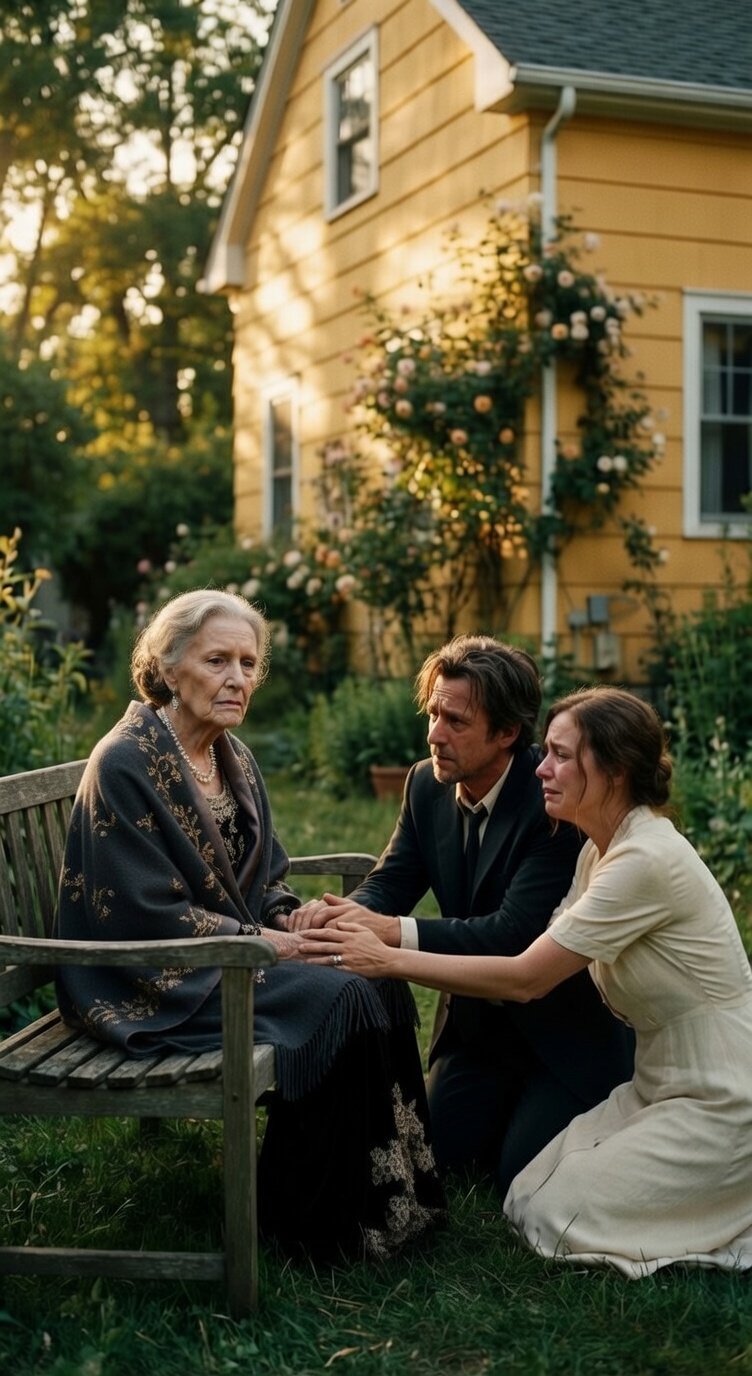
I have resided within these specific four walls for forty-one years. In the sweltering July of 1983, I spent three days coating the kitchen walls in a cheerful marigold paint simply because my husband, Harold, casually mentioned that yellow kitchens cultivate happiness. I chose to believe him. The following spring, the very year our son Derek was born, I knelt in the damp loam and planted a row of climbing rose bushes along the front walkway. Every subsequent spring, they bloomed with a fierce, unprompted loyalty—reliable as the sunrise, which is vastly more than I can say for certain human beings.
Harold departed this world in March of last year. He passed quietly, slipping away in his faded blue recliner, a piece of furniture he had fiercely defended since the Reagan administration. At seventy-three, I was abruptly recategorized as a widow. Through proper probate channels, the deed to the house transitioned from a joint tenancy to my sole possession. The paper bore my name, and my name alone.
In the immediate, disorienting aftermath of Harold’s funeral, Derek performed the role of the attentive, grieving son with practiced ease. He called faithfully on Sunday evenings. He and his wife, Renee, drove down for Thanksgiving. I spent four hours boiling cranberries and zesting oranges for a sauce made entirely from scratch; Renee praised its presentation lavishly, though I noted with quiet precision that she never actually allowed a single spoonful to touch her plate. It was a microscopic detail, a tiny thread of insincerity, but I mentally filed it away.
As the new year dawned, a subtle, insidious shift infected our interactions. Derek ceased asking about my garden or my health, pivoting instead to interrogations that felt chillingly like assessments.
“What do you reckon the property is pulling in today’s market, Mom?” he asked one afternoon, his tone overly casual, vibrating with the stiff cadence of rehearsed dialogue. “You know, maintaining a footprint this large is an awful lot of overhead for a solo occupant.”
Renee sat adjacent to him, nodding rhythmically to his every syllable. She possessed the eager, aggressive enthusiasm of a woman who had spent hours practicing her supportive posture in a vanity mirror.
I answered them with my standard, unvarnished honesty. I explicitly stated that Harold’s pension, coupled with my social security disbursements, provided a comfortable surplus. I told them this structure was not a burden; it was a living, breathing archive of my existence.
They looked directly at me, but they did not hear a single word.
By February, Renee began accompanying Derek on every visit. I initially tried to interpret this as familial warmth, but there was a distinct, predatory quality to the way she physically navigated my home. She moved slowly through the dining room and the parlor, her eyes darting to the crown molding and the hardwood floors, mentally measuring square footage. I felt less like a beloved matriarch and more like a stubborn piece of antique furniture slated for auction.
“This truly is a spectacular, oversized lot,” she murmured once, gazing out the bay window into the backyard. Her tone was completely devoid of aesthetic appreciation; it was the voice of a developer analyzing zoning potential. She turned to me, offering a shark-like smile. “Have you ever entertained the concept of downsizing, Margaret? Simplifying your footprint?”
“I have not,” I replied flatly.
Her smile didn’t waver, but it hardened at the edges—the unmistakable expression of a woman who was nowhere near finished.
The climax of their covert campaign arrived in mid-March. The roses were just beginning to push their green buds through the frost when my son sat down at my marigold kitchen table. This was the exact oak table where he had agonized over middle school algebra, the surface where I had signed a decade of field trip permissions. He folded his hands, looked me in the eye, and informed me that I was relocating to Meadow View Senior Living.
Furthermore, he announced, he was initiating the sale of my home.
He did not frame it as a question. He delivered it as a corporate mandate.
“Mom, Renee and I have consulted with the right people,” Derek stated, his voice adopting a patronizing, managerial hum. “The facility is top-tier. You’ll have a private suite, organized bingo, and 24-hour medical staff on standby. And honestly…” He paused, and I watched his eyes dart away as he meticulously selected his next phrase like a mechanic choosing a wrench. “A property of this scale is simply a practical impossibility for an elderly woman living alone. It’s a liability.”
Renee leaned forward, resting her hand over his, already deeply entrenched in her role as the voice of reason. “We merely want what is optimally best for you, Margaret,” she cooed.
Perhaps she genuinely believed her own rhetoric. That is, historically, the most terrifying breed of lie—the one the liar has repeated so frequently it metastasizes into their personal truth.
I stared at the boy I had raised. I examined his hands, the familiar slope of his shoulders, the specific tension in his jaw when he coveted something just out of reach. What I witnessed in his eyes that afternoon was not the protective anxiety of a loving son. It was cold, naked calculation.
I did not scream. I did not weep. Harold always used to joke that I possessed the emotional metabolism of a receding glacier—a trait he deeply admired. Sitting there, looking at my son’s greed, I felt myself snap entirely, coldly awake.
After they departed, I remained paralyzed at the kitchen table as the afternoon light shifted from gold to gray. My coffee turned to sludge. I systematically dismantled the situation, adopting Harold’s old engineering methodology. Identify the core problem. Isolate the variables. Formulate the countermeasure.
The problem was grotesque but simple: my only child had officially reclassified me from a mother to a depreciating asset. He viewed my beloved home as a trapped reservoir of liquid capital, and I was the inconvenient roadblock delaying the payout.
I weighed my options. A flat, aggressive refusal would only trigger an escalating war. He would deploy lawyers, or worse, aggressive physicians. The whisper of “mental decline” is the deadliest weapon wielded against the elderly, and I was no longer naive enough to assume my son was incapable of pulling that trigger. If I fought him openly, he would become careful. He would become stealthy.
I needed him sloppy. I needed him bloated with the intoxicating arrogance of an easy victory.
Lying awake that night, listening to the familiar settling creaks of the floorboards, I drafted my opening gambit. I would metamorphose into the exact fiction they desired: the tired, confused, highly compliant old widow who had surrendered to the superior intellect of her offspring. I would tour Meadow View. I would nod at their brochures. I would let them pop champagne in premature celebration.
And while they were celebrating, I would sever the ground right beneath their feet.
Chapter 2: The Architecture of Defense
At nine o’clock the following morning, I parked my sedan outside the Elm Street Public Library. Libraries are the ultimate equalizers—quiet, dignified sanctuaries hoarding information that belongs to anyone possessing the patience to read.
I approached the reference desk and requested comprehensive literature regarding Ohio property law, deed transfers, and the specific mechanics of power of attorney. The young librarian produced a dense stack of legal treatises without asking a single prying question, a professional courtesy I deeply appreciated.
I sequestered myself in a corner carrel for four uninterrupted hours, filling a spiral-bound notebook with precise, methodical handwriting. By noon, I had educated myself on the robust legal shields designed to protect the elderly from predatory heirs. I studied the nuances of life estates and remainder interests. But most crucially, I realized I required a specific type of mercenary. I needed a legal architect with zero ties to Derek’s social or professional circles.
I located her in the yellow pages. Patricia Owens. Her austere advertisement read: Real Estate, Estate Planning, Elder Law. Serving Columbus families with integrity for 22 years.
When Derek phoned that evening to cheerfully gauge my “readiness” regarding the Meadow View brochures, I injected just enough fatigue into my voice. “I’m reviewing the pamphlets, Derek,” I sighed. “The dining hall does look rather accommodating. I suppose… I suppose you might be right about the stairs.”
I could practically hear the triumphant grin stretching across his face through the receiver. “It’s the smart play, Mom. I’m so proud of you for being sensible.”
Sensible. I disconnected the line, settled into Harold’s blue recliner, and whispered to the empty room, “Derek, my darling boy, you have miscalculated catastrophically. You mistook my silence for submission.”
Forty-eight hours later, I walked into Patricia Owens’s office. The space smelled of dark roast coffee and aging paper, instantly lowering my blood pressure. Patricia was a compact, formidable woman in her mid-fifties, wearing tortoise-shell reading glasses on a silver chain. She possessed the laser-focused demeanor of a professional who had spent two decades navigating the treacherous swamps of familial greed without losing her ethical compass.
She did not address me with the loud, patronizing cadence society often reserves for the elderly. She spoke to me as an intellectual equal.
I laid my spiral notebook on her desk and narrated the entire saga. I detailed Harold’s probate, the marigold kitchen, Renee’s predatory appraisal, and Derek’s unilateral decree regarding the nursing home. I outlined my preliminary library research and articulated my ultimate objective.
Patricia listened with her hands steepled, her eyes never leaving mine. When I concluded, a slow, dangerous smile touched the corners of her mouth.
“Mrs. Caldwell,” she murmured, “you have marched in here better briefed than half the junior partners holding law degrees in this city. Let’s dismantle his strategy.”
Patricia confirmed that without a signed power of attorney, Derek’s corporate posturing was legally impotent. However, she warned that relying on a simple “no” left me vulnerable to future harassment. To permanently neutralize the threat, she introduced me to the concept of a Medicaid-Compliant Irrevocable Living Trust.
“We don’t just secure the house,” Patricia explained, tapping a silver pen against her legal pad. “We evaporate your individual ownership entirely. We transfer the deed into a trust entity. You remain the sole trustee with absolute control during your lifetime, but legally, Margaret Caldwell the individual will no longer own a single brick of that property. Derek cannot sell what his mother does not own.”
We spent ninety minutes fortifying the trap. When I exited her office, I didn’t just have a defense; I had a live explosive.
Three days later, the true depth of my son’s depravity was dragged into the light.
As a standard precaution, Patricia had initiated a routine title search on my property to ensure no hidden liens existed. What the search unearthed made the blood freeze in my veins.
Someone had recently contacted two prominent Columbus real estate brokerages, aggressively requesting Comparative Market Analyses on my address. The requests were submitted by Derek Caldwell, fraudulently listing his official capacity as the “Estate Representative.”
He possessed no such legal designation. He had simply lied to two licensed agencies, and based on his brazen confidence, they had provided him with a comprehensive valuation.
My home—my forty-one years of memories, the yellow walls, the climbing roses—had been appraised at $412,000.
I sat at my kitchen table, staring blankly at the printed email Patricia had handed me. Four hundred and twelve thousand dollars. That was the exact price tag my son had placed on my dignity, my autonomy, and my memories. Patricia clinically referred to it as “premature and fraudulent misrepresentation.”
I recognized it for what it truly was: my son had already begun secretly hawking my sanctuary to the highest bidder.
A lesser woman might have confronted him immediately, demanding explanations, begging for scraps of familial loyalty. But that number—$412,000—was a profound clarity. Whatever vestigial affection Derek held for me was entirely subordinate to his greed.
I signed the preliminary trust documents the following Tuesday. I told absolutely no one.
The trap was elegantly lethal. The property would be titled to the Caldwell Family Living Trust. I was the sole lifetime trustee, and upon my death, the primary beneficiary was not Derek, but the Columbus Community Foundation. Furthermore, Patricia inserted a brilliant, poisoned pill into the contract: any future sale of the property required a secondary, notarized confirmation letter directly from Patricia’s law firm, submitted to the title company a mandatory seventy-two hours prior to any closing.
Without that specific letter, no title insurance underwriter in the state of Ohio would authorize the transfer.
By Wednesday afternoon, the county recorder stamped the documents. My home was legally untouchable.
I anticipated coasting quietly toward the closing date Derek had secretly arranged, but the universe rarely accommodates a peaceful timeline. That very evening, as I was brewing a pot of chamomile tea, heavy footsteps pounded up my front steps.
The door handle rattled violently before the bell rang. I opened it to find Derek standing on my porch, his face flushed, his chest heaving. Renee was idling in his Audi at the curb.
He didn’t use the patronizing, managerial voice. He used the sharp, panicked tone of a man who realizes he might be losing control of the narrative.
“Mom,” he demanded, stepping aggressively over the threshold, “I need to know exactly what is going on behind my back.”
Chapter 3: The Threat of Incapacity
I remained perfectly still, holding the front door open, letting the cool evening draft swirl around his ankles. “I have absolutely no idea what you’re referencing, Derek.”
He paced into the center of the living room, running a hand through his hair. “Someone from Renee’s tennis club saw you walking into a boutique law firm on High Street. A real estate attorney. Why the hell are you secretly consulting with lawyers, Mom? If you have questions about the transition, you come to me. You are supposed to come to me.”
You come to me. Of all the indignities he hurled at me during that wretched spring, that specific phrase burned the hottest. He spoke to me as if I were a confused, errant toddler requiring his benevolent supervision to manage the disposition of my own assets.
I kept my features arranged in a mask of mild, grandmotherly confusion. “Derek, legal documents are incredibly dense. I merely wanted an independent pair of eyes to translate the jargon so I fully comprehended the paperwork for Meadow View.”
He squinted at me, his jaw working side to side. He didn’t entirely buy the innocent act, but his ego couldn’t afford to accept the alternative—that his elderly mother was outmaneuvering him.
Before he could press the interrogation, the front door swung wider. Renee marched inside. Whatever thin veneer of suburban sweetness she normally projected had completely evaporated, replaced by the naked aggression of a woman who felt her impending payday slipping.
“Margaret,” Renee began, her voice dripping with artificial concern that felt like a straight razor. “If you are attempting to complicate the property transition, you need to understand that this could severely damage the family. We have already made financial commitments based on your agreement.”
I raised an eyebrow. “Financial commitments?”
Renee ignored the question, stepping closer, invading my personal space. “An elderly widow, living in isolation, making erratic legal decisions without consulting her designated caretakers… well, it raises highly alarming concerns about your overall judgment. About your cognitive capacity.”
The room went dead silent.
There it was. The nuclear option. Capacity.
I looked at the woman attempting to steal my home. Then, I looked directly at my son, the boy I had carried, birthed, and fiercely protected. He stared at his shoes, refusing to contradict his wife’s veiled threat.
The glacier inside me froze solid.
“I would like you both to vacate my property immediately,” I stated, my voice devoid of any warmth.
Derek’s head snapped up, panic flashing in his eyes. “Mom, Jesus, no one is trying to threaten you. We just want to ensure you’re protected—”
“I am impeccably protected, Derek,” I interrupted, stepping toward the door and gesturing to the porch. “I will see you at the signing appointment on Friday. Get out of my house.”
They retreated. It wasn’t a graceful exit, but the tight-lipped, furious withdrawal of predators realizing the prey had teeth. I locked the deadbolt, leaned my forehead against the cool wood, and listened to the Audi’s engine roar down the street.
My hands were shaking. I will not feign absolute fearlessness; I was a seventy-four-year-old widow who had just been softly threatened with institutionalization by her own flesh and blood.
I walked straight to the kitchen telephone and dialed Arizona.
My best friend, Barbara, answered on the second ring. We had shared backyards and secrets for thirty-seven years. I didn’t bother with pleasantries. I unloaded the entire horrific encounter, my voice finally cracking as I repeated Renee’s threat regarding my mental capacity.
Barbara listened in absolute silence until I finished.
“Margaret Elaine,” Barbara barked, her voice a bracing splash of ice water. “Have you consumed any protein today?”
I let out a wet, startled laugh. “Yes, Barbara.”
“Excellent. Now shut up and listen to me. You have executed this flawlessly. You have the attorney, the trust, the upper hand. Derek’s little comment about your capacity is a desperate terror tactic. It only holds power if you flinch.”
She was unequivocally correct. But Barbara offered more than just moral support; she possessed tactical connections. She provided me with the direct line to Helen, a senior coordinator at Elder Right, a non-profit legal advocacy group in Columbus.
I called Elder Right the following morning. A brilliant advocate named James spoke with me for an hour. He confirmed Patricia’s legal maneuvering but provided a crucial piece of armor against Renee’s threat.
“If they attempt to formally challenge your competency to invalidate your real estate decisions,” James explained, “the burden of proof is astronomically high. However, to make yourself bulletproof, I want you to undergo a preemptive competency evaluation with a board-certified geriatric psychiatrist tomorrow. Once a medical doctor documents your lucidity, their threat is legally dead on arrival.”
I booked the evaluation. I passed with flying colors. I was documented, legally represented, and completely lethal.
The anxiety that had been crushing my chest for weeks abruptly mutated into something exhilarating. I was no longer afraid; I was weaponized.
On Sunday, less than a week before the closing, Derek and Renee made a final, desperate play. They arrived at my door with grocery store carnations and a foil-covered casserole, dressed in the casual-wealthy attire of people desperate to appear benevolent.
We sat in the living room. After three agonizing minutes of small talk, Derek produced a heavily stapled packet from his breast pocket.
“Mom,” he said, deploying his most earnest, boyish smile. “Renee and I spoke with our wealth manager. He advised that holding an asset of this magnitude in your sole name is actually a massive tax liability. We’ve drawn up a simplified ‘Gift Deed’.” He slid the paper across the coffee table. “It transfers the title to us, but we have a verbal agreement—a sacred promise—that you can live here as long as you want while we cover the taxes.”
A verbal agreement. I stared at the fraudulent document. I thought about the $412,000 appraisal. I thought about the psychiatric evaluation currently sitting in my manila folder.
“Derek,” I said softly, clasping my hands in my lap. “I appreciate your concern. But the answer is no.”
Renee’s artificial smile instantly evaporated. Derek’s posture went rigid.
“Mom,” he ground out, the mask slipping completely. “If you stubbornly insist on making catastrophic financial decisions in isolation, we are going to be forced to contact the state to evaluate your need for a conservatorship.”
I looked at my only child, feeling nothing but a profound, hollow pity.
“I have already retained a real estate attorney,” I declared, my voice echoing off the hardwood. “I have already executed my estate planning. And as of Thursday, I possess a certified medical affidavit from a geriatric psychiatrist documenting my flawless cognitive competency. If you attempt to challenge my autonomy in a court of law, you will be publicly humiliated.”
Derek stared at me, his mouth slightly open, the color draining from his face.
“Friday at ten o’clock,” I said, standing up. “I will see you at the closing.”
They practically fled the house.
I stood in the center of the yellow kitchen, the silence ringing in my ears. The battle lines were irrevocably drawn. Friday morning would not be a real estate transaction; it would be an execution.
Chapter 4: The Closing Table Coup
I arrived at the downtown offices of Derek’s attorney precisely ten minutes early. I was draped in the impeccably tailored navy blue suit I had originally purchased for Harold’s retirement gala two decades prior. It still fit flawlessly. Tucked tightly under my left arm was a thick manila folder organized by Patricia, containing every piece of ordnance required to obliterate my son’s future.
I had consumed a full breakfast. I had slept eight uninterrupted hours. I was seventy-four years old, and I was stepping onto the battlefield as a conquering general.
Patricia Owens was already waiting in the lobby, sipping black coffee. She didn’t offer nervous platitudes. She simply touched my elbow and murmured, “The trap is set. Let’s make them bleed.”
Derek and Renee breezed through the glass doors at 10:03 AM. They were radiating the obnoxious, manic energy of lottery winners. Renee had treated herself to a fresh blowout. Derek’s suit was sharply pressed. According to intel Patricia had gathered through the Columbus grapevine, Renee had already formally cancelled her suburban gym membership and boasted to her tennis partners that she was “resolving a complex property acquisition.”
Resolving. As if my entire existence was merely a math equation waiting to be balanced.
At 10:10 AM, the buyers arrived. The Hendersons were a strikingly young, visibly anxious couple, clutching briefcases and sweating with the specific terror of first-time homeowners preparing to liquidate their life savings. They were accompanied by their own legal counsel and carried a certified cashier’s check for $480,000. Derek had managed to negotiate a bidding war behind my back.
We filed into the expansive, glass-walled conference room.
Garrett, the attorney Derek had retained to facilitate this robbery, assumed his position at the head of the mahogany table. He possessed the slick, bored demeanor of a professional who routinely processed these transactions in his sleep. He didn’t offer coffee or water; he merely wanted the signatures so he could bill his hourly rate and make his tee time.
Garrett slid the colossal stack of closing documents to the center of the table, addressing me with practiced indifference.
“Mrs. Caldwell, as the primary seller, I require verbal confirmation of your identity and your sole ownership of the parcel located at 4417 Lynden Avenue.”
I folded my hands perfectly in front of me. “I confirm my identity. However, before my pen touches a single page, I would like to formally introduce my personal counsel, Patricia Owens, who has critical addendums regarding the title status.”
Garrett frowned, his pen hovering over the paper. He glanced at Derek, whose confident smirk faltered slightly.
Patricia didn’t wait for permission. She stood up, commanding the oxygen in the room. With the fluid, lethal grace of a seasoned litigator, she extracted a single, heavily watermarked document from her folder and placed it in the center of the table.
“For the official record,” Patricia stated, her voice slicing through the tense silence, “the property situated at 4417 Lynden Avenue was legally transferred into the Caldwell Family Living Trust on March 8th, 2024. Margaret Elaine Caldwell serves as the sole, lifetime trustee.”
Garrett blinked, confusion warring with rising panic. “Excuse me?”
Patricia ignored him, placing a second document adjacent to the first. “Furthermore, Article 4, Section B of said trust explicitly mandates that any conveyance or sale of the physical property requires a secondary, notarized letter of authorization directly from my law office, submitted to the acting title underwriter a minimum of seventy-two hours prior to execution.”
She looked directly into Garrett’s eyes. “No such authorization has been drafted, because the Trustee has explicitly prohibited this sale. You are attempting to close on a property that your client does not legally own.”
She dropped the final bomb: the Franklin County Recorder’s official, date-stamped confirmation of the trust transfer.
The silence in the conference room was absolute, ringing with catastrophic failure.
Garrett’s face cycled rapidly through shades of gray. He was experiencing the specific, nauseating terror of a lawyer realizing he had committed a massive malpractice error. He had been so arrogant, so eager to collect his fee, that he had bypassed a rudimentary, independent title search. He had blindly trusted Derek’s fraudulent assurances that an elderly widow would obediently sign her life away.
Derek violently pushed his heavy leather chair back, springing to his feet. “This is… wait, this is a mistake!” He pointed a shaking finger at me. “Mom, what the hell did you do?”
“I secured my assets, Derek,” I replied, my voice holding the calm, terrifying depth of the ocean.
“You can’t just blindside me like this!” His professional facade disintegrated completely, revealing the petulant, terrified eleven-year-old boy I once caught trying to hide a shattered garage window beneath a tarp. “We have a deal! The buyers are right here!”
Renee slammed her palms on the mahogany, her face contorted in fury. “Garrett! Do something! Can this fraudulent trust be contested?”
Garrett practically scrambled backward in his chair, desperate to physically distance himself from the radioactive fallout of his clients. “The trust documents appear flawlessly executed and filed with the county,” he stammered, wiping sweat from his upper lip. “The terms are ironclad. I… I cannot facilitate this transaction.”
Derek turned to me, a wild, cornered desperation bleeding into his eyes. “Mom, please. We can pause. We can step into the hallway and negotiate this right now. We can make a deal.”
He wanted to negotiate. With a $480,000 cashier’s check sitting on the table, the buyers watching in horrified fascination, and two weeks of premature celebration turning to ash in his mouth, he believed he could still charm his way out of the trap.
The Hendersons’ attorney leaned over, whispering frantically into the young couple’s ears. Mr. Henderson immediately stood up, his face flushed with anger, and snatched the cashier’s check off the table. Mrs. Henderson looked at me—a long, complicated look that held both pity and a strange, quiet respect.
Without a single word, the buyers and their lawyer walked out of the conference room. The heavy glass door clicked shut behind them, sounding like the slam of a prison cell.
Derek watched his half-million-dollar payday vanish into the hallway. He looked as though he might physically vomit.
“Derek,” I stated, ensuring my voice penetrated the ringing in his ears. “The house is mine. It has always been mine. It will remain mine until the day I take my final breath. If you are curious regarding its disposition after my funeral, I strongly advise you to hire competent, independent counsel.” I shot a scathing glare at Garrett, who refused to make eye contact. “Because this one is utterly useless.”
I collected my purse, nodded deeply to Patricia, and walked out of the conference room.
I pushed through the revolving glass doors and stepped into the crisp, blinding sunlight of a Columbus morning. The air tasted sharp and incredibly clean. A delivery truck rattled down Broad Street; pigeons bickered on a concrete ledge. The city continued its chaotic, indifferent rhythm, completely unaware that I had just successfully executed the most critical battle of my life.
I stood on the pavement, took a massive, shuddering breath, and felt the crushing weight of the past two months finally slide off my shoulders.
Chapter 5: A New Season in the Soil
The fallout from that Friday morning was a radioactive silence that lasted exactly eleven days.
I utilized that silence to aggressively purge the house. I scrubbed the marigold kitchen walls until my knuckles ached; I stripped the guest bedroom and repainted the trim. While dragging a heavy oak dresser away from the baseboards, a small, faded piece of paper fluttered to the floor. It was a crude crayon drawing of a house with a yellow door, signed in blocky, uneven letters: DEREK, AGE 7.
I sat on the hardwood floor, tracing the waxy lines. I didn’t frame it, but I didn’t discard it either. I gently slid it back behind the dresser, allowing it to rest in the dark where it had survived for thirty years without demanding anything from anyone.
On the twelfth day, the telephone rang.
It was Derek. He didn’t deploy the managerial hum or the arrogant charm. It was his genuine voice—small, fractured, and hesitant.
“Mom,” he whispered. “I am so deeply sorry. I lost my mind. I behaved like a monster, and I am so sorry.”
I sat in Harold’s blue chair and allowed him to deliver the entire, agonizing apology. I did not interrupt to soothe his guilt. I did not offer premature absolutions. For an apology to possess any molecular weight, the offender must be forced to hear their own sins spoken aloud.
When he finally fell silent, exhausted and audibly weeping, I responded.
“I believe your remorse is genuine, Derek,” I said smoothly. “But I also believe that this spring, under the pressure of money, you revealed a capacity for cruelty and deceit that I can never un-see. It is a bell that cannot be un-rung.”
He choked on a sob. “Mom, please…”
“I have already updated my estate plan with Patricia,” I continued, cutting through his grief. “The trust is impenetrable. However, depending entirely on the integrity of your choices moving forward, your specific position as a beneficiary may evolve. Your inheritance is no longer a birthright; it is a conditional privilege dictated by your behavior. I am not harboring vengeance, Derek. I am simply awake.”
There was a long, heavy silence on the line. “Are you… are you still moving to Meadow View?”
“No,” I replied, looking out the window at the front walkway. “I am staying in my home. I am going to plant fresh roses, and I am going to live the remainder of my life on my own terms.”
“Okay, Mom,” he whispered, defeated.
The consequences rippled outward, destroying the arrogant assumptions Derek and Renee had built. Renee’s father—a brutal, self-made businessman—discovered they had leveraged a massive, uncollateralized loan against my supposedly imminent house sale. Furious at their financial incompetence, he ruthlessly called the loan in. Derek and Renee were forced to abandon their luxury apartment deposit, cancel their leased vehicles, and scramble to avoid bankruptcy.
Garrett, the negligent attorney, suffered a quiet but devastating professional excommunication after Patricia subtly exposed his malpractice to the local bar association network.
As for me, I flourished.
I permanently amended the trust. The Columbus Community Foundation received a substantial endowment. I established a baseball scholarship at Harold’s old high school, funded my friend Barbara’s granddaughter’s college tuition, and donated a massive sum to Elder Right. Derek was not entirely disinherited, but his percentage was drastically reduced and locked behind severe behavioral stipulations. It was not a punishment; it was a portrait of a mother holding her son strictly accountable to reality.
I kept the foil-covered casserole dish Renee had brought me. I threw the actual food into the garbage disposal—an act of petty but profound satisfaction—and washed the glass. I later used it to deliver homemade chicken noodle soup to Dorothy, a retired schoolteacher I befriended in the watercolor class I finally found the courage to join.
By mid-July, the two new rose bushes I planted along the walkway had aggressively taken root. They were a vibrant, unapologetic pink, the exact botanical variety I had planted the summer I brought Derek home from the maternity ward. They would require another harsh winter to reach their full, towering height, but their foundation was unbreakable.
I spent the autumn traveling. I flew to Savannah, walking the historic, moss-draped squares in the humid heat, eating buttery shrimp and grits, finally taking the trip Harold and I had perpetually postponed. I flew to Arizona, drinking iced tea on Barbara’s patio, laughing until my ribs ached. Barbara examined my face in the desert sunlight and declared I looked a decade younger.
I did not correct her.
My life had violently contracted in the suffocating shadow of Harold’s death and my son’s betrayal. But I had refused to be compressed into a manageable, disposable asset. I fought back, utilizing the terrifying power of patience, preparation, and absolute silence.
I am Margaret Elaine Caldwell. I am seventy-four years old. The kitchen is still yellow, the roses are blooming, and the house is entirely, unequivocally mine.