My name is Eleanor Whitmore, and if you have ever walked along Riverfront Avenue in Savannah, Georgia, there is a good chance you passed by my café without realizing that inside those brick walls, decades of human stories have quietly unfolded over cups of burnt espresso and over-buttered biscuits. I opened Magnolia Brew House thirty-one years ago, back when the street still smelled faintly of salt and diesel and fewer tourists knew how to pronounce “Savannah” correctly, and in that time, I have learned that running a café is less about coffee and more about observation, about recognizing the rhythms of people’s lives, the habits that reveal who they are when no one is asking them to perform, and the quiet rituals that define them more honestly than any introduction ever could. And among all the faces that have come and gone, all the regulars who drifted in and out like tides, there was one man whose presence became so consistent, so precise, that it almost felt like the city itself had arranged its clock around him.
His name, though I did not learn it until much later, was Dominic Hale.
He was not the kind of man people approached easily. At first glance, he looked like trouble—the kind of trouble that doesn’t shout but waits. He stood at least six foot three, maybe taller, with a heavy, grounded build that suggested years of labor rather than leisure. His head was shaved clean, his beard thick and streaked with gray, and his arms were covered in old tattoos that had faded unevenly, like stories that had been told too many times or not enough. He rode a matte-black Harley—loud enough to turn heads but somehow never obnoxious—and when he walked into my café, he never looked around. He already knew exactly where he was.
Every Tuesday, at precisely 11:28 in the morning, he would walk through my door.
Not 11:27. Not 11:29.
11:28.
He would order a large black coffee—no cream, no sugar, no lid—and he would pay in cash, always exact, always followed by a folded five-dollar bill dropped quietly into the tip jar. He never lingered. Never made small talk. Never checked his phone. He would take the coffee, give a small nod that somehow carried more sincerity than most people’s full conversations, and then he would leave.
But that was only the beginning of what he came to do.
Across the street, near the corner where Riverfront Avenue meets Bay Street, sat a man named Leonard “Lenny” Griggs. Lenny had been there for nearly four years, long enough that most pedestrians stopped registering him as a person and started treating him like a fixture—a part of the city’s texture rather than its humanity. He was sixty-four, a former Marine who had served in the late seventies, and if you sat down with him long enough, he would tell you stories that sounded like they belonged to someone else, someone who had once had a house, a wife, and a reason to shave every morning. But life, as it does, had taken its turns. His wife passed after a long illness, the bills stacked higher than his ability to manage them, and somewhere along the way, the structure of his life collapsed quietly enough that no one noticed until he was already gone from it.
That was where Dominic found him.
Or maybe it’s more accurate to say that Dominic recognized something in him.
The first time Dominic sat beside Lenny, he didn’t speak. He just lowered himself onto the sidewalk, placed his coffee between them, and stared ahead at the river. Lenny told me later that he had been suspicious at first. Men like Dominic didn’t usually sit down without wanting something. But Dominic didn’t ask for anything. He didn’t even look at him. He just sat there, silent, steady, like someone who understood the weight of presence.
The next week, he brought two coffees.
The week after that, he brought two coffees and a paper bag from my café with breakfast sandwiches inside.
By the second month, they were talking.
By the third, they didn’t need to talk much at all.
And by the end of the first year, Dominic had built a routine that was so consistent, so unwavering, that even my staff began to anticipate it. We stopped charging him for the second coffee. He still left the tip.
Always the tip.
But what none of us realized—not me, not my staff, not even Lenny—was that Dominic had been building toward something much bigger than coffee and conversation.
And everything came to a head on a Tuesday in late October.
It was one of those days where the air carried a strange kind of tension, the kind that doesn’t announce itself but lingers just beneath the surface, like something waiting to happen. Dominic walked in earlier than usual—11:25—and for the first time since I had known him, he didn’t go straight to the counter. He paused near the door, scanning the street through the glass with a focus that felt different, sharper, almost alert in a way that made me uneasy without knowing why.
“Two coffees,” he said when he finally approached.
I handed him the bag. Inside, along with the sandwiches, was something I had not put there. I didn’t know it yet, but he had slipped an envelope into the bag before entering.
He paid.
Left the tip.
Walked out.
What happened next lasted no more than two seconds.
But those two seconds would ripple through the lives of everyone who witnessed them.
Dominic stepped off the curb.
Lenny looked up, smiling in recognition.
And then Dominic moved.
Not hesitantly. Not cautiously.
He lunged.
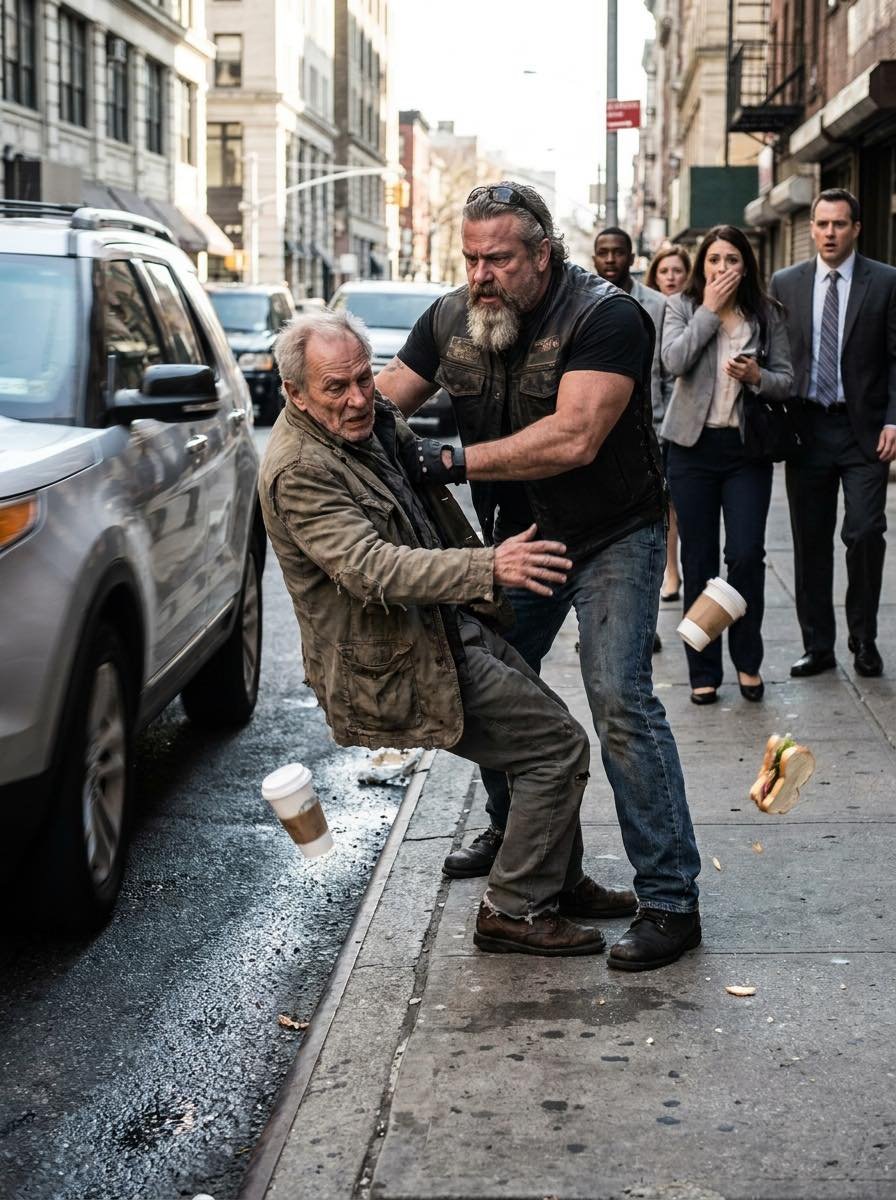
With a force that looked almost violent, he shoved Lenny backward, sending him crashing onto the pavement, his body sliding across the sidewalk as a scream cut through the air from somewhere nearby.
At that exact moment, a silver SUV came tearing around the corner, far too fast, the driver’s attention clearly somewhere else. The vehicle surged through the intersection, missing Lenny by less than a foot.
If Dominic had been one second slower—just one—Lenny would have been hit directly.
There would have been no second chance.
The SUV didn’t stop immediately. It rolled forward another twenty yards before braking, as if the driver had only just realized what had happened.
But by then, the damage—or rather, the near damage—had already been done.
People shouted.
Someone dropped their phone.
Another person had already started dialing emergency services.
And Dominic, the man who had just shoved another human being with enough force to knock the air out of him, was now kneeling beside him, gripping his shoulders with a kind of urgency that didn’t match the violence of the action.
“Stay with me,” he said.
“I didn’t see it,” Lenny replied, his voice shaking.
“I know,” Dominic said quietly.
That was when everything shifted.
Officer Rachel Kim arrived expecting an assault.
What she found instead was something far more complicated.
A large man holding another man like he was afraid to let go.
A scattered breakfast on the pavement.
A crowd caught between shock and confusion.
And a silence that felt heavier than noise.
Then she found the envelope.
It had fallen from the paper bag during the impact, landing near the curb, slightly crumpled but intact.
Inside was cash.
Keys.
And a signed lease agreement.
An apartment.
Paid for in advance.
Dominic hadn’t said a word about it.
When Lenny realized what it was, he didn’t react the way most people would expect. He didn’t grab it. Didn’t thank him. Didn’t celebrate.
He refused.
“I can’t take this,” he said.
Dominic’s response was the moment that revealed everything.
“My father died on the street,” he said.
The words landed quietly, but they carried a weight that silenced the entire space around them.
“I told myself I had reasons,” he continued. “I told myself he made his choices. That I wasn’t responsible. And then one winter, he was gone. And I’ve spent every year since wishing I had done one thing differently.”
His voice didn’t break.
But his hands did.
“This isn’t about you owing me anything,” he said. “It’s about me not making the same mistake twice.”
That was when Lenny stopped resisting.
That was when he took the envelope.
And that was when the story changed from something about a shove to something about redemption.
The Lesson
What we see in a single moment is rarely the full truth. We are quick to judge actions without understanding the history behind them, quick to label people based on appearances, and quick to speak before we truly see. But real character is revealed not in grand gestures, but in consistency, in quiet acts repeated over time, and in the courage to correct the mistakes we carry from the past. The man who pushed someone to the ground did not act out of violence, but out of urgency, compassion, and a promise he had made to himself long ago. In the end, it is not the worst thing we have done that defines us, but what we choose to do after we understand it.
Website Disclaimer
The information provided on this website is for general informational and educational purposes only. While we strive to ensure that all content is accurate and up to date, we make no guarantees regarding the completeness, reliability, or accuracy of any information published.
The views and opinions expressed in articles belong to their respective authors and do not necessarily reflect the views of this website. Any action you take based on the information found on this website is strictly at your own risk. We will not be liable for any losses, damages, or inconveniences arising from the use of our content.
Some articles may contain opinions, third-party information, or external links. We do not endorse or guarantee the accuracy of content on external websites and are not responsible for their practices or policies.
All content on this website is provided in good faith and is intended for informational purposes only. Readers are encouraged to verify information independently and seek professional advice where appropriate.