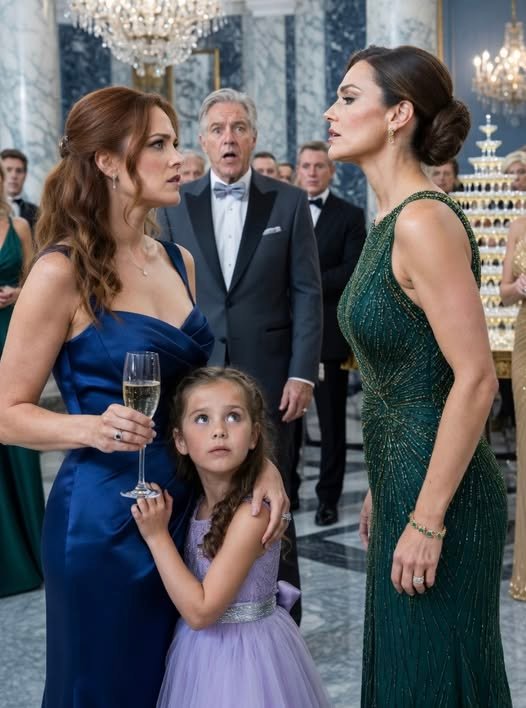
The woman looked at me the way people look at a stain on a white carpet—annoyed that something unpleasant had appeared where it clearly did not belong.
“Excuse me,” she said, her voice dipped in polished contempt. “Are you with the staff?”
For a second, I honestly thought she might be talking to someone behind me.
The ballroom at the Ritz Carlton was loud with soft wealth. Crystal glasses chimed against manicured fingers. A string quartet floated through the room like background music in a luxury commercial. Everywhere I looked, executives laughed too hard at each other’s jokes while balancing champagne they barely drank.
Then I realized she was staring directly at me.
Her eyes swept over my black dress. Plain. Knee-length. No designer logo. No diamonds hanging from my ears. My hair pulled back simply. Comfortable shoes.
I watched the judgment settle into place.
Not important.
Not rich enough.
Not one of us.
“The catering entrance is around the side,” she added, motioning lazily toward the hallway. “It helps avoid confusion.”
Behind her, three men in tailored tuxedos smirked into their drinks.
Beside me, my daughter Zoey stiffened instantly.
Fourteen years old and still young enough to believe adults usually behave like adults.
I could almost feel the embarrassment radiating off her.
“I’m not with catering,” I said calmly.
The woman blinked slowly, clearly surprised that someone she had mentally categorized as invisible had answered back.
“Oh.” One eyebrow lifted. “Then who are you?”
“This is a private executive event,” she continued smoothly. “Invitation only.”
“I know,” I said. “I approved the guest list.”
Confusion flickered across her face.
It almost would have been funny if Zoey hadn’t gone so quiet beside me.
The woman opened her mouth again, but another voice interrupted her.
“Diane, darling, there you are—”
The CEO stopped mid-sentence.
Gregory Ashworth froze so suddenly it looked painful.
His face drained of color.
“Ms. Monroe,” he said quickly. Too quickly. “I didn’t realize you were attending tonight.”
Zoey shifted closer to me.
I rested a hand lightly against her shoulder.
“I almost didn’t,” I said. “But Zoey wanted to come.”
I glanced down at my daughter. She stared at the floor now, jaw tight enough to crack teeth.
“Your daughter?” Diane repeated slowly.
She looked between Gregory and me like she was trying to solve a puzzle that made no sense.
“I’m Diane Ashworth,” she said finally, lifting her chin.
“I know,” I replied.
The silence around us thickened.
One of the executives near the bar suddenly became deeply interested in the bubbles inside his champagne.
“I was just explaining,” Diane said carefully, “that I mistook you for—”
“The help?” I supplied.
Her cheeks colored faintly.
Gregory forced out a laugh that sounded miserable.
“Simple misunderstanding,” he said quickly. “Easy mistake.”
I looked down at my dress.
“I suppose,” I said lightly, “black fabric can be very confusing.”
Zoey snorted before immediately pretending she hadn’t.
Gregory’s smile twitched.
“We should sit together,” he said hurriedly. “I’d love to introduce you properly to some of the investors—”
“We’re leaving,” I said.
His expression faltered.
“Already?”
“Yes.” I slid my arm around Zoey’s shoulders. “I think tonight taught my daughter everything she needed to learn about corporate culture.”
The words landed harder than yelling would have.
I saw Gregory flinch.
As Zoey and I walked away, our shoes clicked softly across the marble floor.
Behind us, I heard Gregory hiss under his breath.
“Do you have any idea who that was?”
I didn’t stay to hear Diane answer.
In the car, Zoey stayed silent for almost ten minutes.
The city lights streaked across the windshield while the gala disappeared behind us like some glittering illusion shrinking into the distance.
Finally, she spoke.
“She really thought you worked there?”
“Yes.”
“That’s insane.”
I smiled faintly. “People see what they expect to see.”
“But you own the company.”
The word hung heavily in the car.
Own.
Technically true.
Ashford Technologies existed because twelve years earlier I had sat inside a tiny apartment with peeling paint, a secondhand laptop, and absolutely nothing left to lose.
But people never imagined the founder looking like me.
They expected polished charisma. Expensive watches. Sharp designer suits.
Not a tired woman in sensible shoes.
“You could’ve told her immediately,” Zoey said. “You could’ve embarrassed her.”
“I didn’t need to.”
Zoey crossed her arms. “I would have.”
“I know.”
“She was horrible.”
“Yes.”
“And those men laughing were horrible too.”
“Yes.”
She stared out the window for another moment.
“Are you going to do something?”
That question settled deep in my chest because the truthful answer was complicated.
For years, I had kept myself distant from operations.
I built the company. Then I hired executives to run it.
I stayed involved strategically. Quietly. Safely.
But over time, I had started hearing stories.
Women leaving departments suddenly.
Brilliant employees disappearing.
Complaints brushed aside.
Patterns hidden inside polished quarterly reports.
And maybe the worst part was this:
Part of me had known.
Not fully.
Not enough.
But enough.
“I am going to do something,” I said finally.
Zoey nodded once.
“Good.”
When we got home, she climbed halfway upstairs before stopping.
“Mom?”
“Yeah?”
“If Dad had been there, he would’ve yelled at her.”
The old ache surfaced instantly.
Her father had vanished from our lives one broken promise at a time. But in Zoey’s mind, the version of him that should have existed still lingered stubbornly.
“Maybe,” I said carefully.
“You won’t yell though.”
“No.”
“Why not?”
Because yelling feels powerful for five seconds and useless afterward.
Because men like Gregory built careers recovering from loud scandals.
Because real consequences happened quietly.
“Because,” I said slowly, “sometimes the smartest thing you can do is let people show you exactly who they are.”
Zoey studied me for a second.
Then she nodded again and disappeared upstairs.
I barely slept.
By dawn, I was sitting in my home office wearing sweatpants and reading three years of HR reports with cold coffee beside me.
My office did not look like the office of someone worth hundreds of millions of dollars.
The desk was scarred from old coffee cups.
Zoey’s school papers covered part of the corkboard.
A faded photograph of my mother sat near the keyboard.
She wore her housekeeping uniform in the picture. Hands folded awkwardly. Tired eyes. Gentle smile.
My mother spent thirty years cleaning homes belonging to people wealthier than she could ever imagine becoming.
Most of them barely looked at her.
I remembered being twelve years old and watching one woman snap her fingers at my mother without even saying please.
As if kindness was wasted on workers.
“Don’t let anyone decide your value for you, mija,” my mother used to say.
At the time, I thought she meant confidence.
Years later, I realized she meant survival.
I opened my email.
For a long moment, I stared at the blinking cursor.
Then I typed.
To: Executive Leadership Team
Cc: Board of Directors
Subject: Emergency Board Meeting – Mandatory Attendance
I kept it short.
Mandatory attendance. Ten a.m. Executive conference room. Immediate discussion regarding leadership culture, complaint procedures, and executive accountability.
Then I signed it:
Eleanor Monroe
Founder & Majority Shareholder
My phone rang less than two minutes later.
Gregory.
I answered calmly.
“Good morning, Greg.”
His voice came tight and careful.
“Eleanor… I assume this is about last night.”
“It’s about a lot more than last night.”
“Diane made an honest mistake.”
“Did she?”
“She didn’t know who you were.”
“That’s the problem.”
He exhaled sharply.
“She feels terrible.”
“I’m sure she feels embarrassed.”
“That’s not fair.”
“No,” I said quietly. “What’s not fair is employees feeling small inside a company they help build.”
Silence.
Then: “You’re overreacting.”
I almost laughed.
Men always called consequences overreactions when consequences finally arrived.
“We’ll discuss it at ten,” I said.
“Eleanor—”
I hung up.
At breakfast, Zoey watched me carefully while eating toast.
“You’re wearing the scary blazer,” she observed.
“The navy one?”
“The boardroom one.”
I smiled despite myself.
“That bad?”
“Yes.”
She studied my face for another moment.
“Are you nervous?”
“Very.”
“You don’t look nervous.”
“That’s because adulthood is mostly performance art.”
That earned a laugh.
Then she became serious again.
“You’re going to win though.”
“This isn’t about winning.”
“Then what’s it about?”
I thought about that while pouring coffee.
“It’s about deciding what kind of company we are.”
Ashford Technologies occupied nine floors downtown.
Glass walls. Steel elevators. Expensive art chosen by consultants pretending to understand creativity.
The lobby still displayed the mission statement I wrote at twenty-nine years old:
Build systems that make life easier for people.
Back then, I had meant clients.
Now I realized employees counted too.
When I entered the executive conference room, conversations stopped almost instantly.
Gregory sat near the head of the table in a flawless charcoal suit.
Board members glanced between us carefully.
Sandra from HR looked exhausted before the meeting even started.
I took my seat slowly.
Not near Gregory.
At the actual head of the table.
Mine.
Gregory recovered first.
“Before we begin,” he said smoothly, “I think last night’s misunderstanding has been blown somewhat out of proportion.”
“No,” I said. “It hasn’t.”
Silence.
I turned toward Sandra.
“Start with the turnover numbers.”
Sandra opened her laptop immediately.
“Female employee turnover has increased forty-seven percent over the last three years.”
The room shifted.
Gregory frowned. “Turnover increased everywhere after the pandemic.”
“Not proportionally,” Sandra replied quietly.
She clicked another slide onto the screen.
“Women in leadership-track positions leave at nearly double the rate of men in equivalent roles.”
Another slide.
“Fourteen formal complaints involving executive behavior in eighteen months.”
Another.
“Repeated concerns involving dismissive treatment, exclusion from advancement opportunities, and inappropriate workplace comments.”
Gregory leaned back sharply.
“This data lacks context.”
“It has three years of context,” I said.
“These are isolated complaints.”
“No,” Sandra said softly. “They aren’t.”
Everyone looked at her.
I realized suddenly how rarely people actually listened when HR spoke.
Gregory folded his hands.
“Employees complain. That’s normal.”
“Patterns are not normal,” I replied.
The room grew very still.
I opened the folder in front of me.
“I reviewed every exit interview from the last three years,” I said. “Do you know how many mention feeling ignored or belittled?”
Nobody answered.
“Enough.”
Gregory’s jaw tightened.
“With respect, Eleanor, you’ve never been involved in day-to-day operations.”
“I know.”
“Then you may not fully understand executive management pressures.”
There it was.
The subtle dismissal.
Too emotional. Too removed. Too female.
I had heard versions of it my entire career.
“I understand this company because I built it,” I said evenly. “From a folding table in a one-room apartment.”
Gregory looked away first.
I continued.
“Last night your wife assumed I was staff because I didn’t look wealthy enough to belong. That attitude doesn’t appear magically. It grows inside environments where status matters more than respect.”
“Diane is not an employee.”
“No,” I agreed. “But she reflects the culture surrounding your leadership.”
Gregory exhaled hard.
“This is becoming personal.”
“It became personal when employees started feeling invisible inside a company carrying my name.”
Nobody spoke.
Then Lauren, one of the board members, leaned forward.
“What exactly are you proposing?”
I already knew.
I had decided sometime around three in the morning.
“Independent culture audit. External investigators. Executive review procedures. New complaint channels outside standard reporting structures.”
Gregory stared at me.
“You’re serious.”
“Yes.”
“This could damage investor confidence.”
“You know what damages investor confidence more?” Lauren said quietly. “Lawsuits.”
Sandra almost looked relieved hearing someone else say it aloud.
Gregory rubbed a hand across his mouth.
“You’re treating me like the enemy.”
I looked directly at him.
“I’m treating you like the leader responsible for the environment under your leadership.”
That hit.
Hard.
The room stayed silent long enough for the air conditioning hum to become noticeable.
Finally, Harold—the oldest board member—cleared his throat.
“What happens now?”
I folded my hands calmly.
“That depends on Gregory.”
Everyone looked at him.
He looked suddenly older than he had that morning.
“And if I disagree with all this?”
“You can,” I said. “But you won’t remain CEO.”
Shock flashed openly across several faces.
Even Gregory looked stunned.
“You’d remove me?”
“If necessary.”
“You’ve never interfered before.”
“That was my mistake.”
Silence again.
Heavy this time.
Real.
Finally, Gregory spoke quietly.
“What if I cooperate?”
“Then you get the opportunity to prove growth is possible.”
He stared at the table for several seconds.
Then he nodded once.
“Fine.”
Not graceful.
Not warm.
But real.
And honestly?
That mattered more.
The next few months were brutal.
Consultants flooded the building.
Anonymous reporting systems launched.
Executives attended leadership training they clearly hated.
Some employees resisted openly.
Others looked cautiously hopeful.
One afternoon, I overheard two junior developers whispering near the elevators.
“Do you think things are actually changing?”
“I don’t know,” the other replied. “But at least someone important finally noticed.”
That sentence stayed with me for days.
Someone important finally noticed.
Because they had been speaking long before I listened properly.
At home, Zoey tracked every update like a detective.
“How many executives cried this week?” she asked one evening while doing algebra homework.
“Only one,” I said.
“Improvement?”
“Depends who you ask.”
She grinned.
Then she hesitated.
“Mom?”
“Yeah?”
“Are you happier now?”
The question surprised me.
I thought about it honestly.
“No,” I admitted. “But I think I’m becoming someone I respect more.”
She considered that.
“Same difference, probably.”
Maybe she was right.
The audit findings arrived four months later.
The numbers were ugly.
Promotion disparities.
Retention problems.
Departments where women left twice as fast.
Repeated complaints minimized or buried.
One anonymous comment nearly broke my heart:
I love my work. I just hate how small I feel here.
We shared everything publicly inside the company.
No hiding.
No sanitizing.
Gregory stood beside me during the all-hands meeting looking deeply uncomfortable.
Good.
He should have been uncomfortable.
So should I.
“We failed people,” he admitted into the microphone.
The room stayed silent.
“I failed people,” he corrected after a moment.
That mattered too.
Afterward, a young engineer approached me with tears in her eyes.
“I almost quit last year,” she admitted.
“Why didn’t you?”
She smiled faintly.
“I wanted to believe things could change.”
I thought about that long after she walked away.
Hope is a terrifying thing to be responsible for.
Six months after the disastrous gala, the next annual event arrived.
Zoey watched me hold up the same black dress.
“You’re seriously wearing that again?”
“Yes.”
“Why?”
“Last year,” I said, “I wore it because I wanted to disappear into the room.”
“And this year?”
I smiled slightly.
“This year I know the room belongs to me.”
Zoey grinned immediately.
“That’s cold.”
“Thank you.”
She disappeared briefly and returned holding her own black dress.
“Then we should match.”
At the Ritz ballroom, conversations shifted when we entered.
People recognized me now.
Not just the mysterious founder hidden behind emails and board votes.
Me.
Gregory approached first.
He looked different somehow.
Less polished.
More careful.
“The latest retention numbers improved,” he told me quietly.
“I saw.”
“And… thank you,” he added awkwardly.
I studied him for a second.
Growth looked strange on powerful people.
Uncomfortable.
Like muscles stretching after years of being unused.
“You still have work to do,” I said.
“I know.”
Across the room, Diane stood beside a group of spouses wearing silver silk and perfect makeup.
Our eyes met.
She hesitated.
Then she walked toward me.
“Ms. Monroe.”
“Mrs. Ashworth.”
Zoey stayed beside me silently.
Diane inhaled carefully.
“I owe you an apology.”
“Yes,” I said simply.
To her credit, she didn’t retreat from the honesty.
“I was cruel,” she admitted. “And arrogant.”
I waited.
“I judged you immediately,” she continued. “By your clothes. By what I assumed your status was. I’m ashamed of that.”
Zoey crossed her arms.
“You hurt my mom’s feelings.”
Diane looked genuinely stricken.
“I know,” she said softly.
I studied her carefully.
For the first time, she looked less polished and more human.
Not transformed into a saint.
Just aware.
Which honestly mattered more.
“I accept your apology,” I said finally.
Relief flickered across her face.
“Thank you.”
Zoey narrowed her eyes slightly.
“If you’re mean to her again,” she warned, “I’ll tell everyone your dress looks like a melted disco ball.”
I nearly choked trying not to laugh.
Diane blinked once before bursting into startled laughter.
“That’s fair,” she admitted.
After she walked away, Zoey leaned toward me.
“That felt weirdly mature of me.”
“It did.”
“I hated it.”
“I know.”
Later that evening, Gregory stepped onstage for the keynote speech.
The ballroom quieted.
He looked out across the crowd for a moment before speaking.
“This company spent years measuring success only by growth,” he said. “Revenue. Expansion. Performance.”
His voice steadied.
“But numbers are incomplete if the people creating them feel unseen.”
The room stayed silent.
“We’ve spent the last six months learning difficult truths about ourselves,” he continued. “About leadership. About respect. About the difference between authority and dignity.”
Zoey glanced at me sideways.
“Did you write this speech?”
“No.”
“Huh.”
Gregory continued.
“We are all, in some way, the help,” he said. “We help clients. We help teams. We help build lives, careers, families, futures. And no one inside this company should ever be treated as less valuable because their role looks different from someone else’s.”
Applause slowly spread through the ballroom.
Not explosive.
Not performative.
Real.
Zoey picked up a glass of sparkling water from a passing tray and handed one to me.
“What are we toasting to?” she asked.
I thought about my mother scrubbing strangers’ floors.
About sleepless nights building software at a folding table.
About all the employees who stayed long enough to hope things could improve.
“To help,” I said finally.
Zoey smiled.
“To help.”
We clinked glasses softly beneath the ballroom lights.
And for the first time in a very long time, I didn’t feel invisible inside the company I built.
Website Disclaimer
The information provided on this website is for general informational and educational purposes only. While we strive to ensure that all content is accurate and up to date, we make no guarantees regarding the completeness, reliability, or accuracy of any information published.
The views and opinions expressed in articles belong to their respective authors and do not necessarily reflect the views of this website. Any action you take based on the information found on this website is strictly at your own risk. We will not be liable for any losses, damages, or inconveniences arising from the use of our content.
Some articles may contain opinions, third-party information, or external links. We do not endorse or guarantee the accuracy of content on external websites and are not responsible for their practices or policies.
All content on this website is provided in good faith and is intended for informational purposes only. Readers are encouraged to verify information independently and seek professional advice where appropriate.