There is a special kind of frustration that comes with a soft-boiled egg gone wrong. One morning the yolk is gloriously runny, the next it is chalky and gray. The white is sometimes delicate, sometimes rubbery. For years, home cooks blamed their timing, their stove, or their eggs. The truth is simpler: without a reliable way to measure what is happening inside the pot, perfect soft-boiled eggs are mostly luck.
That is where a simple, inexpensive tool changes everything: the color-changing egg timer. It looks like a small plastic egg, and it sits in the pot right next to your real eggs, changing color as it heats up. When its color reaches the mark for soft, medium, or hard, your eggs are ready. No guessing, no phone timer, no peeking. Here is how it works and how to use it to get a perfect soft-boiled egg every single time.
What Is an Egg Timer?
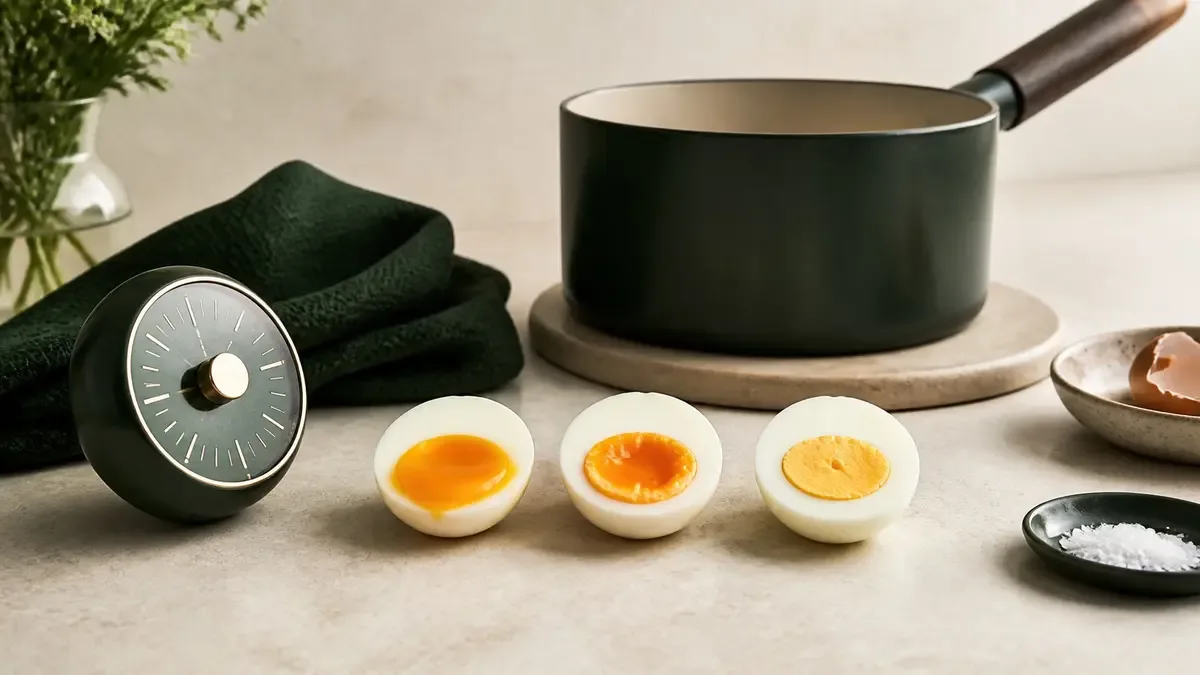
An egg timer, sometimes sold as an egg-perfect timer, is a heat-sensitive disc shaped like an egg. It is made from a special plastic that gradually changes color from red to white as the temperature rises, mimicking the way a real egg cooks. The timer has rings printed on it that show soft, medium, and hard. You drop it into the pot with your eggs, and when the color reaches the soft ring, the yolk is still runny and the white is just set.
The clever part is that the timer responds to the actual heat and water conditions in your pot, not to a fixed number of minutes. That means it adjusts automatically whether your eggs started cold from the fridge, whether your pot is large or small, and whether your stove runs hot or cool. A clock timer cannot do any of that.
How to Use It, Step by Step
Step 1: Place your eggs and the timer in a saucepan, then cover them with cold water by about an inch.
Step 2: Put the pan over medium-high heat and bring the water to a gentle boil.
Step 3: Watch the timer. As the water heats, the red color will slowly fade toward the center. When the edge of the color reaches the soft mark, your eggs are soft-boiled.
Step 4: Lift the eggs out with a slotted spoon and place them in a bowl of cold water for 30 seconds, just enough to stop the cooking and make them easier to handle. Peel and serve immediately.
The Timing Cheat Sheet
If you prefer a clock, these times work for large eggs started in cold water and brought to a boil, then kept at a gentle simmer: 6 minutes for a runny yolk and set white, 7 minutes for a slightly jammy yolk, and 8 to 9 minutes for a firmer yolk. But altitude, egg size, and stove strength all shift these numbers, which is exactly why the color-changing timer is more reliable.
Other Tools That Help
A second simple tool is the egg piercer, a small device that pricks a tiny hole in the wide end of the shell before cooking. It lets trapped air escape, which reduces cracking and makes peeling easier. Used together with the timer, it is the closest thing to a foolproof system.
A slotted spoon and a small bowl of ice water also matter. The ice bath stops the cooking instantly, so the yolk stays exactly as you like it, and the shells slip off more easily.
Common Mistakes to Avoid
- Starting with boiling water and cold eggs often cracks the shells. Cold water starts are gentler.
- Letting the water boil violently can crack eggs and overcook the whites. A gentle simmer is enough.
- Skipping the cold-water stop lets the eggs keep cooking in their shells, turning a runny yolk firm within a minute.
- Using very fresh eggs makes peeling harder. Eggs that are a week old peel much more cleanly.
How to Serve a Perfect Soft-Boiled Egg
Serve it in an egg cup with the top sliced off, with buttered toast soldiers for dipping. Or peel it and place it on avocado toast, ramen, or a grain bowl, where the runny yolk becomes a rich sauce. A pinch of flaky salt and cracked pepper is all it needs.
Final Thoughts
The perfect soft-boiled egg is not about skill or luck. It is about information. A simple color-changing egg timer, which costs less than a fancy coffee, tells you exactly when your eggs are ready, in your pot, on your stove, with your eggs. Once you try it, the guesswork disappears, and breakfast becomes reliably delicious.
Website Disclaimer
The information provided on this website is for general informational and educational purposes only. While we strive to ensure that all content is accurate and up to date, we make no guarantees regarding the completeness, reliability, or accuracy of any information published.
The views and opinions expressed in articles belong to their respective authors and do not necessarily reflect the views of this website. Any action you take based on the information found on this website is strictly at your own risk. We will not be liable for any losses, damages, or inconveniences arising from the use of our content.
Some articles may contain opinions, third-party information, or external links. We do not endorse or guarantee the accuracy of content on external websites and are not responsible for their practices or policies.
All content on this website is provided in good faith and is intended for informational purposes only. Readers are encouraged to verify information independently and seek professional advice where appropriate.