At exactly 2:13 a.m. on a freezing Thursday in early March, a man who looked like trouble incarnate slammed the side of his fist against my apartment door with such force that the metal frame vibrated through the walls and into my bones, and in those first few seconds—those loud, violent, terrifying seconds—I believed, with complete certainty, that I was about to become the victim of something irreversible; what I did not understand, what I could not possibly understand in that moment, was that the man on the other side of that door was not there to harm me, but to interrupt something far more silent, far more patient, and far more deadly than anything I had ever imagined.
My name is Lauren Hale, and at the time I was twenty-nine years old, living alone in a second-floor unit at Alder Crest Apartments, a three-story brick building tucked into a quiet, almost forgettable street just outside downtown Bozeman, Montana, a place where nothing dramatic ever seemed to happen, where people locked their doors more out of habit than fear, and where neighbors nodded politely in passing but rarely learned each other’s names; I was a graduate researcher in environmental science, the kind of person who lived more in data and field notes than in social circles, and my world, up until that night, had been defined by routines so predictable that even small disruptions felt unsettling.
That night had followed the same pattern as countless others before it: I left the lab a little after eleven, stopped by a 24-hour grocery store for yogurt and tea, returned home just before midnight, fed my aging tabby cat Winston—who was seventeen and nearly deaf—took a quick shower, and climbed into bed with a paperback novel I barely remember now, something about mountain ecosystems, something that seemed important at the time but now feels like a detail from another life; I cracked the bedroom window slightly, as I always did regardless of temperature, because I couldn’t sleep in still air, and by 12:45 a.m., I was asleep, the kind of deep, unbroken sleep that only comes from exhaustion.
When the pounding started, it didn’t register immediately as danger; it entered my dreams first, blending into them as something abstract and distant, but then it grew louder, sharper, more insistent, until it forced its way into consciousness with a violence that made my heart lurch into a sprint before my mind could catch up, and when I opened my eyes, the room was still dark, the clock glowing 2:13 in dull red digits, and the pounding continued—three strikes, then three more, then three again, rhythmic, deliberate, impossible to ignore.
I remember sitting up slowly, every instinct telling me not to move, not to respond, not to acknowledge whatever was happening on the other side of that door, because nothing good ever arrives at that hour uninvited, especially not with that kind of force, but the pounding didn’t stop, and then came the voice—a deep, rough voice that carried through the metal and wood like it was trying to break through both at once.
“Ma’am! Open up! You need to get out—now!”
Fear is a physical thing; it sits in your chest, presses against your lungs, makes your hands cold and your thoughts sharp in all the wrong ways, and as I stepped out of bed and moved quietly toward the front door, I could feel that fear building, layering itself with every step, every second, every unanswered question; Winston didn’t even stir, his deafness shielding him from the chaos, and for a brief, absurd moment, I envied him.
I reached the door and stood there, staring at it as if it might explain itself, as if the pounding might translate into something logical if I just waited long enough, but it didn’t, and so I leaned forward and looked through the small wired-glass peephole.
What I saw did not reassure me.
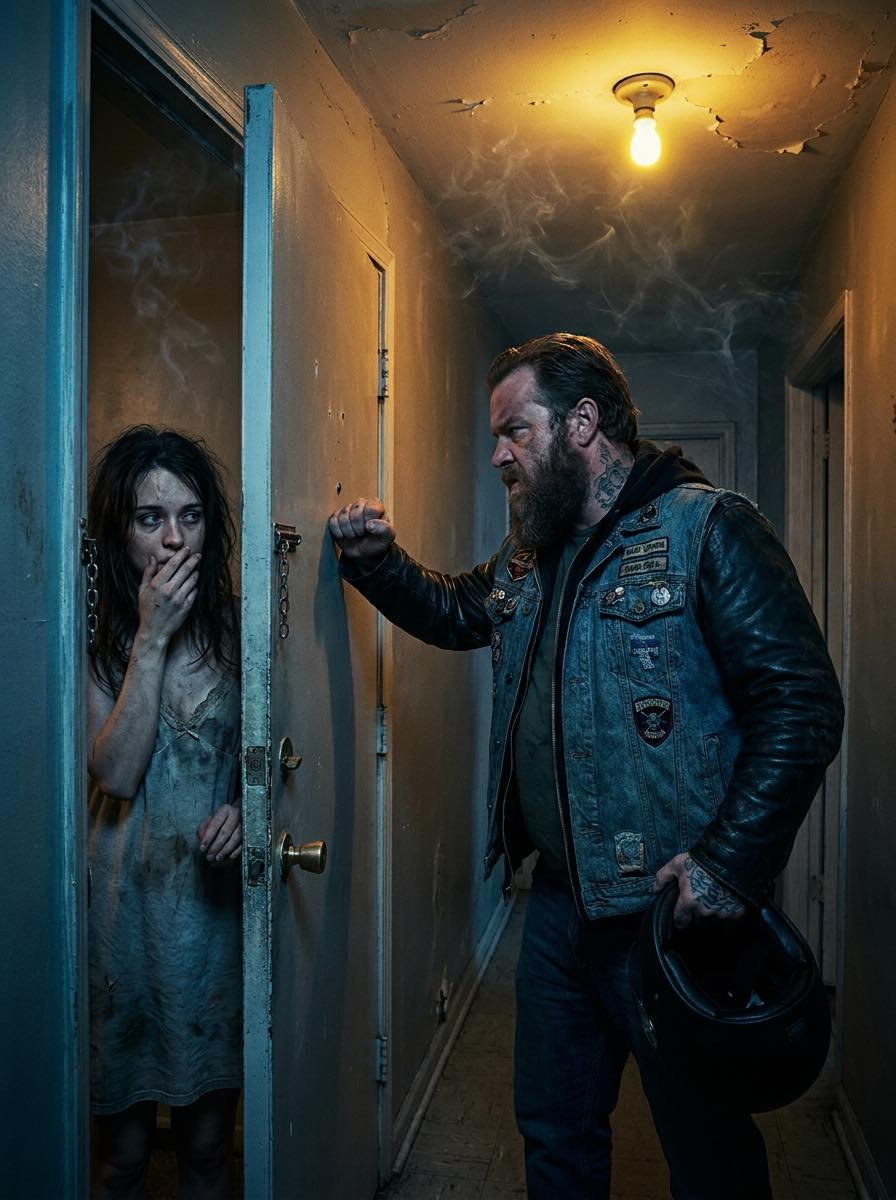
The man outside filled the entire frame of that tiny circle—broad shoulders, shaved head, thick beard streaked with gray, tattoos covering both arms in dense, faded ink that blurred together into something almost uniform, and a worn leather vest layered over a dark shirt, the kind of presence that immediately triggers every warning system your body has evolved to keep you safe; he looked like someone who had lived a hard life and learned to survive it, someone who carried weight—not just physical, but something heavier, something quieter.
And he was pounding on my door like it mattered.
He leaned closer, his face almost pressed against the glass, and when he saw my eye on the other side, he didn’t soften, didn’t hesitate.
“I see smoke coming out of your kitchen vent,” he shouted. “You need to get out right now!”
I didn’t believe him.
Not at first.
Because nothing in my apartment suggested fire; there was no alarm, no visible haze, no smell reaching me where I stood, just the familiar scents of my own space—fabric softener, old books, a faint trace of cat food—and the idea that danger could exist without announcing itself felt, in that moment, impossible.
So I hesitated.
And that hesitation nearly cost me everything.
The man hit the door again, harder this time, the sound echoing down the hallway, and his voice changed—not louder, but more urgent, more focused.
“Crack the door,” he said. “Just a little. You’ll smell it.”
There was something in the way he said it—not pleading, not threatening, just certain—that cut through my fear in a way logic hadn’t, and before I could talk myself out of it, I unlatched the deadbolt and opened the door two inches, the chain still secured.
The smell hit instantly.
It wasn’t the dramatic, choking smoke you see in movies; it was subtler, sharper, the unmistakable scent of something electrical burning behind walls, insulation heating beyond its limits, something hidden and spreading, something that didn’t need flames to become lethal.
I froze.
And in that freeze, the man stepped back, giving me space, his voice dropping into something calmer, steadier.
“You’ve got less time than you think,” he said. “Grab what you need. Thirty seconds. I’ll get the others.”
He didn’t wait for a response.
He moved on.
That, more than anything, is what convinced me.
Because someone with bad intentions doesn’t leave.
I turned, adrenaline taking over, and moved through my apartment in a blur—coat, boots, Winston, his carrier barely zipped as I rushed back to the door, my mind finally catching up to reality, finally understanding that something was wrong in a way I couldn’t fix alone.
By the time I stepped into the hallway, he was already at the next unit, pounding with the same relentless rhythm, his voice carrying through the building as he repeated the same message, the same urgency, over and over, moving door to door with a precision that felt practiced, almost methodical.
Later, we would realize just how deliberate it was.
But in that moment, all I knew was that he was the reason I was moving instead of sleeping.
Within minutes, the hallway filled with confused, half-awake residents—people I had passed dozens of times without speaking now suddenly united by the same fear, the same uncertainty, the same need to understand what was happening.
We made our way downstairs, out into the cold night, gathering in the parking lot as more doors opened, more people emerged, some clutching pets, others still wrapped in blankets, all of us looking back at the building as if it might reveal its secrets from the outside.
At first, nothing seemed wrong.
And then we saw it.
A thin, almost invisible stream of smoke drifting from a vent along the side of the building, rising slowly into the cold air, subtle enough that it could have been ignored, overlooked, dismissed as nothing.
But it wasn’t nothing.
It was everything.
Fire crews arrived quickly—faster than I would have expected at that hour—and within minutes, they were inside, assessing, containing, working with a calm efficiency that contrasted sharply with the chaos we felt standing outside, and it wasn’t until much later, after the immediate danger had passed, after the trucks had begun to pack up and the adrenaline had started to fade, that we began to understand what had almost happened.
The fire chief explained it in simple terms.
The source had been a slow electrical failure in a unit on the first floor, a hidden fault that had been building heat for hours, eventually producing smoke that traveled through shared ventilation channels, rising silently into the apartments above, including mine, where it would have continued to accumulate, unnoticed, until it reached a concentration capable of rendering me unconscious in my sleep.
“Another forty minutes,” he said, looking directly at me, “and you wouldn’t have woken up.”
Forty minutes.
It’s a strange number to carry.
Not long enough to change your life.
Long enough to end it.
I looked around at the others—my neighbors, people I barely knew—and realized that number applied to many of us, not just me, and suddenly the man who had pounded on my door wasn’t just a stranger anymore.
He was the reason we were all standing there.
When the chief approached him, asking for his name, the man shook his head.
“It doesn’t matter,” he said.
But it did.
To us, it did.
Because we needed to understand why someone would do what he had done—why he had noticed something we hadn’t, why he had acted when he could have kept walking, why he had cared enough to intervene in a situation that wasn’t his responsibility.
We didn’t get our answer that night.
He left before we could ask.
Just walked to his motorcycle, started the engine, and disappeared into the dark like he had never been there at all.
For months, we tried to find him.
We posted online, shared descriptions, reached out to local groups, hoping someone would recognize him, hoping he might come forward, but nothing came of it, and slowly, the urgency faded into something quieter, something more reflective, until one day, nearly half a year later, a security camera captured a brief moment that gave us the only closure we would ever receive.
He rode past the building.
Didn’t stop.
Didn’t get off the bike.
Just slowed slightly, looked toward the entrance, and nodded once before continuing on his way.
That nod said more than words could have.
Because it wasn’t about recognition.
It wasn’t about gratitude.
It was about something internal, something private, something that had nothing to do with us and everything to do with him.
Later, through a chain of coincidences and quiet conversations, we learned his story.
And everything made sense.
He wasn’t saving us for the first time.
He was trying to undo something he had lost.
Years earlier, his wife had died in a fire that started exactly the same way—hidden, silent, traveling through vents, reaching her before she could react—and he hadn’t been there.
So now, wherever he went, he watched.
He noticed.
He acted.
Not because he had to.
But because once, he hadn’t been able to.
And that difference defined everything.
Lesson of the Story
Sometimes the people who change our lives the most are the ones who refuse to take credit for it, the ones who act not out of recognition or reward but out of a quiet, personal promise to never ignore what they once lost. True courage is not loud, and it is not always visible; often, it looks like a man pounding on a stranger’s door in the middle of the night, asking nothing in return except that they wake up in time to keep living. And perhaps the deeper truth is this: we are all capable of being that person, if we choose to pay attention when it matters most.
Website Disclaimer
The information provided on this website is for general informational and educational purposes only. While we strive to ensure that all content is accurate and up to date, we make no guarantees regarding the completeness, reliability, or accuracy of any information published.
The views and opinions expressed in articles belong to their respective authors and do not necessarily reflect the views of this website. Any action you take based on the information found on this website is strictly at your own risk. We will not be liable for any losses, damages, or inconveniences arising from the use of our content.
Some articles may contain opinions, third-party information, or external links. We do not endorse or guarantee the accuracy of content on external websites and are not responsible for their practices or policies.
All content on this website is provided in good faith and is intended for informational purposes only. Readers are encouraged to verify information independently and seek professional advice where appropriate.