And then I froze, standing barefoot in the living room, my phone trembling in both hands. On the screen, Emily was asleep beneath her lavender blanket, one arm wrapped around her white rabbit. The room looked normal at first. The nightlight glowed softly. The curtains barely moved. The bookshelf stood perfectly still.
Then the bedroom door opened. Slowly.
Not wide enough for a dramatic entrance. Just enough for someone familiar with the house to slip inside.
My throat closed before I could make a sound.
A tall figure stepped into the room, wearing dark clothes, moving carefully through the yellow light.
For one insane second, I thought it was a stranger.
Then the figure turned slightly.
It was Daniel.
My husband.
Emily’s father.
He was still wearing his hospital scrubs beneath his coat, his hair messy, his shoulders bent with exhaustion.
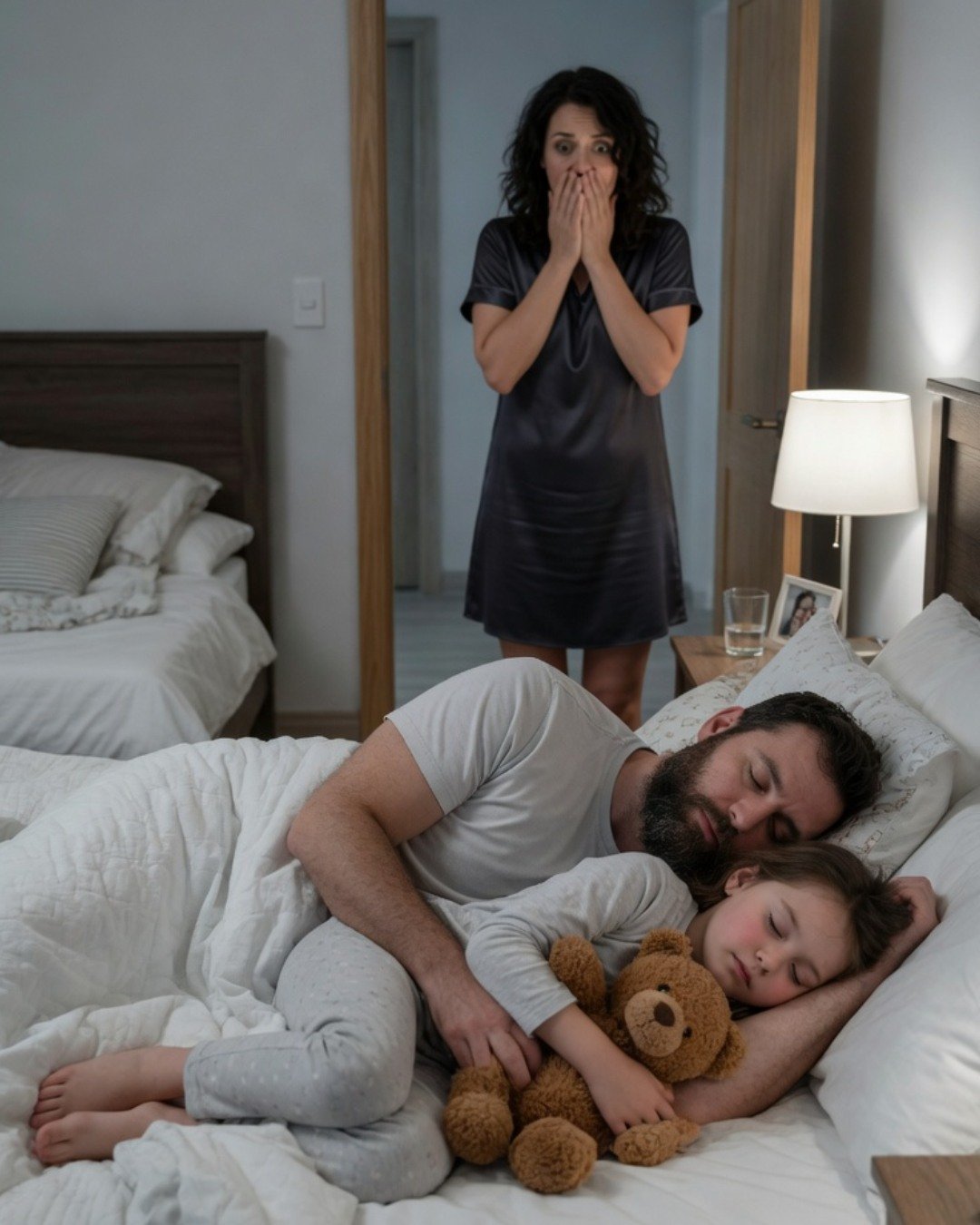
I stared at the screen, confused and terrified, while he stood beside Emily’s bed like a man afraid to touch sunlight.He didn’t wake her.
He didn’t speak at first.
He simply looked at her.
Then he lowered himself onto the very edge of her oversized bed, careful not to disturb her pillow.
Emily stirred, half asleep, and shifted toward the wall.
That was why she felt pushed aside.
That was why she kept saying her bed felt too small.
I watched Daniel lie down beside our daughter, not under the blanket, just on top of it.
He turned toward her, curled his body as small as he could, and gently placed one hand near her little fingers.
He did not hold her fully.
He only let one finger touch hers.
And then my husband, the brilliant surgeon everyone admired for his steady hands, began to cry.
Silently.
Completely.
His shoulders shook, but he covered his mouth so Emily would not wake.
I stood in the living room, unable to breathe, unable to move, unable to understand what I was seeing.
Daniel whispered something.
The camera had audio, but his voice was too low.
I raised the volume with shaking fingers.
At first, I heard only the soft hum of the nightlight and Emily’s slow breathing.
Then Daniel’s broken voice came through.
“I’m sorry, baby,” he whispered. “Daddy is trying. I promise I’m trying.”
My knees weakened.
I sat on the sofa without looking away from the screen.
Daniel stayed beside her for nearly ten minutes, crying into the sleeve of his coat.
Then he reached into his pocket and pulled out a small white envelope.
He slid it under Emily’s pillow with the kind of care people use around sleeping angels.
After that, he kissed the blanket near her shoulder.
Not her cheek. Not her forehead. Just the blanket.
As if touching her directly might break him.
Then he stood, wiped his face with both hands, and left the room as quietly as he had entered.
I didn’t go after him.
I couldn’t.
I sat in the dark living room until the phone screen went black in my hands.
For the first time in our marriage, Daniel had entered our daughter’s room like a secret.
And whatever he had hidden under her pillow terrified me more than any stranger could.
At 5:30 a.m., Daniel was gone again.
His side of the bed was cold.
On the kitchen counter, there was a note beside the coffee machine.
Emergency surgery. Don’t wait for me. Love you.
The handwriting was his, but the last two words looked heavier than usual.
I stared at them for a long time.
Then I walked to Emily’s room.
She was still asleep, cheek pressed against her rabbit, hair scattered across the pillow.
I slid my hand beneath the pillow and felt paper.
The envelope was there.
On the front, Daniel had written in small careful letters:
For Emily, when she turns sixteen.
My body went cold.
I sat on the edge of the bed and stared at the envelope until my vision blurred.
Why would a father write a letter eight years early?
Why would a healthy man leave messages for birthdays he expected to miss?
Emily opened her eyes and blinked at me sleepily.
“Mommy?” she whispered. “Are you okay?”
I forced the envelope behind my back and smiled badly.
“Yes, baby,” I said. “I just came to check on you.”
She rubbed her eyes. “My bed felt small again.”
I swallowed hard. “I know.”
Emily sat up slowly. “Did you come in?”
“No,” I said, my voice breaking. “But I think Daddy did.”
Her face changed.
Not fear.
Recognition.
“So it was him,” she whispered.
I stared at her. “You knew?”
Emily looked down at her blanket.
“I thought maybe,” she said. “He smells like hospital soap.”
That small sentence broke something in me.
Hospital soap.
Not danger. Not ghosts. Not nightmares.
Her father’s exhaustion had become a smell she recognized in the dark.
“Did he scare you?” I asked.
Emily shook her head. “No. He just cries.”
I gripped the envelope tighter.
“How many times has this happened?”
She shrugged, trying to look casual in the heartbreaking way children do.
“I don’t know. A lot. Sometimes he says sorry.”
I pulled her into my arms.
She was warm, small, and confused by my sudden trembling.
“Mommy, did Daddy do something bad?”
I closed my eyes.
“No, love,” I whispered. “But he may be hiding something very sad.”
That evening, Daniel came home at 10:48 p.m.
He looked destroyed.
His face was pale, his eyes shadowed, his hands tucked into his coat pockets like he was protecting them.
I was waiting in the kitchen.
The envelope lay on the table between two untouched cups of coffee.
Daniel stopped when he saw it.
For a moment, the surgeon vanished, and a frightened man stood in my kitchen.
“Claire,” he said quietly.
My name sounded like an apology.
I folded my arms to keep from shaking. “How long?”
He looked at the envelope, then at the hallway leading to Emily’s room.
“How much did you see?”
“Enough,” I said. “Enough to know you have been saying goodbye to our daughter while pretending to go to work.”
His jaw tightened.
He looked toward the window, then down at his hands.
“I didn’t want you to find out like this.”
A bitter laugh escaped me.
“You didn’t want me to find out at all.”
Daniel closed his eyes.
That silence was the answer.
I stepped closer. “Tell me the truth. Right now. Not the husband version. Not the doctor version. The truth.”
His hands came out of his pockets.
For the first time, I noticed the tremor.
Small.
Controlled.
But real.
His right hand shook before he clenched it into a fist.
My breath caught.
Daniel saw me see it.
“Three months ago,” he said, “I noticed my hand slipping during a procedure.”
I gripped the back of a chair.
He continued slowly. “At first I thought it was exhaustion. Stress. Too many hours.”
“Daniel,” I whispered.
“I ran tests privately,” he said. “Then more tests. Then I saw a neurologist outside the hospital.”
The room tilted.
“What is it?”
He swallowed hard.
“Early-onset Parkinson’s.”
The words landed softly, but the damage was enormous.
I stood there while every complaint, every late night, every strange absence rearranged itself into another shape.
“You knew for three months?” I asked.
He nodded.
“And you told no one?”
“I told one doctor,” he said. “Not the hospital board. Not my parents. Not you.”
My anger rose so fast it burned through the grief.
“You are my husband.”
“I know.”
“No,” I said, voice breaking. “You don’t get to know that quietly. You don’t get to make me a widow before you are gone.”
“I am not dying tomorrow,” he said.
“But you were writing letters like you were.”
His face crumpled then.
He sat down hard at the kitchen table and covered his face with both hands.
“I’m a surgeon, Claire,” he said. “My hands are my life. My hands feed our family. My hands built everything.”
I sat across from him, shaking.
“No,” I said. “Your hands are not your life. We are.”
He cried then, openly, not trying to hide it from cameras or sleeping children.
“I was scared,” he said. “I was ashamed. I didn’t know how to tell Emily her superhero father was breaking.”
My anger softened, but it did not disappear.
“She is eight,” I said. “She doesn’t need a superhero. She needs a father who doesn’t haunt her bedroom.”
Daniel flinched.
Good.
He needed to feel that.
“I thought if I lay beside her for a few minutes,” he whispered, “I could survive the day.”
I looked at the envelope again.
“And the letters?”
His voice became smaller.
“For her birthdays. Graduation. Wedding day. First heartbreak. Things I may not be able to say properly someday.”
My eyes filled.
I wanted to hate him for it.
Instead, I hated the disease. I hated the secrecy. I hated the way love sometimes dresses as protection while causing pain.
“You should have told me,” I said.
“I know.”
“No,” I said again. “You should have trusted me enough to fall apart in front of me.”
Daniel looked at me like that sentence hurt worse than the diagnosis.
From the hallway, a small voice whispered, “Daddy?”
We both turned.
Emily stood there in her pajamas, holding her rabbit, eyes wide and wet.
Daniel froze.
“Sweetheart,” he said carefully. “You should be sleeping.”
She walked into the kitchen.
“Are you sick?”
The question sliced through every adult lie left in the room.
Daniel looked at me.
I nodded.
No more hiding.
He knelt slowly in front of her.
“I have something that makes my hand shake sometimes,” he said. “The doctors are helping me.”
Emily looked at his hands.
“Is that why you cry in my bed?”
Daniel’s face twisted.
“Yes,” he whispered. “I’m sorry, baby. I thought you were asleep.”
“I was,” she said. “But children can hear crying.”
Neither of us knew what to say to that.
Emily stepped closer and touched his trembling hand.
“Does it hurt?”
“Not much,” Daniel said. “Mostly it scares me.”
She nodded solemnly.
Then she said, “You can be scared in Mommy’s room. My bed is too small.”
I almost laughed and sobbed at the same time.
Daniel pulled her into his arms, and she hugged him with the complete forgiveness only children possess.
But I did not forgive him that quickly.
Love does not erase betrayal just because betrayal came from fear.
The next morning, Daniel called the hospital board.
I sat beside him while he reported the diagnosis and requested medical leave.
His voice shook more than his hand.
When he ended the call, he looked like a man who had signed away his identity.
I put my hand over his.
“You are still here,” I said.
He stared at our joined hands.
“I don’t know who I am if I’m not operating.”
I looked toward the living room, where Emily was coloring a picture of our family with wildly purple hair.
“You are the man she drew with a crooked smile,” I said. “Start there.”
The following weeks were not inspirational in the way movies prefer.
They were ugly.
Daniel snapped at small things. I cried in the laundry room. Emily asked questions adults found too honest.
“Will Daddy forget me?”
“No.”
“Will his hands fall off?”
“No, sweetheart.”
“Can he still make pancakes?”
“Yes, but they may look weird.”
That made her laugh, and Daniel heard it from the doorway.
The first Saturday of his leave, he tried to make pancakes.
They were terrible.
One looked like Brazil. One looked like a shoe. One split in half when he flipped it.
Emily clapped like he had performed surgery on the moon.
“Best ugly pancakes ever,” she declared.
Daniel bowed dramatically, and for three minutes, disease did not own the kitchen.
But at night, I still checked the camera.
Not because I distrusted him.
Because fear becomes a habit before peace becomes believable.
At 2:00 a.m., the bedroom door opened again.
I sat upright instantly, phone in hand.
This time, Daniel stood at Emily’s doorway and did not enter.
He whispered, “Goodnight, sweetheart.”
Then he walked back to our room.
Seconds later, he appeared beside our bed, eyes full of shame and hope.
“Can I sleep here?” he asked softly.
I pulled back the blanket.
“You were always supposed to.”
He lay beside me and broke down like the last three months had finally found permission to leave his body.
I held him.
Not as a nurse. Not as a fixer. Not as a woman pretending fear was manageable.
As his wife.
And in the room down the hall, Emily slept freely in her enormous bed.
A month later, Daniel began treatment openly.
He stepped away from operating and started teaching younger surgeons, guiding hands that would continue where his could not.
At first, he hated it.
Then one evening, a resident called to thank him for saving a patient through instructions given from outside the operating room.
Daniel sat in the car afterward, unable to speak.
When he came inside, Emily ran to him with a drawing.
It showed him wearing a cape, but not holding a scalpel.
Instead, he held a flashlight.
“What’s this?” he asked.
“You help other people see,” Emily said.
Daniel looked at me over her head.
That night, he cried again.
But this time, he did not hide in a child’s room to do it.
On Emily’s ninth birthday, Daniel gave her a new envelope.
Not the secret one from beneath her pillow.
This one was bright yellow, decorated with stickers, and handed to her at breakfast.
She opened it cautiously.
Inside was a letter that said:
Dear Emily, I am still here. Today we eat cake. Love, Daddy.
She read it twice, then hugged him so hard he nearly dropped his coffee.
“What about the other letters?” she asked.
Daniel looked at me.
We had talked about this.
He went upstairs and returned with a small wooden box.
Inside were the letters he had written for the future out of fear.
Graduation. Sixteen. Eighteen. Wedding. First heartbreak. First failure. First big dream.
Emily touched the box carefully.
“Are these sad?”
Daniel sat beside her.
“They were sad when I wrote them,” he said. “But now they are reminders.”
“Of what?”
“That I don’t have to say goodbye before it’s time.”
Emily considered this seriously.
“Can we keep them anyway?”
“Of course.”
“Can I write one too?”
Daniel blinked. “To who?”
“To future Daddy,” she said. “In case he gets scared again.”
I left the room before they saw me cry.
Not silent tears this time.
Real ones.
Loud enough to belong to the living.
That evening, after the birthday candles were blown out, Emily climbed into her own bed.
Daniel and I stood in her doorway together.
She arranged her rabbit beside her pillow and looked at us suspiciously.
“Both of you,” she said, “do not sneak in here tonight.”
Daniel raised his hands. “Understood.”
I smiled. “Anything else, ma’am?”
“Yes,” Emily said. “If someone is sad, they knock first.”
Daniel’s face softened.
“That is a very good rule.”
She nodded. “And my bed is big, but not for secrets.”
I felt Daniel’s fingers find mine in the hallway.
The old fear moved through us, but it did not control us.
“Goodnight, baby,” I said.
“Goodnight,” Emily answered. “Leave the door open a little.”
We did.
Later, Daniel and I sat downstairs with the camera feed open on the coffee table.
Emily slept peacefully, stretched diagonally across the bed like a queen claiming her kingdom.
Daniel watched her and whispered, “I almost made her carry my fear.”
I leaned against his shoulder.
“But you stopped.”
He shook his head. “You stopped me.”
“No,” I said. “She did. With one honest complaint.”
He laughed softly.
“My bed feels too small,” he repeated.
And somehow, those words no longer sounded frightening.
They sounded like the moment our family finally noticed one person had been disappearing into silence.
Months passed.
The tremor remained. Some days were better. Some days Daniel dropped spoons and cursed under his breath.
Emily learned not to panic when his hand shook.
She would simply slide things closer and say, “Teamwork.”
Daniel learned to accept help without treating it like defeat.
I learned marriage is not saved by never breaking.
It is saved by choosing not to break alone.
Sometimes people still praised Daniel as a brilliant surgeon.
He would smile and say, “I teach now.”
At first, that sentence hurt him.
Eventually, it became true without bleeding.
One rainy night, I found Emily standing outside our bedroom door with her rabbit tucked under one arm.
“Mommy,” she whispered, “Daddy sounded sad.”
Daniel was sitting on the edge of the bed, staring at his shaking hand.
Emily climbed between us without asking.
“This bed is bigger,” she said. “Sad people can fit here.”
Daniel looked at me.
I nodded.
So the three of us lay there, not hiding, not pretending, not performing bravery for anyone.
Emily fell asleep first.
Daniel’s hand trembled against the blanket.
I covered it with mine.
The house was quiet. Safe. Honest.
And for the first time in months, no room felt too small.
Website Disclaimer
The information provided on this website is for general informational and educational purposes only. While we strive to ensure that all content is accurate and up to date, we make no guarantees regarding the completeness, reliability, or accuracy of any information published.
The views and opinions expressed in articles belong to their respective authors and do not necessarily reflect the views of this website. Any action you take based on the information found on this website is strictly at your own risk. We will not be liable for any losses, damages, or inconveniences arising from the use of our content.
Some articles may contain opinions, third-party information, or external links. We do not endorse or guarantee the accuracy of content on external websites and are not responsible for their practices or policies.
All content on this website is provided in good faith and is intended for informational purposes only. Readers are encouraged to verify information independently and seek professional advice where appropriate.