I lived across from Ruth Delaney for twelve years.
My name is Marjorie Bell, and I am old enough to know when a neighborhood is kind and when it is only polite.
Briar Lane was polite.
We waved.
We brought casseroles after funerals.
We borrowed ladders and returned them late.
But we also watched.
We watched Ruth turn that porch light on every night.
We watched Tyler’s old Harley sit untouched in the garage, black paint under a gray tarp, front tire slowly losing air.
We watched the Smoky Ridge Riders come by once a month, engines low, boots on Ruth’s porch, rough hands carrying groceries, fixing gutters, changing air filters, leaving before she could fuss too much.
The club president was a Black American man named Earl “Preacher” Watkins. Sixty-four years old, retired lineman, big shoulders, gray beard, arms tattooed with Scripture verses and old road dates. He rode a dark green Harley Road King and wore a leather vest softened by decades of weather.
Preacher was the only man Ruth allowed to touch Tyler’s bike.
Not ride it.
Never ride it.
Just keep it alive.
Once a month, he would open the garage, pull back the tarp, check the battery tender, roll the tires, wipe dust off the tank, and start the engine for exactly one minute.
That sound did something to the whole street.
Tyler’s Harley had a deep, uneven rumble. Not polished. Not showy. It sounded like gravel and thunder and a man clearing his throat before saying something difficult.
Ruth always stood in the kitchen when Preacher started it.
Never in the garage.
Never too close.
She listened with one hand on the sink.
Then Preacher shut it off.
The silence after was worse.
Tyler had been Ruth’s only child.
His father left when Tyler was eleven, taking a suitcase, a paycheck, and the good truck. Ruth raised him on motel shifts, church pantry boxes, and the kind of stubborn love that leaves no room for self-pity.
Tyler got in trouble young.
Not terrible trouble.
The kind poor boys get into when they are angry and no one has time to sit with them. Fights. Skipping school. A stolen case of beer. One night in county jail after he broke a man’s nose for calling Ruth a name.
Ruth marched into that jail at 2:00 in the morning wearing house shoes and a winter coat over her nightgown.
When Tyler came out, she slapped him once.
Then hugged him so hard he cried into her shoulder.
“You don’t get to become what hurt you,” she told him.
He never forgot that.
The motorcycle came later.
A beat-up Harley he bought from a man behind a pawn shop. Ruth hated it on sight.
“That thing is death with handlebars,” she said.
Tyler grinned. “Then I’ll ride careful.”
“You better ride smart.”
“That too.”
He didn’t always.
But he came home.
Late, usually.
Midnight.
One in the morning.
Sometimes later after charity rides, tow calls, hospital visits, or sitting with some club brother whose marriage had fallen apart.
Ruth would leave the porch light on.
Tyler would roll into the driveway, kill the engine before reaching the house, and coast the last few feet so he wouldn’t wake her.
It never worked.
Ruth would open the door.
“You hungry?”
“Always.”
She would heat leftovers.
He would sit at the kitchen table in leather and road dust, eating meatloaf or soup while she pretended not to inspect him for blood, bruises, or sadness.
That was their ritual.
After he died, the ritual stayed.
Only one part of it.
The light.
The first seed was the porch light itself.
The second was Tyler’s vest.
Ruth kept it hanging on the back of a kitchen chair, not in a closet. Black leather. Smoky Ridge Riders patch across the back. A small stitched name on the front: SAINT.
People thought the road name was ironic.
It wasn’t.
Tyler got it after he rode ninety miles in freezing rain to bring insulin to an elderly club member snowed in outside Gatlinburg. He caught pneumonia afterward and complained the whole time.
The third seed was the left saddlebag.
It stayed locked.
Preacher had the key.
Ruth never asked why.
Maybe because grief is full of doors we are not ready to open.
The trouble began with a storm.
Three years and two months after Tyler died, a bad line of thunderstorms rolled through Knoxville from the west. Trees bent sideways. Rain hit windows like handfuls of gravel. Power flickered twice before going out across most of Briar Lane.
At 8:30, Ruth’s porch light did not come on.
That sounds small.
It was not small.
Not to her.
I saw her from my window, standing at the front door, flipping the switch up and down like stubbornness could restore electricity.
The street was dark except for lightning.
No warm yellow circle on her porch.
No glow over the empty driveway.
No marker for a dead son coming home late.
I grabbed a flashlight and crossed the street in the rain.
By the time I reached her porch, Ruth was outside in a raincoat, holding a battery lantern with shaking hands.
“Ruth,” I shouted over the rain, “get inside.”
“The bulb won’t come on.”
“The power’s out.”
“I know that.”
“Then what are you doing?”
She looked at me like the answer should have been obvious.
“I’m putting another light.”
My throat tightened.
She set the battery lantern on the porch rail, but the wind knocked it sideways. I caught it before it fell.
“Let me help.”
“I can do it.”
“I know. Let me anyway.”
That was the first time she let me.
Together, we tied the lantern to the porch post with twine from her kitchen drawer. It swung in the wind, wild and weak, but it shone toward the road.
Ruth stood back, soaked through, breathing hard.
“There,” she said.
I wanted to tell her Tyler didn’t need it.
I wanted to tell her dead sons do not miss turns.
But I was not cruel enough to call that truth.
So I said, “There.”
The next morning, Preacher came.
Not alone.
Six Smoky Ridge Riders rolled up Briar Lane just after breakfast, their Harleys moving slow over storm debris. They wore leather vests over rain gear, boots splashed with mud, faces serious.
A big white American biker named Dutch brought a chainsaw.
A Cherokee American biker named Leon carried roof tarps.
Preacher brought a generator.
Ruth stood on the porch in her slippers.
“I didn’t ask for all this.”
Preacher set the generator down.
“No, ma’am.”
“I don’t need babysitting.”
“No, ma’am.”
“I can handle a storm.”
“Yes, ma’am.”
She narrowed her eyes. “Then why are you here?”
Preacher looked at the dead porch light.
“Saint would be mad if we didn’t fix his runway.”
Ruth’s face changed.
Just a little.
Then she let them work.
They cleared branches, checked the roof, fixed a gutter, and wired the generator to keep her refrigerator and porch light running until power came back.
At 8:30 that night, the porch light turned on.
Powered by a generator sitting beside six muddy bikers drinking coffee from Ruth’s mismatched mugs.
For one moment, it felt like the story had found its shape.
Grieving mother.
Loyal biker club.
Porch light restored.
A whole neighborhood learning tenderness from men it had judged too quickly.
That would have been enough.
But it was only the false climax.
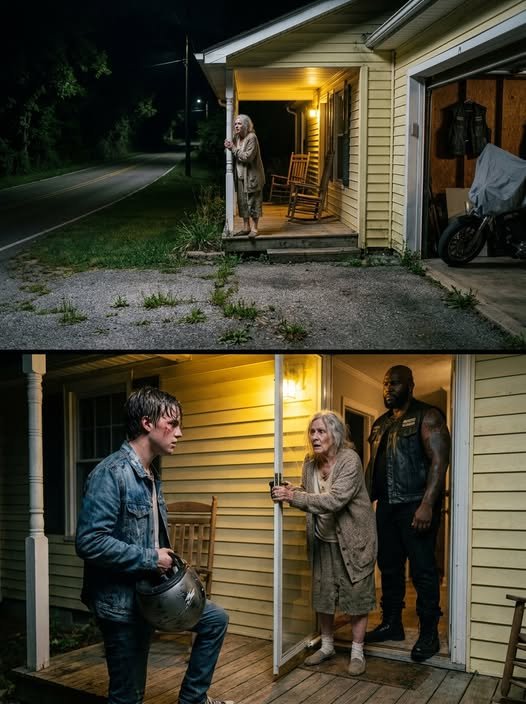
Because two nights later, at 12:17 a.m., someone knocked on Ruth’s door.
Not a neighbor.
Not Preacher.
Not anyone from Briar Lane.
A white American teenage boy stood under the porch light, soaked, shaking, carrying a motorcycle helmet under one arm.
And when Ruth opened the door, he said, “Is this where Saint’s mom lives?”
The boy’s name was Cody Miles.
Seventeen years old. White American. Thin as a fence rail. Brown hair plastered to his forehead from rain. Old denim jacket. Boots too big for him. Split lip. One eye swelling purple.
Ruth should have been scared.
A boy appearing after midnight, bruised, asking about her dead son.
Instead, she opened the door wider.
“Come in before you drip through the floor.”
He stepped inside.
I know because she called me five minutes later.
“Marjorie,” she said, voice too calm, “come over. And bring that first-aid kit you brag about.”
When I arrived, Cody sat at Ruth’s kitchen table in Tyler’s chair.
That hit me hard.
Ruth had not let anyone sit there in three years.
A towel was around Cody’s shoulders. His helmet sat on the floor beside him. Not a motorcycle helmet like Tyler’s. Cheaper. Scratched. Probably from a dirt bike or scooter.
Ruth set a bowl of soup in front of him.
He stared at it.
“Eat,” she said.
“I’m not hungry.”
“That’s not what I asked.”
He ate.
Preacher arrived ten minutes later, because Ruth called him too. He stepped into the kitchen, saw Cody’s face, and his jaw tightened.
“Who hit you?” Preacher asked.
Cody looked down.
Ruth shot Preacher a look sharp enough to cut wire.
Preacher sat.
Softer now.
“You knew Saint?”
Cody nodded.
“How?”
The boy reached into his jacket and pulled out a folded piece of paper, damp at the edges.
It was a photograph.
Tyler stood outside a gas station, three years younger, leather vest on, one hand resting on Cody’s shoulder. Cody looked maybe fourteen in the picture. Smaller. Scared. Trying not to smile.
Ruth took the photo.
Her hand trembled.
“I never saw this.”
Cody swallowed.
“He told me not to bother you.”
Ruth looked at him.
“He said you worried enough.”
That sounded so much like Tyler that Ruth had to sit down.
Cody told the story in pieces.
Three years earlier, before the crash, Tyler had found him behind a gas station off Chapman Highway. Cody had run from a violent stepfather. He was hungry, bruised, and trying to steal a sandwich from the store dumpster.
Tyler caught him.
Did not call the police.
Did not lecture.
Bought him two sandwiches, a bottle of water, and a pair of gloves because it was cold.
Then he sat with him behind the station for almost an hour.
Cody said Tyler did not talk like social workers. Did not ask a thousand questions. Just said, “You got somewhere safe tonight?”
Cody lied.
Tyler knew.
For six months, Tyler checked on him.
Not every day.
Enough.
He connected Cody with a youth outreach worker. Brought him food. Bought him a prepaid phone. Gave him the number of a shelter in Knoxville. Told him that leaving a bad house was not the same as being bad.
Then Tyler died.
Cody found out two weeks later.
“I went to the funeral,” Cody said.
Ruth looked stunned. “You were there?”
“Across the road.”
I remembered then.
A skinny boy under an oak tree.
I had thought he was just a stranger watching the motorcycles.
Cody looked at the porch light through the kitchen window.
“I didn’t come here before because I didn’t think I had the right.”
Preacher leaned forward.
“What changed tonight?”
Cody touched his split lip.
“My stepdad came back. Mom let him in. I ran.”
Ruth’s face hardened.
“Why here?”
Cody’s eyes filled.
“Because Saint told me once if I ever got lost late, look for the yellow porch light on Briar Lane.”
That was the twist.
Ruth thought she had been keeping the light on for Tyler.
But Tyler had turned that light into a promise for somebody else.
A boy nobody knew he had been helping.
A boy who had finally needed the road home.
Preacher opened the left saddlebag the next morning.
Ruth asked him to.
For three years, that locked bag had sat untouched on Tyler’s Harley. Preacher had kept the key because Tyler gave it to him two weeks before the accident.
“If anything happens,” Tyler had told him, “don’t let Ma open it till she asks.”
Preacher had hated that promise.
But he kept it.
That morning, Ruth stood in the garage wearing Tyler’s old flannel shirt over her nightgown. Cody stood near the doorway, both hands wrapped around a mug of coffee he was too young to like but too polite to refuse. I stood beside the tool bench because Ruth asked me to stay.
Preacher put the key in the lock.
The click sounded too loud.
Inside the saddlebag were no dramatic treasures.
That made it worse somehow.
A small notebook.
A roll of cash in a rubber band.
A list of phone numbers.
Two granola bars long expired.
A cheap prepaid phone.
A child-sized pair of winter gloves.
And a folded envelope with Ruth’s name on it.
She touched the envelope first.
Then pulled back.
“You read it,” she told Preacher.
He did not argue.
His voice was low when he began.
Ma,
If you’re reading this, I either got stupid or unlucky. Don’t fuss. I know you.
There’s a kid named Cody. He ain’t mine, but he’s somebody’s, and right now nobody is acting like it. If he comes by, feed him first and ask questions later. He trusts yellow porch lights more than people. That’s my fault. I told him yours never goes out.
Don’t be mad I didn’t tell you. You would’ve worried.
Also, don’t sell the bike fast. Preacher knows what to do.
I love you. I know I don’t say it enough.
Leave the light on if you can.
Ty.
Ruth sat down on the garage step.
No one spoke.
Cody cried first.
Quietly.
Like he was ashamed to take up room in someone else’s grief.
Ruth looked at him.
Then at the notebook.
She opened it.
Tyler’s handwriting filled the pages. Messy. Slanted. Practical.
Cody — likes tomato soup, hates onions.
Shelter contact: Denise.
School counselor name? Ask again.
Bring gloves. Kid’s hands always cold.
Don’t push him. He bolts when cornered.
Tell Ma someday? Maybe.
Porch light helps. Don’t laugh.
Cody says he can hear my bike before he sees it. Says it means somebody came back.
Ruth pressed the notebook to her chest.
The seeds returned then.
The porch light.
The locked saddlebag.
The extra groceries Tyler used to buy without explanation.
The nights he came home even later than usual.
The way he always asked Ruth if the porch bulb was working.
She had thought it was because he needed the light.
Now she knew he had been making sure someone else did.
Preacher took off his glasses and wiped them with a bandana.
“Saint never could leave strays alone,” he said.
Ruth looked at Cody.
The boy flinched slightly, as if kindness might still turn into a demand.
Ruth saw it.
Her voice softened.
“You got somewhere safe?”
Cody shook his head.
“Then you do for breakfast.”
He looked confused.
“For breakfast?”
Ruth stood slowly.
“We’ll figure lunch after.”
That was Ruth.
Too hurt for big promises.
Too practical to let a hungry boy stand in a garage.
By noon, Preacher had called the youth outreach worker in Tyler’s notebook. By evening, Cody had a safe placement through a crisis program. By the next week, legal wheels were moving, slow and imperfect, but moving.
Ruth became what the paperwork called a supportive adult.
Cody called her Miss Ruth.
She hated that.
“Sounds like I run a Sunday school room,” she said.
“What should I call you?”
She thought about it.
Then said, “Ruth is fine.”
He never called her Mom.
She never asked him to.
Grief does not need replacement to become love again.
After Cody came, the porch light changed.
Not to the eye.
Same warm yellow bulb.
Same cracked porch.
Same two rocking chairs.
Same driveway with weeds growing through gravel.
But the waiting changed.
It was no longer only backward.
It faced forward too.
Cody came by twice a week at first.
Then more often.
He helped Ruth carry groceries. Took trash cans to the curb. Learned to fix the porch railing from Preacher. Sat in Tyler’s chair only when Ruth nodded.
The first time he heard Tyler’s Harley start in the garage, he nearly dropped a glass.
Preacher had come for the monthly engine check. Cody was in the kitchen, drying dishes.
The Harley rumbled to life.
Deep.
Rough.
Alive for one minute.
Cody froze.
Ruth watched him.
“You okay?”
He nodded, but his eyes had gone somewhere else.
After Preacher shut it off, Cody whispered, “I used to hear that at the gas station.”
Ruth dried her hands.
“He had a loud way of being gentle.”
Cody smiled a little.
“Yeah.”
The Smoky Ridge Riders took Cody in the way bikers take people in.
Awkwardly.
Without asking enough questions.
With food.
Dutch gave him an old tool roll.
Leon taught him how to patch a bicycle tire.
Preacher taught him how to check oil, then made him repeat the steps until he got annoyed.
Ruth taught him how to make biscuits.
He was terrible at it.
She said so.
He came back anyway.
One evening in November, Cody arrived just before dark and found Ruth standing on a chair, trying to change the porch bulb.
He panicked.
“Get down.”
“I’ve changed bulbs since before you were born.”
“Not on a chair that wobbles.”
“It does not wobble.”
The chair wobbled.
Cody grabbed it.
Ruth climbed down, muttering.
He changed the bulb himself.
At 8:30, he flipped the switch.
The porch filled with yellow light.
Ruth stood beside him.
For once, she was not looking down the road alone.
Cody looked at the light.
“He really told you to keep it on?”
Ruth shook her head.
“He told me if I could.”
“Could you have turned it off?”
She looked at the driveway where Tyler’s Harley used to pull in late, engine low, son hungry, boots muddy, smile crooked.
“Yes,” she said. “But I wouldn’t have slept.”
Cody nodded.
“Me neither, some nights.”
She glanced at him.
He stared at the road.
“Before I came here,” he said, “I used to ride buses at night when I had nowhere to go. If I saw porch lights, I’d pretend one of them was for me.”
Ruth’s eyes filled.
This time, she did not hide it.
“This one is,” she said.
Cody turned eighteen the following spring.
No party.
He said he hated parties.
Ruth made a cake anyway.
It leaned to one side.
Preacher brought ribs.
Dutch brought a used motorcycle manual.
Leon brought a helmet and said, “For someday, not today.”
Cody looked at it for a long time.
Then he looked at Ruth.
She knew what he was asking.
She looked toward the garage.
Tyler’s Harley sat under the tarp, battery charged, tires full, chrome wiped clean by men who still missed him.
“No,” she said.
Cody nodded fast. “I wasn’t asking.”
“Yes, you were.”
He looked down.
Ruth touched the back of a kitchen chair.
Not Tyler’s vest.
That still hung there.
But close.
“One day maybe,” she said. “Not because you earned it. Not because you’re replacing him. Because roads need respect, and grief ain’t a license.”
Cody swallowed.
“Yes, ma’am.”
“I told you not to ma’am me.”
“Yes, Ruth.”
That night, after everyone left, Cody stepped onto the porch.
The light glowed above him.
Ruth came out with two cups of coffee, one mostly milk because Cody still hated the taste.
They sat in the rocking chairs.
The road was dark beyond the yellow circle.
Crickets sang.
A truck passed far off on the highway.
After a while, Cody said, “You still turn it on for him?”
Ruth looked at the light.
Then at the road.
Then at the boy Tyler had sent home without ever bringing him through the door.
“Yes,” she said.
Cody nodded.
Then Ruth added, “And for whoever else is still trying to find the turn.”
Cody leaned back in the chair.
For the first time since I had known him, he looked less ready to run.
Inside the garage, Tyler’s Harley sat quiet.
His vest hung over the kitchen chair.
His notebook rested in the drawer beside Ruth’s Bible and the spare porch bulbs.
At 8:30 every night, the light still came on.
Warm.
Steady.
Waiting.
And somewhere down Briar Lane, if you stood still long enough, you could almost hear a motorcycle coasting home late, careful not to wake his mother.
Website Disclaimer
The information provided on this website is for general informational and educational purposes only. While we strive to ensure that all content is accurate and up to date, we make no guarantees regarding the completeness, reliability, or accuracy of any information published.
The views and opinions expressed in articles belong to their respective authors and do not necessarily reflect the views of this website. Any action you take based on the information found on this website is strictly at your own risk. We will not be liable for any losses, damages, or inconveniences arising from the use of our content.
Some articles may contain opinions, third-party information, or external links. We do not endorse or guarantee the accuracy of content on external websites and are not responsible for their practices or policies.
All content on this website is provided in good faith and is intended for informational purposes only. Readers are encouraged to verify information independently and seek professional advice where appropriate.