My name is Elena Rossi. I’m thirty-nine, and if you passed me on the street in Allentown, you probably wouldn’t remember me five minutes later. I work in accounts payable for a mid-sized logistics company just off Hamilton Boulevard, I drink too much coffee, I forget to water my plants until the leaves curl at the edges, and for most of my adult life I’ve been the kind of person who plans everything three steps ahead because life, as I learned early, doesn’t always give you the courtesy of warning you before it changes.
I have one child. His name is Leo.
Leo is eleven now, though the story I’m about to tell you starts when he was ten, at a birthday party I almost canceled twice that week because I was tired—tired in the bone-deep, quiet way that doesn’t announce itself loudly but sits behind your ribs and makes even small decisions feel heavy.
Leo has Down syndrome.
He also has a way of looking at the world that makes you feel like maybe we’re the ones who learned everything wrong.
He notices things most people rush past. The exact shade of the sky before it rains. The rhythm of a dog’s tail when it’s almost—but not quite—excited. The way a person’s voice changes when they’re pretending to be okay. He remembers details that don’t seem important until you realize they are. He once asked me why people say “I’m fine” when their eyes look sad, and I didn’t have an answer that didn’t sound like an excuse.
He laughs with his whole body. He doesn’t hold back affection. If he loves you, you know it immediately, because he will lean into you like you are something solid in a world that sometimes feels unsteady.
And he talks. God, he talks.
He tells stories that loop and circle back on themselves. He builds sentences carefully, like he’s assembling something fragile in his hands. He has opinions—strong ones—about fairness, about animals, about which superhero would win in a fight and why kindness should count as a superpower even if nobody writes it that way.
But his speech… his speech is where the world often stops listening.
It’s not that he doesn’t know what to say. It’s that his mouth doesn’t always cooperate with the clarity people expect. His consonants blur at the edges. His vowels stretch in a way that sounds unfamiliar if you’re not used to it. When he’s excited, his words tumble over each other, like they’re trying to get out faster than his body can manage.
And people—good people, not cruel ones—get uncomfortable.
They nod. They smile politely. And then they look at me.
“What did he say?”
That question, asked casually, has a weight to it that most people don’t notice.
Because every time someone asks me that, Leo hears something else.
He hears: You are not understood.
He hears: You need a translator.
He hears: Your voice isn’t enough on its own.
I’ve watched it happen so many times I can predict it before it does. The slight tilt of the head. The glance in my direction. The pause that stretches just a second too long.
And every time, I step in. I translate. I smooth the moment over. I make it easier for everyone else.
And every time, a tiny piece of something in Leo goes quiet.
By the time he turned ten, he had already learned to look at me after he spoke, waiting—not for confirmation, but for rescue.
That’s the part that broke me the most.
So when I planned his tenth birthday, I told myself it would be different, even though I didn’t quite know how.
It was a small party. Backyard. A handful of kids from his mixed-ability class. My sister, Clara. My husband, Daniel. A few neighbors. Nothing elaborate—just balloons tied to the fence, a folding table with a plastic tablecloth that kept lifting in the breeze, and a cake from the grocery store with frosting that was a little too sweet but looked cheerful enough.
Clara asked if she could bring a friend.
“Just one,” she said. “He’s… you’ll see. He’s good people.”
I didn’t think much of it. I said yes.
That’s how Marcus Hale walked into our backyard.
He arrived late, around four in the afternoon, the kind of late that usually feels awkward but somehow didn’t in his case. You could hear the motorcycle before you saw him—a low, steady rumble that turned a few heads and made the younger kids run toward the fence to look.
He parked along the curb, took off his helmet, and for a second just sat there, like he was deciding something.
Then he got off the bike.
He was tall—easily over six feet—with broad shoulders that made his black T-shirt stretch across his back. His arms were covered in tattoos, not the random kind but the kind that looked intentional, like each piece meant something. His hair was short, his beard threaded with gray, and there was a stillness about him that didn’t match the noise of the motorcycle he rode in on.
He carried a small box wrapped in bright blue paper.
Clara waved him over. “Elena! This is Marcus.”
He nodded once, not overly friendly, not distant either. Just… present.
“Thanks for letting me crash the party,” he said.
His voice was lower than I expected. Calm.
I smiled, the automatic host response kicking in. “Of course. Any friend of Clara’s…”
I didn’t finish the sentence because Leo had already noticed him.
Leo has a radar for new people. Especially people who don’t look like everyone else.
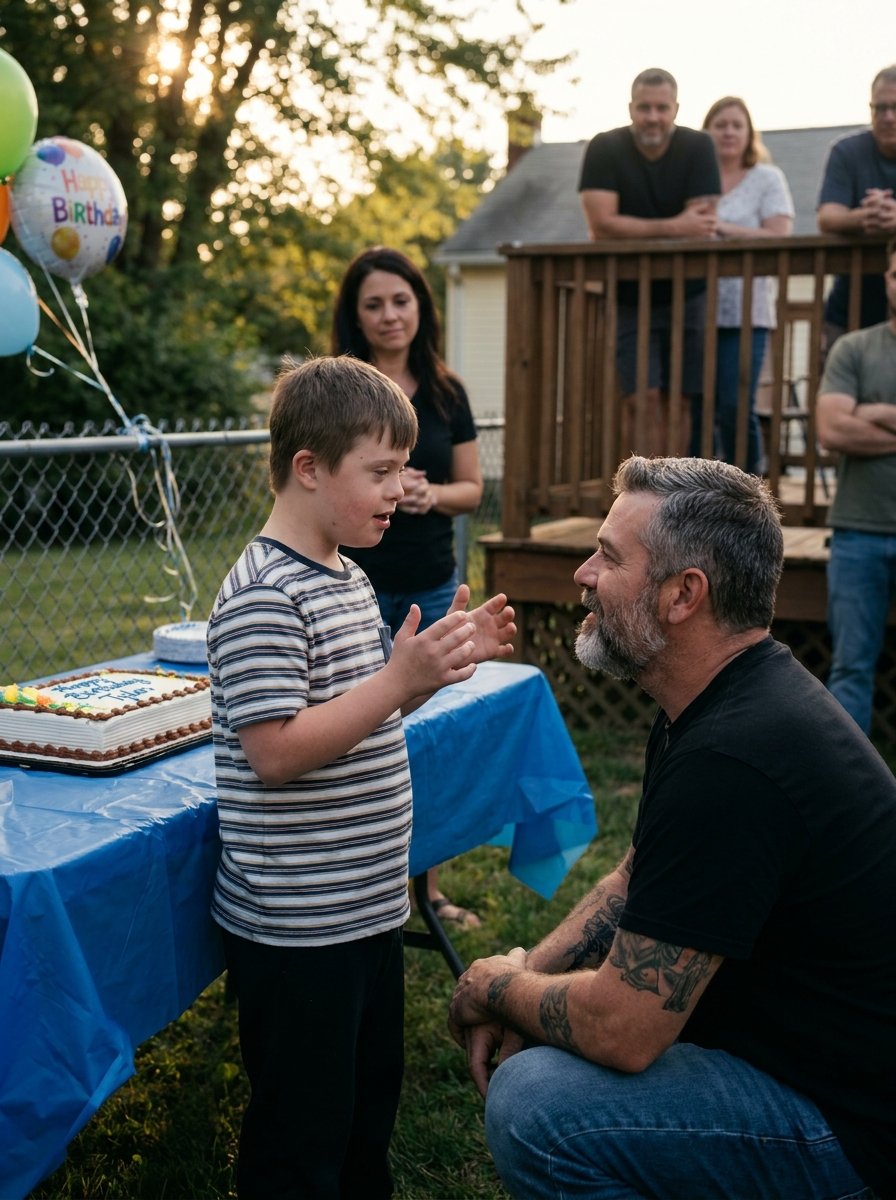
He walked straight up to Marcus, stopped about two feet away, and looked up at him with that open, curious expression that doesn’t filter itself.
“Your bike is loud,” Leo said, the words coming quickly, slightly blurred, excitement pulling them forward.
Marcus crouched down.
Not quickly. Not awkwardly. Slowly, like he was lowering himself into Leo’s space with intention.
“Yeah,” he said. “It is.”
Leo launched into a sentence—something about how he liked motorcycles but only if they weren’t too loud near dogs because dogs get scared and his friend Noah’s dog once ran away because of fireworks and—
It was a long sentence. Maybe three.
I felt it happen before I saw it. That familiar tightening in my chest.
Here it comes, I thought.
The confusion. The glance toward me. The translation.
Clara shifted slightly. Daniel glanced in my direction. It was like a silent choreography everyone had learned without meaning to.
But Marcus didn’t look at me.
He didn’t even glance.
He stayed exactly where he was, eyes on Leo, listening.
Really listening.
There was a pause—not the uncomfortable kind, but the kind where something is actually being processed.
Then Marcus said, “You’re saying loud noises can scare dogs, and your friend’s dog ran away once, so you don’t like when bikes are too loud near them. That right?”
The air shifted.
I don’t know how else to describe it.
Leo blinked. Once. Twice.
“Yes,” he said, slower now. “Yes. That is what I said.”
Marcus nodded, like that was the most normal thing in the world. “That makes sense.”
No one spoke for a second.
Clara’s mouth was slightly open. Daniel looked at me like he was trying to confirm what had just happened. I realized my hands were gripping the edge of the table.
Leo took a step closer to Marcus.
“You understand me,” he said. Not as a question. As a realization.
Marcus smiled—not big, not performative. Just real.
“I do,” he said. “Keep going.”
And Leo did.
For the next hour, something unfolded in my backyard that I had never seen before.
Leo talked.
Not in the cautious, measured way he sometimes did with new people. Not with the hesitations that came from expecting not to be understood.
He talked freely.
About school. About a boy who cheated during a game and why that bothered him. About his favorite cartoon. About how he thought birds might have conversations humans can’t hear. About why birthdays were important because “it means you stayed here another year.”
Marcus listened to all of it.
He didn’t interrupt. He didn’t simplify his responses in that patronizing way people sometimes do. He asked questions—real ones. Follow-ups that showed he was actually tracking what Leo was saying.
At one point, Leo told a long, winding story about a class project that had gone wrong. It took him nearly three minutes to get through it.
Marcus waited.
Then he said, “So you felt like it wasn’t fair because you did your part, and the other kids didn’t do theirs, but the teacher still graded it as a group. That’s frustrating.”
Leo exhaled like someone had just lifted something off his chest.
“Yes,” he said. “That is exactly it.”
I had to step inside.
I didn’t want Leo to see me cry.
In the kitchen, I leaned against the counter, pressing my palms into the cool surface, trying to steady myself.
Clara followed me.
“Do you know him?” she asked quietly.
I shook my head. “No.”
“He’s never met Leo before,” she said.
“I know.”
We stood there for a moment, listening to the muffled sounds of laughter from the backyard.
“Then how—” she started.
“I don’t know,” I said, and that was the truth.
When I went back outside, nothing had changed—and everything had.
Leo was sitting next to Marcus now, their heads bent slightly toward each other like they were sharing something important.
The rest of the party moved around them. Kids ran, shouted, played. Adults chatted, refilled drinks, cut cake.
But at that table, there was a different kind of space.
A quieter one.
A listening space.
Marcus stayed until the end.
He helped clean up without being asked. Folded chairs. Gathered trash. Wiped down the table.
Leo hovered near him the entire time.
When it was time to leave, Leo stood in front of him, hands clasped together like he was holding onto something fragile.
“Will you come back?” he asked.
Marcus glanced at me, just briefly.
I nodded.
“If your mom’s okay with it,” Marcus said.
“I am,” I said, my voice steadier than I felt.
Leo hugged him—tight, unrestrained.
Marcus hesitated for half a second, then hugged him back just as firmly.
After Leo went upstairs, after the house settled into that post-party quiet, I found Marcus on the front porch.
I handed him a cup of coffee.
We sat in silence for a minute, the kind that isn’t awkward.
Then I asked the question that had been sitting in my chest since the moment he spoke to Leo.
“How did you understand him?”
Marcus didn’t answer right away.
He looked out at the street, at nothing in particular.
“I had a sister,” he said finally.
Her name was Lila.
She had Down syndrome.
He told me about growing up with her—how her voice had sounded, how her words had shaped themselves in ways that other people found difficult but he never did.
“When you hear someone every day,” he said, “you don’t think of it as different. It’s just… them.”
Lila had died when she was nineteen.
A heart condition. Sudden. Unexpected.
Marcus had been twenty-four.
“I spent my whole life understanding her,” he said. “So I guess… I never unlearned it.”
There was more to it, I could tell. Something heavier. Something he wasn’t saying yet.
I didn’t push.
But the story didn’t end there.
Because a few weeks later, Marcus came back.
And then again.
And slowly, over time, the truth unfolded—not all at once, but in pieces.
Lila hadn’t just been his sister. She had been the center of his world.
After she died, Marcus had tried to stay connected to that part of his life. He worked in special education for years. He said it felt like a way to keep listening to her voice, even after she was gone.
But something happened.
Burnout, yes—but not just that.
“There was a day,” he told me one evening, “when I realized I wasn’t listening anymore. Not really. I was managing. Getting through. And that scared me.”
So he left.
He walked away from it completely.
The motorcycle, the job he took after—it wasn’t just about money or practicality.
It was distance.
“I thought if I stepped away,” he said, “it would hurt less.”
It didn’t.
It just got quieter.
Too quiet.
And then he met Leo.
“I wasn’t sure I could still hear it,” he admitted. “That way of speaking. I thought maybe I’d lost it.”
He hadn’t.
He just needed someone to speak to him again.
Leo gave him that.
And Marcus gave Leo something in return.
Not just understanding.
Belief.
Over the next year, I watched my son change.
Not in a dramatic, overnight way. But in small, steady shifts.
He stopped looking at me after every sentence.
He started repeating himself when people didn’t understand, instead of going quiet.
“Listen again,” he would say. “You can get it.”
Sometimes they did.
Sometimes they didn’t.
But Leo stopped assuming the problem was him.
That… that was the real change.
One evening, months later, I asked Marcus something I had been thinking about for a long time.
“Were you sure?” I said. “That first day. When you told him you understood him… were you sure you would?”
Marcus smiled, just a little.
“No,” he said. “Not at all.”
“Then why say it?”
He looked at me, and there was something steady in his expression. Something certain.
“Because sometimes,” he said, “people don’t need you to be sure. They need you to be willing to try.”
Lesson of the story:
Understanding isn’t a talent reserved for a few—it’s a choice most people don’t realize they’re avoiding. Listening, real listening, requires patience, humility, and the willingness to sit in discomfort without immediately reaching for an easier path. When we stop outsourcing understanding—when we stop looking for someone else to translate, explain, or simplify—we give people back something fundamental: the dignity of being heard in their own voice. And sometimes, all it takes to change a life is one person who decides to listen long enough to understand.
Website Disclaimer
The information provided on this website is for general informational and educational purposes only. While we strive to ensure that all content is accurate and up to date, we make no guarantees regarding the completeness, reliability, or accuracy of any information published.
The views and opinions expressed in articles belong to their respective authors and do not necessarily reflect the views of this website. Any action you take based on the information found on this website is strictly at your own risk. We will not be liable for any losses, damages, or inconveniences arising from the use of our content.
Some articles may contain opinions, third-party information, or external links. We do not endorse or guarantee the accuracy of content on external websites and are not responsible for their practices or policies.
All content on this website is provided in good faith and is intended for informational purposes only. Readers are encouraged to verify information independently and seek professional advice where appropriate.