I’ve spent enough years editing long-form stories and SEO-driven narratives to know when a piece is trying too hard to sound like a “story” instead of simply letting life speak for itself. Real moments don’t arrive with clean edges or perfect pacing. They show up messy, inconvenient, sometimes even quiet enough that people almost miss them—almost. This one begins exactly like that, in a town that doesn’t advertise itself and doesn’t need to, because places like Millhaven, Ohio, don’t really change much no matter how many years pass over them. The sidewalks still crack in the same places, the same diner still flickers its neon sign at night, and people still learn—whether they admit it or not—that looking away is easier than getting involved.
The old man in this story wasn’t someone you’d notice twice unless you had lived long enough to understand that quietness can sometimes be louder than noise. His name, though he rarely used it anymore outside of official forms, was Harold Whitmore. Eighty years old, bent slightly at the shoulders, walking with a cane that had seen better craftsmanship decades ago. He had the kind of face that looked permanently in conversation with memory, as if he was always half here and half somewhere else, probably a time when things cost less, hurt less, or at least felt more explainable.
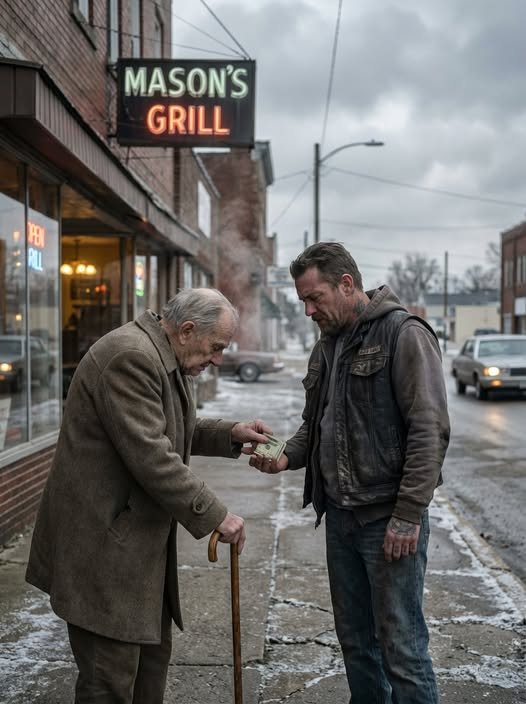
That afternoon in late November, the cold didn’t just sit in the air; it worked its way into everything. Harold had just come out of Mason’s Grill on Willow Street, a place that smelled like burnt coffee and grilled onions, holding onto the last bit of warmth he could get before the weather took it away again. Inside his coat pocket was a single folded twenty-dollar bill. Not spare change, not disposable money—his last twenty until the pension cycle reset in two weeks. Anyone younger might not have understood what that kind of waiting meant, but Harold did. He had lived long enough to know that hunger doesn’t always announce itself immediately. Sometimes it just sits quietly in the background of your decisions, shaping them without permission.
He stood outside the diner for a moment, debating the practical things people like him always debated: whether to buy something now or stretch what little he had left, whether pride had any real place in budgeting survival, whether tomorrow would feel different enough to justify waiting. That’s when he saw him.
A man leaning near the diner window. Not begging, not performing. Just… paused there in a way that suggested exhaustion more than anything else. He was younger than Harold, maybe in his early fifties, broad-shouldered, wearing a worn leather vest over a hoodie, boots that had clearly walked more roads than sidewalks. Tattoos ran along his arms like old stories he no longer bothered explaining to strangers. People like that tend to make others uncomfortable without doing anything at all. The world does that to them first, and only later do people ask why.
But Harold wasn’t most people.
He noticed the way the biker—whose name, though Harold didn’t know it yet, was Jace Rourke—looked at the food through the diner glass. Not greedily. Not desperately. Just long enough to betray something he probably thought no one would catch: hunger managed by pride. That specific tension in the body that says I can handle it even when every signal says otherwise.
Harold recognized it immediately. Not from textbooks or documentaries, but from life. From years when his wife, Eleanor, used to quietly pretend she wasn’t skipping meals so their daughter could eat more. From early mornings when bills sat on the kitchen table like verdicts. From the kind of memory that doesn’t fade, even when everything else does.
He adjusted his coat, stepped off the curb slowly, cane tapping the pavement with a rhythm that didn’t rush for anyone anymore, and approached the man by the window.
Jace noticed him immediately, posture shifting in that reflexive way people learn when they’ve spent enough time being misread. “Can I help you, sir?” he asked, polite but guarded, like someone preparing for either trouble or misunderstanding.
Harold didn’t answer right away. He reached into his pocket, pulled out the folded twenty, and held it out between them.
“Maybe you can,” he said simply. “You look like you could use this more than I can.”
The wind passed between them at that exact moment, carrying the smell of fuel from passing cars and something faintly like wet leaves. Jace didn’t take the bill immediately. People rarely do when kindness doesn’t match their expectations.
“No,” Jace said after a moment, shaking his head. “I can’t take that.”
Harold gave a small, tired smile, the kind that doesn’t ask permission. “Yes, you can.”
There was a pause—not dramatic, not cinematic, just real. The kind of pause where two strangers briefly share the uncomfortable fact that they are both human and both aware of it.
Jace hesitated again, then tried to push the money back. “Sir, you should keep it.”
Harold stepped forward just enough to close the distance, took the biker’s hand—not forcefully, not aggressively, just firmly—and pressed the bill into his palm. Then he closed Jace’s fingers around it himself.
“Go eat,” he said quietly. “That’s what it’s for.”
And just like that, Harold turned away as if the moment had already resolved itself.
But life, as it tends to do, refused to end the story there.
Inside Mason’s Grill, Jace sat at the counter staring at that folded bill like it had changed shape in his hand. His real name wasn’t widely known in Millhaven. Most people called him “Rook” because that’s what his motorcycle club had always used for him. He wasn’t a bad man, despite what assumptions tried to assign to him. He was just a man who had spent too long being treated like he was dangerous even when he wasn’t doing anything except existing.
He ordered the cheapest plate on the menu out of habit, turkey with sides, coffee black. When it arrived, he didn’t eat immediately. Instead, he looked back through the glass window at the bench outside.
Harold was still there.
Still alone.
Still small against the weight of the street.
And something in Jace shifted—not dramatically, not loudly, but enough that appetite suddenly felt inappropriate.
He pushed the plate away, untouched, and instead paid for it, boxed it, and walked out carrying both the meal and the coffee. When he reached the bench, Harold was gone.
That absence changed everything for him.
Because now it wasn’t just about a meal. It was about a person who had given something away without expecting it to return in the same form.
Jace spent the next hours doing something he didn’t fully understand at the time: asking questions. A vendor pointed him toward the older residential block off Willow Street. That eventually became Apartment 4C, a place that looked like it had been surviving longer than it had been maintained.
When Harold opened the door and saw Jace standing there with grocery bags and a boxed meal, his first reaction wasn’t surprise—it was resignation mixed with faint amusement.
“You found me,” he said.
Jace nodded slightly. “You gave a stranger your last twenty dollars. I figured I’d at least owe you dinner that doesn’t come from a bench.”
That was the beginning of something neither of them had names for yet.
Inside the apartment, everything was minimal in the way that only comes from long-term restraint. One chair by a window. A table that had been repaired more than once. A heater that sounded like it had opinions about staying alive. The space wasn’t dirty—it was careful. Like someone had slowly removed everything unnecessary from their life until only survival remained.
Jace started unpacking groceries he hadn’t originally planned to buy: bread, eggs, soup, fruit, a chicken, coffee. Then, almost without thinking, he made a phone call.
“Bring tools,” he said. “And whatever food you can carry. Willow Street, 4C.”
Harold watched him with narrowed eyes. “I’m not running a shelter operation in my living room.”
“Too late,” Jace replied.
And that was when the motorcycles arrived.
Not violently. Not chaotically. Just a steady roll of engines that made people in the building pause mid-task and look out their windows. One by one, members of Jace’s club showed up—people like Marla, sharp-eyed and efficient, Boone, large enough to make furniture seem smaller, and others who didn’t waste time explaining themselves.
What followed wasn’t charity in the way people usually imagine it. No speeches. No emotional performances. Just work. Someone fixed the heater. Someone sealed the windows. Someone stocked the kitchen. Someone checked Harold’s medication cabinet without making it feel like an invasion.
Harold sat through all of it in silence, not because he didn’t want to speak, but because he didn’t yet know what language this situation required.
At some point, he finally asked the question that had been sitting in his chest.
“Why are you doing this?”
Jace didn’t stop what he was doing. “Because you gave me your last twenty dollars.”
“That’s not an answer,” Harold said.
Jace finally looked at him. “It is if you understand what that meant.”
And Harold did. Slowly, reluctantly, he did.
The truth of Harold’s life didn’t arrive all at once. It came in fragments over days—mention of a daughter named Sylvia who had once been kind before life reshaped her priorities; bank statements that didn’t add up; quiet manipulation disguised as “helping manage finances.” The kind of betrayal that doesn’t feel like betrayal until you finally look at it directly.
Jace and his crew didn’t just fix a heater after that. They started asking harder questions. And those questions eventually pulled in people who weren’t part of any biker club—lawyers, advocates, neighbors who had noticed similar patterns but never spoken up.
Millhaven, for the first time in a long time, started paying attention.
When Sylvia arrived weeks later in a polished SUV that felt completely out of place on Willow Street, she came prepared for confrontation. She wasn’t prepared for documentation.
“You’ve filled his head with nonsense,” she snapped at Jace.
Harold, sitting at the table where groceries now actually existed, finally spoke with a clarity that made the room tighten.
“No,” he said. “You did that by forgetting I was a person.”
Silence has weight in moments like that. And hers cracked under it.
The legal unraveling that followed revealed more than financial manipulation. It revealed a pattern of isolation—how easily an elderly person can be slowly removed from their own autonomy when the people closest to them decide convenience matters more than consent.
But something else happened too.
The town woke up.
A diner started a community meal fund. A hardware store donated heaters. Volunteers showed up at Harold’s apartment not because they were asked, but because they finally noticed what had been there all along: people slipping through the cracks while everyone else stepped over them politely.
Jace kept showing up too. Not as a savior, not as a hero, but as someone who had once been given something small enough to ignore—and didn’t.
Months later, Harold sat again on a bench outside Mason’s Grill. Jace joined him with two coffees. Nothing dramatic. No grand resolution. Just two people sitting in a place where everything had once quietly begun.
“You ever think about how small that twenty dollars was?” Jace asked.
Harold smiled faintly. “It was never small.”
And that, really, is where the story settles.
Because most of what changes people’s lives doesn’t look like change at all in the moment it happens. It looks like a decision someone almost didn’t make. A pause someone almost took. A hand someone almost didn’t extend.
And sometimes, that’s all it takes to redirect an entire community’s sense of what it means to see each other.
Final lesson of the story:
Kindness is not measured by the size of what you give, but by the willingness to give it when you have the least to spare. And when someone chooses to see another person clearly—without assumptions, without fear, without distance—they often end up restoring more than just one life. They restore the possibility that people still matter to each other in ways that cannot be quantified.
Website Disclaimer
The information provided on this website is for general informational and educational purposes only. While we strive to ensure that all content is accurate and up to date, we make no guarantees regarding the completeness, reliability, or accuracy of any information published.
The views and opinions expressed in articles belong to their respective authors and do not necessarily reflect the views of this website. Any action you take based on the information found on this website is strictly at your own risk. We will not be liable for any losses, damages, or inconveniences arising from the use of our content.
Some articles may contain opinions, third-party information, or external links. We do not endorse or guarantee the accuracy of content on external websites and are not responsible for their practices or policies.
All content on this website is provided in good faith and is intended for informational purposes only. Readers are encouraged to verify information independently and seek professional advice where appropriate.