“I’ll be right back—don’t go anywhere,” he said, and the six-year-old waited for hours beneath a flickering streetlight, trusting her grandfather—until a police officer arrived, and her answer revealed a heartbreaking truth that changed everything.
There are certain kinds of silence that don’t feel empty—they feel wrong, like something has been misplaced in the world and no one has noticed yet. The kind that presses in on your ears, makes you slow down without knowing why, makes you look twice at something you might otherwise pass by. On that particular night, in a part of the city where the streetlights buzzed faintly and the air held onto the heat long after sunset, that silence wrapped itself around a single, unmoving figure.
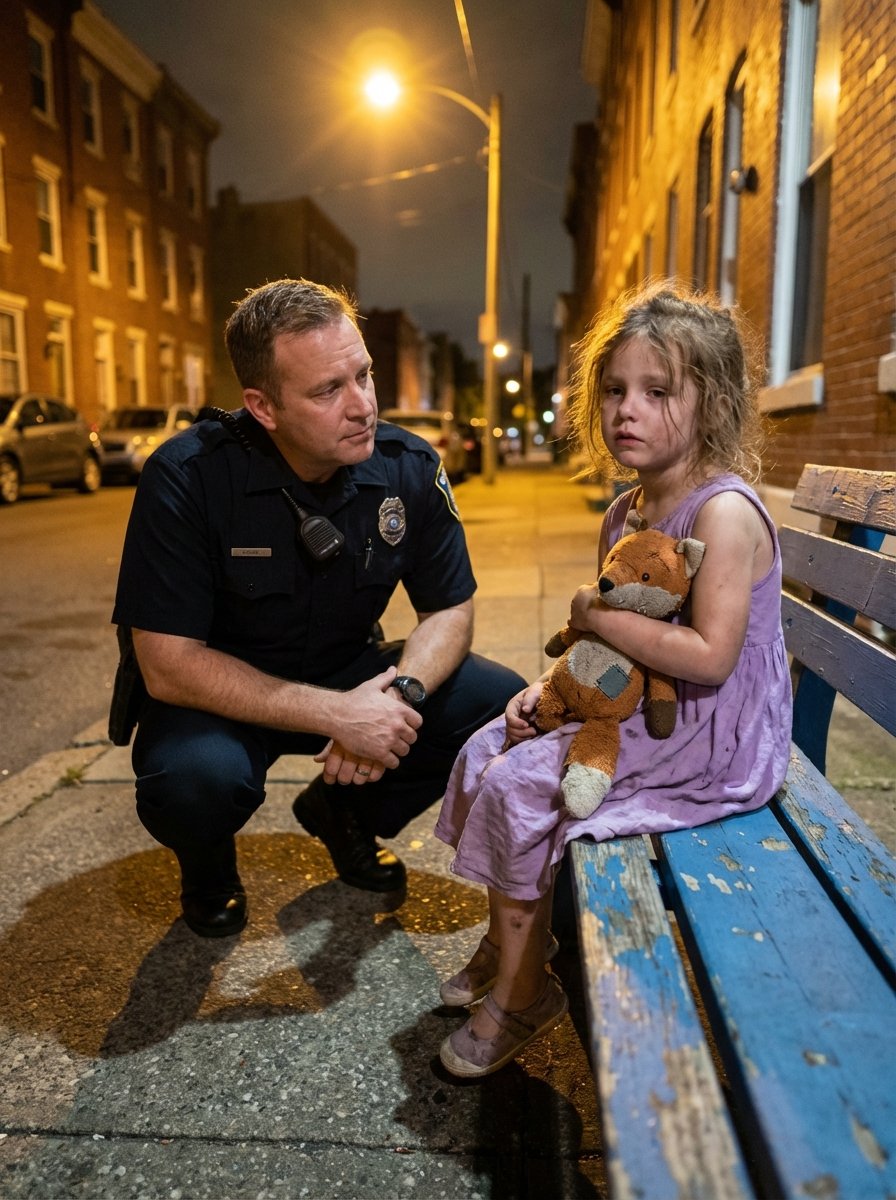
Her name was Lila Bennett, and she had been sitting on the same chipped blue bench for so long that even the stray cats had stopped circling her. At six years old, she didn’t have a proper sense of time—not in the way adults measure it with watches and schedules—but she understood waiting. She understood it in the way children do when they’ve had to learn patience too early, when promises become the only structure holding their small world together.
Her legs swung back and forth, not out of restlessness, but because it gave her something to do, something that made the waiting feel less heavy. The hem of her faded lavender dress was creased and damp from the humidity, clinging slightly to her knees, and her hair—once neatly tied—had loosened into uneven strands that stuck to her cheeks. In her arms, she held a stuffed fox with one ear partially torn and hastily stitched back together with mismatched thread. She called it Maple, though no one remembered exactly when she had started.
At first, she had cried. Quietly, because she had learned that crying too loudly sometimes made adults impatient. That had been earlier, when the sky was still painted in streaks of orange and gold, when the promise still felt fresh and real.
“I’ll be right back,” her grandfather had told her, crouching just enough to meet her eyes, though even then his gaze had seemed to drift somewhere else, somewhere beyond her. “Stay right here. Don’t go wandering off, okay? If you move, I won’t know where to find you.”
Lila had nodded without hesitation. “I won’t move.”
She meant it. Children like Lila didn’t treat promises lightly, because promises weren’t just words—they were instructions for survival, guidelines for how to make sense of a world that didn’t always make sense back.
So she stayed.
Even when the sun slipped away and the colors drained from the sky, replaced by a dull, uneven gray that slowly deepened into night. Even when the traffic thinned out, the steady stream of cars turning into occasional bursts of headlights that cut through the darkness before disappearing again. Each time a car approached, she straightened just a little, her grip on Maple tightening as hope rose instinctively, only to sink again when the car passed without slowing.
“Maybe he’s just picking the best one,” she whispered once, her voice barely audible even to herself. “Maybe the line was long.”
But as the hours stretched on, that explanation began to fray at the edges, like the stitching on Maple’s ear. There’s a moment, subtle and almost imperceptible, when a child begins to understand that something isn’t just delayed—it’s wrong. Lila didn’t have the language for it, not fully, but she felt it in the way her chest tightened, in the way the night seemed to grow larger around her.
By the time the streetlight above her started flickering—buzzing faintly before dimming and then flaring back to life—she had stopped talking altogether. She simply sat, legs still swinging, eyes fixed on the direction her grandfather had walked away, holding onto the one thing she had been told to hold onto: stay.
It was close to ten when Officer Marcus Hale noticed her.
He had been driving the same route he always did on late shifts, the kind of routine patrol that rarely produced anything more than minor disturbances or the occasional noise complaint. His mind had been half on the radio chatter, half on the quiet monotony of the road, when something—something small and out of place—caught his attention.
At first, it was just a shape under the streetlight.
Too still.
Too small.
He slowed the car, his instincts nudging him before his thoughts could catch up. Years on the job had taught him that the things that didn’t make sense at a glance were often the ones worth stopping for.
He pulled over, the engine idling softly, and stepped out into the warm night air.
“Hey there,” he called gently, keeping his voice low, non-threatening. “You alright?”
Lila looked up at him, her eyes reflecting the dim light. They weren’t wide with fear the way he might have expected. They were tired. Steady in a way that didn’t quite belong to someone her age.
“My grandpa said he’d be right back,” she said, as if that explained everything. “He went to get something.”
Marcus felt a quiet unease settle in his chest. He glanced around, taking in the empty stretch of sidewalk, the closed storefronts, the absence of any adult presence nearby.
“How long ago was that?” he asked, crouching down to her level.
Lila frowned slightly, considering the question. She didn’t look at the sky this time. She looked at her hands, at the threads on Maple’s ear.
“When it was still bright,” she said after a moment. “When the sun was big.”
Marcus followed her earlier glance instinctively, though there was nothing to see now but darkness. The sun had set hours ago.
He shifted his weight, choosing his next words carefully. “Has anyone come by to check on you since then? Anyone at all?”
She shook her head, then added quickly, almost defensively, “But I didn’t move. So he can find me.”
There was something about the way she said it—like she was reassuring him, or maybe herself—that made Marcus swallow hard.
“Do you know his phone number?” he asked.
She nodded and recited it without hesitation, the digits flowing out with the practiced ease of repetition.
Marcus stepped aside, pulling out his phone as he dialed. The line rang. And rang. Then clicked over to voicemail.
He tried again.
Same result.
A third time, just to be sure.
Nothing.
The unease in his chest deepened into something colder, heavier. He keyed his radio, his voice steady but edged with urgency.
“Dispatch, I’ve got a possible abandonment. Female, approximately six years old. Says she’s been here several hours. I need a trace on this number.”
There was a brief pause, the faint crackle of static.
“Copy that,” came the response. “Stand by.”
Lila watched him from the bench, her small fingers tightening around Maple.
“Is he coming?” she asked.
Marcus looked at her, really looked this time, and forced a smile that felt thinner than he wanted it to be. “We’re going to figure out where he is,” he said.
He didn’t say yes.
He didn’t say no.
Because something in his gut was already telling him that whatever answer came back, it wasn’t going to be simple.
The information came through faster than he expected.
The number was registered to a man named Harold Bennett—Lila’s grandfather, the same name she had given. The address matched a small house on the edge of town. Nothing unusual at first glance.
But then another detail surfaced.
A recently filed insurance policy.
High value.
Under Lila’s name.
Marcus felt the pieces begin to shift, not yet forming a clear picture, but enough to suggest that this wasn’t just neglect. This was something more deliberate, something calculated.
“Unit 7,” dispatch added, “we’ve got traffic cam footage. Vehicle registered to Bennett left the area about an hour after sunset. Heading north. No stops recorded nearby.”
Marcus exhaled slowly, his eyes drifting back to Lila, who was still sitting exactly where she had been, as if anchored to that spot by nothing more than a promise.
“Alright,” he said into the radio, his voice quieter now, more focused. “Let’s track him.”
They found Harold Bennett just past midnight.
Not fleeing.
Not hiding.
Sitting in his living room, the television casting a soft blue glow across his face, as if the night had unfolded exactly as he expected it to.
When Marcus knocked, Harold answered without hesitation, his expression composed, almost mildly irritated at the interruption.
“Can I help you?” he asked.
“You left your granddaughter alone on the street,” Marcus said plainly.
Harold’s brow furrowed, a performance of confusion that might have been convincing under different circumstances. “She must have wandered off. Kids do that.”
Marcus stepped closer, his tone sharpening. “She’s been sitting in the same spot for hours. Waiting.”
There was a pause, brief but telling.
Then Harold said it.
“She was supposed to stay there.”
The words hung in the air, heavier than anything else he could have said.
Marcus didn’t raise his voice. He didn’t need to.
“Thank you,” he replied quietly, then glanced back at the officers behind him. “That’s all we needed.”
The arrest itself was uneventful, almost anticlimactic compared to the weight of what had led up to it. Harold didn’t resist. He didn’t argue. It was as if, in his mind, the plan had been logical, justified by something only he could see.
The investigation that followed filled in the gaps.
Debt.
Mounting bills.
A belief—twisted, cold—that removing Lila from the equation would solve more problems than it created.
He hadn’t expected her to be found so quickly.
He hadn’t expected anyone to ask the right question.
The trial moved swiftly, the evidence too clear to leave room for doubt. Surveillance footage, phone records, financial documents—all of it painted a picture that was impossible to ignore.
But it wasn’t the evidence that lingered in people’s minds.
It was Lila.
Sitting in a chair too large for her, feet dangling just above the floor, Maple clutched tightly in her lap.
“He told me to stay,” she said softly. “So I did.”
There was no anger in her voice.
No accusation.
Just the simple truth.
It was enough.
Harold Bennett was sentenced to a long term—years measured not just in numbers, but in the weight of what he had tried to do.
Months later, the season shifted.
The heavy air of summer gave way to something lighter, something that carried the faint promise of change. In a small backyard not far from where it had all happened, Lila stood barefoot in the grass, chasing after bubbles that drifted lazily through the air.
Her laughter, when it came, was tentative at first, as if she wasn’t entirely sure it was allowed.
Marcus stood nearby, leaning against the fence, off duty but not entirely detached. Some cases didn’t end when the paperwork was filed. Some stayed with you, settling into the quiet spaces of your thoughts.
Lila paused, watching a bubble rise higher than the others before popping softly in the sunlight.
Then she turned to him.
“Do I still have to stay in one place?” she asked.
The question was small, almost casual, but it carried something deeper—a lingering uncertainty about the rules she had been given, about whether they still applied.
Marcus shook his head, a genuine smile finally breaking through.
“No,” he said gently. “You don’t have to stay anymore.”
She considered that for a moment, then nodded, as if filing it away, making sense of it in her own way.
And then she ran.
Not far, not recklessly—but freely.
As if, for the first time in a long while, she understood that moving forward was allowed.
Life Lesson:
Sometimes the most dangerous instructions are the ones wrapped in trust. Children believe because they have to; they depend on the adults in their lives to mean what they say and to protect what is fragile. But when that trust is broken, it takes more than time to repair—it takes truth, courage, and someone willing to step in and question what doesn’t feel right. Not every promise deserves to be kept, especially when it asks you to stay in a place where you are no longer safe. And sometimes, the most important act of care is not waiting—but walking away when you finally can.
Website Disclaimer
The information provided on this website is for general informational and educational purposes only. While we strive to ensure that all content is accurate and up to date, we make no guarantees regarding the completeness, reliability, or accuracy of any information published.
The views and opinions expressed in articles belong to their respective authors and do not necessarily reflect the views of this website. Any action you take based on the information found on this website is strictly at your own risk. We will not be liable for any losses, damages, or inconveniences arising from the use of our content.
Some articles may contain opinions, third-party information, or external links. We do not endorse or guarantee the accuracy of content on external websites and are not responsible for their practices or policies.
All content on this website is provided in good faith and is intended for informational purposes only. Readers are encouraged to verify information independently and seek professional advice where appropriate.