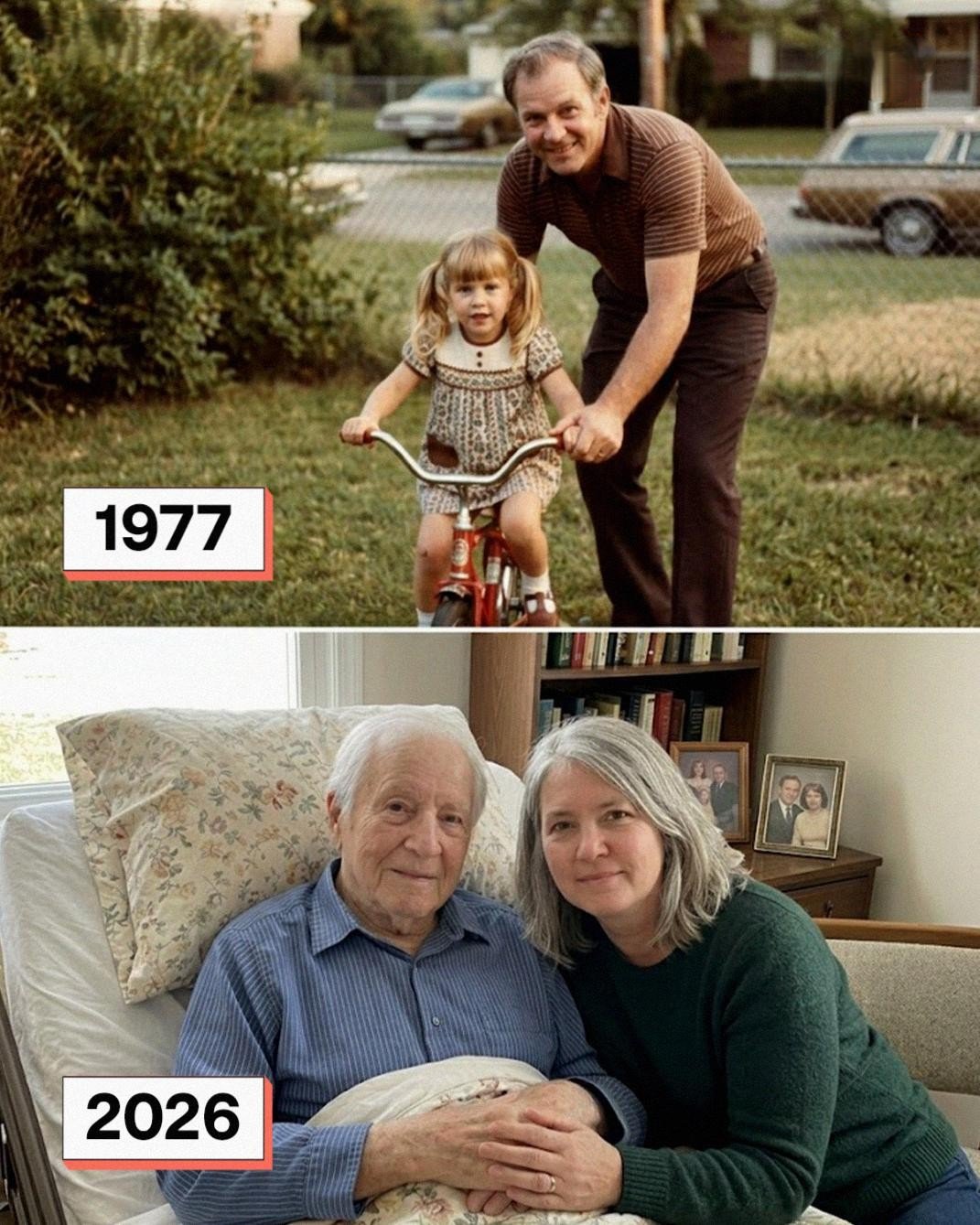
The grief was a heavy, suffocating blanket, but the funeral felt like a performance. As I stood by the urn of the only man I ever called “Dad,” strangers offered hollow platitudes about how much Michael loved me. He was seventy-eight, a man of grease-stained hands and quiet strength who had raised me since I was two. My mother, Carina, had died when I was only four, leaving Michael to navigate the world of pigtails and parent-teacher conferences alone. I never questioned our life together; he was my father in every way that mattered. But at his service, a creased, older man named Frank leaned in and whispered a sentence that turned my history into a lie: “Check the bottom drawer in your stepfather’s garage.”
That night, the house felt haunted by the scent of his aftershave and wood polish. I retreated to the garage, the air thick with the smell of cedar and motor oil. The bottom drawer of Michael’s workbench was deep and stubborn, groaning as I forced it open. Inside sat a manila folder and a sealed envelope with my name, Clover, written in his sturdy, blocky print.
As I tore it open, the truth spilled out like shattered glass. My mother hadn’t just died in a car accident while running errands. She had been driving in a blind panic to meet Michael to sign final guardianship papers. Why the rush? Because my Aunt Sammie—the woman currently dabbing her dry eyes in my living room—had threatened to take me away. Sammie believed that “blood mattered more than love” and had hired lawyers to argue that Michael, a man with no biological relation to me, was unfit to raise a child.
My mother’s last written words were a desperate plea scrawled on a torn journal page: “If anything happens, don’t let them take her.”
Michael had spent the next fifteen years fighting a silent war. He kept the letters of threat and the legal notices hidden so I would never feel like “contested property.” He protected my peace by carrying the weight of my aunt’s cruelty alone. He chose me every single day, even when the law told him he didn’t have to.
The climax came at the reading of the will. Aunt Sammie arrived draped in pearls and calculated sorrow, suggesting we “sit together as family.” I waited until the lawyer finished before I stood up, the garage documents clutched in my hand like a weapon. “You didn’t lose a sister when my mother died,” I told her, my voice echoing in the silent room. “You lost control. I know about the letters. I know you tried to orphan me just to prove a point about bloodlines.”
The room went cold as the lawyer confirmed the existence of Michael’s “correspondence file.” Sammie’s mask of grief finally slipped, revealing the sharp, bitter woman beneath. She had come expecting a payday or a reconciliation; instead, she found a legacy of truth that she couldn’t manipulate.
That night, I sat on the porch wearing Michael’s old flannel shirt, a macaroni bracelet from second grade dug out of a storage box and tucked onto my wrist. I realized that my father hadn’t just raised me; he had rescued me from a family that valued possession over personhood.
Tomorrow, I’m heading to the clerk’s office to officially restore his name to my birth certificate. It isn’t about a legal title—it’s about honoring the man who stayed when everyone told him he should walk away. Michael taught me that family isn’t something you’re born into; it’s something you earn through every tire changed, every scraped knee kissed, and every secret kept to protect a child’s heart. He didn’t just leave me a house; he left me the strength to finally tell the world exactly who I am: Michael’s daughter.
Website Disclaimer
The information provided on this website is for general informational and educational purposes only. While we strive to ensure that all content is accurate and up to date, we make no guarantees regarding the completeness, reliability, or accuracy of any information published.
The views and opinions expressed in articles belong to their respective authors and do not necessarily reflect the views of this website. Any action you take based on the information found on this website is strictly at your own risk. We will not be liable for any losses, damages, or inconveniences arising from the use of our content.
Some articles may contain opinions, third-party information, or external links. We do not endorse or guarantee the accuracy of content on external websites and are not responsible for their practices or policies.
All content on this website is provided in good faith and is intended for informational purposes only. Readers are encouraged to verify information independently and seek professional advice where appropriate.