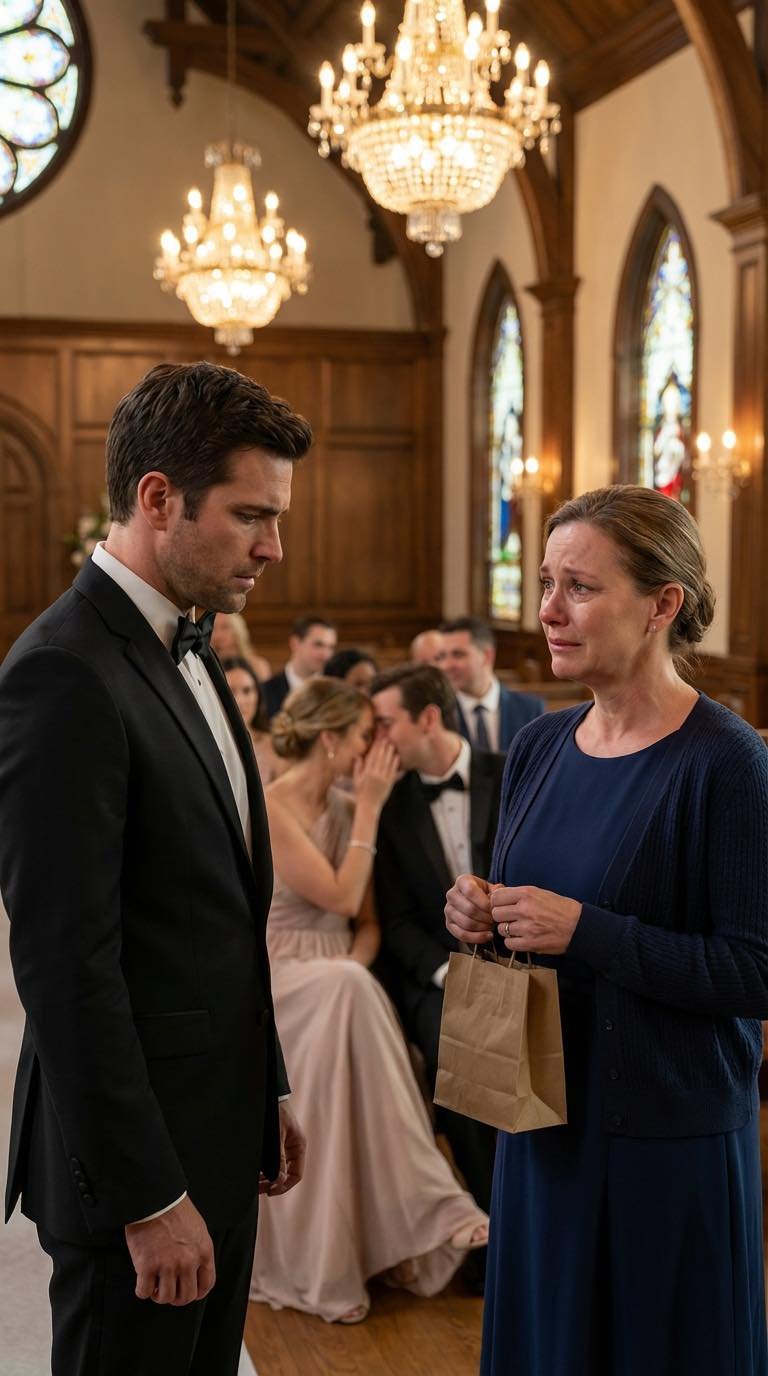
The truth is, if you had walked into that chapel that afternoon without knowing anything about me, you would have thought you were stepping into a carefully staged version of perfection—the kind that only exists when money has been given enough time to refine every rough edge out of reality. The chandeliers weren’t just decorative, they were deliberate; the light they cast softened everything in the room, making every guest look a little more elegant, every smile a little more sincere. A string quartet played something classical and unobtrusive near the altar, and the air carried that faint mix of polished wood, expensive perfume, and anticipation that only shows up at events where people are more invested in appearances than truth. I stood at the front, thirty-two years old, dressed in a tailored tuxedo that fit me better than any suit I had ever owned, about to marry into a family whose last name opened doors I had spent a decade trying to unlock on my own, and if I’m being honest now—far more honest than I was willing to be then—I wasn’t just marrying Elara Vance. I was marrying the life that came with her.
My name is Julian Mercer, and up until that moment, I had built my entire adult identity around the idea that I had earned everything myself. It’s a convenient belief, especially in the kind of circles I had recently entered, where success is treated like a personal virtue and not, as I would later learn, something often stitched together quietly by other people’s sacrifices. I ran a fast-growing cloud infrastructure company that investors liked to describe as “inevitably scalable,” which was their way of saying they saw profit without having to understand the work behind it, and over the last two years I had become just visible enough to be invited into rooms where conversations happened behind closed doors and handshakes meant more than contracts. Elara belonged to that world effortlessly. Her father owned half the real estate along the harbor. Her mother chaired three nonprofit boards and treated philanthropy like a performance art. Their home hosted people whose names showed up in financial headlines. Standing beside her felt like confirmation that I had made it—that the years of pushing, climbing, proving had finally paid off.
And yet, for all the careful planning, all the curated details, there was one variable I had convinced myself I could control simply by ignoring it.
My mother.
Her name is Marisol Vega, though most people who met her once would remember her as the quiet woman who didn’t take up more space than necessary. She had spent most of her life doing exactly that—making herself smaller so I could grow. When she arrived at the rehearsal the afternoon before the wedding, she didn’t make a scene. She didn’t interrupt anything. She simply stood near the entrance, as if unsure whether she had the right to step any further inside. She wore a simple navy dress, carefully pressed, and a light cardigan that had clearly seen better years, and she held that same small leather handbag she had carried for as long as I could remember, the one with the worn edges and the stubborn zipper that never quite closed properly. If you didn’t know her, you might have overlooked her entirely. But I saw her immediately.
And so did everyone else.
There’s a particular kind of silence that only happens in rooms full of socially aware people when something doesn’t fit the script. It’s subtle, almost polite, but it spreads quickly, like a ripple moving through water. Conversations paused mid-sentence. Eyes shifted—not obviously, not rudely, but just enough to acknowledge that something unexpected had entered the space. Elara, standing beside me, felt it too. I could tell by the way her posture stiffened, the way her smile tightened at the edges without disappearing completely. Her mother, Diane Vance, leaned in slightly and whispered something that I didn’t catch, but I didn’t need to. I knew that tone. I had heard it before in different forms—measured, controlled, quietly disapproving.
Across the room, my mother saw me and lifted her hand in a small wave, her smile hesitant but full of warmth, the kind of smile that belonged to a different life entirely, one that didn’t include marble floors or curated guest lists.
“Julian,” she called softly.
Hearing my name in her voice, in that room, did something strange to me. It pulled me backward and forward at the same time—back to the cramped apartment where she used to sew late into the night, the rhythmic hum of the machine filling the silence while I studied at the kitchen table, and forward into the present, where that version of my life suddenly felt out of place in ways I hadn’t wanted to admit. It shouldn’t have made me uncomfortable. It should have grounded me. But standing there, surrounded by people who measured worth in ways I had spent years learning to navigate, it felt like exposure.
Elara leaned closer, her voice low but sharp. “You said she wasn’t coming.”
“I didn’t think she would,” I replied, keeping my tone neutral, though I could already feel the tension building in my chest.
Diane’s lips pressed into a thin line. “This is… unfortunate timing,” she said, in a way that suggested timing wasn’t the real issue.
A few of my groomsmen shifted awkwardly. Someone near the back let out a quiet, poorly concealed laugh. I felt the weight of it all pressing down on me—the expectations, the unspoken judgments, the fear of being seen as less than what I had worked so hard to become.
“Julian,” Elara whispered, her fingers tightening around my arm, “please handle this.”
And so I did.
I walked toward my mother, each step feeling heavier than it should have, like I was moving through something thicker than air. When I reached her, I caught that familiar scent of detergent and fabric softener, something simple and clean that instantly reminded me of home in a way that didn’t belong here.
She held out a small gift bag, both hands wrapped around it carefully. “Mijo,” she said, her voice soft but bright with pride, “you look so handsome. I just wanted to see you before everything started.”
There was nothing inappropriate about her being there. Nothing wrong. And yet, instead of embracing her, instead of introducing her proudly as the woman who had raised me, I glanced back over my shoulder. Elara stood near the altar, her expression composed but tense, her family watching closely. The pressure in the room wasn’t loud, but it was constant, like a hum I couldn’t shut off.
“Mom,” I said, lowering my voice, “you shouldn’t be here.”
Her smile faltered, just slightly. “I know it’s a big wedding,” she replied quickly, as if trying to adjust to the tone she heard in my voice. “I won’t stay long. I only wanted to give you this.”
She lifted the bag a little higher, hopeful.
I didn’t take it.
Instead, I said the words that would later replay in my mind more times than I can count. “You don’t belong here. Please go.”
There are moments in life when time doesn’t slow down—it sharpens. Everything becomes clearer, more defined, and the impact of what you’ve done lands all at once. I saw it happen in her eyes. The warmth didn’t disappear entirely, but it dimmed, like a light turned down too far. Her shoulders sank just a little, not dramatically, not in a way that would draw attention, but enough for me to notice.
“I stitched through nights so you could stand tall,” she said quietly, almost to herself. “I thought… maybe today I could see what that looked like.”
Then she turned.
And that should have been the end of it. The ceremony would have continued. The music would have resumed. People would have forgotten the moment as quickly as they had noticed it.
But life doesn’t always allow you to move on so easily from your worst decisions.
“Stop.”
The voice cut through the room with a clarity that made everyone turn.
I recognized him a second later. Marcus Hale. We had been close once, back in college, before ambition and distance had pulled us in different directions. He stood near the second row now, his expression not angry, not loud—just deeply, unmistakably disappointed.
“A man who’s ashamed of his own mother,” he said, his voice carrying effortlessly through the chapel, “has no business promising loyalty to anyone else.”
A ripple of murmurs spread through the guests. Elara’s composure cracked for the first time. “Julian,” she hissed, “tell him to leave.”
But Marcus didn’t look at her. He looked at me. “Do you even know what she’s done for you?” he asked.
Something in my chest tightened. “What are you talking about?”
He shook his head slowly. “You really don’t know.”
I didn’t wait for him to explain. I turned and ran.
Outside, the air felt colder, sharper, like stepping into reality after being inside something artificial for too long. I spotted my mother halfway down the path leading toward the parking lot, walking steadily, her posture composed in that quiet way she always carried herself when she didn’t want anyone to worry.
“Mom!” I called.
She didn’t stop immediately, but she slowed. When I caught up to her, she turned, her eyes slightly red but still gentle.
“You should go back,” she said softly. “Your wedding is about to start.”
“What did he mean?” I asked, my breath uneven. “What have you been hiding?”
She hesitated, glancing down at the gift bag still in her hands. “It’s nothing important.”
I took it gently from her.
Inside was a worn leather notebook and a small, simple key.
When I opened the notebook, the world shifted again—but this time, not with confusion. With clarity so sharp it almost hurt.
Every page was filled with careful handwriting. Dates. Numbers. Transfers. Investments. Tuition payments. Seed funding rounds. Early-stage buy-ins I had always believed came from anonymous investors who had “seen potential” in me.
They hadn’t been anonymous.
They had been her.
My throat tightened. “The scholarships… the early funding… the office lease…”
She nodded slowly. “I didn’t want you to feel like you hadn’t earned it,” she said. “I wanted you to walk into every room believing you belonged there.”
Behind us, Marcus stepped closer. “She didn’t just help,” he added quietly. “She built the foundation. Half the equity structure in your company traces back to accounts she controlled.”
I looked at the key in my hand.
“A house,” she said, almost shyly. “Near the coast in Spain. I thought maybe you and your wife could start your life there.”
At that moment, the chapel doors opened behind us.
Elara and her parents stepped out, their expressions tight with impatience and something else—something colder.
“Well?” Elara demanded. “Are you coming back or not?”
I looked at my mother’s hands, at the lines and calluses that told a story I had chosen to ignore. Then I looked at Elara, at the life waiting for me inside that chapel.
“The wedding is over,” I said.
Silence followed.
“You’re being ridiculous,” Diane snapped. “You’re throwing everything away for—”
“For the person who made everything possible,” I interrupted.
And for the first time that day, I felt something shift inside me—not pressure, not expectation, but clarity.
“I’m done pretending that success means forgetting where you came from,” I said.
I took off my jacket and placed it gently over my mother’s shoulders.
“Let’s go home,” I told her.
She hesitated. “Are you sure?”
I smiled, genuinely this time. “Yeah. I am.”
As we walked away, the sound of the string quartet starting again behind us felt distant, almost irrelevant. The sunlight outside was warmer than anything inside that chapel, and for the first time in years, I felt like I was standing in something real.
Lesson of the story:
Success that requires you to erase your past is not success—it’s performance. The people who stand beside you at your lowest, who sacrifice quietly without asking for recognition, are the foundation of everything you become. If you forget them in the pursuit of status, you don’t rise—you lose yourself.
Website Disclaimer
The information provided on this website is for general informational and educational purposes only. While we strive to ensure that all content is accurate and up to date, we make no guarantees regarding the completeness, reliability, or accuracy of any information published.
The views and opinions expressed in articles belong to their respective authors and do not necessarily reflect the views of this website. Any action you take based on the information found on this website is strictly at your own risk. We will not be liable for any losses, damages, or inconveniences arising from the use of our content.
Some articles may contain opinions, third-party information, or external links. We do not endorse or guarantee the accuracy of content on external websites and are not responsible for their practices or policies.
All content on this website is provided in good faith and is intended for informational purposes only. Readers are encouraged to verify information independently and seek professional advice where appropriate.