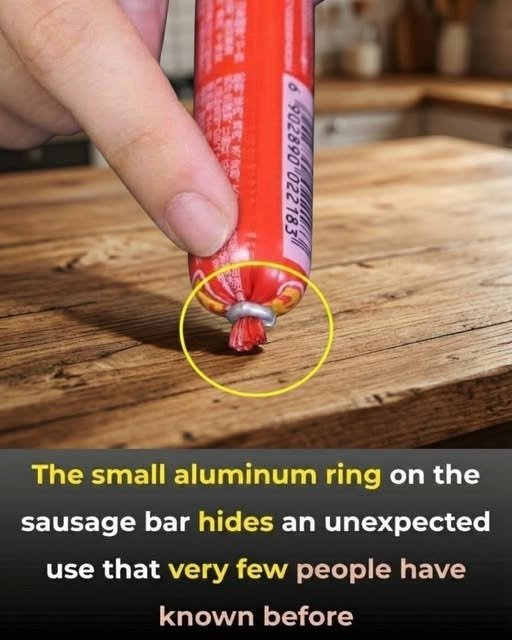
If you have ever looked closely at a sausage stick, you may have noticed a tiny aluminum ring attached to one end. Most people assume it is just a leftover piece of packaging or a decorative detail added during production. Because it is small and easy to overlook, it rarely attracts attention. Yet this modest ring plays an important role in how sausages are made, stored, and delivered. Behind its simple appearance lies a practical design that helps ensure quality, safety, and convenience long before the product reaches your kitchen.
The primary function of the aluminum ring is to securely close the sausage casing. Sausages are wrapped in natural or synthetic casings that must be tightly sealed to protect the contents from air and external contaminants. By crimping the end of the casing, the ring creates a firm closure that helps preserve freshness and prevents the sausage from losing moisture or flavor. It also supports the structure of the sausage during handling and transport, helping it maintain its shape so it arrives intact and ready for use. Without this small component, sausages would be far more vulnerable to damage or spoilage.
Beyond its technical purpose, the ring can offer subtle practical benefits that many people never consider. Some producers use it as a convenient point for hanging sausages during curing or storage, allowing better air circulation. In home kitchens, the ring can sometimes make it easier to grip or separate sausages without tearing the casing. While most consumers simply discard it, creative individuals have even found small reuse ideas, such as organizing lightweight items or crafting simple household tools. These uses are secondary, but they highlight how thoughtful design can serve multiple functions beyond its original intent.
The reason this detail often goes unnoticed is precisely because it is designed to be unobtrusive. It quietly does its job without demanding attention, which is why few people stop to wonder about its purpose. In fact, aluminum rings have been used in sausage production for decades, especially in European and North American food industries, because they are reliable, hygienic, and efficient. The next time you pick up a sausage, that tiny ring may look insignificant, but it represents a clever solution developed through years of food manufacturing experience. Sometimes, the most ordinary objects around us carry the most interesting stories—reminding us that even the smallest design choices can make a meaningful difference in everyday life.
Website Disclaimer
The information provided on this website is for general informational and educational purposes only. While we strive to ensure that all content is accurate and up to date, we make no guarantees regarding the completeness, reliability, or accuracy of any information published.
The views and opinions expressed in articles belong to their respective authors and do not necessarily reflect the views of this website. Any action you take based on the information found on this website is strictly at your own risk. We will not be liable for any losses, damages, or inconveniences arising from the use of our content.
Some articles may contain opinions, third-party information, or external links. We do not endorse or guarantee the accuracy of content on external websites and are not responsible for their practices or policies.
All content on this website is provided in good faith and is intended for informational purposes only. Readers are encouraged to verify information independently and seek professional advice where appropriate.