He Found an Injured Woman and 7 Kids Sleeping in His Barn, What He Did Next, Shocked the Whole Town
The lantern’s flame danced low against the frost-laced windowpane, its golden light barely warming the edges of Samuel Boon’s quiet world. Outside, snow fell in solemn sheets, each flake drifting down like a whisper from heaven, piling softly atop the slanted barn roof. Inside the house, the fire burned low, his supper untouched, and the old rocking chair creaked under his stillness.
He was not waiting for anything.
Just listening.
Samuel had stopped expecting change two winters earlier, the day they buried his wife beneath a cottonwood tree that refused to bloom the following spring. Since then the ranch had run on quiet routine: feed the horse, split the wood, drink his coffee black from a chipped enamel mug.
There were no chickens anymore. No eggs to gather. No one to fuss about flour or speak of town sermons.
Only the barn remained stubborn with purpose.
That night it was a sound that shifted him. A dull thud that did not belong to wind or wood or snow. A low groan, as if the earth itself had stirred.
He took the lantern and his rifle and stepped into the blue-black cold where breath turned to fog and the sky pressed down like a wool blanket soaked in sorrow.
Snow crunched beneath his boots. Each step careful.
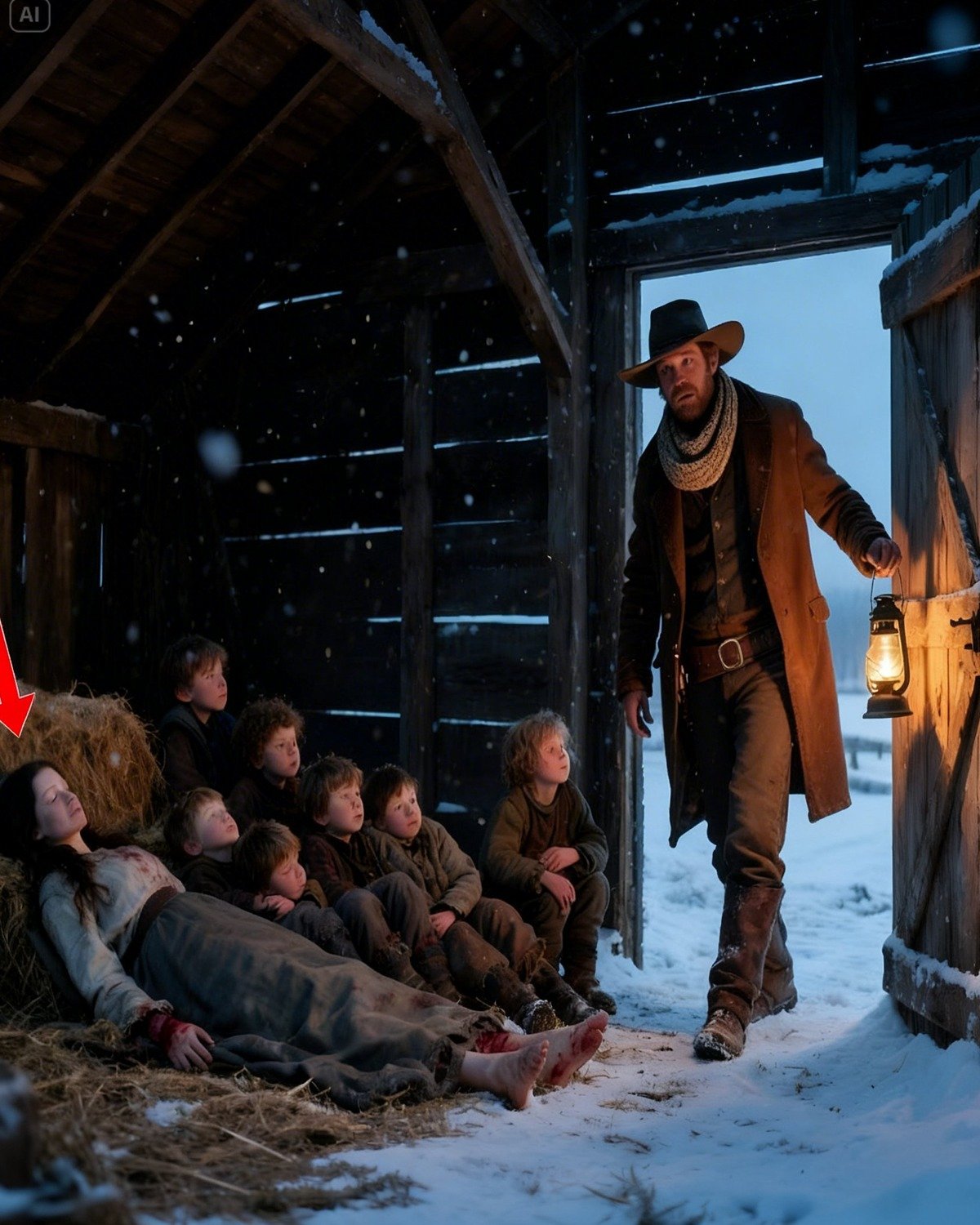
When he slid the barn door aside, the hinges sang with rust and the lantern caught shapes that did not belong.
They were huddled in the shadows near the hayloft ladder.
Small children.
Seven of them.
They pressed together like pups against the side of a woman slumped against a post. She did not move except for the faint flutter of breath on cracked lips.
Blood stained her sleeve.
One child—a girl with dark braids and eyes far too old for her face—met Samuel’s gaze without flinching.
“Please don’t.”
Just that.
No begging. No explanation.
Samuel stood there with the lantern trembling in his hand, the rifle forgotten.
The woman looked like something out of a parable. Her dress torn and gray with dirt. Snow slipped through a gap in the roof and dusted her shoulders like ashes on a mourner.
Her feet were bare.
Samuel took off his coat and stepped forward quietly. Without a word he laid it over the woman’s body.
The youngest boy began to cry then, a soft hiccuping whimper, as if he had tried so long to stay silent that his strength had finally given out.
“Shh,” the braided girl whispered, stroking the boy’s hair.
Samuel knelt beside the woman and touched her forehead.
“Fever,” he murmured. “But alive.”
He stood slowly.
“There’s a fire in the house,” he said, his voice unused to company. “It’s warmer there.”
No one moved.
He left the lantern behind, walked back through the snow, entered the house, and stoked the hearth high. He boiled water, cut thick bread, and spread it with the last of the apple preserve his wife had made their final autumn together.
Then he waited.
They came slowly.
Not all at once.
The girl with the braids led them like a cautious captain guiding a fragile ship into harbor. She dragged the wounded woman gently across the floor.
Samuel did not help.
Not because he would not, but because he understood the sacredness of dignity and how easily it broke beneath offered pity.
One by one the children curled near the fire. The smallest boy fell asleep before the warmth reached his skin.
The woman—mother or not—was laid on Samuel’s cot.
He stood by the door with his hat in hand.
“Who are you?” he asked.
The girl shrugged.
“Hungry?”
Samuel nodded.
“I’ve got stew. Not much. But hot.”
A freckled boy across the room eyed him like a wary coyote.
“You gonna make us work for it?”
“No.”
“You gonna call the sheriff?”
“No.”
The braided girl studied him carefully, weighing him against her exhaustion.
“Then we’ll eat.”
They did.
In silence.
Near midnight the woman stirred. Her eyes opened suddenly, flashing fear and shame. She sat up too quickly, clutching the blanket.
“It’s all right,” Samuel said gently. “You’re safe here.”
Her lip trembled.
“The barn…”
“You were freezing.”
“I didn’t know it was your land.”
“Still is,” he said quietly. “Doesn’t matter.”
She looked around frantically, counting the children with trembling hands.
“They followed me.”
“You were leading.”
She blinked, uncertain.
“We won’t stay long.”
“You will tonight.”
She nodded.
Later, after the children slept on the rug in tangled piles, Samuel moved quietly through the room. He covered thin shoulders with a quilt his wife had sewn and slipped wool socks onto the smallest boy’s feet.
His rifle remained above the mantel untouched.
Outside the snow deepened. Coyotes howled in distant hills.
Inside the house, warmth settled.
Samuel did not sleep that night.
By morning the ranch had a rhythm again.
It was slow, like a hymn hummed beneath breath.
Tin cups clinked softly. Children’s feet padded across cold floorboards. Norah—she had given him her name—moved carefully around the room, favoring one leg as she worked.
Samuel did not ask questions.
He measured his days in small offerings. More wood split than necessary. Coffee left fuller than needed. The broom placed by the door where she could reach it easily.
She never asked for help.
He never insisted.
But they watched each other.
Norah stirred soup without tasting it. Samuel turned his wedding band slowly on his finger whenever his thoughts wandered.
The second night the soup was thin.
Boiled potatoes and onions.
No salt.
Norah served it without apology. Her lips pressed tight.
Jed—the freckled boy—took a cautious spoonful.
“Ain’t there no salt here?”
“Don’t complain,” Norah said sharply.
Samuel leaned back.
“There’s salt,” he said calmly. “I just forgot.”
The boy looked at him skeptically.
“You forget a lot.”
“I remember what matters.”
The table fell quiet.
Norah’s eyes lingered on the pot before she stood and carried it away.
She did not cry.
But her hands shook.
By midweek the town had noticed.
It began with Miss Agatha Winslow, who saw children’s socks hanging from Samuel’s fence like mismatched flags.
By evening whispers filled the feed store.
“He’s housing a woman and seven children.”
The banker’s wife added details. Said the woman wore no shoes. Said she saw children hauling wood.
The town had not cared about Samuel in two years.
Now they remembered him.
Pastor Silas Harper received three letters that week concerning the moral condition of the Boon household.
He read them quietly by lamplight.
And said nothing.
Samuel noticed the looks in town.
But he returned home to find Norah sitting on the porch, repairing a boot with thread pulled through a rusted needle.
“There was a woman in town,” she said without looking up. “She turned her face when I passed.”
“Miss Winslow thinks God watches through curtains,” Samuel said.
Norah gave a tired laugh.
“She’s wrong.”
“God watches through quiet men like you.”
Samuel said nothing.
A long silence passed.
“I’ll leave when the snow melts,” Norah said softly.
Samuel nodded though something inside him resisted.
“You don’t have to go.”
“You’ll want to marry again.”
“I already did,” he replied. “She’s in the ground.”
That ended the conversation.
The thread snapped in Norah’s hands.
Inside the house a child hummed softly.
That night the soup was thicker.
Samuel had added flour and salt.
The children noticed.
They licked their bowls clean.
One boy muttered awkwardly, “Thanks, mister.”
Norah corrected him gently.
“His name is Samuel.”
It was the first time she had spoken it.
Later Samuel stood outside watching stars bloom above the hills.
Norah joined him wrapped in a blanket.
“You’ve been kind,” she said.
“You’ve been strong.”
She stared at the brittle trees beyond the fence.
“My family said I was bad luck,” she whispered. “Said anyone who gathered strays deserved what they got.”
“Then I suppose we deserve each other.”
She laughed suddenly, surprised by the sound of it.
When she turned to go inside she paused.
“Do you miss her?”
“Yes,” Samuel said.
“But missing doesn’t mean there’s nothing left.”
She nodded once and closed the door softly.
That night Samuel realized the house was no longer empty.
It felt like a story beginning.
The wind shifted days later.
Samuel sensed it before he saw anything.
The dog growled low near the porch.
Norah stepped from the barn doorway with flour on her hands.
Three riders appeared over the ridge.
Norah’s face drained of color.
The lead rider dismounted with swagger and a crooked grin.
“Thought I’d find you here, Norah.”
Samuel stepped forward.
The children gathered behind Norah.
“You the man feeding my brother’s property?” the rider asked.
“I don’t feed property,” Samuel replied quietly. “Just people.”
The man laughed harshly.
“She ain’t people. She’s a curse dressed in grace.”
Samuel stepped closer.
“She walked away.”
“Did she?”
The rider’s smile twisted.
“Funny how every place she lands ends up missing something.”
“She brought life,” Samuel said.
“She brought filth.”
That word broke the silence.
Samuel’s stance changed.
The rider’s hand hovered near his pistol.
“Touch that gun,” Samuel said quietly, “and I’ll bury you with it.”
Norah stepped forward.
“Isaac. Go home.”
Isaac sneered.
“You still think you got a voice?”
“They followed me because I fed them,” she said calmly.
“Charity ain’t worth much.”
“They’re children,” Samuel said.
Isaac’s hand tightened near his pistol.
Then another voice spoke.
“Gentlemen.”
Pastor Silas Harper approached slowly.
Isaac scoffed.
“Didn’t come for a sermon.”
“Then you came to the wrong house.”
Silence stretched.
“You want to make orphans out of them?” Harper asked quietly.
Samuel spoke.
“I want to make them a home.”
The children stepped forward beside Norah.
Isaac stared at them, calculating.
“You’ll regret this,” he said finally.
Samuel shrugged.
“I’ve lived with worse regrets.”
Isaac spat in the dirt and mounted his horse.
“You’re soft.”
“No,” Norah said quietly.
“He’s kind.”
Isaac rode away.
When the riders disappeared over the ridge, Norah’s shoulders finally trembled.
Samuel placed a hand gently on her shoulder and waited until her breathing steadied.
“I’m free now,” she said softly.
“Yes,” he replied.
Weeks passed.
The ranch filled with small joys.
Tin lanterns hung from barn rafters. Children’s laughter returned to the yard.
And one morning Norah stood by the well watching the sunrise.
Samuel brought her boots.
“You’ll catch a cough.”
“I wanted to see the day start,” she said.
“I’ve never done that without dread.”
She looked up at him.
“Do you believe in second names?”
“What do you mean?”
“A name you earn, not the one you’re given.”
“You already have one,” he said gently.
She stepped closer.
“I’d marry you if you asked.”
He kissed her hair.
By noon the town had gathered quietly at the ranch.
No invitations had been sent.
But word traveled.
Pastor Harper stood in the barn between rows of candles and hay bales.
Norah wore Eliza’s blue dress.
The children stood in a half circle holding wildflowers.
Samuel wore his old wedding coat.
They clasped hands.
Pastor Harper spoke softly.
“Some vows come dressed in lace. Others come in silence when one soul recognizes another as shelter.”
Samuel pressed his forehead to Norah’s.
“You’re home.”
No one applauded.
They simply stayed.
That night Samuel and Norah buried a scrap of Norah’s old torn dress beneath the cottonwood tree where Eliza rested.
Not to forget.
But to begin again.
Later, lying beneath a single quilt, Norah whispered into the dark.
“Do you think the world will remember us?”
Samuel kissed her wrist.
“No,” he said softly.
“But the children will.”
Norah smiled.
“That’s enough.”
Website Disclaimer
The information provided on this website is for general informational and educational purposes only. While we strive to ensure that all content is accurate and up to date, we make no guarantees regarding the completeness, reliability, or accuracy of any information published.
The views and opinions expressed in articles belong to their respective authors and do not necessarily reflect the views of this website. Any action you take based on the information found on this website is strictly at your own risk. We will not be liable for any losses, damages, or inconveniences arising from the use of our content.
Some articles may contain opinions, third-party information, or external links. We do not endorse or guarantee the accuracy of content on external websites and are not responsible for their practices or policies.
All content on this website is provided in good faith and is intended for informational purposes only. Readers are encouraged to verify information independently and seek professional advice where appropriate.