My name is Nathan Cole, and until last October I would have told you, without bitterness but with a kind of resigned certainty, that my life had settled into its final shape sometime around my second divorce, the way wet concrete hardens into whatever form it has been poured into whether you like the edges or not, and that nothing short of catastrophe would disturb the symmetry of my evenings in the tidy cul-de-sac outside Cedar Rapids where every lawn is trimmed within half an inch of its neighbor’s and the mailboxes lean at identical, HOA-approved angles as if saluting a flag that no one remembers raising.
I am forty-one now, though I still instinctively say thirty-nine when strangers ask, as if shaving off two years might rewind a few miscalculations, and I work as a financial compliance analyst for a regional insurance firm where my days are spent scrutinizing other people’s risk tolerance while privately cultivating a near-phobic avoidance of my own. I drive home at five-thirty, loosen the knot of my tie before I even shut off the engine, and heat whatever single-serving meal has been thawed long enough to pretend it was chosen rather than defaulted to. Sometimes I vacuum even when the carpet is visibly clean, pushing the machine back and forth with unnecessary diligence because the hum fills the house with something that approximates companionship. I named the vacuum “Bernard” after a joke that never quite landed at the office holiday party, and the name stuck in my head because it was easier to laugh at my own habits than to interrogate them.
Across the narrow stretch of grass to my left stands a pale blue bungalow with chipped white trim and a porch swing that creaks in a steady rhythm on warm evenings, and that house belongs to Evelyn Grant, who turned fifty-nine in July and who has lived there since long before I signed my first mortgage papers. She was widowed at thirty-seven when her husband, Thomas, died of a sudden aneurysm in their driveway while shoveling snow, an event that the neighbors still reference in hushed tones as if grief were contagious and proximity required discretion. She never remarried, never publicly dated, and never appeared to be waiting for anything in particular. She mowed her own lawn, changed her own furnace filters, and hosted exactly one garage sale in the nine years I have lived beside her, selling old books and hand-embroidered linens with the efficient detachment of someone decluttering memory without ceremony.
We exchanged the usual pleasantries over the fence—remarks about humidity, about the early frost that threatened her tomato plants, about the way the city never quite managed to fill potholes before winter—but we did not cross into each other’s kitchens or histories. I assumed she preferred it that way because I certainly did, and in our mutual avoidance of unnecessary intimacy we forged what I believed was an unspoken agreement: you keep your grief on your side of the hedges, and I will keep my disappointments on mine.
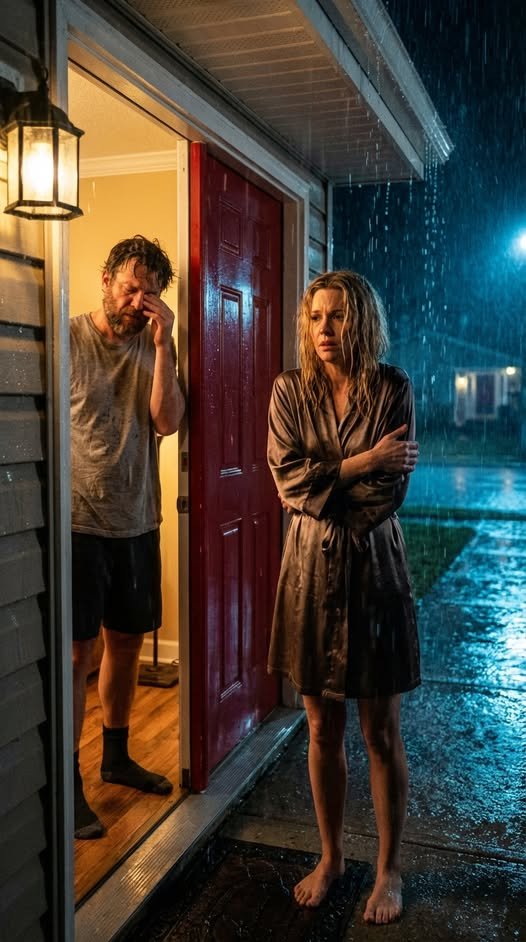
Then, on a Wednesday night at precisely 12:03 a.m., someone knocked on my front door with a force that did not suggest casual neighborliness or a misdelivered package, but rather the kind of urgency that cracks open whatever illusions you have about control.
I had fallen asleep on the couch with the television still flickering silent infomercials across the walls, the remote balanced on my chest like a paperweight. The knock was uneven, not frantic but insistent, and it echoed through the hallway in a way that made the house feel briefly foreign to me. For a disoriented second I wondered whether I had imagined it, but then it came again, three quick raps followed by a pause, as if the person on the other side were negotiating between pride and necessity.
When I pulled back the curtain beside the door, the porch light illuminated Evelyn in a navy cardigan thrown hastily over a nightgown, her gray-streaked hair loose around her shoulders, her face pale in a way that had nothing to do with makeup or lighting. She was barefoot, I realized, her slippers abandoned somewhere between her house and mine, and the sight of her standing there without the composed posture she usually wore like armor unsettled me more than the knock itself.
I opened the door immediately, and she stepped closer, lowering her voice though there was no one else awake to overhear.
“Nathan, I’m sorry,” she began, and the apology felt misplaced before she even explained, “but I think someone was in my backyard. I heard the gate slam, and when I looked out the kitchen window I saw a shadow moving near the shed. I didn’t know who else to call.”
There are moments when the world rearranges itself in subtle increments, when the narrative you have told about yourself—self-sufficient, detached, immune to drama—collides with a more immediate reality. Standing there in my wrinkled T-shirt and socks, I realized I had not considered what I would do if someone ever needed me for something larger than borrowing a ladder.
“Did you call the police?” I asked, already reaching for the flashlight I keep in the hall drawer for power outages that never come.
“I thought about it,” she said, and the tremor in her voice was more pronounced now, “but I didn’t want to overreact if it was just a raccoon. And then I thought… I don’t know why I thought of you, except that you’re right here.”
Right here. The phrase carried weight I had not anticipated.
“Stay on my porch,” I told her, slipping on my shoes without bothering to change clothes. “I’ll take a look.”
The air outside felt thick, the kind of humidity that presses against your skin and magnifies every sound. As I crossed the strip of grass between our houses, the motion sensor light above her back door flicked on, casting the yard in a harsh white glare. The gate at the far end hung slightly ajar, swaying in a breeze too mild to justify its movement. Her garden tools leaned neatly against the shed, nothing obviously disturbed, and yet the atmosphere felt charged, as if something had passed through and left a residue of unease.
I circled the perimeter slowly, sweeping the flashlight beam across the fence line and into the shadowed corners where weeds had grown taller than she would have allowed had she noticed them. That was when I saw it: a footprint pressed deep into the damp soil near the shed, larger than mine, the tread pattern unfamiliar. It was not the delicate impression of a curious animal but the deliberate mark of a boot.
I felt my pulse quicken, not with cinematic heroism but with the sobering awareness that this was not a raccoon.
Evelyn had followed me despite my instruction, hovering near the back steps, her arms wrapped around herself as if bracing against more than the night air.
“Did you see anything?” she called softly.
“Someone was here,” I answered, keeping my voice steady for her sake even as my thoughts scrambled. “I don’t think they’re still around, but we should call the police now.”
She nodded, and for the first time since I had known her, she looked small, diminished not by age but by the sudden intrusion of vulnerability into a life she had meticulously kept orderly.
The officers arrived within fifteen minutes, two patrol cars that disrupted the stillness of the cul-de-sac with flashing lights and clipped radio chatter. Officer Ramirez, a woman with sharp eyes and an efficient manner, took our statements while her partner photographed the footprint and examined the shed door for signs of tampering.
“Has anything like this happened before?” Ramirez asked.
Evelyn hesitated, and I noticed it because hesitation had never been part of her repertoire.
“There were a few odd things this summer,” she admitted slowly. “A flower pot knocked over, the gate unlatched once or twice. I assumed it was the wind.”
“Or someone testing the perimeter,” Ramirez said bluntly, jotting notes on her pad. “We’ve had a couple of reports in this neighborhood recently. Nothing violent yet, mostly trespassing and petty theft. But it’s escalating.”
Escalating. The word hung in the air like a warning flare.
After the police left, promising increased patrols, Evelyn stood on her back steps staring at the darkened yard as if expecting it to reveal its secrets under scrutiny.
“I didn’t tell anyone about the earlier incidents,” she said quietly. “It felt foolish. Like admitting I couldn’t manage my own property.”
I understood that impulse too well.
“You don’t have to manage everything alone,” I said, surprising myself with the firmness of my tone. “That’s not a moral achievement. It’s just exhausting.”
She let out a breath that sounded almost like a laugh, though it carried no humor.
“Would you mind staying for a little while?” she asked. “Just until I feel… steadier.”
I followed her inside without analyzing the decision the way I usually would. Her living room smelled faintly of lavender and old books. A framed photograph of Thomas sat on the mantel, his smile broad and unguarded, a younger version of the woman now pacing her own kitchen.
We sat at her dining table with the overhead light casting a warm circle around us, and she poured coffee despite the hour, her hands trembling slightly as she measured the grounds.
“I used to feel safe here,” she said after a long silence. “Thomas built that fence himself. He said it wasn’t about keeping people out so much as defining our space. I never questioned it.”
“And now?” I prompted gently.
“Now I realize a fence is only wood,” she replied. “It doesn’t replace another human being in the house.”
Her admission was not dramatic; it was factual, almost clinical, and yet it cut deeper than the footprint in the soil.
We talked until nearly two in the morning, not only about the intruder but about the quieter intrusions that had shaped our lives. She told me about the night Thomas died, how she had called 911 while kneeling on cold concrete, how the ambulance lights had painted their house in alternating red and blue while she clutched a future that had just been erased. I told her about the slow unraveling of my marriages, about the way disappointment can calcify into preemptive detachment if you let it.
Twenty minutes after she had knocked on my door, nothing was the same, though at the time I could not have articulated why. It was not romance, not yet, nor was it merely neighborly concern. It was the recognition that our carefully maintained independence had left both of us ill-equipped for the unpredictable.
In the days that followed, I found myself checking her backyard each evening under the pretense of watering my own lawn. She pretended not to notice the pretense but left her porch light on a little longer than usual. We installed a new lock on her gate together, reinforced the shed door, and mounted a motion-activated camera above the garage. Practical measures, yes, but beneath them ran a current of shared vigilance that felt almost intimate.
Then, three nights later, the camera caught something.
At 11:48 p.m., a figure in a dark hoodie slipped through the side gate, moving with cautious familiarity rather than random curiosity. He headed straight for the shed, bypassing the flower beds and patio furniture, and knelt near the door as if expecting to find something specific.
Evelyn called me the moment the alert pinged her phone. I was at her house within seconds, adrenaline replacing hesitation. We watched the live feed together, our shoulders nearly touching as the figure fumbled with the shed lock.
“Call the police,” I whispered, already reaching for my own phone.
But before she could dial, the intruder looked up directly at the camera, and even through the grainy night vision I recognized him.
It was Mark Delaney, my former stepbrother.
The twist landed with the force of a physical blow. Mark had drifted out of my life after my second marriage dissolved, a relationship forged not by blood but by circumstance when our parents married briefly in our early twenties. He had always been restless, perpetually chasing schemes that promised quick profit and delivered slower consequences. The last I had heard, he was facing mounting debts and had moved back to town.
“What do you know about him?” Evelyn asked, sensing the shift in my posture.
“He’s… complicated,” I replied, my mind racing through fragmented memories of late-night poker games, whispered loans, and the uneasy realization that proximity does not guarantee trust.
The police arrived swiftly this time, and Mark was apprehended before he could retreat, caught in the beam of patrol car headlights as he tried to slip back through the gate. From the porch, Evelyn and I watched the scene unfold, the officers’ voices firm but controlled as they placed him in handcuffs.
When Officer Ramirez approached us afterward, her expression was professional but probing.
“He claims he was looking for something he believes is on the property,” she said. “Something about a lockbox left by the previous owner.”
Evelyn’s brows knit together. “We’ve lived here for over twenty years,” she replied. “There’s no lockbox.”
Mark’s gaze found mine over the hood of the patrol car, and in that moment I understood the true target of his intrusion. He had not been searching for a random stash; he had been searching for leverage.
Later, at the station, I learned that Mark believed I had hidden cash on Evelyn’s property during my second divorce, a paranoid theory fueled by half-remembered conversations and his own financial desperation. He had been watching my routines, waiting for an opportunity to search undetected, assuming that my emotional distance extended to the neighbors around me.
The realization unsettled me profoundly. My isolation had not made me invisible; it had made me predictable.
In the aftermath, as legal processes unfolded and restraining orders were discussed, Evelyn surprised me by refusing to retreat into fear.
“I won’t let this house become a fortress,” she said one evening as we sat on her porch swing, the wood creaking gently beneath our shared weight. “Thomas built it to be lived in, not defended.”
“And what does that mean?” I asked.
“It means I won’t stop inviting the world in because one person misused the gate,” she replied, turning to face me with a steadiness that felt newly forged. “And it means you don’t get to retreat either.”
Her words carried a quiet challenge. For years I had curated a life that minimized risk by minimizing connection. Yet in protecting her yard, I had exposed the illusion of my own safety.
Weeks passed, and the neighborhood settled back into its familiar rhythms, though something had shifted beneath the surface. Neighbors who had previously limited their interactions to nods and HOA meetings began sharing information about security and organizing informal check-ins. What had begun as a midnight knock became a catalyst for collective awareness.
Evelyn and I continued to spend time together, not out of obligation but out of choice. We cooked dinners that required more than one set of hands, argued amiably about whether to repaint her kitchen cabinets, and discovered that companionship did not demand the theatrics of youth to feel substantial.
One evening, as autumn leaves gathered along the curb, she reached across the table and took my hand without preamble.
“I didn’t knock on your door expecting my life to change,” she said. “I knocked because I was scared.”
“And I opened it because I was bored,” I admitted with a faint smile. “Or so I thought.”
We both knew it had been more than boredom.
The lesson I carry from that night is not that danger lurks behind every fence or that past relationships inevitably resurface in disruptive ways, though both may be true. It is that independence, when taken to its extreme, can become a quieter form of isolation that leaves us unprepared for both threat and tenderness. We tell ourselves we are self-sufficient to avoid the vulnerability of needing someone, yet it is precisely that vulnerability that creates resilience. A fence defines space, but it does not replace presence. A locked door may deter intrusion, but it cannot generate warmth. The knock at midnight forced me to confront the fragility of my carefully ordered solitude and to recognize that safety is not the absence of risk but the presence of relationship. Twenty minutes can redraw the map of a life if you allow them to.
Website Disclaimer
The information provided on this website is for general informational and educational purposes only. While we strive to ensure that all content is accurate and up to date, we make no guarantees regarding the completeness, reliability, or accuracy of any information published.
The views and opinions expressed in articles belong to their respective authors and do not necessarily reflect the views of this website. Any action you take based on the information found on this website is strictly at your own risk. We will not be liable for any losses, damages, or inconveniences arising from the use of our content.
Some articles may contain opinions, third-party information, or external links. We do not endorse or guarantee the accuracy of content on external websites and are not responsible for their practices or policies.
All content on this website is provided in good faith and is intended for informational purposes only. Readers are encouraged to verify information independently and seek professional advice where appropriate.