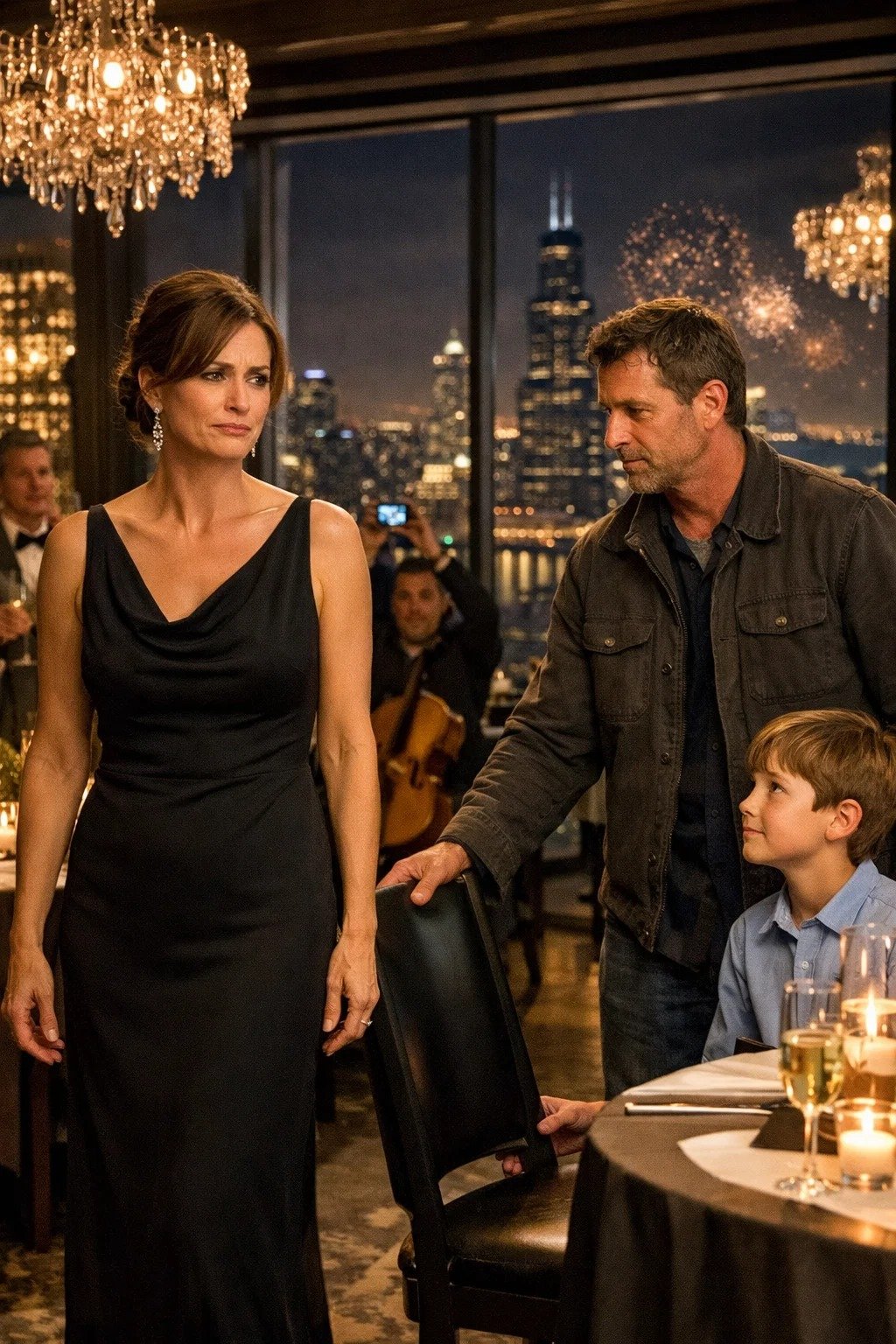
On the last night of the year, when Chicago feels like it’s holding its breath between what was and what might be, the city always looks richer than it actually is, and I don’t mean financially, I mean emotionally, as though every lit window and every glittering rooftop is a promise whispered into the wind off Lake Michigan. That was the night Eliza Hartwell, who had once been called ruthless in business magazines and visionary in financial columns, discovered that money can open nearly every door in the world except the one that leads to belonging.
The restaurant was called Aurelia’s Crown, a rooftop jewel perched above the Gold Coast, where reservations were secured by assistants weeks in advance and where champagne corks began flying well before the countdown reached ten. The skyline stretched like a jeweled horizon beyond the glass walls, and inside, a string quartet played something soft and expensive-sounding while waiters glided between tables with plates that looked more like art installations than food. Every table was claimed, every guest curated.
Eliza arrived alone, though she was used to entering rooms where heads turned for different reasons—sometimes admiration, sometimes calculation, sometimes envy—and she had learned to walk as though none of it mattered. She was forty-two, founder and CEO of a renewable energy conglomerate that had reshaped infrastructure contracts across three states, a woman who could dismantle a merger with a single raised eyebrow and rebuild it better in the next meeting. But that night she did not want applause or negotiations or polite admiration; she wanted to sit somewhere warm, eat something indulgent, and feel less like a headline and more like a person.
Her assistant had confirmed the reservation two months earlier, table by the window, name on the list, no ambiguity. Yet when she gave her name at the reception stand, the hostess, a young woman with immaculate posture and an apologetic half-smile, glanced at her screen and hesitated just long enough for discomfort to bloom.
“I’m so sorry, Ms. Hartwell,” she began, her tone coated in professional regret, “but it appears your table was reassigned earlier this evening.”
Eliza didn’t understand the words at first; reassigned was a verb she used when restructuring teams, not something that happened to her personally at a restaurant she had supported for years.
“That must be a mistake,” she said calmly, because composure had been drilled into her from childhood, and because public embarrassment was a luxury she could not afford. “The reservation was under my name.”
The hostess swallowed. “It was transferred at the request of Mr. Adrian Locke. He claimed authorization.”
The name hit like ice water. Adrian. Her former fiancé. The man who had once spoken about shared futures and then, six months ago, had walked away after a bruising argument about “priorities” and “public image,” phrases that now felt like euphemisms for ego and insecurity. He had always struggled with the fact that she earned more, decided faster, and commanded more attention in rooms that once belonged to him.
Around them, murmurs began. A couple at the bar leaned subtly closer. Someone lifted a phone, the faint glow of recording unmistakable. A powerful woman denied entry at her own city’s most exclusive New Year’s venue—it was the sort of story that could spiral into commentary before midnight.
Eliza felt heat climb her neck, not because she cared about the table itself, but because she understood the intent behind the sabotage. Adrian had wanted to puncture her poise in public, to remind her that influence can be manipulated socially as well as financially.
“That’s fine,” she said after a pause, forcing a polite nod. “I’ll make other arrangements.”
She turned toward the elevator, spine straight, expression controlled, but somewhere behind her ribs something cracked in a small, humiliating way, because success does not inoculate against loneliness, and the truth was that she had hoped tonight would feel less empty than her penthouse with its floor-to-ceiling windows and echoing silence.
She had nearly reached the elevator when a voice, unpolished and steady, cut through the room.
“Ma’am, you don’t have to leave.”
She turned. The voice belonged to a man standing from a corner table near the far glass wall, a table clearly meant for three but currently occupied by only two. He wore a charcoal work jacket with faint grease stains near the cuffs, the kind that suggested real labor rather than curated fashion, and his dark hair was pulled back in a loose tie as though he’d rushed from somewhere else entirely. Beside him sat a boy of about ten, cheeks freckled, eyes bright with curiosity rather than judgment.
“There’s an empty chair,” the man continued, gesturing simply. “You’re welcome to it.”
The hostess rushed toward him, whispering urgently, but he met her gaze without flinching. “Food doesn’t check bank accounts before it tastes good,” he said quietly, not loudly enough to cause a scene, but firmly enough that the sentence carried.
Eliza hesitated, because she had never in her life accepted an invitation like that from a stranger, and yet something about the absence of performance in his expression—the lack of recognition or opportunism—felt disarming.
She walked across the restaurant under the weight of dozens of glances and took the offered seat.
“I’m Rowan Hale,” the man said, extending a hand roughened by actual work rather than handshakes in conference rooms. “And this is my son, Milo.”
“Eliza,” she replied. She did not add her last name.
Milo grinned as if this were an entirely normal arrangement. “Dad says you shouldn’t eat alone on New Year’s Eve,” he said earnestly. “It messes up the wish.”
Eliza felt her throat tighten unexpectedly. “Does it?”
“Yeah,” he nodded. “Wishes work better when someone else hears them.”
Dinner began awkwardly but warmed quickly. Rowan, she learned, owned a small auto repair garage on the South Side, the kind of place that survived on word of mouth and long hours, and he spoke about engines the way poets speak about language, describing how every machine had a rhythm and how you could tell when something was wrong if you listened long enough. He wasn’t embarrassed by the grease under his nails or the fact that his jacket bore the name of his shop stitched in fading thread; he wore his life plainly.
Eliza found herself talking about factory floors and policy battles in Washington, but stripped of the jargon she usually deployed, her stories sounded less like triumph and more like exhaustion. She admitted, almost against her will, that she could not remember the last time she had sat at a table without someone needing something from her.
Rowan listened without interruption, nodding occasionally, not impressed, not intimidated, just present. “Sounds like you built something big,” he said eventually, “but forgot to leave room inside it for yourself.”
The sentence lingered.
As the evening unfolded, Milo showed her a small notebook from his backpack filled with sketches of cars that could fly and bridges powered by wind turbines shaped like dragon wings. Eliza examined each page with genuine interest, asking questions about design and fuel systems, and Milo’s eyes widened as though no adult had ever taken his drawings so seriously.
By the time the clock neared midnight, laughter had replaced the earlier tension in her shoulders. For the first time that evening, she forgot entirely about Adrian and the stolen table.
Then, in the midst of rising chatter and the clinking of glasses, a sudden crash shattered the atmosphere. A man at a nearby table stood abruptly, knocking over his chair as the woman beside him clutched at her throat, her face flushing an alarming shade. Panic spread faster than reason.
Rowan moved before anyone else did. There was no hesitation, no glance around for permission. He was at the woman’s side in seconds, guiding her to stand, positioning himself with efficient certainty, performing the Heimlich maneuver with controlled force until a grape shot free and clattered against the floor. The woman collapsed into a chair, coughing, gasping, alive.
Applause erupted, but Rowan stepped back almost immediately, brushing off thanks with an embarrassed shrug. “Just basic first aid,” he muttered.
The husband, shaken and pale, grasped Rowan’s shoulders. “You saved her,” he said hoarsely. “We were supposed to meet with Eliza Hartwell’s company tomorrow to finalize a partnership. I can’t imagine—”
He stopped mid-sentence as his gaze shifted to Eliza, recognition dawning. “Ms. Hartwell?”
There it was, the public identity sliding back into place like a mask.
Before she could respond, the hostess approached her again, visibly trembling. “I need to tell you something,” she whispered. “Mr. Locke paid me to reassign your reservation. He said you’d understand the lesson.”
The cruelty of it landed with a different weight now, because she was no longer alone in a humiliating moment; she was surrounded by witnesses who had just seen a mechanic act with more integrity in seconds than Adrian had shown in months.
She could have demanded the hostess be fired, could have called the restaurant owner personally, could have made an example of someone. Instead, she inhaled slowly. “Thank you for telling me,” she said. “That’s enough.”
When midnight arrived, fireworks exploded beyond the glass, painting the sky in gold and crimson. Milo grabbed both her hand and his father’s. “Make a big wish,” he insisted.
Eliza closed her eyes. She did not wish for profit margins or market expansion or revenge. She wished, simply, for a life that felt less curated and more lived.
The twist did not arrive immediately. Life rarely delivers transformation overnight, even when fireworks are involved. But in the weeks that followed, she found reasons to drive south more often than necessary. She told her board she wanted to understand how her company’s electric vehicle initiatives were impacting independent mechanics, and somehow those research visits always ended at Rowan’s garage, where engines lay open like patient hearts and coffee was poured into mismatched mugs.
Rowan remained wary at first. “You’re from a different world,” he said one afternoon, wiping his hands on a rag. “I don’t want Milo thinking life’s supposed to look like magazine covers.”
“And I don’t want him thinking life’s supposed to feel like a boardroom,” she replied.
Slowly, cautiously, a friendship formed that felt startlingly honest. She attended Milo’s school robotics fair and helped him refine a design that combined mechanical ingenuity with sustainable energy. Rowan fixed a minor issue in her car personally, refusing payment. She insisted on paying anyway, and they argued about it until they were both laughing too hard to maintain stubbornness.
Then came the second twist, the one she did not see approaching.
A journalist published an exposé about corruption in mid-sized automotive supply chains, hinting that certain independent garages were being pressured to source parts from questionable vendors. Rowan’s shop was mentioned in passing, not accused directly but implicated by association. Adrian’s name surfaced in the same article as a consultant to one of the suspect distributors.
Eliza understood the pattern immediately. Adrian had not simply wanted to embarrass her socially; he had wanted leverage, perhaps hoping to entangle her future partnerships in scandal. If Rowan’s garage suffered, she would feel it.
When she confronted Adrian privately, his smile was thin and satisfied. “You think you’re untouchable,” he said. “But everyone has weak spots.”
“You’re confusing kindness with weakness,” she replied evenly.
Instead of retaliating through press statements or legal threats, she did something quieter and far more devastating to him. She commissioned an independent audit of every supplier linked to her company and publicly pledged funding for transparency initiatives across small automotive businesses in Chicago, including Rowan’s. The investigation cleared Rowan entirely and exposed deeper corruption that traced back, indirectly, to Adrian’s consulting network. Investors withdrew from his ventures within weeks. He had engineered his own collapse.
Through it all, Rowan never asked her to intervene. “I can handle my own messes,” he insisted.
“I know,” she said. “I’m not fixing you. I’m fixing what tried to break you.”
The night he kissed her was not under fireworks or chandeliers but beneath the fluorescent hum of his garage after hours, when snow pressed softly against the windows and Milo was asleep in the office chair with a blanket over him. He brushed a smudge of grease from her cheek, and the gesture was so gentle, so uncalculated, that she leaned into it without analyzing the implications.
Years passed in ways that felt organic rather than orchestrated. She did not abandon her company, but she restructured her role, stepping back from daily dominance to cultivate mentorship programs for young engineers from neighborhoods like Rowan’s. He expanded his garage, hiring apprentices who needed second chances. Milo grew into a teenager who could dismantle a carburetor and code a prototype in the same afternoon.
Every New Year’s Eve, they returned to Aurelia’s Crown, not out of nostalgia for humiliation but as a reminder of how fragile status can be and how durable character must be. The hostess who had once trembled now greeted them warmly, and Eliza tipped generously without ostentation.
One year, as fireworks flared again across the skyline, Milo—taller now, voice deepening—looked at her thoughtfully. “You know,” he said, “if that guy hadn’t stolen your table, you’d never have sat with us.”
She considered the strange arithmetic of fate. “Sometimes,” she replied, “losing a seat shows you where you’re actually meant to sit.”
Rowan slipped his arm around her shoulders, not possessively, not performatively, simply because it felt natural. The city shimmered, as it always did, pretending to be made of certainty. But she knew better now. Wealth could vanish, reputations could fracture, reservations could be reassigned by spiteful hands. What endured were the choices made in unguarded moments—the decision to offer a chair, to tell the truth, to act when someone is choking rather than film it for spectacle.
The lesson she carried, the one she shared whenever young entrepreneurs asked her about resilience, was this: power without humility isolates, and humiliation without reflection hardens, but when you allow an unexpected kindness to interrupt your narrative, you may discover that the life you were meticulously constructing is not the one that will ultimately make you whole. Sometimes the most important mergers are not between corporations but between worlds that would otherwise never share a table, and sometimes the bravest act is not reclaiming what was taken from you but accepting what is freely offered instead.
Website Disclaimer
The information provided on this website is for general informational and educational purposes only. While we strive to ensure that all content is accurate and up to date, we make no guarantees regarding the completeness, reliability, or accuracy of any information published.
The views and opinions expressed in articles belong to their respective authors and do not necessarily reflect the views of this website. Any action you take based on the information found on this website is strictly at your own risk. We will not be liable for any losses, damages, or inconveniences arising from the use of our content.
Some articles may contain opinions, third-party information, or external links. We do not endorse or guarantee the accuracy of content on external websites and are not responsible for their practices or policies.
All content on this website is provided in good faith and is intended for informational purposes only. Readers are encouraged to verify information independently and seek professional advice where appropriate.