Christmas has a way of making everything look softer than it is, which is probably why no one noticed the cracks in the Hale marriage until they were splattered across five stories of frozen air and twisted metal, until the snow that had fallen like confetti over the city became a silent witness to something far uglier than a holiday argument, and by the time the sirens cut through the music drifting from the penthouse balcony, the illusion of perfection had already shattered beyond repair.
Let me tell you this the way it deserves to be told, without the glossy magazine filter that people like the Hales spend millions to maintain, because behind every luxury high-rise glowing on Christmas Eve there are stories that never make it into the society pages, stories about control, fear, and the moment a woman realizes that survival is sometimes more powerful than love.
Her name wasn’t Claire. Let’s call her Elara Quinn, because she had always liked names that sounded like constellations, names that suggested distance and possibility, which was ironic considering how small her world had become inside the five-story penthouse owned by her husband, Julian Hale, a man who had once been worth more than a hundred million dollars and measured his self-worth in market dominance and media coverage rather than kindness.
From the street below, the Hale residence looked like something out of an architectural digest spread—floor-to-ceiling windows glowing amber against the winter night, garlands of fresh pine woven along the balconies, white lights wrapped meticulously around every railing so that the building shimmered like a crystal palace suspended above the city; jazz drifted from inside, the smooth hum of a saxophone curling into the cold air, and guests in velvet gowns and tailored tuxedos arrived in sleek cars, laughing as if the world had never disappointed them, as if no one inside that penthouse had ever cried alone in a bathroom with mascara running down her cheeks.
Inside, everything was curated within an inch of its life. The Christmas tree stood nearly twelve feet tall, decorated in gold and ivory ornaments chosen by a designer who had flown in from Milan, because apparently local talent could not be trusted with something as sacred as aesthetic consistency; crystal chandeliers cast warm light across marble floors; waiters circulated with silver trays of champagne flutes that caught the glow like liquid fire. And at the center of it all stood Julian Hale, immaculate in a midnight-blue tuxedo, smiling that precise, controlled smile that had once convinced investors to trust him with their life savings, his arm occasionally draped around the waist of his wife as if she were an accessory rather than a human being.
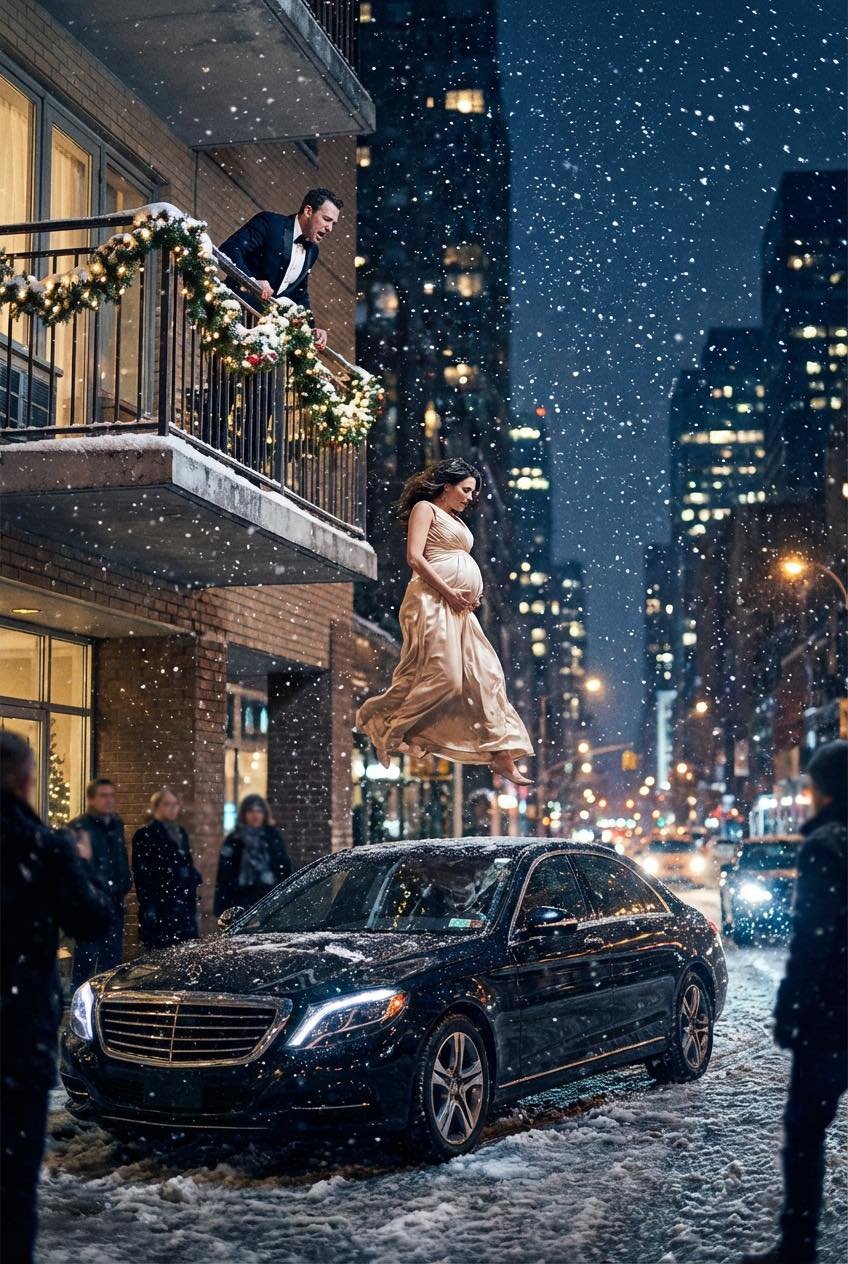
Elara stood beside him in a champagne-colored gown he had selected for her, the fabric clinging to her six-months-pregnant body in ways that made her feel exposed rather than elegant, the heels pinching her swollen feet while a thin shawl rested uselessly on her shoulders against the draft that slipped in every time the balcony doors opened; she kept one hand pressed against the gentle curve of her belly, grounding herself in the steady rhythm of the child growing inside her, because that heartbeat was the only thing in the room that felt unquestionably real.
Guests approached her with practiced warmth. “You must be so excited,” they would say, eyes drifting to her stomach before returning to Julian, as if confirming the lineage of future wealth. “A baby just in time to solidify the Hale legacy.” She would nod, smile, murmur something polite, all the while swallowing the tightening knot in her throat because excitement was not the word she would have chosen; she felt exhausted, anxious, increasingly invisible in her own life.
Not far from the grand piano, draped in a silver gown that shimmered with every calculated movement, stood Marissa Vaughn, Julian’s longtime business partner and rumored confidante, a woman whose beauty was sharp rather than soft and whose gaze lingered a second too long whenever Julian laughed at her jokes. Marissa had a way of speaking to Elara that sounded supportive on the surface but carried a faint undertone of condescension, like a blade hidden beneath silk.
“You should sit down,” Marissa had whispered earlier, lips curved in a smile that didn’t quite reach her eyes. “Julian worries when you look overwhelmed. Investors read everything, you know. Appearances matter.”
Appearances matter. The phrase echoed in Elara’s mind as she leaned against a marble column, the music swelling around her, laughter rising and falling like waves, cameras flashing as a lifestyle blogger documented the “most exclusive Christmas celebration in the city.” She felt like she was drowning in noise, suffocating beneath expectations she never agreed to carry, and for a moment she wondered how she had become a prop in someone else’s performance.
When the room began to spin slightly, whether from the heat or the relentless pressure of pretending, she slipped through the glass doors onto the balcony, the sudden blast of cold air hitting her lungs like clarity. Snowflakes landed on her lashes and melted instantly, the city stretching below in a grid of lights and moving headlights, distant and indifferent to whatever drama was unfolding five stories above.
She closed her eyes and inhaled deeply, letting the cold steady her racing thoughts. This cannot continue, she told herself, though she had no concrete plan beyond survival; she had endured Julian’s temper before, the sharp words, the silent treatments, the way he dismissed her concerns as hormonal exaggerations, but something inside her had shifted since she felt the first flutter of life within her, a protective instinct that made every insult feel more dangerous.
Behind her, the balcony door slid open with a sharp sound that sliced through the music.
She didn’t need to turn to know it was Julian.
“Elara,” he said, his voice low but edged with irritation. “What are you doing out here? People are asking about you.”
She turned slowly, snow gathering at the hem of her dress. “I needed air. It’s too loud inside.”
He stepped onto the balcony and closed the door behind him, shutting out the jazz and laughter so that only the wind and the faint hum of traffic below remained. Up close, she could smell whiskey on his breath, see the flush creeping along his cheekbones, the vein pulsing at his temple.
“You’re embarrassing me,” he said, each word clipped. “It’s Christmas. The board is here. Reporters are here. And my wife disappears like a sulking teenager.”
“I’m not performing,” she replied, her voice softer than she felt. “I’m pregnant. I’m exhausted.”
He let out a bitter laugh. “You’re always something. Tired. Emotional. Sensitive. Do you know how much is riding on tonight? I’m finalizing a merger that could triple our portfolio. I can’t have distractions.”
The word distractions lodged painfully in her chest.
“I’m carrying your child,” she said quietly. “That’s not a distraction.”
His eyes dropped to her stomach, not with tenderness but with something closer to resentment. “You’ve made this pregnancy your entire identity,” he snapped. “Everything is about what you can’t do now.”
Snow had begun to accumulate on the balcony tiles, a thin, slick layer that glistened under the lights. She took a small step backward without realizing it, her heel sliding slightly before she steadied herself against the glass railing.
“Julian,” she whispered, a flicker of fear threading through her voice, “you’re scaring me.”
He moved closer, invading her space, his hand gripping her upper arm with more force than necessary. “You always paint me as the villain,” he said through clenched teeth. “You twist everything.”
“You’re hurting me,” she gasped, trying to pull free.
What happened next was not a dramatic, slow-motion shove preceded by a villainous speech; it was faster, uglier, more human in its volatility. His grip tightened, she stumbled again on the snow, and in a flash of frustration—whether intentional or reckless, whether fueled by anger or alcohol—he pushed her away from him.
Her back hit the railing.
For a fraction of a second, everything froze.
She saw his expression shift from rage to something like horror, as if he had not fully calculated the physics of what he had done; she felt the cold metal dig into her spine; she heard the distant swell of the saxophone inside, absurdly cheerful; and then the world tilted.
The railing, slick with snow, offered no resistance.
Her feet left the ground.
There is a peculiar clarity that comes in moments of extreme danger, when time stretches thin and details sharpen unnaturally, and as Elara fell she noticed the way the snowflakes spun around her like broken stars, the glow of the Christmas lights reflected in the glass facade of the building, the faint outline of guests pressing toward the balcony doors above, their faces contorted in confusion.
Her scream tore through the night, swallowed almost immediately by the wind.
Five stories below, parked directly beneath the balcony, was Julian’s latest acquisition: a black luxury sedan he had purchased after liquidating several assets during a recent financial downturn that had quietly stripped him of his billionaire status, a detail he had managed to keep out of the headlines through strategic PR; the car’s hood gleamed under the streetlights, a symbol of the wealth he clung to even as his empire wavered.
She hit the hood with a violent crash, metal crumpling beneath the force, the windshield spiderwebbing instantly, the sound echoing through the street like a gunshot. The impact stole her breath and sent a white-hot surge of pain through her body, but it did not extinguish her consciousness.
Above, Julian stood gripping the balcony railing, his knuckles white, staring down at the wreckage of what he had just done.
Inside the penthouse, the music faltered. Glass shattered. Someone screamed.
“She fell!”
Phones were raised instinctively, recording before comprehending.
Below, steam rose from the damaged engine of the car, mingling with the snow that continued to fall as if nothing extraordinary had happened. For a terrifying second, Elara could not move, could not breathe, could not feel anything beyond a roaring in her ears, and then pain returned in waves, along with the frantic realization that she was still alive.
Her hand moved instinctively to her stomach.
Please, she thought, not even sure to whom she was praying.
People gathered around the car, their elegant shoes crunching in the snow. “Call an ambulance!” someone shouted, though multiple people were already dialing. “Is she breathing?”
“She’s moving,” a voice said, disbelief laced with urgency.
Julian did not come downstairs.
He remained on the balcony until security ushered guests back inside, until the first siren pierced the night, until the narrative began to form in whispers: accident, slip, tragic misstep.
Paramedics arrived swiftly, their movements efficient and practiced. “Ma’am, can you hear me?” one of them asked, shining a light into her eyes. “What’s your name?”
“Elara,” she whispered, each syllable scraping against her throat.
“Six months pregnant,” another paramedic confirmed, glancing at her abdomen with concern. “We need to move carefully.”
As they secured her onto a stretcher, she caught a glimpse of the balcony above, now crowded with silhouettes. For a brief moment, she saw Julian’s figure among them, rigid and distant, and something inside her shifted from fear to clarity.
Inside the ambulance, the world became a blur of white lights and beeping monitors. A paramedic squeezed her hand. “Stay with us,” he urged. “How did you fall?”
The question hung heavy.
She could have said I slipped. She could have protected the illusion one more time. She could have bought Julian a few precious hours to craft a story.
Instead, she swallowed hard and forced the truth through trembling lips.
“He pushed me,” she said.
The paramedic’s eyes flickered with recognition, the kind that suggests he has heard this before in different forms. “He pushed you?” he repeated, ensuring accuracy.
“Yes,” she breathed. “Julian pushed me.”
Those words were written down.
Back at the penthouse, Julian moved quickly, slipping into damage-control mode as instinctively as he once closed deals. He instructed his security team to secure all internal footage, to “prevent leaks,” unaware that several guests had already captured the aftermath on their phones and that the building’s external cameras were backed up to a cloud server he did not directly control. Marissa hovered near him, whispering strategies in his ear.
“She was emotional,” Marissa murmured. “Pregnancy hormones. She’s been unstable lately. You know how this looks. We need to frame it carefully.”
Julian nodded, already drafting the statement in his mind: tragic accident, slippery conditions, our thoughts and prayers.
What he did not anticipate was that financial instability had already weakened his shield of influence. His fortune, once vast enough to silence scandals before they bloomed, had diminished significantly after a series of failed investments and a market crash that had slashed his net worth; he was still wealthy by any reasonable standard, but no longer untouchable, and the board members who once deferred to him were quietly distancing themselves from controversy.
At the hospital, doctors rushed Elara into emergency evaluation. Miraculously, aside from multiple fractures and severe bruising, her internal organs had been spared catastrophic damage; even more astonishing, the fetus showed a stable heartbeat on the monitor, a steady rhythm that brought tears to the eyes of the nurse holding the ultrasound device.
“You’re very lucky,” the obstetrician said gently, though luck felt like an inadequate word for what had just occurred.
In the waiting area, a man paced back and forth, his jaw tight, his hands trembling with contained anger. His name was Rowan Pierce, and he had been Elara’s closest friend long before she met Julian, a journalist who had always been skeptical of the Hale empire’s polished image. Elara had texted him earlier that evening, a simple message—“I feel trapped”—that he had not fully understood until he received the call about her fall.
When he was finally allowed to see her, he approached the hospital bed cautiously, as if afraid she might disappear.
“You’re here,” she whispered, relief flooding her voice.
“Of course I’m here,” he replied, taking her hand. “What happened?”
She looked at him, eyes clearer now despite the pain medication coursing through her veins. “He pushed me.”
Rowan’s expression hardened. “Are you sure?”
“I remember,” she said. “I remember his hand.”
He nodded slowly. “Then we make sure everyone else remembers too.”
Police officers arrived shortly thereafter, not deferential but methodical. “Mrs. Hale,” one of them began, “we understand you fell from your balcony. Can you tell us what led up to that?”
She did not hesitate.
“He pushed me,” she repeated, and this time her voice was steadier.
Statements were taken. Paramedic reports were reviewed. Guests were interviewed, some reluctantly, some with an eagerness that bordered on opportunistic. A few admitted to hearing raised voices. One confessed to seeing Julian grab her arm before the fall. Security footage, once assumed safely contained, revealed a partial angle of the balcony through a neighboring building’s camera, enough to show a struggle, enough to challenge the narrative of a simple slip.
Julian was arrested two days later, not in handcuffs broadcast live but in a controlled, quiet operation that nonetheless leaked within hours. Headlines exploded: “Prominent Investor Under Investigation After Wife’s Fall,” followed by more pointed versions as details emerged. The story spread faster than any PR team could contain.
Marissa, sensing the shifting tide, distanced herself publicly, issuing a statement expressing “deep concern” and emphasizing her lack of involvement in “personal matters,” though private messages later revealed a very different tone.
The real twist, however, came weeks later, when financial documents surfaced during the investigation. It turned out that Julian’s recent merger negotiations, the ones he had been so desperate to secure that Christmas night, were not about expansion but survival; he had leveraged company assets against risky ventures and stood on the brink of bankruptcy. Elara’s pregnancy had complicated a pending divorce he had quietly explored months earlier, and insurance policies taken out in her name suddenly looked less like routine financial planning and more like motive.
When confronted with the possibility of attempted murder charges, Julian’s composure fractured. The man who once commanded boardrooms with unwavering confidence now sat in an interrogation room under fluorescent lights, his tailored suits replaced by something off-the-rack, his empire reduced to legal strategy.
Elara remained in the hospital for several weeks, healing slowly, learning to navigate pain that was both physical and emotional. She replayed that night in her mind countless times, not to torture herself but to reclaim the narrative from shame; she refused to frame herself as foolish or blind. She had loved him. She had trusted him. And she had survived him.
On the day she was discharged, snow fell again, softer this time, settling gently on the sidewalks. Rowan helped her into his car, careful not to jar her healing ribs.
“You don’t have to decide everything at once,” he said quietly. “You just have to keep moving forward.”
She looked down at her stomach, where a faint kick reminded her of the life still growing within. “I thought falling would be the end,” she murmured. “But it feels like the beginning.”
He smiled faintly. “Sometimes it takes hitting rock bottom to realize you deserve solid ground.”
In the months that followed, Elara filed for divorce, testified in court, and began speaking publicly about domestic violence in high-society spaces, challenging the myth that wealth insulates against abuse. Her story resonated with women who had felt silenced by power and reputation, who had been told to protect the brand rather than themselves.
Julian’s trial unfolded under intense scrutiny. The defense argued accident, emotional instability, slippery conditions. The prosecution presented evidence of financial desperation, witness accounts, and the paramedic’s report documenting her immediate accusation. Ultimately, the jury found him guilty of aggravated assault and attempted homicide, a verdict that sent ripples through the business community that had once celebrated him.
Elara gave birth to a healthy baby girl three months later, a child she named Aurora, not after wealth or legacy but after the dawn, because surviving that fall felt like stepping into a new morning she had never imagined possible.
The lesson in all of this is not simply that abuse can hide behind luxury or that money cannot buy decency, though both are true; it is that silence protects the wrong people, that image can be a prison more suffocating than poverty, and that survival, when claimed openly and without shame, becomes a form of power no one can easily strip away. Falling did not define Elara; choosing to speak did. And sometimes, the most miraculous survival is not of the body, but of the voice.
Website Disclaimer
The information provided on this website is for general informational and educational purposes only. While we strive to ensure that all content is accurate and up to date, we make no guarantees regarding the completeness, reliability, or accuracy of any information published.
The views and opinions expressed in articles belong to their respective authors and do not necessarily reflect the views of this website. Any action you take based on the information found on this website is strictly at your own risk. We will not be liable for any losses, damages, or inconveniences arising from the use of our content.
Some articles may contain opinions, third-party information, or external links. We do not endorse or guarantee the accuracy of content on external websites and are not responsible for their practices or policies.
All content on this website is provided in good faith and is intended for informational purposes only. Readers are encouraged to verify information independently and seek professional advice where appropriate.