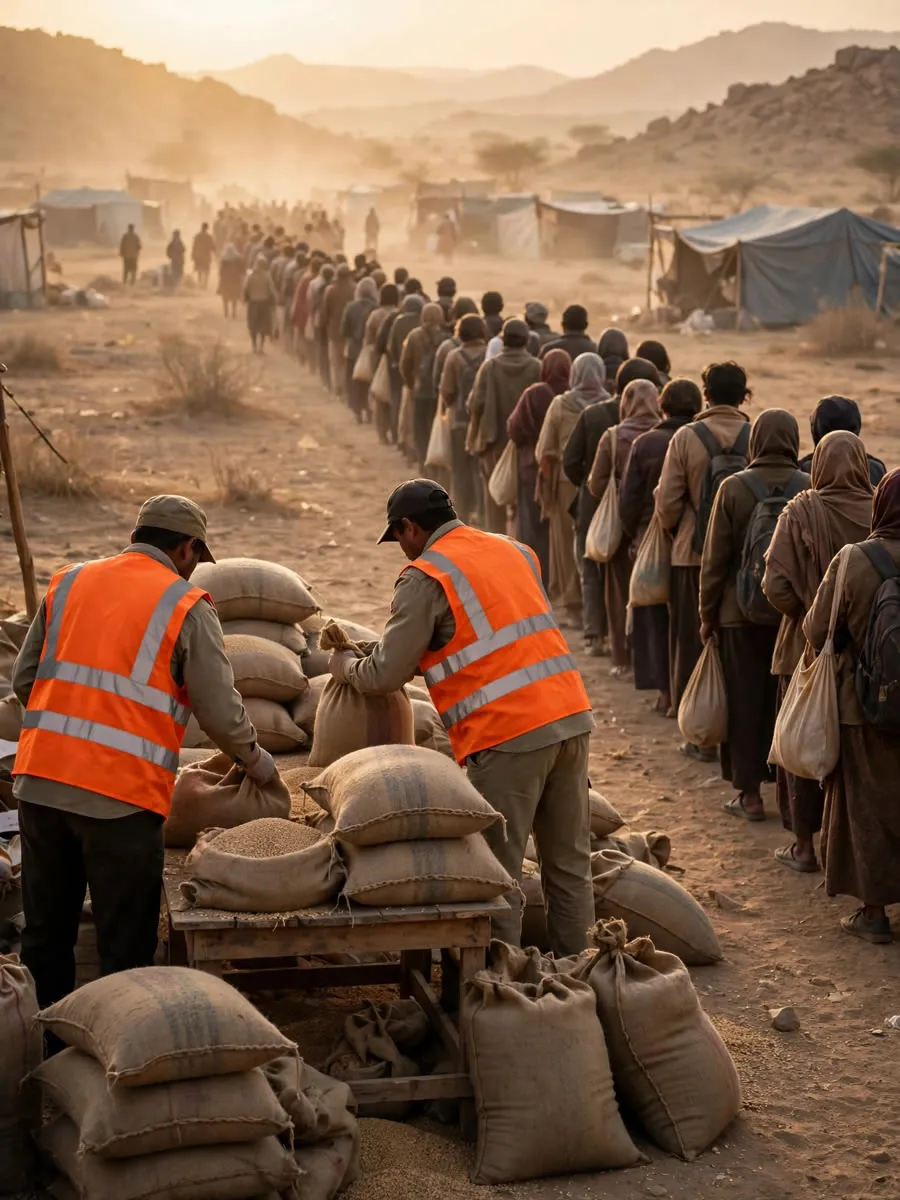
Acute hunger is expected to worsen significantly in 16 global hotspots over the coming six months, two United Nations agencies warned on Friday, 27 November 2026. The Food and Agriculture Organization (FAO) and the World Food Programme (WFP) said famine threatens parts of Africa, with conflict, displacement, economic hardship and extreme weather driving the crisis.
The warning comes in the agencies’ latest Hunger Hotspots report, covering December 2026 to May 2027. The number of hotspots has risen from 13 in the previous report, published in June, to 16. Chad, Uganda, and parts of southern Africa and Central America were added to the list, while Lebanon was removed.
Sudan, South Sudan, Somalia, northern Nigeria and Yemen face the gravest threats. In Sudan, famine is a risk in 13 areas of North Darfur and South Kordofan through January 2027, with fighting disrupting food production, markets and aid deliveries. In two displacement camps in South Darfur, acute malnutrition has already passed famine thresholds. Famine risks were also identified among displaced people in Somalia’s Baidoa region and in parts of South Sudan.
Afghanistan, Haiti, the Democratic Republic of Congo and Gaza were classified as areas of very high concern. Gaza was downgraded from the highest level after food security improved following the October 2025 ceasefire, although the agencies warned that conditions there remain severe and fragile. The remaining hotspots are Chad, the Central American Dry Corridor, Madagascar, Mali, Myanmar, southern Africa and north-eastern Uganda.
Conflict, Climate and Collapsing Aid
Armed conflict and violence are the main drivers of hunger in 12 of the 16 hotspots. Political violence worldwide has risen by more than 15 per cent compared with the same period last year, triggering alarming levels of displacement, particularly in Sudan, South Sudan, Yemen, Somalia and northern Nigeria.
Soaring food, energy and transport costs are further eroding people’s ability to feed themselves. And an exceptionally strong El Niño, expected this year and persisting into next spring, could push nearly 49 million additional people into acute food insecurity by the end of 2027.
But the agencies stressed that the crisis is being made worse by shrinking aid. Humanitarian funding for the five countries facing the gravest threats fell by nearly two-thirds between 2022 and 2025, dropping from $5.1 billion to $2 billion — a decline of about 62 per cent. “Declining humanitarian resources have reduced the capacity to sustain gains and mitigate worsening conditions,” the agencies said. The cuts are also undermining the collection of data needed to assess the scale of the crisis.
In Yemen, fighting that resumed in July has displaced more than 300,000 people since then, while in Gaza, winter rains and localised flooding could further worsen conditions for displaced families by damaging already inadequate shelters.
Safe Spaces for Refugee Women Are Closing
On the same day, the UN refugee agency, UNHCR, warned that deep funding cuts are severely weakening protection for refugee and stateless women and girls at risk of gender-based violence. Across 14 country operations, 171 safe spaces supported by UNHCR and its partners were closed last year, with further closures in 2026. Only 203 remain open.
The spaces are critical for women and girls to safely access psychosocial support, medical and legal aid, and prevention activities. “When safe spaces close, specialist services are cut, referral pathways are weakened,” Edem Wosornu, UNHCR’s Assistant High Commissioner for Protection, told journalists in Geneva. “You’ve been attacked. You need medical services. You need psychosocial services. You need to be transferred. These are the services we talk about.”
The closures are part of a wider erosion of services. In 2025, UNHCR’s gender-based violence programmes were less than one-third funded, and in 2026 they have received less than a quarter of what was requested. As a result, 5.6 million forcibly displaced and stateless people were left without life-saving prevention and response services. In all, 63 per cent of UNHCR operations reported delays in survivors accessing specialised case management because of funding and staffing cuts.
A System Under Strain
More than 60 million forcibly displaced and stateless women and girls face heightened risks today, UNHCR said, and the funding cuts are “slashing the very services that are needed to support them.” Despite the shortfalls, the agency’s specialised programmes still reached 2.2 million people in 77 countries in 2025 and the first half of 2026.
The two warnings, issued on the same day, describe different crises driven by the same pressure: a humanitarian system being asked to do more with far less. The FAO and WFP called for urgent, targeted action to save lives and protect livelihoods in every hotspot. UNHCR, marking the 16 Days of Activism against Gender-Based Violence, called on governments and donors to protect life-saving services, invest in prevention, and ensure that refugees and stateless people are not left out.
Whether donors respond will decide how many of the warnings in Friday’s reports become reality in the months ahead.
Website Disclaimer
The information provided on this website is for general informational and educational purposes only. While we strive to ensure that all content is accurate and up to date, we make no guarantees regarding the completeness, reliability, or accuracy of any information published.
The views and opinions expressed in articles belong to their respective authors and do not necessarily reflect the views of this website. Any action you take based on the information found on this website is strictly at your own risk. We will not be liable for any losses, damages, or inconveniences arising from the use of our content.
Some articles may contain opinions, third-party information, or external links. We do not endorse or guarantee the accuracy of content on external websites and are not responsible for their practices or policies.
All content on this website is provided in good faith and is intended for informational purposes only. Readers are encouraged to verify information independently and seek professional advice where appropriate.