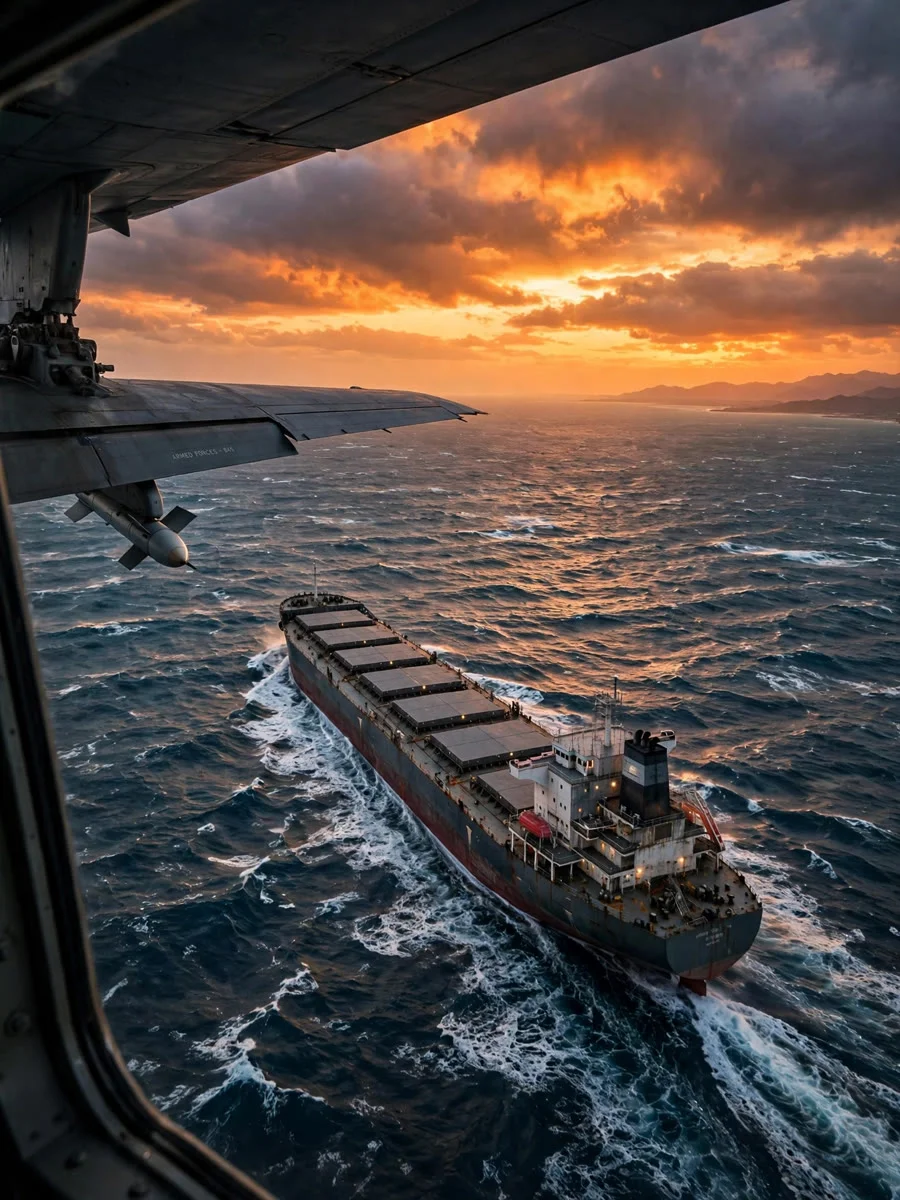
The United States military said on Friday that it disabled a commercial ship that tried to run its naval blockade of Iran, in the latest escalation of a standoff that has now lasted more than four months. US Central Command (CENTCOM) said military aircraft fired precision munitions at the stern of the Palau-flagged bulk carrier M/V Pacific Archer in the Gulf of Oman on Thursday, 26 November, after the vessel departed from the Iranian port city of Bandar Abbas and ignored repeated warnings to stop.
A precision strike in the Gulf of Oman
According to CENTCOM, the strike knocked out the ship’s propulsion while leaving the civilian crew unharmed. The command released video of the incident, showing a projectile striking the vessel, and warned all mariners operating in the Gulf of Oman and near the approaches to the Strait of Hormuz to heed blockade warnings issued by American forces. The Pacific Archer is the sixth vessel to have been disabled for refusing to comply with the blockade, CENTCOM said, while 158 other commercial ships have been redirected after following instructions.
The United States reimposed its naval blockade on Iranian ports in mid-July, after a short-lived agreement with Tehran collapsed. Earlier this month, Washington announced Task Force Iron Gate, an effort to restrict the movement of weapons and sanctioned materials across Iran’s land borders and the Caspian Sea. On 21 November, CENTCOM said the blockade had completed 130 consecutive days.
Tehran vows to fight back
Iran’s response was defiant. Mohammad Mokhber, an adviser to Supreme Leader Ayatollah Mojtaba Khamenei, said on Friday that Tehran would keep the Strait of Hormuz shut and break the American embargo. “Neither will the Strait of Hormuz be reopened, nor will we allow the blockade to remain in place,” Iranian state media quoted him as saying, though he gave no details of how Iran planned to break it.
Iranian navy commander Shahram Irani told state television that breaking through the blockade was already under way and that Iran’s ports remained active. Separately, Iranian Foreign Ministry spokesman Esmaeil Baghaei said earlier in the week that Tehran would not tolerate the blockade and would “use all our tools to confront this US aggression.”
A shadow war at sea
The confrontation is not limited to the American blockade. Iran has sought to impose its own restrictions on ships transiting the Strait of Hormuz, insisting that vessels using routes designated by the US Navy are violating Iranian maritime regulations. At least eight vessels have been struck by unidentified projectiles in the strait over the past ten days, according to maritime security reports. On Thursday, Iran’s Islamic Revolutionary Guard Corps said two oil tankers had struck mines and caught fire near the Omani coast, including a supertanker carrying more than two million barrels of crude oil.
Iran has said the strait could reopen within two days — but only if Washington agreed to its list of demands, including lifting the blockade. That condition shows how far apart the two sides remain, with each now enforcing its own version of who may sail where in one of the world’s most important waterways.
What the standoff means for shipping
For the shipping industry, the Gulf of Oman and the Strait of Hormuz have become a zone of overlapping warnings and real danger. American forces say they will continue to strictly enforce the blockade, and Tehran says it will keep challenging it. With commercial crews caught in the middle — unharmed in this incident, but operating in waters where other vessels have caught fire — the risk of a miscalculation that turns a blockade enforcement action into a wider clash is growing by the week.
Website Disclaimer
The information provided on this website is for general informational and educational purposes only. While we strive to ensure that all content is accurate and up to date, we make no guarantees regarding the completeness, reliability, or accuracy of any information published.
The views and opinions expressed in articles belong to their respective authors and do not necessarily reflect the views of this website. Any action you take based on the information found on this website is strictly at your own risk. We will not be liable for any losses, damages, or inconveniences arising from the use of our content.
Some articles may contain opinions, third-party information, or external links. We do not endorse or guarantee the accuracy of content on external websites and are not responsible for their practices or policies.
All content on this website is provided in good faith and is intended for informational purposes only. Readers are encouraged to verify information independently and seek professional advice where appropriate.