A Dramatic Draw Opens the Youngest Title Match in History
Defending champion Dommaraju Gukesh survived a serious time crisis to hold challenger Javokhir Sindarov to a draw in the opening game of the 2026 World Chess Championship in Geneva. The game, played on Tuesday at the Fondation Martin Bodmer in Cologny, lasted 38 moves and almost four hours before the players repeated the position and shared the point.
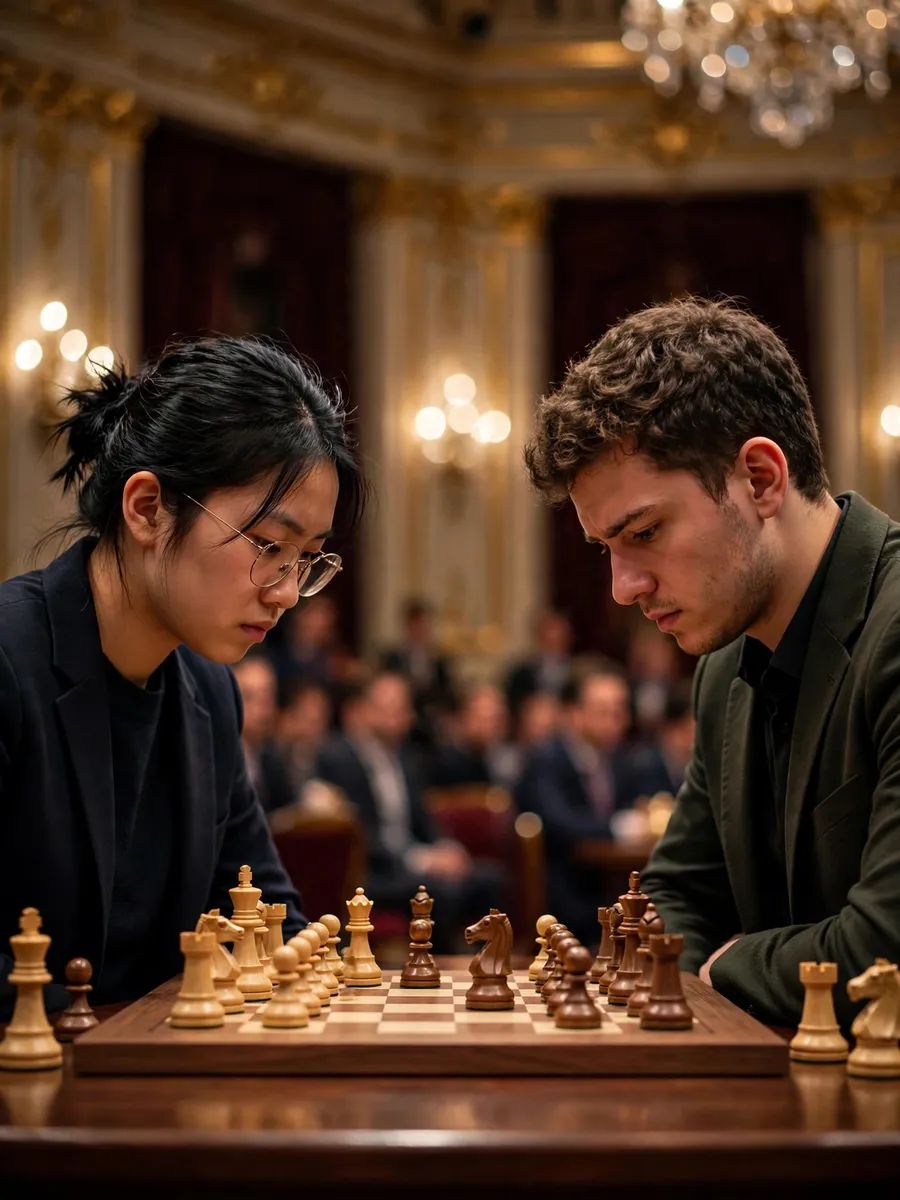
The match is the youngest world championship contest in chess history, with both players aged just 20 when the first move was played. It is being played over 14 classical games, with a prize fund of $2.5 million. The first player to reach 7.5 points wins the title, and if the scores are level at 7-7 after 14 games, a series of rapid and blitz tiebreaks will decide the champion on 12 December.
Sindarov Strikes Fast on the Clock
Sindarov, playing with the white pieces, opened with the Ruy Lopez, and Gukesh replied with the Berlin Defence, an opening in which the queens leave the board early and a long endgame struggle follows. The queens were exchanged by move eight, just as in Vladimir Kramnik’s famous victory over Garry Kasparov in their 2000 title match.
But the challenger had a surprise ready. On move 13 he played the knight to e4, a new idea never before seen at the top level in a major individual event, and he rattled through his preparation at remarkable speed. After 17 moves, Gukesh was already 50 minutes behind on the clock. The champion then spent almost 37 minutes on a single move, 17…Bb4, attacking the rook on d2.
By move 19, the situation looked alarming for the defending champion. Gukesh had just 16 minutes left to make 21 moves before the time control, with no extra time added until after move 40, while Sindarov still had 57 minutes. At one point the gap stretched to almost an hour. Yet the computer evaluation never showed White with even half a pawn of advantage — the real pressure was on the clock, not on the board.
Gukesh Fights Back With Black
Despite the time shortage, Gukesh refused to play only for safety. On move 23, with just 11 minutes remaining for 17 moves, he boldly captured a pawn on e5, allowing Sindarov to open the kingside with f4 and f5. Both sides had chances in the complications that followed, and the champion’s moves were measured by the engine as being as precise as his opponent’s.
His replies also made Sindarov think hard. Between moves 18 and 22, the challenger’s clock fell from 75 minutes to 27, with 20 of those minutes spent on a single move, 22.Ne1. Gukesh later explained that the time he invested early helped him play faster when the position sharpened. “When I got into the time trouble, I’d already thought about the next few moves,” he said after the game. “And then the moves after that were pretty easy.”
The Only Move, and a Draw Claimed Twice
The decisive moment came on move 32, when Sindarov captured the pawn on h6 with check. Gukesh had to find the only king move that kept his position together, 32…Kg8, because every other king move loses a piece. He found it, and the attack faded. From there, White’s rook moved back and forth between g5 and h5, and the position was repeated.
There was even drama in the finish. Sindarov first claimed the draw in the wrong way, and the arbiter added two minutes to Gukesh’s clock as the rules require. The players then repeated the moves correctly, and the draw was agreed after 38…Kg8. Sindarov had earlier reached the position in his preparation, but the draw was a professional decision once his advantage had disappeared.
What the Opener Tells Us About the Match
Commentators were impressed by the champion’s composure. Sindarov played the kind of game chess fans have come to expect from him since his commanding, unbeaten victory at this year’s Candidates tournament in Cyprus, where he finished with six wins and eight draws against a field including Fabiano Caruana, Hikaru Nakamura and Anish Giri. But Gukesh showed more than many had expected after a difficult year, defending precisely and boldly with the black pieces and even trying to turn the tables.
The psychological edge may have passed to the champion. Sindarov’s calling card is lightning-fast play in the opening, designed to turn the clock into a weapon, yet it was Gukesh who emerged from the time scramble with a draw and a smile. Game 2 takes place on Wednesday, with Gukesh having the white pieces, and Sindarov must now show that he can trouble the champion with the black pieces as well as he did with white.
Website Disclaimer
The information provided on this website is for general informational and educational purposes only. While we strive to ensure that all content is accurate and up to date, we make no guarantees regarding the completeness, reliability, or accuracy of any information published.
The views and opinions expressed in articles belong to their respective authors and do not necessarily reflect the views of this website. Any action you take based on the information found on this website is strictly at your own risk. We will not be liable for any losses, damages, or inconveniences arising from the use of our content.
Some articles may contain opinions, third-party information, or external links. We do not endorse or guarantee the accuracy of content on external websites and are not responsible for their practices or policies.
All content on this website is provided in good faith and is intended for informational purposes only. Readers are encouraged to verify information independently and seek professional advice where appropriate.